Event Security Resume Examples: the lines they read
Build an Event Security Resume That Gets You on Big Shows
By Mustafa Tarabya, founder of CVBooster · Published · Updated
Event security resume example with crowd management, bag search, pit and barricade keywords, plus a guide to writing capacity and ejection numbers.
Sample resumes for a event security
The same event security content laid out in three CVBooster templates, so you can see what the finished document looks like before you write a word.
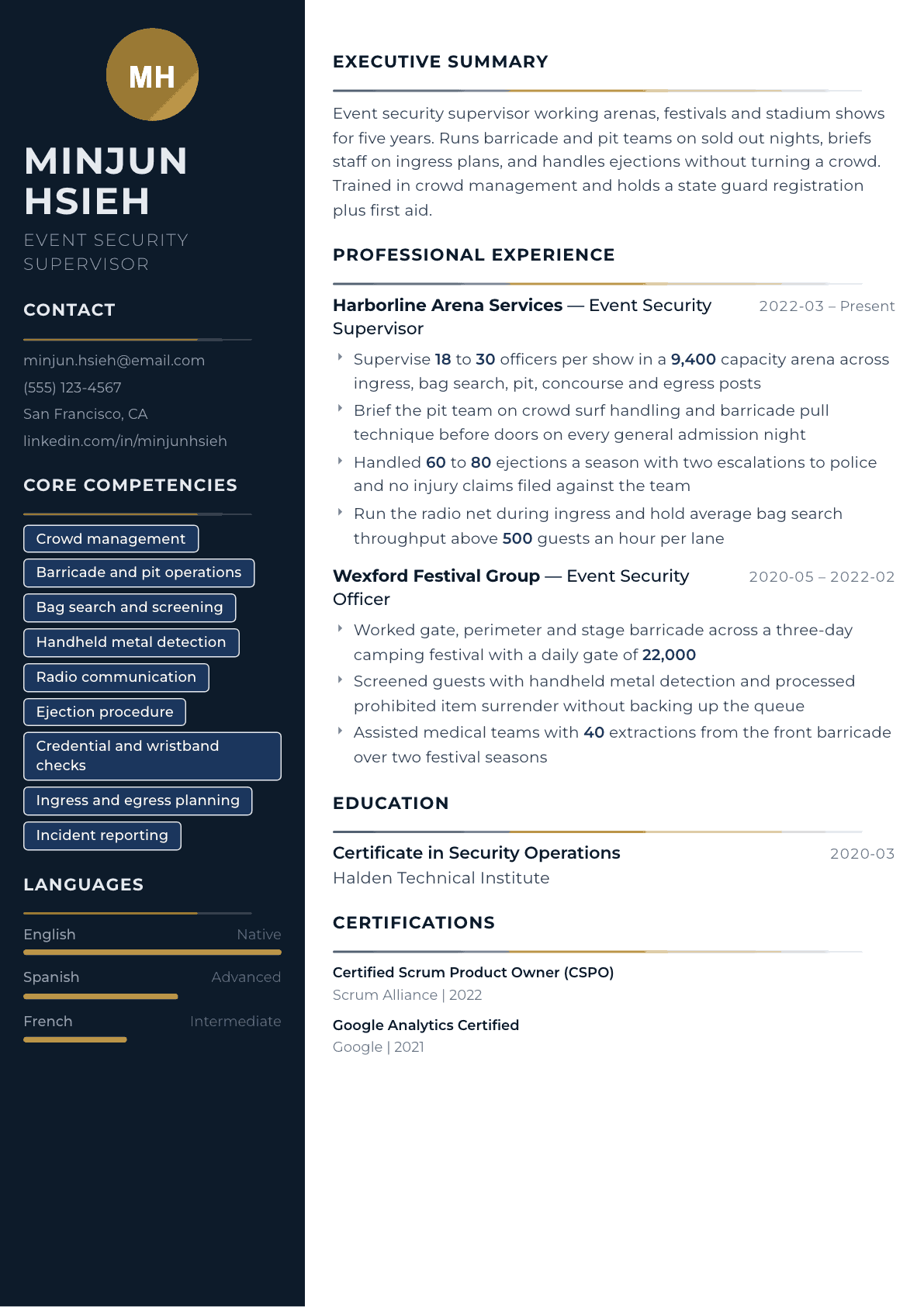
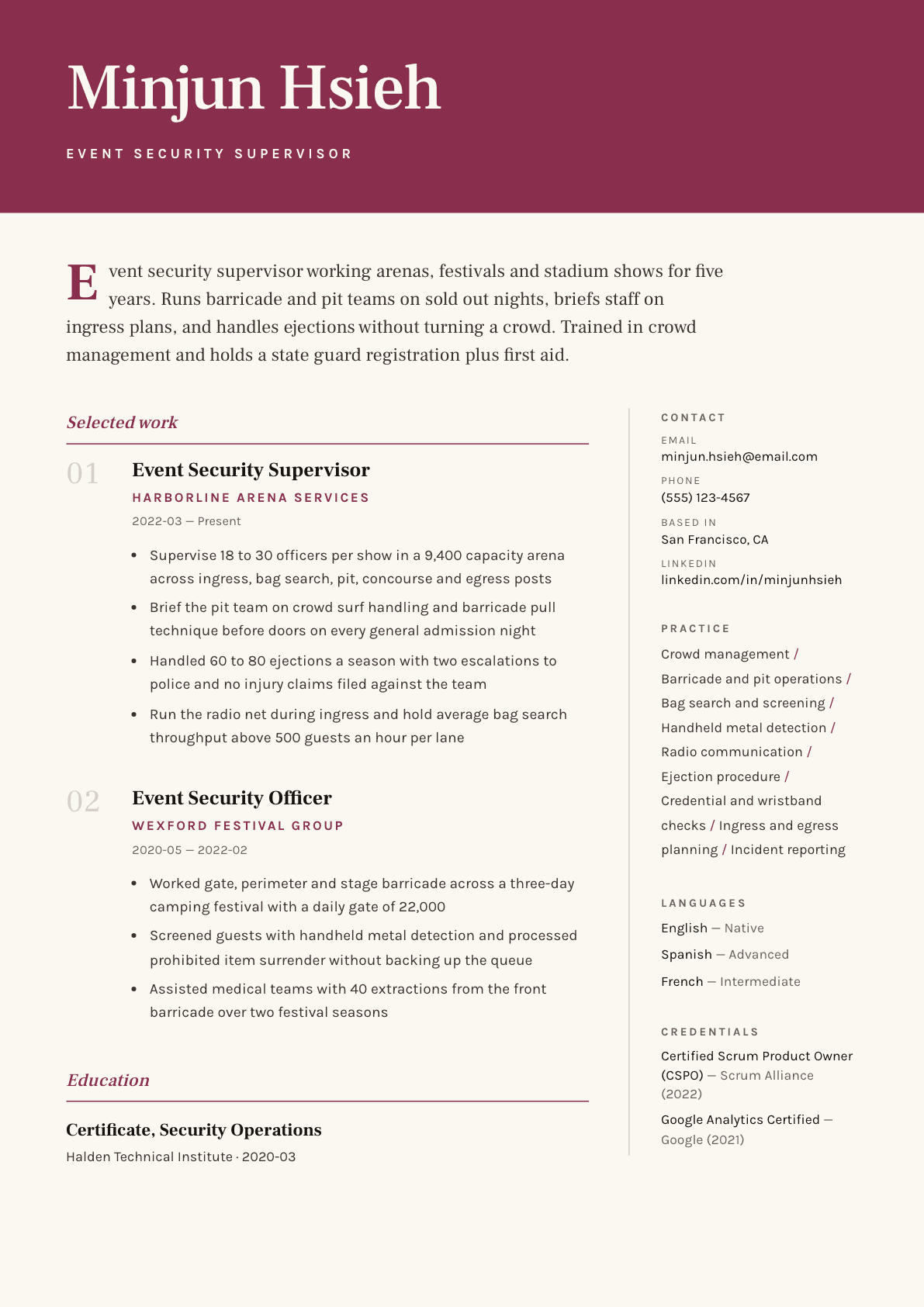
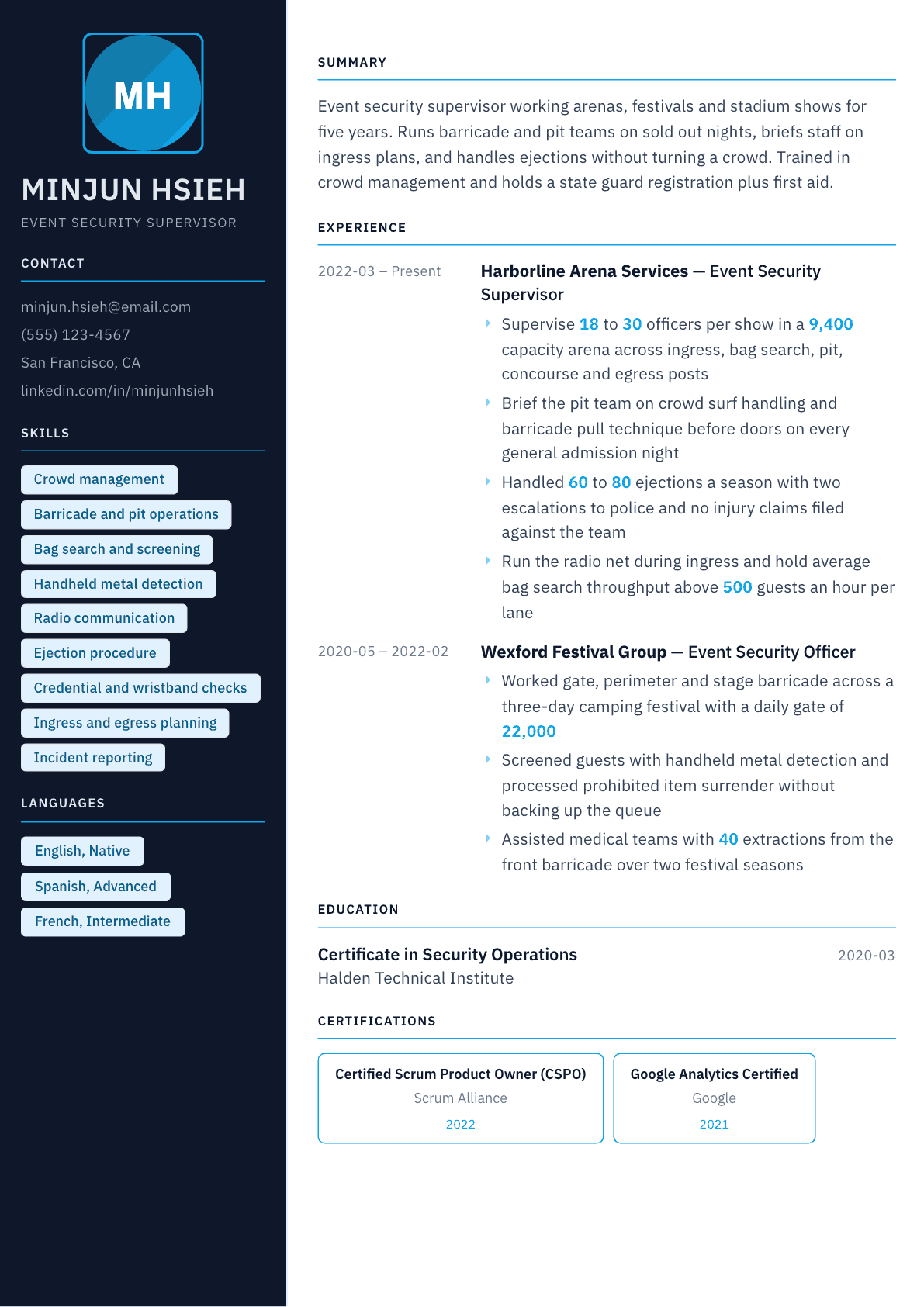
Example Event Security summary
Event security supervisor with five years across arenas, festivals and theater shows, running teams of up to 30 officers on sold out nights. Briefs pit and barricade staff before doors, keeps bag search lanes moving through peak ingress, handles ejections without escalating a crowd, and assists medical with front barricade extractions. State registered guard with current first aid and crowd management training.
Skills to list on a Event Security resume
- Crowd management
- Barricade and pit work
- Bag search and screening
- Handheld and walkthrough metal detection
- Credential verification
- Ejection and refusal procedure
- Radio net discipline
- Ingress and egress flow
- Emergency evacuation support
- Access point staffing
- Incident report writing
- Verbal de-escalation
- Medical extraction assistance
- Post briefing and staff assignment
What actually gets this resume read
- Give the venue capacity for every job, because a club night and a stadium show are judged as different experience.
- Say how many officers you supervised per show if you have led, and name the posts you assigned them to.
- Name the post types you have worked: gate, pit, barricade, concourse, backstage, credentialing, parking and perimeter.
- Put throughput numbers on ingress work, since screening speed is the metric event managers argue about all season.
- State your state guard registration or license number status and your first aid card, both of which gate assignments.
- Describe ejections with the outcome, not the confrontation, because promoters hire people who keep the room calm.
- List the artists or event types you have covered by genre rather than by name, since crowd behavior varies by genre.
How to write a event security resume
Event security hiring runs on a different clock from every other protective job. A venue operations manager is staffing a calendar, not a permanent post, and he needs to know within a few seconds whether you can hold a barricade on a general admission night, run a bag search lane at peak ingress, or take a supervisor radio when someone calls out. Your resume has to answer the staffing question, not describe your character.
The people who read these applications have watched hundreds of guards write that they provided excellent customer service while maintaining a safe environment. What they remember is the applicant who wrote the capacity of the room, the number of officers on the shift and the number of posts he has covered. Those three facts are the vocabulary of the trade.
What follows is a section by section walk through of an event security resume, with summaries for a first season officer, a seasoned crowd worker and a supervisor, before and after bullets from arena and festival work, and answers to the questions people ask when they try to move up from small clubs to touring shows.
Format: one page, venue list visible, cards near the top
One page is right for almost everyone in this trade, because the hiring decision is made off a short list of facts. Reverse chronological, plain layout, and no attempt to disguise the seasonal shape of the work. Event security is seasonal by nature and nobody in the industry treats a summer festival run followed by an arena winter as a gap.
Because assignments are gated on paperwork, put your registration and cards where they cannot be missed. A supervisor cannot post you on a metal detection lane or a medical assist position if your first aid card lapsed, so that block belongs above the job history rather than at the bottom under a heading nobody reaches.
- Header for event work: name, city, phone, email, state guard registration status, and your availability for nights, weekends and tour dates.
- A venue block near the top listing the room types you have worked with their capacities, from club to arena to open field.
- Cards and training: guard registration, first aid and defibrillator, crowd management training, and any alcohol service course.
- Job entries in reverse order with the promoter or staffing agency named, since the industry runs on agency reputation.
Summary: room size, post types, team size
Three lines. Name the biggest room you have held responsibility in, the post types you can cover, the number of officers you have supervised if you have supervised, and your cards. That combination lets a manager pencil you into a show sheet without an interview.
If your experience is all small rooms, do not inflate it. Say the capacity honestly and lean on the post variety instead. An officer who has worked gate, floor, backstage and parking at a small venue is more useful than one who has only stood at a single door in a large one, and an honest page is easier to promote from.
Experience: posts, throughput and what happened at the barricade
Each job entry needs the venue type and capacity, the show frequency and the posts you covered. Write the posts by name, because the industry uses them as job descriptions: gate, wanding lane, bag search, credentialing, pit, barricade, floor, concourse, backstage, dressing room, parking, perimeter and egress.
Then bullets with numbers a manager recognizes. Screening throughput per lane per hour. Ejections handled in a season and how many needed police. Extractions assisted from the front barricade with medical. Crowd surfers received and returned. Doors to full house timing. Radio net discipline during an emergency announcement. Those are the metrics arguments happen about in the operations meeting, so they are the ones that carry.
Supervisors add the staffing dimension: officers briefed, posts assigned, breaks rotated, and how you cover a hole when three people no show an hour before doors. That last problem is the one that keeps venue managers awake, and an applicant who names it sounds like a peer.
Writing about ejections without sounding like a problem
Ejections are the most misunderstood part of this resume. Applicants describe them as confrontations they won. Managers read those bullets as future incident reports and future insurance claims. Write the ejection as a controlled process: the observation, the warning, the escort route, the handover, the log entry, the outcome.
The number that matters is not how many people you removed but how many removals turned into something worse. An officer who handled dozens of ejections in a season with two escalations to police and no injury claims is describing a professional standard. That is the line a promoter reads before deciding whether to put you in the pit.
Keywords venues and staffing agencies filter on
Postings for this work reuse a tight vocabulary: crowd management, ingress, egress, wanding, bag check, credential verification, barricade, pit, access control, evacuation, guest experience, radio communication. Put each of them once in the skills block and once inside a bullet where the work is visible.
Add the operational systems if you have used them: the credential scanning app, the incident reporting platform, the radio channel plan. Large venues and touring productions run on specific tools, and an officer who already knows the scanning workflow gets pulled onto the credential post on day one.
- Post vocabulary used exactly as the industry writes it, so an automated filter and a human both find it.
- Capacity figures for each venue, which act as a shorthand for the scale of everything you did there.
- Season and show counts, because a person who worked forty shows a year is not the same hire as one who worked four.
- Any specialty: pit, backstage, artist escort, credentialing, command post radio or medical assist.
Event Security resume summary examples
First full season
Event security officer with one season across a 1,200 capacity club and two outdoor stages, covering gate, wanding, bag search and perimeter posts. State registered guard with current first aid and defibrillator training. Available nights, weekends and multi-day festival runs.
Three seasons, arena and festival
Event security officer with three seasons across arena and festival work, including pit and barricade on general admission nights. Screens roughly 500 guests an hour on a wanding lane, assists medical with front barricade extractions, and handles ejections without escalation. Crowd management trained and state registered.
Show supervisor
Event security supervisor running 18 to 30 officers per show in a 9,400 capacity arena. Assigns posts, briefs the pit team before doors, holds the radio net through ingress, and closed last season with 60 ejections, two police escalations and no injury claims filed against the team.
Work experience bullets: before and after
Before: Provided security at concerts and events.
After: Worked gate, wanding, pit and egress posts across 42 shows a season in a 9,400 capacity arena, including sold out general admission nights.
Post names, show count and capacity give a manager everything he needs to place you on a sheet.
Before: Checked bags at the entrance.
After: Held bag search and wanding throughput above 500 guests an hour per lane during peak ingress while surrendering prohibited items without stalling the queue.
Throughput is the metric operations argues about, and a rate proves you can work under doors pressure.
Before: Removed unruly patrons when necessary.
After: Handled 60 to 80 ejections across a season with two escalations to police, logging each removal with time, description, escort route and outcome.
The escalation count and the log detail show a controlled process instead of a series of confrontations.
Before: Worked in front of the stage.
After: Worked front barricade on general admission nights, receiving crowd surfers, watching for compression in the first ten rows and assisting medical with 40 extractions over two festival seasons.
Barricade work is a specialty and naming its actual tasks separates you from a general floor officer.
Before: Helped supervise other guards.
After: Briefed and posted 18 to 30 officers per show, rotated breaks against the run of show, and backfilled open posts when staff did not report an hour before doors.
Naming the staffing problem every venue manager faces reads as supervisory experience rather than a title.
Hard skills
- Crowd management
- Barricade and pit operations
- Bag search and prohibited item handling
- Handheld and walkthrough metal detection
- Credential and wristband verification
- Ingress and egress flow control
- Ejection and refusal procedure
- Radio net discipline
- Emergency evacuation support
- Medical extraction assistance
- Incident report writing
- Post briefing and assignment
- Access control at backstage boundaries
Soft skills
- Reading a crowd for pressure before it becomes a problem
- Holding a refusal politely with a queue watching
- Working long nights without dropping standards at load out
- Taking a post change without argument mid show
- Handing information cleanly to police and medical
Certifications worth listing
- Certified Protection Officer (CPO) (International Foundation for Protection Officers)
- Adult First Aid, CPR and AED (American Red Cross)
Mistakes that cost event security candidates the interview
- Leaving out venue capacities, which forces a manager to guess whether your experience matches the room he is staffing.
- Describing ejections as fights you handled instead of as a documented process with an escalation count.
- Hiding the seasonal shape of the work behind vague date ranges, when everyone in the industry expects seasons.
- Listing only one post type, so a supervisor cannot tell whether you can be moved when the show sheet changes.
- Forgetting the first aid and defibrillator card, which is the paperwork that decides which posts you are allowed to hold.
- Writing about guest experience in the abstract instead of giving screening throughput and queue times.
Event Security resume questions
How do I get onto bigger shows and touring work?
Build a page that proves post variety and calm ejections, then get the crowd management and first aid cards that larger productions insist on. Supervisors move officers up when they have watched them work a barricade, so name the promoters and agencies you have already worked for.
Do I need a state guard license for event security?
Most states require a registration or guard card for paid security work, and some venues add their own credential on top. Put the status and the issuing state on the resume even if the card is pending, because a manager needs to know when you can legally be posted.
How should I show seasonal and agency work?
Group it by agency or venue rather than listing every show separately. Give the season range, the number of shows worked and the posts covered. A cluster of ten one-night entries looks unstable, while one agency entry with a show count looks like a working professional.
What if I have only worked small bars and clubs?
Lead with post variety and with the parts of small venue work that scale: identification checks, capacity counts, floor sweeps and closing the room. Then say plainly that you are moving to larger rooms. Arena supervisors hire from clubs constantly and would rather see honesty than an inflated capacity.
Should I list the artists whose shows I have worked?
Name genres and event types instead of individual artists. Crowd behavior differs sharply between a metal show, a country night, a stadium football match and an electronic festival, and a manager wants to know which of those crowds you have actually stood in front of.
Related resume examples
- Security Guard Resume example
- Bouncer Resume example
- Security Officer Resume example
- Unarmed Security Guard Resume example
- Campus Security Officer Resume example
- Hospital Security Officer Resume example