Recruiting Coordinator Resume Examples: read this first
Build a Recruiting Coordinator Resume That Shows Scheduling Muscle
By Mustafa Tarabya, founder of CVBooster · Published · Updated
Recruiting coordinator resume example with ATS, interview volume and candidate experience detail, keywords, and a guide.
Sample resumes for a recruiting coordinator
The same recruiting coordinator content laid out in three CVBooster templates, so you can see what the finished document looks like before you write a word.
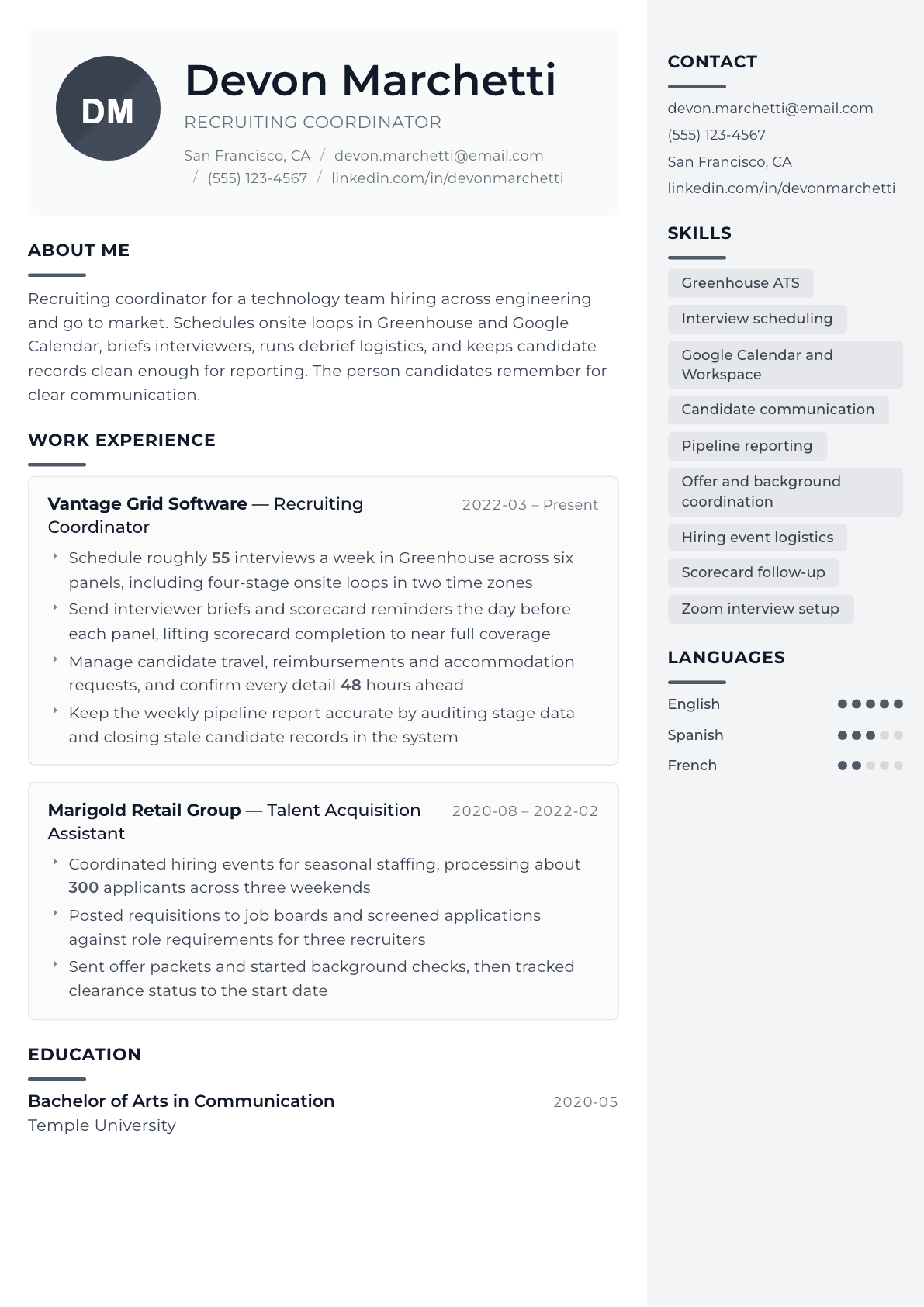
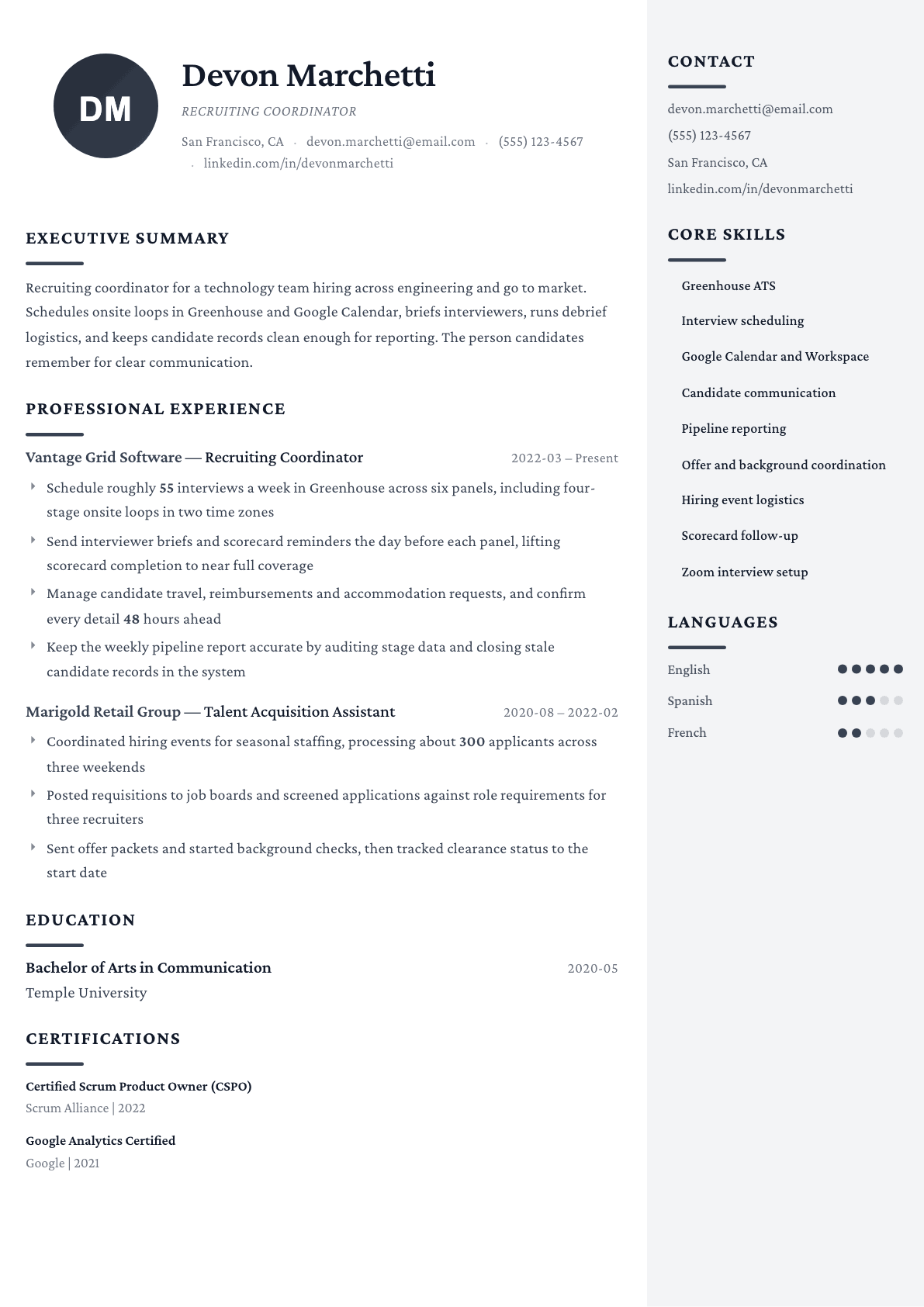
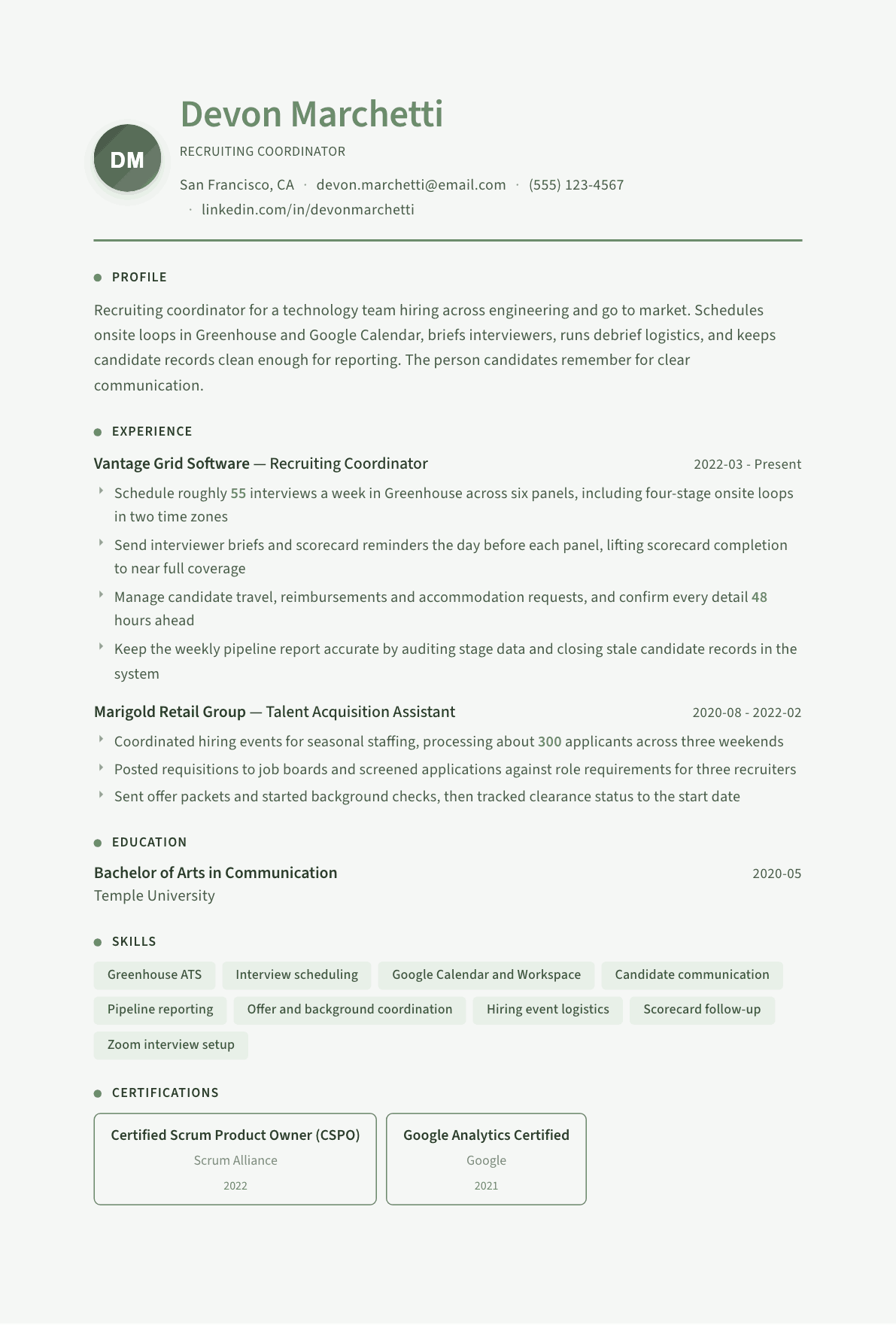
Example Recruiting Coordinator summary
Recruiting coordinator with four years scheduling technical and commercial hiring. Runs about 55 interviews a week in Greenhouse across six panels and two time zones, sends interviewer briefs that keep scorecard completion high, and handles candidate travel and offer logistics. Audits stage data so the weekly pipeline report can be trusted. Bachelor degree in communication.
Skills to list on a Recruiting Coordinator resume
- Interview scheduling
- Greenhouse
- Lever
- Workday Recruiting
- Candidate communication
- Onsite loop coordination
- Interview panel logistics
- Offer letter preparation
- Background check coordination
- Pipeline and stage reporting
- Hiring event logistics
- Calendar management
- Job board posting
- Candidate travel booking
What actually gets this resume read
- Lead with interview volume per week and panel complexity, because that is the number a recruiting manager compares.
- Name the applicant tracking system, such as Greenhouse, Lever, Workday Recruiting, Ashby or iCIMS, and how you used it.
- Show time zone and onsite loop coordination, since rescheduling skill is the hardest part of the role to teach.
- Include candidate experience evidence: response times, confirmation habits, or a template you wrote and rolled out.
- Add data hygiene work such as stage audits and reporting, which separates a coordinator from a calendar operator.
- Keep sourcing and screening claims honest, and label them clearly when the recruiter owned the final decision.
How to write a recruiting coordinator resume
A recruiting coordinator resume is read by a recruiting manager who lost a candidate last month because an interview loop fell apart. She is scanning for scheduling volume, the applicant tracking system you live in, and whether you can hold a four stage onsite together across time zones when two interviewers drop out the night before. Everything else is secondary.
This is also a role where candidates undersell themselves by describing calendars. Scheduling is the visible surface. The real job is protecting candidate experience, keeping interviewers accountable for scorecards, and maintaining pipeline data clean enough that the weekly report can be trusted. A resume that shows all three reads as a coordinator; one that shows only calendar work reads as a calendar operator.
This guide covers the layout recruiting managers scan, how to quantify interview load honestly, three summary examples at different stages, before and after bullets, and the questions coordinators ask when they aim at a recruiter seat next.
Format: one page, volume and system above the fold
One page, reverse chronological, no columns. Recruiting teams run their own applicant tracking system every day, so they know precisely how a decorative template parses and they will not forgive a scrambled work history in a resume from someone applying to work inside that system.
Put interview volume and the applicant tracking system in the first three lines. A recruiting manager comparing files is looking for a number per week and a product name, and if she has to hunt for either one the file goes to the maybe pile that never gets reopened.
- Header: name, city and state, phone, email, then a systems strip such as Greenhouse, Google Calendar, Zoom.
- Section order: summary, systems, recruiting experience, education, any coordinator or recruiter training.
- Open each job with the hiring context: functions supported, requisition load, and how many recruiters you partnered with.
Summary: interviews a week, panel complexity, system, what you protect
Lead with interviews scheduled per week and the complexity behind that number. Fifty five interviews a week across six panels including four stage onsite loops in two time zones is a complete picture in one sentence, because it carries volume, structure and difficulty at the same time.
Then name the applicant tracking system and the thing you protect. Candidate experience, scorecard completion and pipeline data hygiene are the three answers, and choosing one and evidencing it separates you from a stack of files that all claim strong organizational skills. Say which functions you hired for as well, since engineering loops and high volume retail hiring are different crafts.
Experience: scheduling, interviewer accountability, candidate experience, data
For scheduling, show the hard parts. Multi stage onsite loops, cross time zone coordination, panel substitutions on short notice, and rescheduling without dropping the candidate are the situations that reveal skill. A bullet that describes how you handled a collapsing loop is worth more than three that describe booking rooms.
For interviewer accountability, describe the mechanism. Sending interviewer briefs the day before with the resume, the focus area and the scorecard link, then chasing outstanding scorecards before the debrief, is the routine that keeps hiring decisions defensible. Tie it to an outcome such as scorecard completion at or near full coverage before each debrief.
For candidate experience, give something concrete: confirmation timing, a template you wrote and rolled out, travel and reimbursement handling, or accommodation requests managed discreetly. For data, show the audit habit: closing stale records, correcting stage data and validating the pipeline report before it goes to the hiring team. That is the layer that makes a coordinator promotable.
- Name the applicant tracking system by product: Greenhouse, Lever, Workday Recruiting, Ashby, iCIMS, SmartRecruiters.
- Say which functions you supported: software engineering, sales, clinical, warehouse, seasonal retail.
- Label sourcing or screening work honestly and note where the recruiter made the decision.
High volume versus complex loop hiring: pick your evidence
These are two different resumes. High volume hiring is measured in applicants processed, hiring events run, offers extended and time from application to start, so lead with throughput and event logistics. Complex loop hiring is measured in panel coordination, interviewer load balancing, debrief scheduling and candidate travel, so lead with structure and reschedule handling.
If you have both, keep one master file and swap the first bullet of your most recent job to match the posting. A retail seasonal hiring bullet in front of a technical coordinator posting makes a recruiting manager assume you have never held an engineering loop together, even when the rest of the page says otherwise.
Education, credentials and the words the posting will reuse
A degree in communication, business, psychology or human resources is common, and none of them are required. What helps is any recruiting or human resources credential, or vendor training in the applicant tracking system you use, because it signals you treat the tool as a craft rather than a calendar.
Recruiting postings repeat a narrow vocabulary: interview scheduling, onsite loop coordination, candidate experience, applicant tracking system, offer coordination, background check initiation, pipeline reporting, hiring events, interviewer briefing and calendar management. Mirror the true ones once in your skills block and once inside the bullet where the work happened.
Recruiting Coordinator resume summary examples
First recruiting seat
Communication graduate with a year of talent acquisition support: job board posting, application screening against role requirements for three recruiters, and offer packet preparation. Coordinated hiring events processing about 300 applicants across three weekends. Seeking a recruiting coordinator role on a scheduling heavy team.
Four years in
Recruiting coordinator scheduling about 55 interviews a week in Greenhouse across six panels and two time zones, including four stage onsite loops. Sends interviewer briefs that keep scorecard completion high, manages candidate travel and reimbursements, and audits stage data so the weekly pipeline report is trustworthy.
Lead coordinator
Lead recruiting coordinator with seven years across technical and commercial hiring, currently supporting five recruiters and a requisition load above 40. Owns the scheduling standard and the interviewer briefing template, trains new coordinators, and runs onsite and hiring event logistics for engineering and sales.
Work experience bullets: before and after
Before: Scheduled interviews for the recruiting team.
After: Scheduled about 55 interviews a week in Greenhouse across six panels, including four stage onsite loops spanning two time zones with same day interviewer substitutions.
Weekly volume, panel count and the time zone reality show the difficulty behind a task that sounds simple.
Before: Reminded interviewers to fill out feedback.
After: Sent interviewer briefs with the resume, focus area and scorecard link the day before each panel, then chased outstanding scorecards ahead of the debrief so decisions were made on complete feedback.
The mechanism and the outcome turn nagging into a process that protects the quality of hiring decisions.
Before: Communicated with candidates during the process.
After: Confirmed every onsite candidate 48 hours ahead with agenda, interviewer names, location details and travel arrangements, and handled accommodation requests directly and discreetly.
A confirmation standard and specific contents make candidate experience a practice rather than an intention.
Before: Kept the recruiting system up to date.
After: Audited stage data weekly in the applicant tracking system, closed stale candidate records and corrected mis-staged profiles so the pipeline report shared with hiring managers matched reality.
Data hygiene tied to a report the leadership team reads is the work that makes a coordinator promotable.
Before: Helped with hiring events.
After: Coordinated seasonal hiring events processing about 300 applicants over three weekends: interviewer staffing, room flow, on-site offer packets and background check initiation before candidates left.
Applicant throughput and the on-site offer step show high volume hiring competence rather than event attendance.
Hard skills
- Interview scheduling at volume
- Greenhouse
- Lever
- Workday Recruiting
- Onsite loop coordination
- Cross time zone calendar management
- Interviewer briefing and scorecard follow up
- Candidate travel and reimbursement
- Offer letter preparation support
- Background check coordination
- Pipeline and stage reporting
- Hiring event logistics
- Job board posting
- Video interview setup and troubleshooting
Soft skills
- Composure during a collapsing loop
- Warm and precise candidate communication
- Diplomacy with busy interviewers
- Anticipating conflicts before they land
- Discretion with offer information
- Follow through on small commitments
Certifications worth listing
- Associate Professional in Human Resources (aPHR) (HR Certification Institute)
- SHRM Certified Professional (SHRM-CP) (Society for Human Resource Management)
- Professional Recruiter Certification (AIRS)
- LinkedIn Certified Professional Recruiter (LinkedIn)
Mistakes that cost recruiting coordinator candidates the interview
- Describing the job as calendar management with no interview volume attached, which erases the hardest part of the work.
- Omitting the applicant tracking system, the first product name a recruiting manager searches the file for.
- Claiming sourcing or hiring decisions the recruiter owned, which unravels in the first behavioral question.
- Leaving out data hygiene work, the layer that distinguishes a coordinator from a scheduler.
- Sending the same file to high volume and technical loop postings without swapping the lead bullet.
- Using a designed template with columns and icons when the reader works inside a parser every day.
Recruiting Coordinator resume questions
How do I show interview volume if my team never tracked it?
Reconstruct from your calendar and requisition load: interviews in a typical week, panels supported, onsites per month and recruiters partnered with. Use about with a rounded number, and be ready to explain the estimate, because an interviewer may ask how you arrived at it.
What is the difference between a recruiting coordinator and a recruiter?
A coordinator owns the process and the candidate experience around the interview: scheduling, logistics, communication and data. A recruiter owns the search, the screen and the close. Show which decisions were yours and the reader will place you accurately instead of assuming the lower one.
Should I list every applicant tracking system I have used?
List the ones you worked in daily and name the workflows you ran inside each, such as scheduling, offer creation or reporting. A system you saw in a demo belongs nowhere on the page, since a screening call will ask you to describe the interface.
How do I move from recruiting coordinator to recruiter?
Lead with the work closest to recruiting judgment: applicant screening against role requirements, intake meeting participation, market feedback you gave hiring managers, and pipeline analysis. Then name the functions you know well, because recruiters are hired against a specific hiring market.
Does candidate experience belong on a recruiting coordinator resume?
Yes, but only as evidence. Confirmation timing, agenda contents, response speed, a template you wrote or an accommodation process you ran are provable. A general claim about caring for candidates is claimed by everyone and adds nothing to a comparison.
Related resume examples
- Recruiter Resume example
- HR Coordinator Resume example
- Staffing Coordinator Resume example
- Human Resources Assistant Resume example
- Executive Assistant Resume example
- Administrative Coordinator Resume example