Boilermaker Resume Examples: free ATS score and gap list
Write a Boilermaker Resume That Gets You on the Turnaround Crew
By Mustafa Tarabya, founder of CVBooster · Published · Updated
Boilermaker resume example with pressure vessel, tube replacement and code welding keywords, plus a guide to outage work and rig experience.
Sample resumes for a boilermaker
The same boilermaker content laid out in three CVBooster templates, so you can see what the finished document looks like before you write a word.
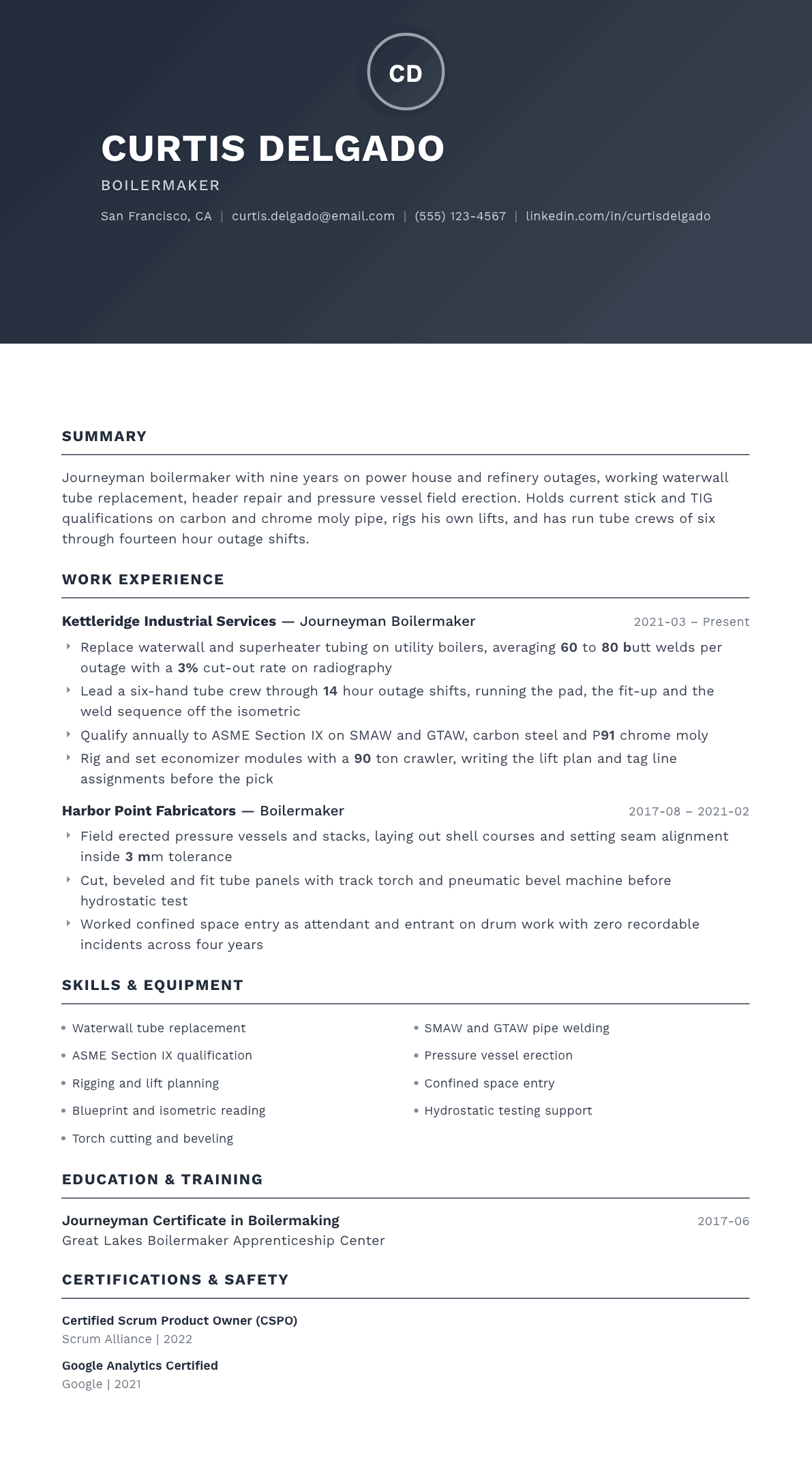
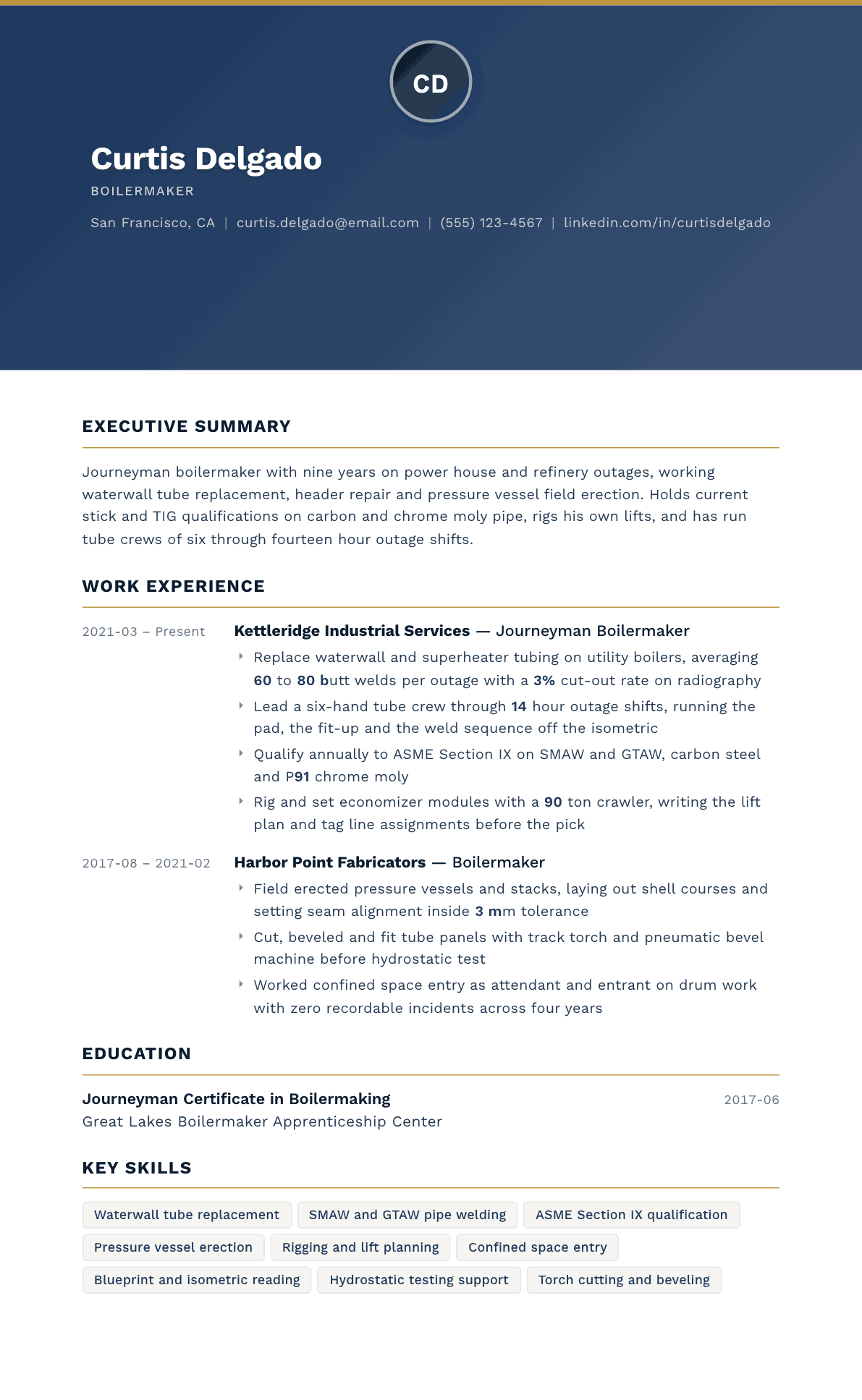
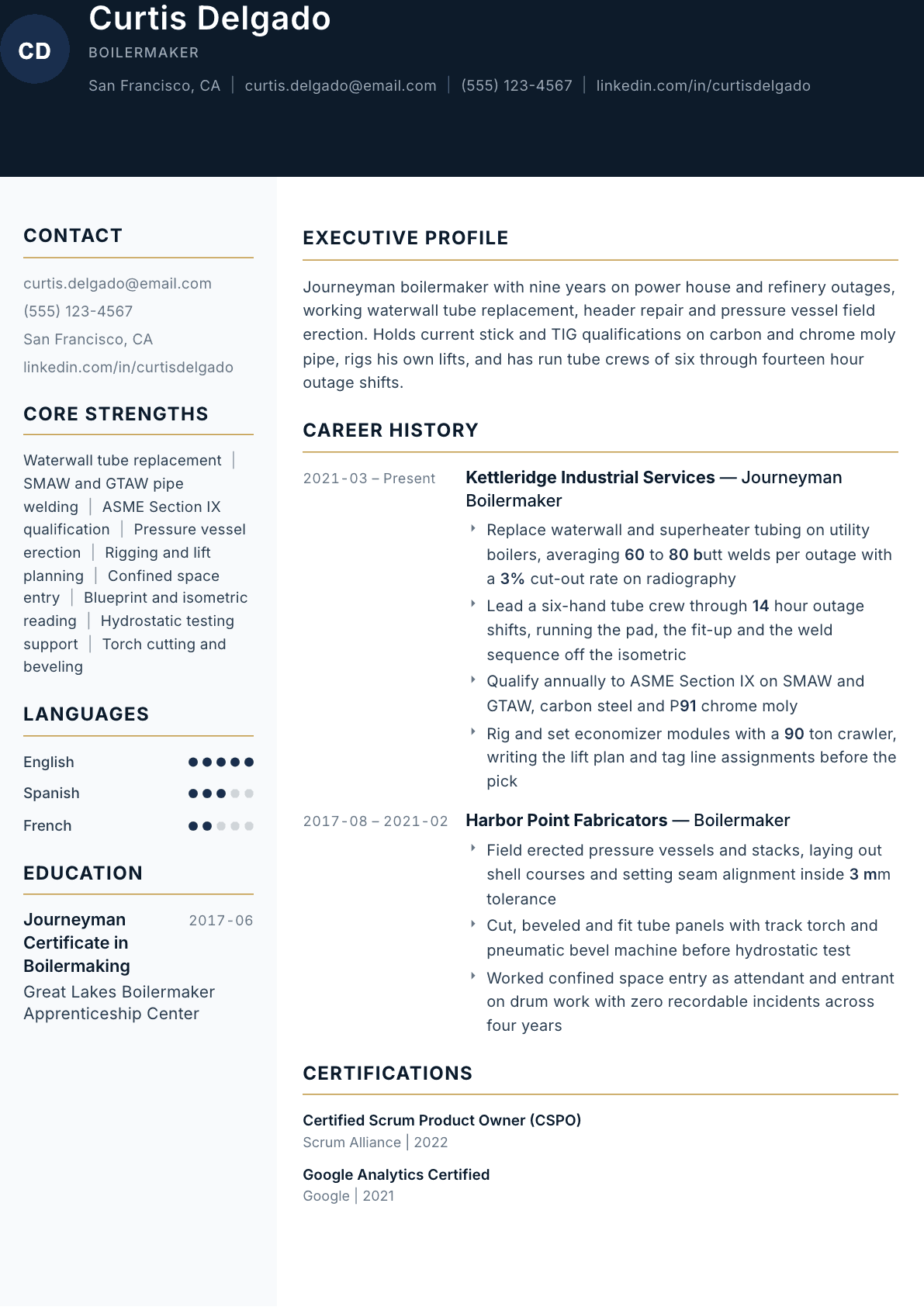
Example Boilermaker summary
Journeyman boilermaker with nine years of utility and refinery outage work covering waterwall and superheater tube replacement, header repair and pressure vessel field erection. Current on SMAW and GTAW qualifications for carbon steel and P91 chrome moly under ASME Section IX, with a radiography reject rate held under 4% across recent outages. Rigs his own picks, runs a six-hand tube crew, and travels for work year round.
Skills to list on a Boilermaker resume
- Boiler tube replacement
- Pressure vessel erection
- SMAW stick welding
- GTAW tube welding
- Chrome moly and P91 welding
- ASME Section I and VIII work
- Rigging and signaling
- Crane lift planning
- Torch cutting and beveling
- Weld fit-up and alignment
- Isometric and shop drawing reading
- Hydrostatic and pneumatic testing
- Confined space entry
- Scaffold and fall protection
- Outage and turnaround planning
What actually gets this resume read
- List your current weld qualifications by process, base metal and position, since a boilermaker hire starts with the test coupon.
- Name the outages you have worked, the unit type and the megawatt class, because that is how a superintendent sizes you up.
- Give your tube count per outage and your radiography reject rate, the two numbers a weld foreman reads first.
- Put confined space, rigging and fall protection training in one block with the issue dates alongside.
- Say whether you travel and how far, because most boilermaker work is outage work away from home.
- Show the codes you have worked under, such as ASME Section I or Section VIII, not just the word welding.
How to write a boilermaker resume
A boilermaker resume is read by a weld foreman or an outage superintendent who is filling a crew against a date that will not move. He has a unit coming down, a scope with a tube count on it, and a list of qualifications the owner will audit before anyone strikes an arc. What he wants from your page is a fast answer to three questions: what can you weld, what have you built or replaced, and can you travel to be there Monday.
The pages that lose are the ones that say "performed welding and fabrication duties in an industrial environment". That sentence fits a shop hand, a millwright and a pipefitter equally well. A boilermaker page has to carry pressure part language: waterwall panels, superheater pendants, economizer modules, headers, drums, stub tubes, membrane, the codes the work was built to and the position you tested in.
This guide covers the layout an outage contractor expects, how to present weld qualifications so they can be checked, what to put in each job when the work was travel work on many sites, and how to write experience when your career is measured in outages rather than in years at one address.
Format: qualifications block high, then outage history
Reverse chronological, one or two pages. Two is normal for a boilermaker because a decade of travel work covers many contractors and many plants, and cutting that history to fit one page hides the thing a superintendent is looking for. What must not be lost to page two is your weld qualification block. Put it directly under the contact line, above the first job.
Boilermaker work is contractor work, so structure each entry as contractor first, then the sites underneath it. A recruiter who sees five separate one line jobs in a year reads it as churn. The same year written as one contractor with four named outages under it reads as a full book of work.
- Contact line: name, cell, home local or union hall if you are a member, and one line saying you travel with your own hand tools and rigging gear.
- Qualification block second: each weld procedure by process, base metal, thickness range, position and the month it was last renewed.
- Then experience, contractor by contractor, with the plants and outages nested underneath as short lines.
- Safety and training block near the end: confined space, fall protection, rigging and signaling, respirator fit test date.
- Apprentices lead with hall hours accumulated, the school portion completed, and every tube or plate coupon passed.
Weld qualifications: write them so they can be verified
This is where most boilermaker resumes fall apart. A line that says "certified welder" tells a foreman nothing, because a qualification is only real as a combination of process, material, thickness, diameter and position, held current by continuity. Write each one out. SMAW on carbon steel pipe in 6G, GTAW root with SMAW fill and cap on P22 and P91, plate qualifications for structural and membrane panel work, and the code the qualification was written to.
Add the month you last renewed and who holds the paper, because the owner will pull it before you badge in. If a qualification has lapsed, say so and say when you can retest. A foreman would rather schedule a test coupon than discover a gap at the gate.
If you have run chrome moly, put it in the summary and not only in the qualification block. Preheat control, interpass temperature and postweld heat treatment on P91 are the part of the trade that separates a tube welder from a hand who can only run mild steel, and it is worth stating that you have worked to a heat treat chart and held preheat through the joint.
Experience: tube counts, reject rates, crew size, shift length
Each outage line needs four things: the unit and its type, what the scope was, the volume you personally welded or fit, and how the welds came back from inspection. Utility boiler, recovery boiler, package boiler, heat recovery steam generator and refinery fired equipment are all different animals, and naming the unit tells a superintendent whether your hands have been in that kind of tight furnace before.
Volume is the number that lets a foreman size you. Butt welds per outage, pads and windows replaced, panels hung, feet of membrane cut and rewelded. Then give the quality figure: your radiography or ultrasonic reject rate, or your cut out rate. A welder who reports his own reject rate is telling the foreman he tracks it, which is itself a hiring signal.
Do not forget the work either side of the arc. Layout from the isometric, torch cutting and beveling, fit up and alignment, hydro prep, blinding and box up. Boilermakers get paid for the whole sequence and a page that only talks about welding reads as half a hand.
- Name the unit: utility boiler with megawatt class, recovery boiler, HRSG, or the refinery fired heater and its service.
- Give butt weld counts and the material, not just the phrase tube replacement.
- State the inspection outcome as a reject or cut out rate against the volume it was measured on.
- Say what you led: crew size, shift length, and whether you ran the pad, the fit or the weld sequence.
- Include rigging you performed yourself, with the crane class and the component weight range.
Rigging, confined space and the safety record a plant checks
Boiler work happens inside drums, in furnace bottoms and off staging hung from the roof. Every owner audits the same training list, so give it as a block with issue dates: confined space entry and attendant, fall protection and rescue, rigging and crane signaling, respiratory fit test, hot work and fire watch. A page that carries the dates saves the contractor a phone call and gets you badged faster.
Add your own safety record as a plain statement of fact with the span it covers. Zero recordables across a set number of outages is a claim a superintendent can check with your last contractor, and it carries far more weight than any sentence about being safety conscious.
Keywords and the wording contractors search
Outage contractors search on process and part names. Use the vocabulary from the call literally: waterwall, superheater, reheater, economizer, generating bank, header, stub, membrane, dutchman, windbox, pressure part, code repair. Use the code names too, since work built to ASME Section I reads differently from Section VIII vessel work and National Board repair work is different again.
Say plainly where you will travel and whether you have a current TWIC, a passport and a clean drug screen. Those three lines are more decisive on a boilermaker resume than a whole skills section, because the job only exists if you can be at the gate on the day the unit comes down.
Boilermaker resume summary examples
Apprentice
Third year boilermaker apprentice with 4800 hall hours across two utility outages and one shop fabrication run. Passed plate and 6G pipe coupons in SMAW and GTAW root. Trained in confined space entry, fall protection and rigging. Travels anywhere in the region and owns a full hand tool bag.
Journeyman on the tube crew
Journeyman boilermaker with nine years of utility and refinery outage work on waterwall and superheater tube replacement, header repair and vessel erection. Current on SMAW and GTAW for carbon steel and P91 under ASME Section IX. Averages 70 butt welds an outage with a 3% cut out rate and rigs his own picks.
Foreman
Boilermaker foreman with sixteen years, running crews of up to twenty on utility boiler and HRSG outages. Plans the scope with the superintendent, writes weld sequences and lift plans, and closes out the package with the inspector. Held a zero recordable record across eleven consecutive turnarounds while beating the schedule twice.
Work experience bullets: before and after
Before: Welded boiler tubes during plant outages.
After: Replaced waterwall and superheater tubing on a 600 MW utility boiler, averaging 74 butt welds per outage in 2.5 inch SA-210 with a 3% radiography cut out rate.
The unit, the material, the weld count and the inspection result together prove the hands, where the weak line only claims them.
Before: Worked as part of a welding crew.
After: Led a six hand tube crew across 14 hour outage shifts, assigning pad, fit up and weld sequence off the isometric and closing each area with the inspector before staging came down.
It shows a leadership scope with the actual tasks assigned, which is what a superintendent hires a lead hand to do.
Before: Experienced with chrome moly welding.
After: Welded P91 header stubs to procedure with 400 F preheat held through the joint, interpass control logged every pass, and postweld heat treatment coordinated with the stress relief crew.
Naming preheat, interpass and PWHT proves you have worked to a heat treat chart rather than only heard of the alloy.
Before: Helped set heavy equipment with the crane.
After: Rigged and set economizer modules up to 30 tons with a 90 ton crawler, writing the lift plan, selecting slings and shackles by chart and assigning tag lines before the pick.
Weights, crane class and the planning steps show competent rigging instead of a pair of hands on a tag line.
Before: Followed all safety procedures on site.
After: Entered drums and furnace bottoms as both attendant and entrant under confined space permit, gas tested before every entry, and finished four years with no recordable incident.
A specific permit role and a record with a span behind it is checkable, unlike a general claim about following procedures.
Hard skills
- Waterwall and superheater tube replacement
- Header and drum repair
- Pressure vessel field erection
- SMAW stick welding
- GTAW tube and root welding
- P22 and P91 chrome moly welding
- Preheat and interpass temperature control
- ASME Section I and Section VIII work
- Torch cutting and pneumatic beveling
- Fit up, alignment and tacking
- Rigging, sling selection and crane signaling
- Confined space entry and attendant duty
- Isometric and shop drawing layout
- Hydrostatic test preparation and box up
Soft skills
- Working a compressed outage clock without cutting corners
- Taking direction from an inspector without argument
- Keeping a crew moving through night shift
- Traveling and living out of a bag for long stretches
- Calling a stop when a joint or a lift is not right
Certifications worth listing
- Certified Welder (American Welding Society)
- NCCER Boilermaking Credential (NCCER)
- OSHA 30-Hour Construction Safety (OSHA Training Institute)
- Transportation Worker Identification Credential (Transportation Security Administration)
Mistakes that cost boilermaker candidates the interview
- Writing "certified welder" with no process, base metal, thickness or position behind it, which forces a foreman to schedule a coupon before he can even consider you.
- Listing every one week outage as its own job so a decade of solid work reads like a decade of churn.
- Leaving out the unit type, so nobody can tell whether you have worked a recovery boiler, a utility unit or a package boiler.
- Talking only about welding and skipping layout, cutting, fit up, rigging and box up, which is most of the pay hours.
- Omitting the safety training block with dates, which slows down badging and makes a contractor pick the hand whose paper is ready.
- Never stating travel availability, when travel is the single condition every outage job depends on.
Boilermaker resume questions
How do I list outage work without making my resume look unstable?
Group by contractor and nest the outages under it as short lines with the plant, the unit and the scope. That reads as continuous employment with a project history, which is exactly what boilermaker work is, rather than a string of short jobs.
Do I need to list every weld qualification I have ever held?
List the ones that are current, with the renewal month, and mention lapsed ones separately only if they cover something valuable like P91. A superintendent is planning who tests on which coupon, so accuracy about what is live matters more than a long list.
What should an apprentice put on the page?
Hall hours accumulated, the school terms completed, every coupon passed, and each outage you have worked with what you actually did on it. Grinding, fitting and staging count. A foreman hires apprentices for willingness and safe habits, so show both concretely.
Should a boilermaker resume mention union membership?
Yes if you are a member, with the local number, because it tells a contractor how you will be dispatched and what agreement applies. If you work non union, say that plainly instead, since it saves both sides a call that goes nowhere.
How do I show quality when I have never tracked my own reject rate?
Ask your last foreman or the quality department for your cut out numbers, since most projects record them by welder stamp. If you cannot get them, describe the inspection regime you worked under and any repairs you were assigned, which still shows you understand how the work is judged.
Related resume examples
- Welder Resume example
- Pipe Welder Resume example
- Millwright Resume example
- Metal Fabricator Resume example
- TIG Welder Resume example
- Fabricator Resume example