Family Support Worker Resume Examples: read this first
Family Support Worker Resume Examples and a Practical Writing Guide
By Mustafa Tarabya, founder of CVBooster · Published · Updated
Family support worker resume example with home visiting bullets, parenting curriculum keywords, and a guide to every section hiring managers read.
Sample resumes for a family support worker
The same family support worker content laid out in three CVBooster templates, so you can see what the finished document looks like before you write a word.
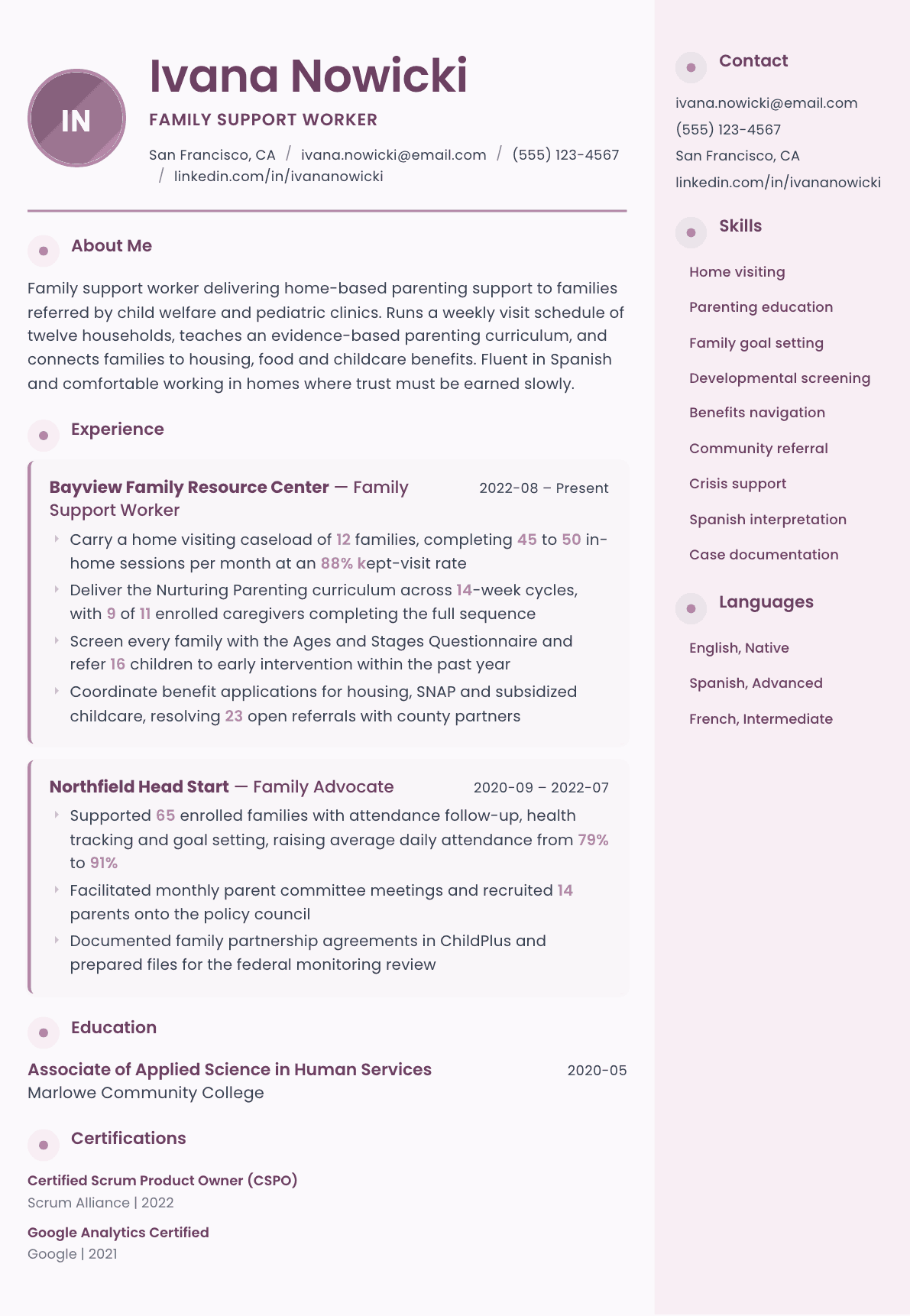
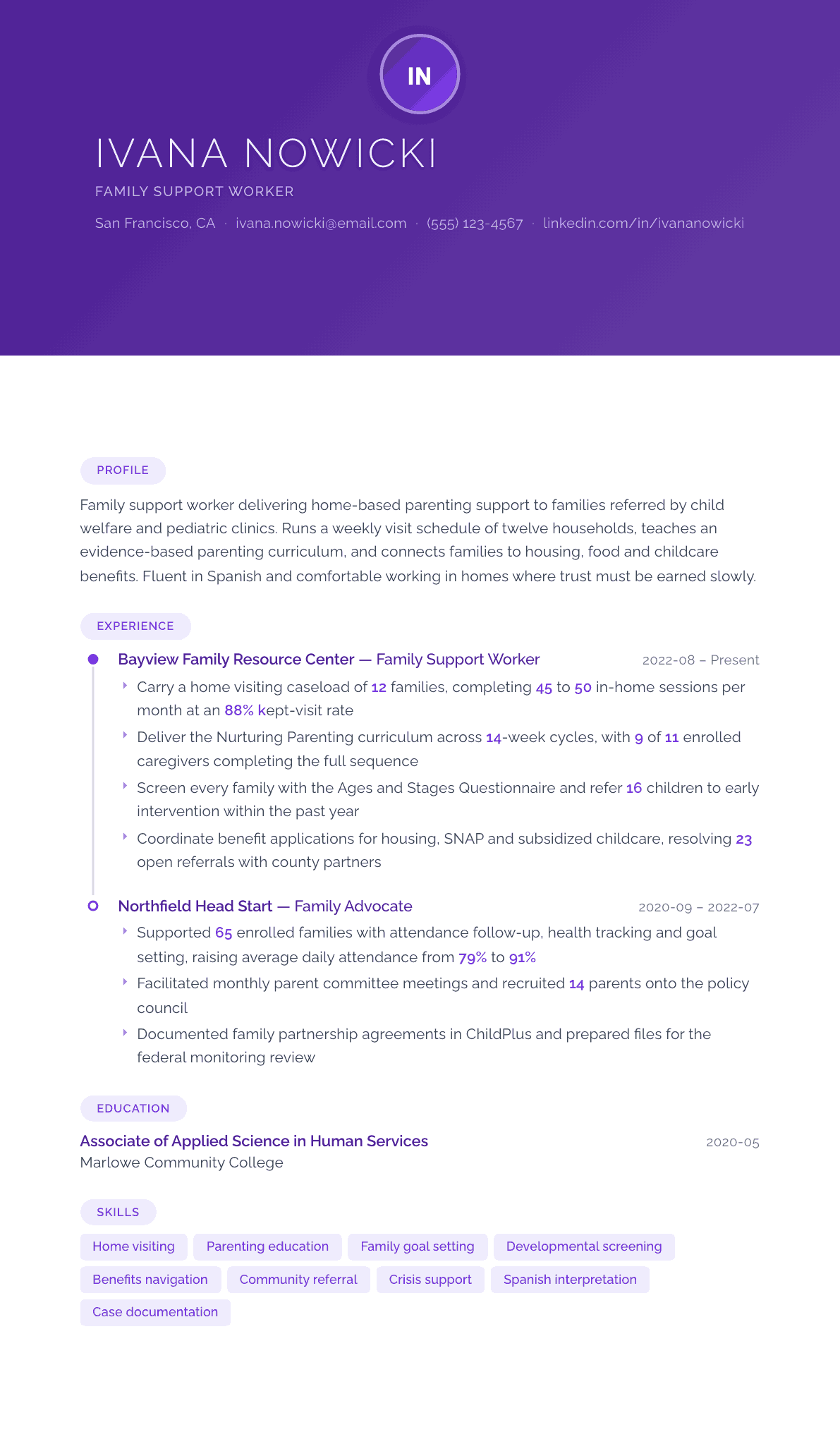
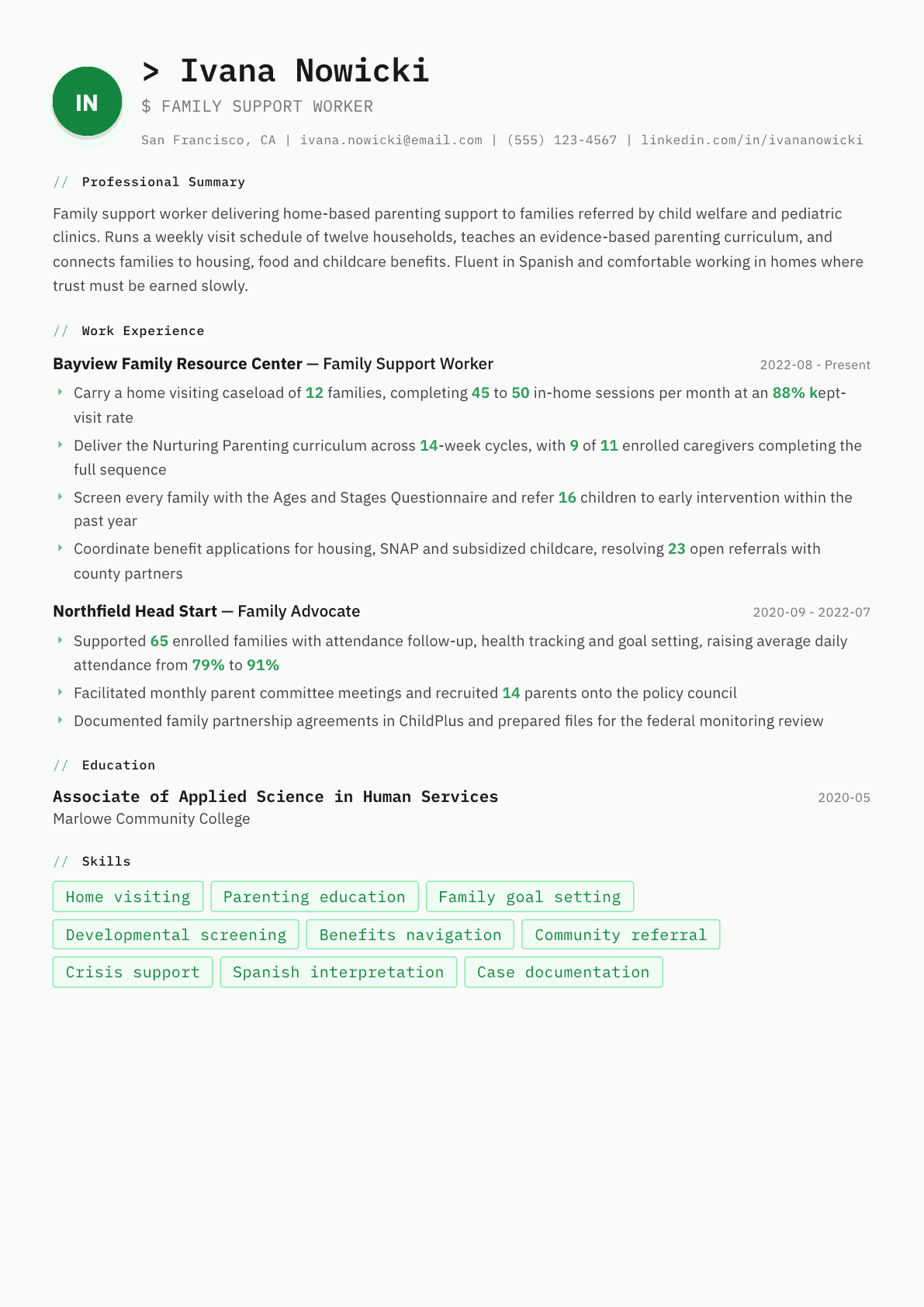
Example Family Support Worker summary
Family support worker with three years of in-home practice serving families referred by child welfare and pediatric clinics. Holds a caseload of twelve households, delivers a structured parenting curriculum across full fourteen-week cycles, and screens every child for developmental delay. Bilingual in Spanish, steady with families in crisis, and consistent at closing benefit referrals with county partners.
Skills to list on a Family Support Worker resume
- Home visiting
- Parenting curriculum delivery
- Family goal planning
- Ages and Stages Questionnaire
- Developmental screening
- Benefits and entitlement navigation
- Community resource referral
- Motivational interviewing
- Crisis support and safety awareness
- Case notes and documentation
- Group facilitation
- Child development knowledge
- Bilingual family communication
- Mandated reporting
What actually gets this resume read
- Give the caseload size and the visit rhythm, because home visiting supervisors judge capacity by visits completed per month.
- Name the parenting curriculum you were trained to deliver and how many cycles you carried from start to finish.
- Include developmental screening tools by name, since early childhood employers filter for those exact instruments.
- Show kept-visit or engagement rates, which prove you can hold a family who cancels the first three appointments.
- List the benefits and systems you helped families access, from housing vouchers to childcare subsidy and food programs.
- State any second language and whether you interpreted in visits, because that skill often decides the assignment.
How to write a family support worker resume
A family support worker resume is judged on a question that sounds simple and is not: can this person get through the door and keep getting through it. Home visiting programs live or die on engagement rates. A supervisor reading applications is scanning for someone who can hold a family that misses the first two appointments, who can teach a parenting curriculum without sounding like a textbook, and who can write a case note that satisfies a funder.
The applications that fail all read the same way. They describe warmth and dedication, list the agency mission, and never say how many families were carried, how often they were seen, or what curriculum was delivered. Warmth is assumed in this field. Structure is what has to be proved.
What follows is the order a home visiting supervisor reads a resume, three example summaries across career stages, before-and-after bullets taken from real application language, and answers to the questions family support workers ask when they rewrite their resume for a better funded program.
Format: single page, plain layout, credentials visible
Nearly every family support worker resume belongs on one page. Community agencies and health departments read a lot of these, and a dense second page usually means duties repeated in three different jobs. Keep a single column, one clean font, and no icons, because small nonprofits often paste the file into a shared review document.
Put language ability, driver license and vehicle access into the header block. Home visiting is a driving job, and a second language often decides which caseload you are assigned before anyone reads your experience.
- Header: name, city and state, phone, email, languages spoken, driver license.
- Order: summary, experience, education, training and certifications, skills.
- New entrants can add a volunteer or practicum section directly under education.
Summary: caseload, visit rhythm, curriculum, population
Three lines that answer capacity. Name the number of families you carried, how often you saw them, the referral source that fed your caseload, and the curriculum you were trained to deliver. A program manager can picture your week from that alone. Then add the population you know, whether that is teen parents, families referred by child welfare, refugee households, or families with a child under three.
If you are new to home visiting, lead with the closest thing you have done. Childcare, community health outreach, shelter work and school family engagement all build the same muscles, and naming the parallel is stronger than apologizing for the gap.
Experience: visits completed, engagement held, referrals closed
Build each job around three measures a funder recognizes. First, volume: families carried and visits completed in a month. Second, engagement: kept visit rate, retention through a curriculum cycle, or the number of families still enrolled after six months. Third, movement: referrals opened and actually closed, screenings completed, goals reached on the family plan.
Then show the teaching. Say which curriculum, how long a cycle runs, and how many caregivers finished it, because completion is the outcome programs report upward. If you adapted delivery for a parent with low literacy, or ran a session in a second language, that belongs here as a concrete practice rather than a claim about cultural competence.
Family support work is also safety work. You are in homes, sometimes alone, and you are a mandated reporter. Write one bullet that shows you handled that boundary well: safety protocols followed, concerns reported inside the required window, and the relationship maintained afterward where it was possible.
Screening tools, curricula and systems: name the exact instrument
This is the keyword layer of the resume. Developmental screening instruments, depression screens used in home visiting, and the parenting curricula are all named products, and hiring managers search for them literally. Write the instrument name rather than a generic phrase like developmental checks.
Do the same for data systems. Home visiting programs report into a database the funder requires, and a candidate who has already entered visit data into a structured system saves the program weeks of training. Say you documented in it, not that you were exposed to it.
- Screening: Ages and Stages Questionnaire, ASQ Social Emotional, standard perinatal depression screens.
- Curriculum: named parenting curricula delivered in full cycles, group and one-to-one formats.
- Systems: agency case management databases, home visiting data systems, benefit application portals.
Keywords community programs repeat in postings
Postings for this role recycle a small set of phrases: home visiting, family engagement, parenting education, developmental screening, goal setting, resource navigation, mandated reporter, strengths-based, family partnership agreement, caseload management. Mirror the ones that are true of you, once in a skills line and once inside evidence.
Where a program is funded to serve a defined population, the posting will say so, and matching that language matters. A program serving families in the first three years of a child life wants to read early childhood vocabulary, not adolescent vocabulary.
Family Support Worker resume summary examples
New to home visiting
Human services graduate with 2 years in early childhood classrooms and a 200-hour practicum supporting family engagement at a community center. Trained in the Ages and Stages Questionnaire and mandated reporting. Bilingual in Spanish and ready to carry a home visiting caseload of 10 families.
Three years in the field
Family support worker carrying 12 households referred by child welfare and pediatric clinics, completing 45 to 50 home visits monthly at an 88% kept-visit rate. Delivers a 14-week parenting curriculum with 9 of 11 caregivers completing, and closed 23 housing, food and childcare referrals last year.
Lead family support worker
Lead family support worker mentoring 5 home visitors across a program serving 70 families. Reviews case notes for fidelity, runs monthly reflective supervision alongside the manager, and rebuilt the intake process so first visits happen within 8 days of referral instead of 21.
Work experience bullets: before and after
Before: Visited families in their homes to provide support.
After: Carried a caseload of 12 families and completed 45 to 50 in-home visits monthly, holding an 88% kept-visit rate across a full year.
Caseload plus visits plus a kept-visit rate is the exact capacity picture a home visiting supervisor needs.
Before: Taught parenting skills to caregivers.
After: Delivered the Nurturing Parenting curriculum in 14-week cycles to groups of up to 11 caregivers, with 9 completing the full sequence in the most recent cohort.
Naming the curriculum, the cycle length and the completion count turns teaching into a measured program outcome.
Before: Referred families to community services.
After: Opened and tracked housing, food assistance and childcare subsidy referrals for 30 households, confirming 23 reached an approved benefit rather than closing at the application stage.
Following a referral to its outcome is the difference between handing out a phone number and doing the work.
Before: Screened children for developmental delays.
After: Administered the Ages and Stages Questionnaire at every required interval for 30 children and referred 16 to early intervention, with 12 receiving services within 60 days.
The named instrument, the interval schedule and the service start date show a real screening pathway.
Before: Kept accurate records of my visits.
After: Entered visit notes, goals and screening results into the program database within 2 business days, passing 4 consecutive file reviews with no missing documentation.
Documentation only counts when the timeframe and the review result are on the page.
Hard skills
- Home visiting practice
- Parenting curriculum delivery
- Family goal and partnership planning
- Ages and Stages Questionnaire
- Developmental and social emotional screening
- Benefits and entitlement navigation
- Community resource referral tracking
- Motivational interviewing
- Case note and database documentation
- Mandated reporting practice
- Group session facilitation
- Child development knowledge
Soft skills
- Building trust in a stranger home
- Nonjudgmental listening
- Reliability across repeated appointments
- Boundary setting with families in crisis
- Bilingual communication
- Calm response to unexpected household situations
Certifications worth listing
- Certified Family Life Educator (CFLE) (National Council on Family Relations)
- Mental Health First Aid (National Council for Mental Wellbeing)
- Child Development Associate (CDA) Credential (Council for Professional Recognition)
Mistakes that cost family support worker candidates the interview
- Describing personal warmth at length while leaving out caseload size, visit frequency and engagement rates.
- Saying you provided parenting education without naming the curriculum, the cycle length or how many caregivers finished.
- Listing referrals made rather than referrals that reached an approved service, which is the outcome funders count.
- Forgetting to state driver license and vehicle access on a role that is built around driving between homes.
- Burying a second language at the bottom of the page when it often decides which caseload you are offered.
- Using clinical therapy language for a role that is deliberately non-clinical, which suggests a mismatch with the program model.
Family Support Worker resume questions
How many families should a family support worker resume say I carried?
State the number your program actually assigned and pair it with visit frequency, because caseload size means nothing alone. Twelve families seen weekly is a very different job from thirty families seen once a month, and a supervisor is trying to tell those apart.
Do I need a degree to work as a family support worker?
Requirements vary by program. Many home visiting models accept an associate degree or relevant experience with a high school diploma, while others require a bachelor degree in social work or human services. Put your highest qualification and any parenting or child development training clearly near the top.
What should I write if my program tracked no formal outcome data?
Reconstruct what you can defend: how many families were on your list, roughly how many visits you completed in a normal month, how many curriculum cycles you ran, and how many referrals you followed to an approved service. Honest approximations beat vague duty statements.
How do I move from childcare or classroom work into family support?
Lead with the family-facing parts of your current job: parent conferences, home communication, attendance follow-up, developmental observation and referrals. Then name the screening tools and mandated reporting training you have. The classroom experience is an asset when you frame it as family engagement rather than supervision of children.
Should I mention safety concerns I have handled in homes?
Yes, in general terms and without identifying anyone. One bullet showing that you followed a safety protocol, reported a concern inside the required window, and continued working with the family afterward tells a supervisor you can hold the mandated reporter role without losing engagement.
Related resume examples
- Social Worker Resume example
- Outreach Coordinator Resume example
- Community Health Worker Resume example
- Youth Worker Resume example
- School Social Worker Resume example
- Geriatric Social Worker Resume example