Youth Worker Resume Examples: free ATS score and gap list
Write a Youth Worker Resume That Shows Real Program Impact
By Mustafa Tarabya, founder of CVBooster · Published · Updated
Youth worker resume example with program delivery bullets, safeguarding keywords, and a full guide to writing each section for youth services jobs.
Sample resumes for a youth worker
The same youth worker content laid out in three CVBooster templates, so you can see what the finished document looks like before you write a word.
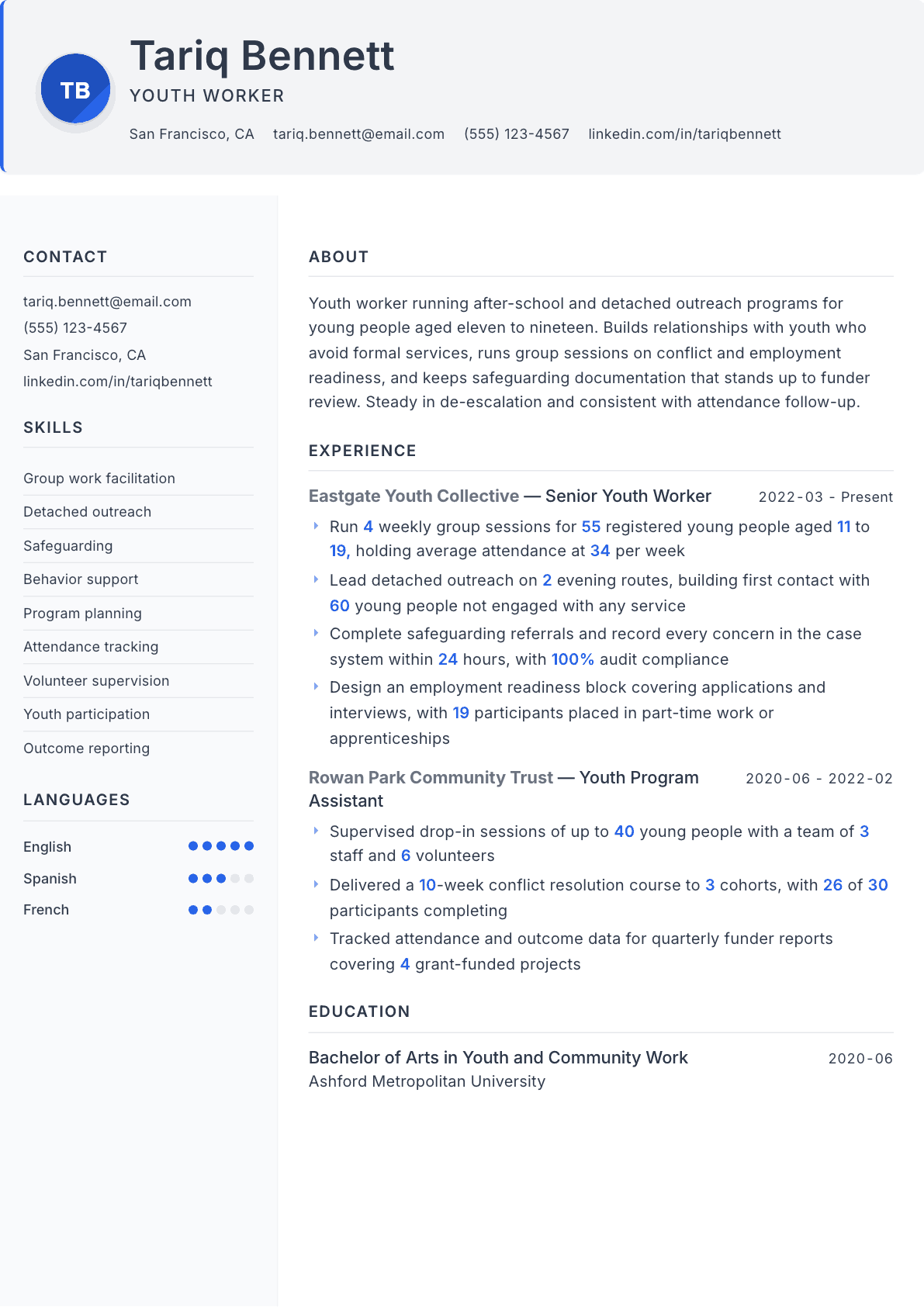
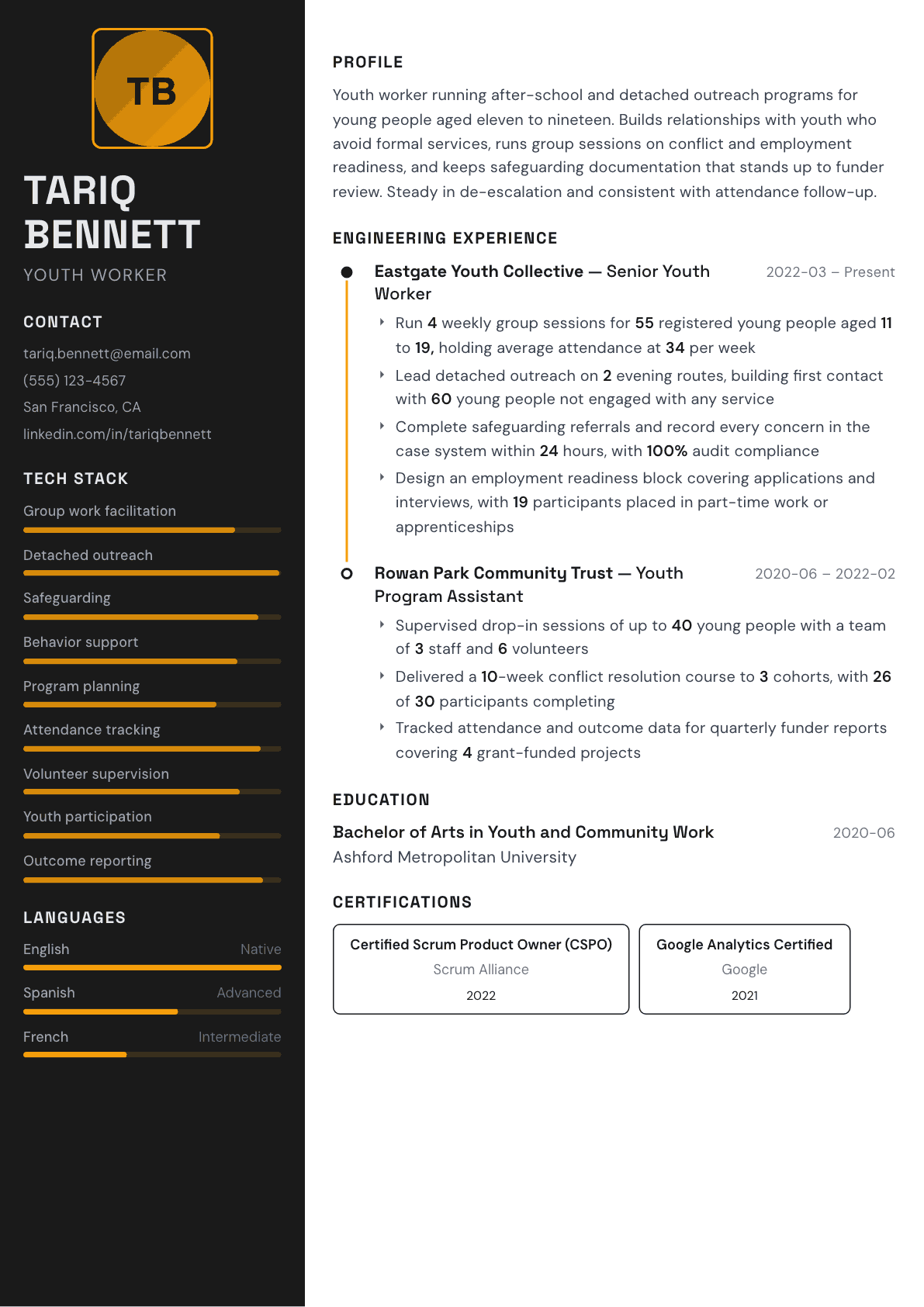
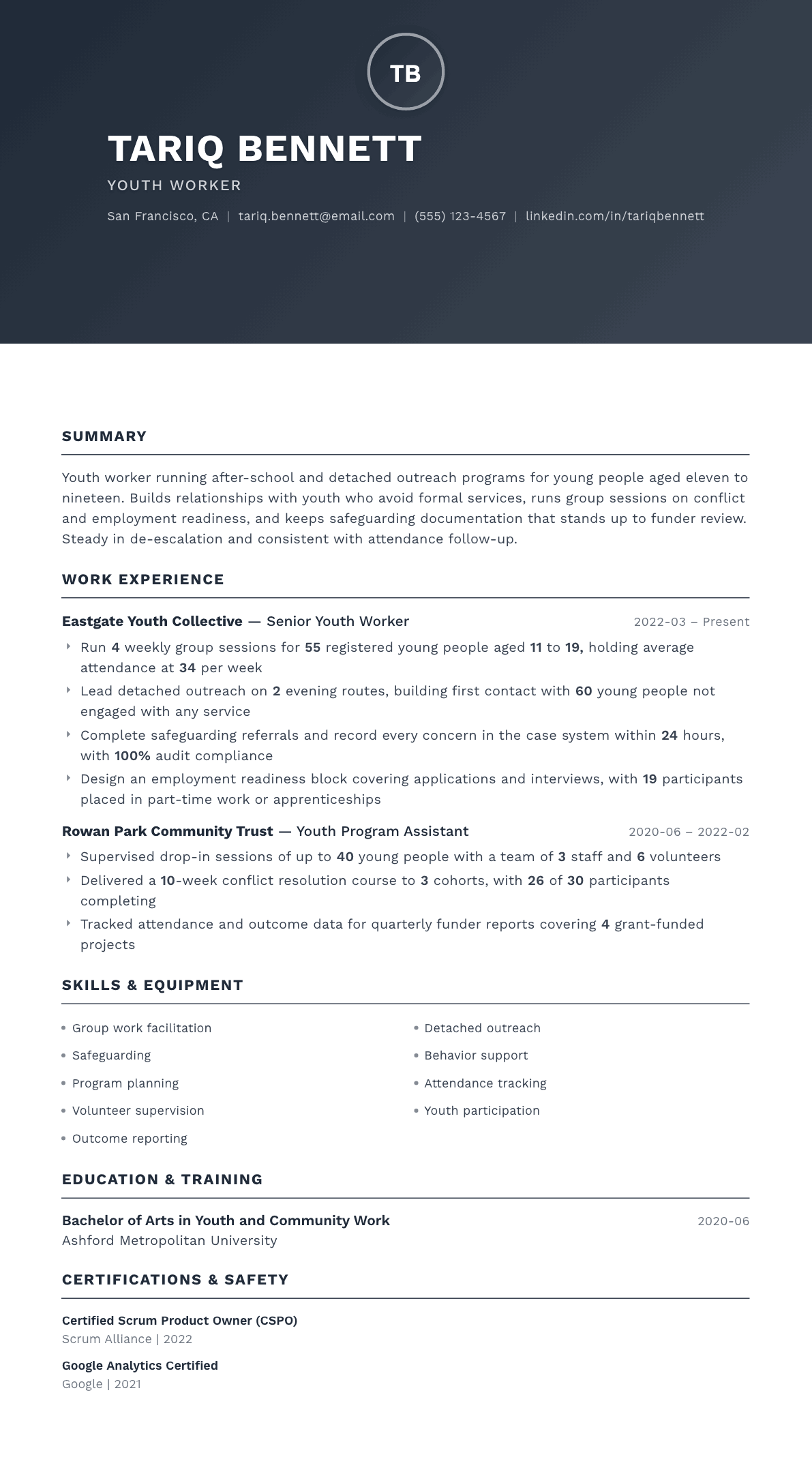
Example Youth Worker summary
Youth worker with four years across after-school provision and detached outreach for young people aged eleven to nineteen. Runs four weekly group sessions, holds keywork relationships with young people who avoid formal services, and records every safeguarding concern inside the agency deadline. Built an employment readiness block that moved nineteen participants into part-time work or apprenticeships.
Skills to list on a Youth Worker resume
- Youth group facilitation
- Detached and street outreach
- Safeguarding and child protection
- One-to-one keywork
- Behavior support and de-escalation
- Session and curriculum planning
- Youth voice and participation
- Volunteer supervision
- Risk assessment for activities
- Outcome and attendance reporting
- Partnership work with schools
- Substance awareness education
- Employment readiness coaching
What actually gets this resume read
- Say how many young people you worked with, how often you saw them, and the age band the program served.
- Separate universal group work from targeted one-to-one support, because employers fund and staff those very differently.
- Put safeguarding practice into a bullet of its own: referrals made, recording timeframes, and audit results.
- Quantify outcomes the funder cared about, such as completions, placements, attendance, or reduced exclusions.
- Mention detached or street-based outreach explicitly, since it signals you can build trust outside a building.
- Include volunteer supervision and session planning if you have it, because that is the step into a senior youth post.
How to write a youth worker resume
Youth work resumes are read by people who have run sessions themselves. A project manager scanning applications knows within a paragraph whether you have stood in a room with thirty teenagers and held it, or whether you have only planned activities on paper. She is looking for three things: numbers of young people reached, evidence you can keep them coming back, and proof that your safeguarding practice is instinctive rather than something you were once told about.
The typical application misses all three. It talks about passion for young people, lists activities run, and never says how many attended, how often, or what changed for them. Funders pay for reach and outcomes, so a manager who cannot see those on your resume cannot justify your post.
This guide sets out the sections in the order a youth services manager reads them, three summaries for different stages of a youth work career, before-and-after bullets, and the questions youth workers ask when they move from a volunteer or assistant post into a paid senior role.
Format: one page early, two pages once you supervise
Reverse chronological, plain single column. Youth services teams are small and hiring panels read fast, so make each job a labeled block with the setting, the age range and the delivery model on the first line. A resume that forces a reader to work out whether you did open access, targeted or detached work has already lost her attention.
Put safeguarding training, first aid and any background clearance status in a short block near the top. These are recruitment gates, and a panel that has to email you about them will put your file to one side while it waits.
- Header: name, city and state, phone, email, background clearance status, driver license.
- Order: summary, youth work experience, training and clearances, education, skills.
- Volunteers should label unpaid roles clearly and give hours, not job titles that overstate the post.
Summary: setting, age band, delivery model, reach
Name the setting first because it defines the job. A drop-in center, a school-based project, an outreach team on the street and a residential summer program share a job title and almost nothing else. Then give the age band, the delivery model, and the number of young people you were responsible for in a typical week.
Add one line about the group you are known for reaching. Youth workers earn their reputation with the young people other services cannot hold: young men outside the building, girls who stopped attending after a fallout, newly arrived families, or young people on the edge of exclusion from school. Say which group and how you built that contact.
Experience: reach, retention, and what actually changed
Write each job as a program rather than a list of activities. State how many young people were registered, how many attended in a typical session, and how you know. Then show retention, because getting a teenager through the door once is easy and getting the same one back for ten weeks is the skill being purchased.
Follow with outcomes the funder counted. Completions of a course, young people moved into work, training or education, reduced school exclusions supported through a partnership, accredited awards achieved, or young people who took on a peer leadership role. Attach a number to each and name the reporting cycle you fed.
Then the practice bullets. Session planning and delivery, one-to-one keywork with agreed goals, risk assessments for trips and activities, behavior boundaries held without excluding people, and partnership work with schools, police and health services. These are the daily craft of youth work and they should read as habits, not aspirations.
Safeguarding: give it a bullet, never a buzzword
Every youth work resume says safeguarding. Almost none of them show it. Write one bullet with the mechanics: how many concerns you recorded in a year, the timeframe you recorded them in, who you escalated to, and whether your records passed an audit or an inspection. That single bullet moves you ahead of most of the pile.
Add the surrounding practice: safe recruitment of volunteers, ratios you worked to on trips, lone working protocols on outreach, and the training you hold with the year it was renewed described as current rather than dated.
- Recording: concerns logged in the case system inside the agency deadline, audit result named.
- Escalation: named route to a designated lead, and what you did when the lead was unavailable.
- Activity safety: written risk assessments, staffing ratios, lone working and transport protocols.
Keywords youth services postings repeat
The vocabulary is consistent across the sector: youth work, group work, detached outreach, open access, targeted provision, keywork, youth voice and participation, positive activities, safeguarding, risk assessment, session planning, partnership working, outcome monitoring. Use the terms that are genuinely yours, once in a skills line and once as evidence inside a job.
If your program used an accredited award scheme or a recognized outcomes framework, name it. Managers search for those because they signal you can produce the paperwork a grant requires without being taught from scratch.
Youth Worker resume summary examples
Volunteer moving to paid work
Youth and community work graduate with 300 volunteer hours across an open access drop-in and a summer play scheme serving young people aged 11 to 16. Supported sessions of up to 40 attendees, completed safeguarding and first aid training, and co-delivered a 6-week conflict resolution course.
Four years delivering
Youth worker running 4 weekly group sessions for 55 registered young people aged 11 to 19 with average attendance of 34, plus 2 detached outreach routes reaching 60 young people not engaged elsewhere. Built an employment readiness block that placed 19 participants into part-time work or apprenticeships.
Youth project coordinator
Youth project coordinator leading 6 staff and 14 volunteers across 3 sites reaching 180 young people a term. Owns safeguarding recording and audit, writes quarterly outcome reports for 4 grant-funded projects, and rebuilt the volunteer induction so new starters are session-ready in 3 weeks.
Work experience bullets: before and after
Before: Ran youth club sessions for local young people.
After: Delivered 4 weekly group sessions for 55 registered young people aged 11 to 19, holding average attendance at 34 across a full academic year.
Registration, attendance and the age band let a manager compare your reach with the post she is filling.
Before: Did outreach in the community.
After: Led detached outreach on 2 evening routes each week, making first contact with 60 young people who were not engaged with any formal service and converting 18 into regular session attendance.
It shows the route structure, the contact volume and the conversion, which is the whole point of detached work.
Before: Followed safeguarding procedures at all times.
After: Recorded 23 safeguarding concerns in the case system within 24 hours of disclosure, escalated each to the designated lead, and passed an external audit with full compliance.
Mechanics and an audit result prove safeguarding practice that a policy statement never can.
Before: Helped young people get ready for work.
After: Designed and ran an employment readiness block covering applications, interviews and workplace expectations, with 19 of 28 participants entering part-time work or an apprenticeship within 4 months.
A named program with a completion and destination figure is what a funder report needs.
Before: Supervised volunteers at the youth center.
After: Recruited, inducted and supervised 6 volunteers across drop-in sessions, running monthly practice discussions and reducing volunteer dropout in the first term from 5 to 1.
Supervision counts when the induction, the rhythm and the retention result are visible.
Hard skills
- Group work facilitation
- Detached and street-based outreach
- One-to-one keywork planning
- Safeguarding recording and escalation
- Session and curriculum design
- Activity risk assessment
- Youth voice and participation structures
- Volunteer recruitment and supervision
- Attendance and outcome monitoring
- Partnership work with schools and police
- Substance and sexual health awareness education
- Employment and education readiness coaching
Soft skills
- Holding boundaries without excluding people
- Reading a room before it turns
- Credibility with hard to reach young people
- Patience across long engagement timelines
- Team communication across shift handovers
Certifications worth listing
- Child and Youth Care Professional (CYC-P) (Child and Youth Care Certification Board)
- Youth Mental Health First Aid (National Council for Mental Wellbeing)
- First Aid, CPR and AED (American Red Cross)
Mistakes that cost youth worker candidates the interview
- Writing about passion for young people instead of the number reached, the retention held and the outcomes recorded.
- Listing activities run without saying who attended, how often, or whether the same young people came back.
- Treating safeguarding as a line in a skills list when it deserves a bullet with recording times and audit results.
- Leaving off background clearance status, which panels check before they schedule an interview.
- Presenting volunteer roles with job titles that imply paid responsibility, which unravels in a reference check.
- Ignoring the funder reporting side of the job, when outcome monitoring is half of what a senior youth post involves.
Youth Worker resume questions
Do I need a qualification to work as a youth worker?
Entry posts often accept relevant experience with safeguarding and first aid training, while senior and coordinator roles usually want a degree in youth work, social work or a related field. List your highest relevant qualification and your current training near the top so a panel can check eligibility quickly.
How do I show impact when my project had no formal outcome data?
Use what you can defend from registers and session plans: how many were registered, typical attendance, how many completed a course, and how many progressed to something specific. A modest number you can explain in an interview is worth more than an impressive claim you cannot.
Should volunteer youth work go on the resume?
Yes, especially early in a career, as long as it is labeled as volunteer and quantified in hours and reach. Panels in this sector treat sustained volunteering as real experience because the practice is identical, but they lose trust fast when unpaid work is dressed up as employment.
How do I write a resume for a detached or street outreach post?
Lead with contact volume and conversion. Name the routes or areas, how often you were out, how many young people you made first contact with, and how many moved into a service. Add your lone working and risk protocols, because managers hiring for outreach worry about staff safety first.
What makes a senior youth worker resume different from a delivery one?
Supervision, planning and reporting. A senior file shows staff and volunteers managed, session programs designed rather than delivered, safeguarding oversight, budget or grant reporting, and partnership relationships you personally hold. Delivery work still appears, but it is no longer the headline.
Related resume examples
- Social Worker Resume example
- Program Coordinator Resume example
- Youth Counselor Resume example
- Residential Counselor Resume example
- School Social Worker Resume example
- Family Support Worker Resume example