Farm Manager Resume Examples: free ATS score and gap list
Build a Farm Manager Resume Around Acres, Crews and Yield
By Mustafa Tarabya, founder of CVBooster · Published · Updated
Farm manager resume example, keyword list and writing guide covering acreage, crop plans, crew scheduling, budgets and food safety audits.
Sample resumes for a farm manager
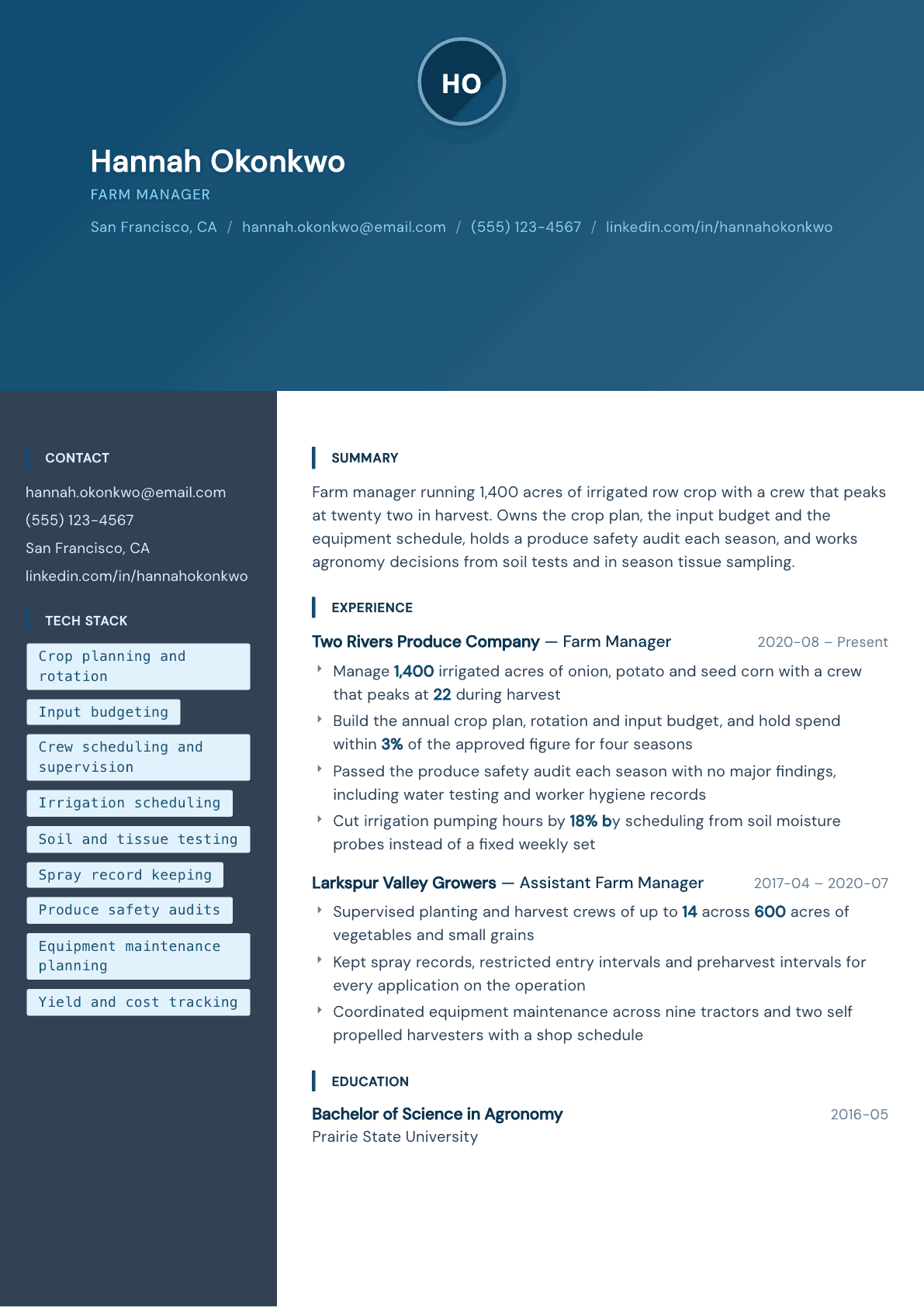
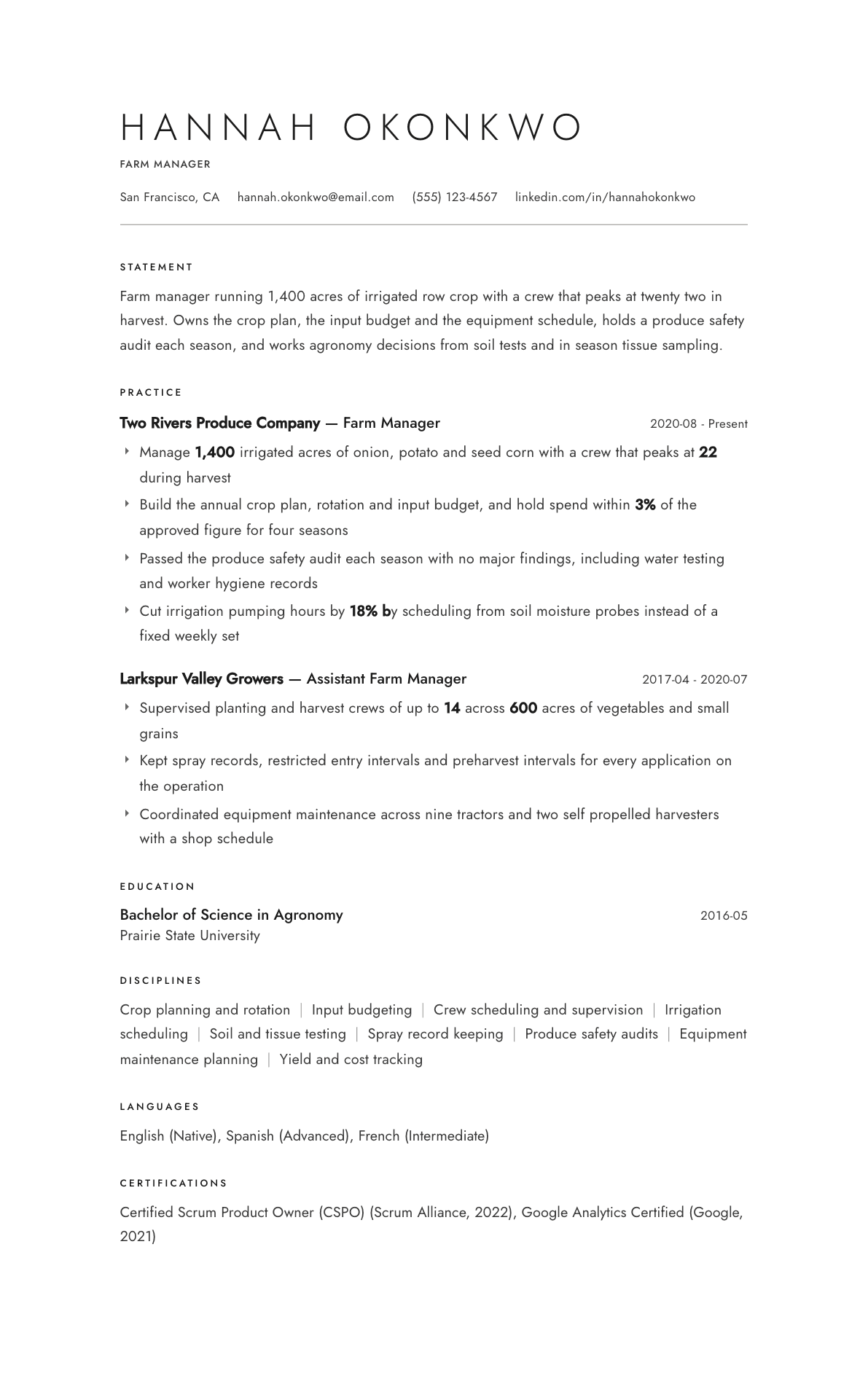
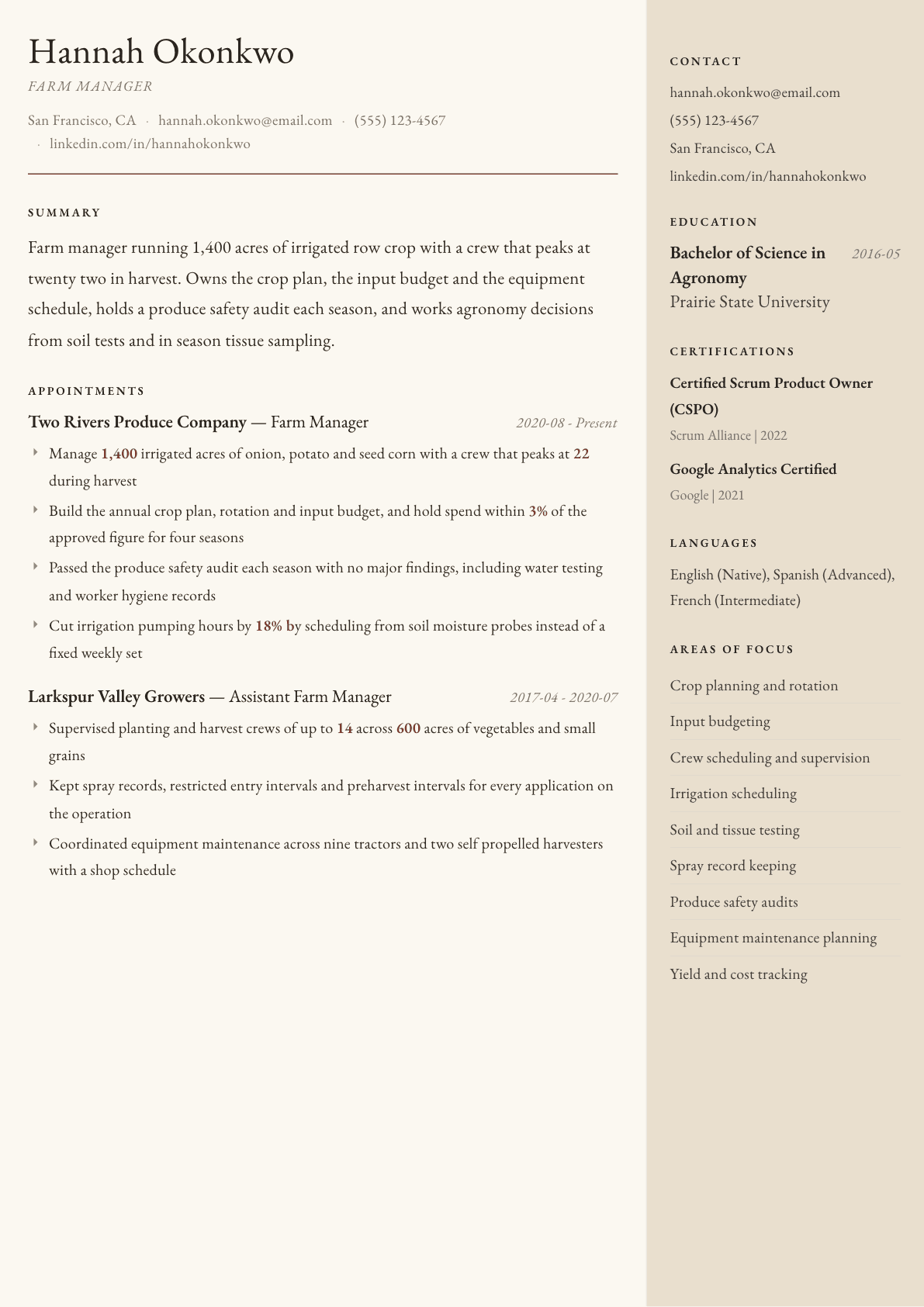
The same farm manager content laid out in three CVBooster templates, so you can see what the finished document looks like before you write a word.
Example Farm Manager summary
Farm manager running fourteen hundred irrigated acres of onion, potato and seed corn with a harvest crew of about twenty two. Owns the crop plan, the input budget and the equipment schedule, has held spend close to plan for four seasons, and clears the produce safety audit each year with clean records. Schedules water from soil moisture probes and works agronomy calls off soil and tissue results.
Skills to list on a Farm Manager resume
- Crop planning and rotation
- Agronomy and soil fertility
- Irrigation system management
- Input and operating budgets
- Crew hiring and scheduling
- Harvest logistics
- Integrated pest management
- Spray program and record keeping
- Produce safety and traceability
- Equipment fleet planning
- Yield and cost analysis
- Grower and buyer relationships
- Farm software and mapping
- Worker safety training
- Storage and post harvest handling
What actually gets this resume read
- Open with acreage, crops and crew size, because those three numbers tell an owner what you have actually carried.
- Show the budget you controlled as a scope, not a salary, and say how close you held to the plan.
- Give yield or quality results per acre or per block, since a farm owner reads outcome before activity.
- Name the food safety scheme you have been audited against and whether you wrote the records or inherited them.
- Describe your agronomy inputs: soil tests, tissue sampling, moisture probes and the agronomist you work with.
- Include labor management honestly, covering hiring, housing coordination, training and the safety record you kept.
How to write a farm manager resume
A farm manager is hired to protect an owner's capital through a season that only runs once. There is no second attempt at a planting window and no way to re-do a spray that went on late. The person reading your resume, usually the owner or a general manager, is asking whether you have carried that responsibility at a scale close to theirs and come out with the yield intact.
So the page has to be built on numbers an agricultural business recognizes: acres, crops, crew size, input budget, yield and audit results. A resume that talks about overseeing daily operations without any of those reads like someone who supervised rather than managed.
This guide sets out the structure, the summary, how to write about agronomy and labor without inflating either, what to do with food safety audits, and the questions managers ask when they move between crop types or from a family operation to a corporate one.
Format: acres, crops and crew in the top block
One page under ten years, two after that. The block under your name should give the acreage you have managed, the crops, the irrigation type and the peak crew size. An owner uses those to decide in seconds whether you are a plausible fit for a property of their size.
Below that, organize by responsibility: production and agronomy, labor, equipment and infrastructure, then compliance and records. This mirrors how an owner thinks about risk, and it stops the page collapsing into a list of seasonal tasks.
- Top block for a farm manager: total acres managed, crop mix, irrigation type and the crew size at peak.
- Four responsibility groups: production and agronomy, labor and safety, equipment and infrastructure, compliance and records.
- Each employer entry names the operation type, whether the land is owned, leased or custom farmed, and who you reported to.
- Keep a short results line per property: yield, quality grade, cost per acre or audit outcome, whichever you can defend.
Summary: scale, ownership of decisions, and one result
Three lines. Acres and crops, what you personally decide, and one result you can defend in an interview. Decision ownership is the thing owners probe hardest: whether you set the crop plan, choose the inputs, hire the crew and sign the equipment purchases, or whether someone above you did.
Choose the result carefully. A yield gain, a water saving, a clean audit or a labor cost held flat through a difficult season all work. Avoid stacking three achievements into one sentence, because a single defensible number reads stronger than a list nobody can check.
Agronomy: show the inputs behind your decisions
Owners are wary of managers who farm by habit. Show the information you use: soil tests and the sampling grid, in season tissue sampling, moisture probes or evapotranspiration data, scouting reports, variety trials and the agronomist or consultant you work with. Then show a decision that came out of it.
Water is usually the sharpest place to demonstrate this. Scheduling irrigation from soil moisture instead of a fixed set, fixing distribution uniformity, or changing a nozzle package are all measurable and all matter to an owner watching a pump bill or a water allocation.
Rotation and soil health belong here too. Cover crops, residue management, tillage decisions and how you plan a rotation across blocks show that you are managing the ground for more than one season, which is exactly what a landowner is buying.
- One bullet on the crop plan: acres, rotation, variety selection and who approved it.
- One bullet on nutrition: soil and tissue testing, the program you built and what it changed.
- One bullet on water: scheduling method, system maintenance and the pumping or yield result.
- One bullet on pest management: scouting cadence, thresholds, mode of action rotation and record keeping.
Labor, safety and the part most resumes skip
Labor is the largest controllable cost and the largest legal exposure on most farms. Say how many people you hire, how you schedule across peak, how you train, and what your safety record has been. If you have coordinated seasonal or guest worker programs, housing or transport, that experience is scarce and worth stating plainly.
Write about training as a system rather than a virtue. A written orientation, a grade standard shown in the field, a daily briefing and a way to check that new hands are keeping the standard is a manager's answer. Saying that you lead by example is not.
Compliance, records and the keywords that get you read
Name the food safety scheme you have been audited under and your outcome. Water testing, worker hygiene, traceability from block to lot, equipment sanitation and corrective actions are the details a buyer's auditor works through, and an owner who has failed an audit once will read this section first.
Postings reuse a familiar vocabulary: crop planning, agronomy, integrated pest management, irrigation scheduling, harvest logistics, yield, cost per acre, crew supervision, equipment fleet, traceability and grower relations. Mirror those words in your skills list and show each in a bullet. Add the software you keep records in, since an owner replacing spreadsheets cares.
Farm Manager resume summary examples
Assistant manager
Agronomy graduate with four seasons as an assistant farm manager on 600 acres of vegetables and small grains. Supervises planting and harvest crews of up to 14, keeps spray records and entry intervals, and coordinates maintenance across nine tractors. Ready to take a full management seat.
Managing a whole operation
Farm manager running fourteen hundred irrigated acres of onion, potato and seed corn with a harvest crew peaking at 22. Owns the crop plan, the input budget and the equipment schedule, has held spend close to plan for four seasons, and clears the produce safety audit each year with clean records.
Director of farming
Director of farming responsible for six thousand acres across three properties, four managers and a seasonal workforce above 120. Sets rotation and variety strategy, negotiates input and custom harvest contracts, and rebuilt irrigation scheduling across the group after a drought year cut allocations sharply.
Work experience bullets: before and after
Before: Oversaw daily farm operations.
After: Managed 1400 irrigated acres of onion, potato and seed corn with a crew that peaked at 22 during harvest, reporting directly to the owner.
Acres, crops and crew size are the three numbers that place a manager against an owner's own property.
Before: Responsible for the farm budget.
After: Built the annual crop plan, rotation and input budget, then held spend within 3% of the approved figure for four consecutive seasons.
A budget claim only means something with a variance and a run of years attached.
Before: Improved irrigation on the farm.
After: Cut irrigation pumping hours by 18% by scheduling from soil moisture probes instead of a fixed weekly set, with no yield loss in either affected crop.
The method, the saving and the yield safeguard together make the improvement credible.
Before: Passed our food safety audit every year.
After: Cleared the produce safety audit each season with no major findings, including agricultural water testing, worker hygiene records and block to lot traceability.
Naming what the audit covered shows you understand the scheme rather than just the result.
Before: Hired and managed seasonal workers.
After: Hired and trained a seasonal workforce of 40 across two crews, running a written orientation and a field grade standard that cut rework at the packing shed.
It turns headcount into a training system with a measurable downstream effect.
Hard skills
- Crop planning and rotation design
- Soil fertility and nutrient programs
- Variety selection and trial evaluation
- Irrigation scheduling and system management
- Integrated pest management programs
- Spray program design and record keeping
- Input and operating budgets
- Harvest logistics and packer scheduling
- Crew hiring, training and scheduling
- Equipment fleet planning and maintenance
- Yield and cost per acre analysis
- Produce safety schemes and traceability
- Farm mapping and record software
- Grower, buyer and landlord relations
Soft skills
- Making the planting call when the forecast is unclear
- Holding a crew together through a hard harvest
- Telling an owner bad news early
- Negotiating with input suppliers and custom operators
- Training a supervisor to make your decisions
Certifications worth listing
- Certified Crop Adviser (American Society of Agronomy)
- Produce Safety Alliance Grower Training Certificate (Produce Safety Alliance)
- Commercial Pesticide Applicator License (State Department of Agriculture)
Mistakes that cost farm manager candidates the interview
- Describing oversight of operations with no acreage, crop mix or crew size anywhere on the page.
- Claiming budget responsibility without a variance, a run of seasons or a cost per acre figure.
- Presenting agronomy as intuition rather than as decisions made from soil, tissue and moisture data.
- Treating labor management as a footnote when it is the largest cost and the largest legal exposure.
- Naming a food safety audit without saying what it covered or how the findings went.
- Listing every crop ever grown on the property instead of the ones you personally managed.
Farm Manager resume questions
How do I move from assistant to full farm manager?
Document the decisions you already make alone. Most assistants set spray timing, direct crews and manage equipment without being credited for it. Write those as ownership, add whatever budget exposure you have had, and name the manager who will confirm it.
Do I need an agronomy degree?
Not always, but it shortens the conversation, and a crop adviser credential does the same. Managers who came up through equipment or crew leadership are common and respected, so if you lack the degree lean harder on yield, cost and audit results.
How do I switch between crop types?
Separate what transfers from what does not. Labor, equipment, irrigation, budgeting and compliance transfer almost completely. Agronomy, timing windows and market channels do not. Name the crop specific gaps yourself and describe how you would close them in the first season.
Should I include the yield numbers from my farm?
Yes, when you can defend them and when the property is not identifiable in a way the owner would object to. Give them as yield per acre with the crop and the season conditions, since a strong number in a bad year is more convincing than a record in an easy one.
What matters most to an owner hiring a manager?
Trust that capital and reputation are safe with you. That comes across through scale you have carried, budget discipline, a clean compliance record and evidence you tell people bad news early. Put those four things where they cannot be missed.
Related resume examples
- Farm Worker Resume example
- Agricultural Engineer Resume example
- Horticulturist Resume example
- Production Manager Resume example
- Operations Manager Resume example
- Manufacturing Manager Resume example