iOS Developer Resume Examples: free ATS score and gap list
Craft an iOS Developer Resume That Gets Downloaded
By Mustafa Tarabya, founder of CVBooster · Published · Updated
Create a standout iOS developer resume with templates optimized for mobile development roles at top tech companies.
Sample resumes for a ios developer
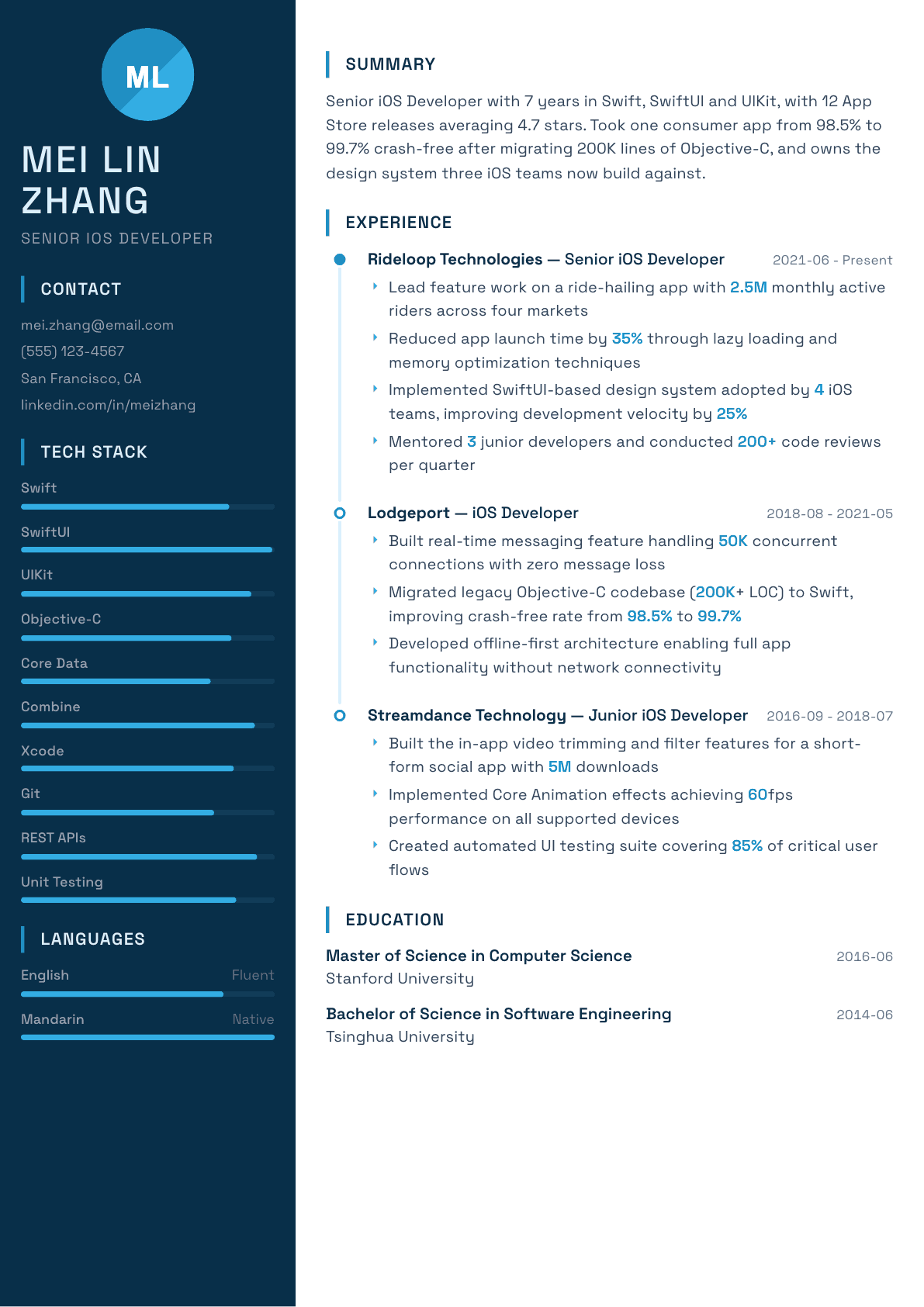
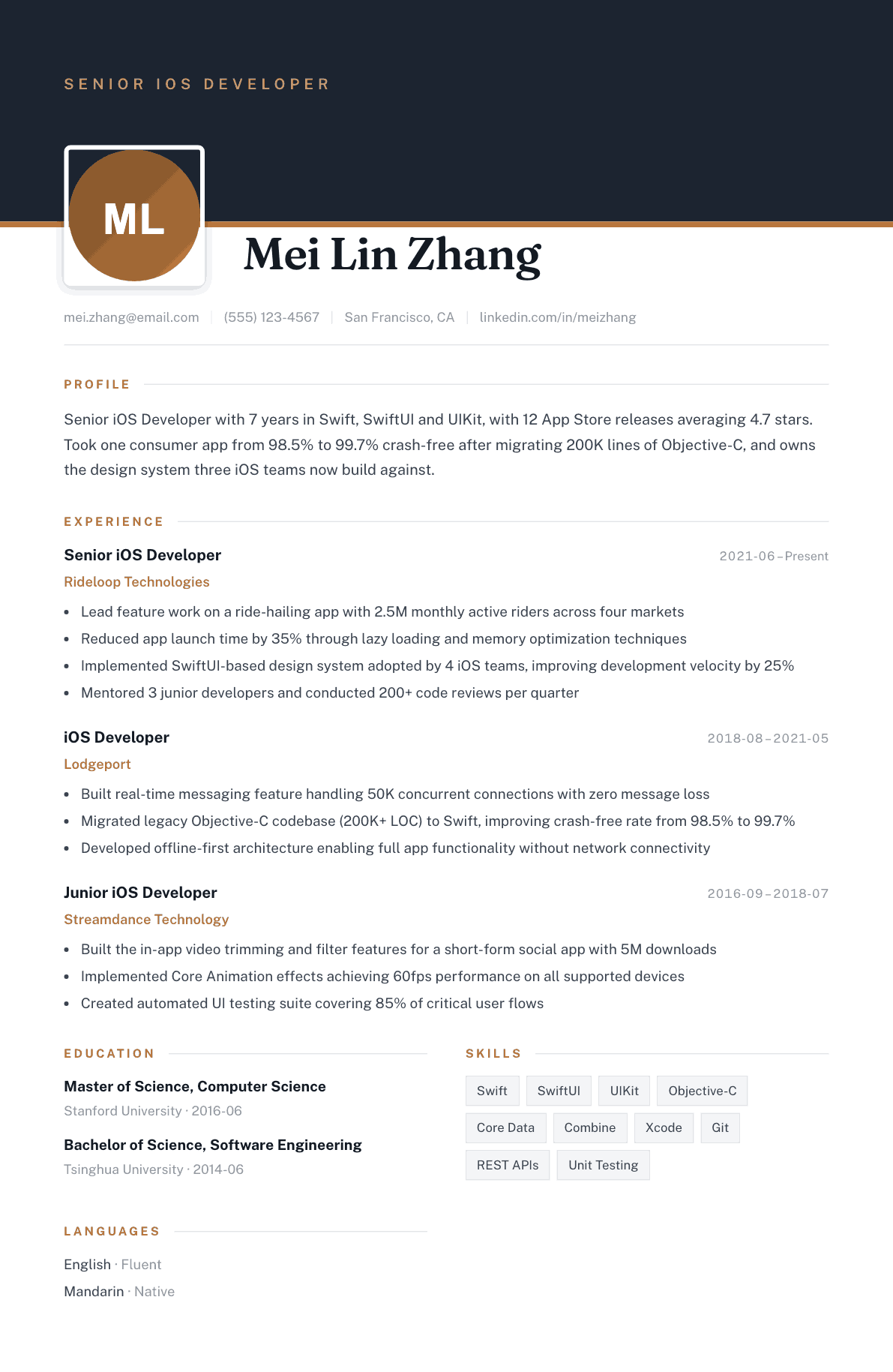
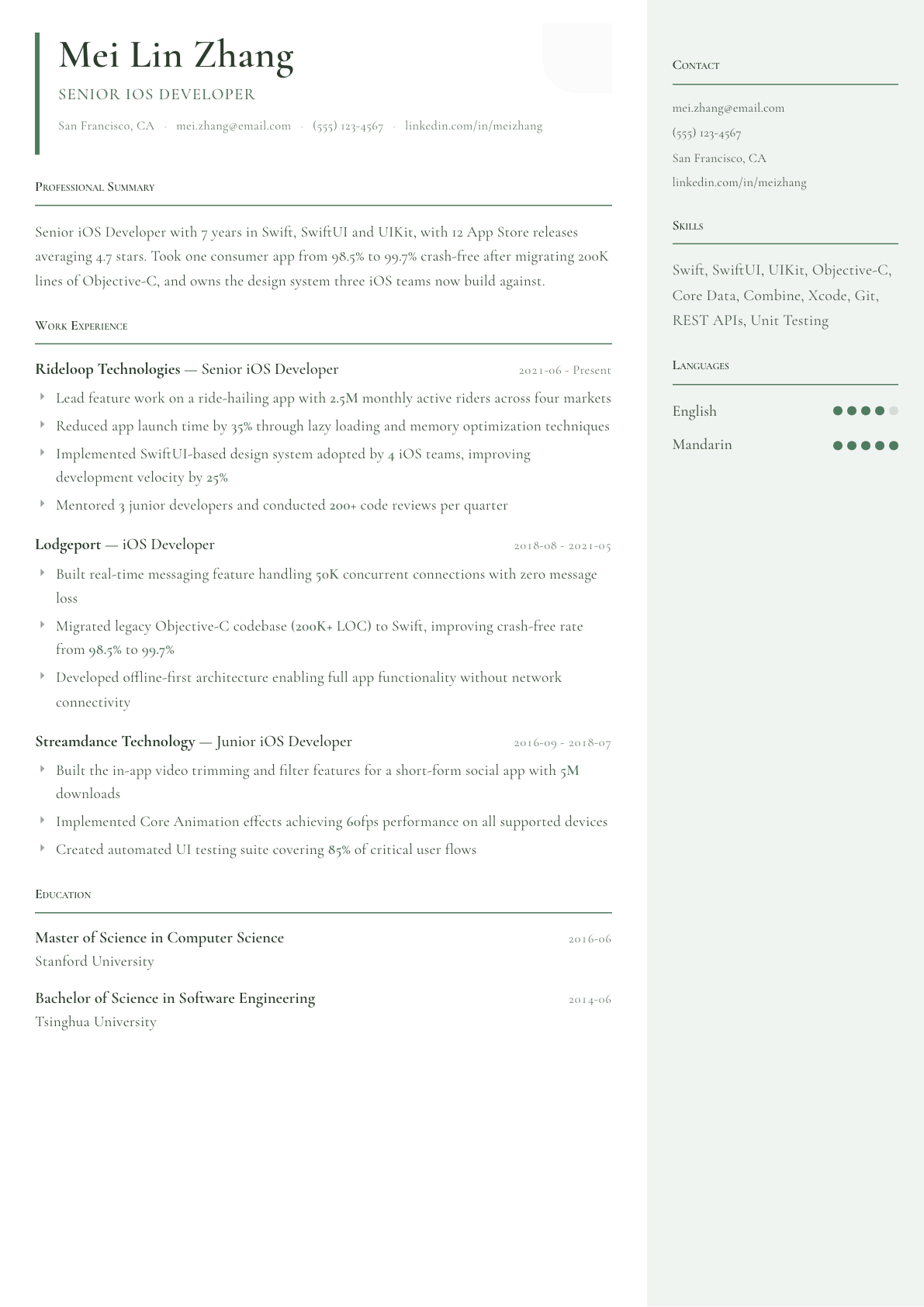
The same ios developer content laid out in three CVBooster templates, so you can see what the finished document looks like before you write a word.
Example iOS Developer summary
iOS developer, 7 years, currently senior on a ride-hailing app serving 2.5M monthly riders. Twelve App Store releases, a SwiftUI design system used by four teams, and a 35% cut in launch time from lazy loading and memory work.
Skills to list on a iOS Developer resume
- Swift
- SwiftUI
- UIKit
- Objective-C
- Core Data
- Combine
- Xcode
- CocoaPods
- SPM
- REST APIs
- GraphQL
- Unit Testing
- CI/CD
- App Store Connect
What actually gets this resume read
- List your shipped apps with the App Store name, download range and current rating, since a reviewer will open them before the interview.
- Say where you sit on the Swift timeline: UIKit maintenance, SwiftUI greenfield, Combine or async await, and any Objective-C you still read.
- Give the health numbers you owned, such as crash-free sessions, cold launch time, memory ceiling and app size, with the before and after.
- Name the release mechanics you run yourself: App Store Connect submissions, TestFlight groups, phased rollouts, and how you handled a rejection.
- Show accessibility and localization as work, not intent: VoiceOver passes, Dynamic Type support, right-to-left layouts and the number of locales.
How to write a ios developer resume
An iOS developer resume has one advantage no other engineering resume has: the reviewer can download your work and use it in the time it takes to make coffee. That is why an App Store link near the top changes the whole review. It moves you from a stack of claims into the small group of candidates whose work can be inspected before anyone speaks to you.
The reviewer, usually a mobile lead, then wants three answers. How deep are you in Swift and the current Apple frameworks, have you owned an app through the release process rather than only writing screens, and can you handle the things that make mobile hard: offline state, background work, memory on older devices, and a release you cannot roll back once it is live.
This guide covers where to put apps and links, how to write about SwiftUI and UIKit without sounding like a list of frameworks, three summaries from a first job to a lead, before and after bullets, and the questions iOS candidates ask when their best work is under a company account.
Format: one page, single column, App Store links that work
One page until roughly eight years of experience. Reverse chronological, single column, standard fonts, no icons. Mobile teams inside larger companies use the same parsers as everyone else, and a designed layout costs you the framework keywords rather than winning any points for taste.
Put the links in the header and check them the morning you apply. An App Store link to a live app, a repository, and if you have one, a page for a personal app. A link to an app that has been removed from sale is worse than no link at all, because the reviewer notices and forms a view.
- Header: name, city, email, App Store links, repository link.
- Order: summary, apps or projects with platform and role, experience, skills grouped by language and framework, education.
- Career changers put a personal app first, with the store link, the download or rating detail if it is respectable, and what you built alone.
Summary: Swift depth, app type, and release ownership
Two or three lines. Name your years in Swift, the kind of apps you have built, and whether you have owned releases. Consumer social, a banking app under security review, a health app with sensitive data, an enterprise field tool distributed internally, and a game are different specialties with different review pressures.
Be precise about SwiftUI and UIKit rather than picking a side. Almost every real codebase is mixed, and a candidate who says they work across both, including hosting one inside the other, sounds like someone who has maintained a real app rather than started fresh ones.
Experience: architecture, frameworks and what you owned
Say which part of the app was yours and how the app was structured. MVVM, a coordinator pattern for navigation, a modular package layout with Swift Package Manager, dependency injection, and how state flows through the app. Then name the Apple frameworks you used in anger: Combine or Swift Concurrency with async and await, Core Data or SwiftData, URLSession, Core Location, AVFoundation, WidgetKit, push notifications, StoreKit for subscriptions, and Keychain for credentials.
Mobile-specific hard problems make the strongest bullets because they cannot be faked: an offline-first sync with conflict resolution, a background refresh that respects the system budget, a memory fix found in Instruments, a launch time reduction, and a migration of a persisted store without losing user data. Any of these outrank three bullets about building screens from designs.
Cover the release side. TestFlight distribution, phased release, App Store review rejections you resolved, privacy manifests and permission strings, crash rate before and after, and how you monitored a live version. Owning a release cycle is the difference between an iOS developer and someone who writes iOS code.
Quality, testing and the numbers that exist on mobile
Mobile gives you measurements most engineers never get: crash-free session rate, cold launch time, app size in megabytes, rating and review volume, and adoption of a new version in the first week. Use them with a before and after. A reviewer reading that you took crash-free sessions from 98.4 to 99.7 knows exactly what kind of engineer you are.
Testing on iOS is worth stating because so many teams skip it. Unit tests around view models and networking, snapshot tests on views, XCUITest for the critical flows, and a continuous integration setup that builds, signs and uploads to TestFlight without a human are all things hiring managers are short of.
- Say whether you have handled code signing, provisioning profiles and certificates, which teams find painful and value in a candidate.
- Name accessibility work concretely: Dynamic Type, VoiceOver labels, contrast and reduced motion support.
- Mention localization if you have shipped in multiple languages, including right-to-left layouts.
Keywords iOS postings repeat
These postings use a narrow vocabulary: Swift, SwiftUI, UIKit, Objective-C, Xcode, Core Data, Combine, async and await, REST and GraphQL, unit testing, App Store Connect, TestFlight, CI/CD, and the architecture pattern. Mirror the posting wording once in the skills group and once inside a bullet where the framework did real work. If a posting still asks for Objective-C, say plainly how much of it you have written, because legacy code is usually the reason it is listed.
iOS Developer resume summary examples
Junior iOS developer
iOS developer with a year in Swift and SwiftUI on a live consumer app, plus a personal app released to the App Store and maintained through four updates. Comfortable with URLSession, Core Data, unit testing view models and the App Store submission process end to end.
Five years in
iOS developer with five years in Swift across two consumer apps with a combined nine hundred thousand monthly users, working in a mixed SwiftUI and UIKit codebase. Owns offline sync and the subscription flow through StoreKit, and raised crash-free sessions from 98.2% to 99.6% over three releases.
Senior or lead iOS engineer
Senior iOS engineer with ten years and eight released apps, currently leading a team of four on a banking application under external security review. Set the modular package architecture, owns the release train and TestFlight process, and mentors engineers through code review and design sessions.
Work experience bullets: before and after
Before: Developed iOS applications using Swift.
After: Built the account and transfer flows in Swift and SwiftUI for a banking app with about three hundred thousand monthly users, including biometric authentication and Keychain-backed session handling.
Naming the flows, the user scale and the security handling shows what you owned rather than that you wrote Swift.
Before: Fixed crashes and improved app stability.
After: Raised crash-free sessions from 97.9% to 99.8% over four releases by fixing a retain cycle found in Instruments, guarding two force unwraps in the payment path and adding regression tests around the decoding layer.
A stability metric with before and after, plus the actual defects, turns a routine claim into proof of debugging skill.
Before: Worked on offline support.
After: Designed offline-first sync with Core Data and a change queue that replays on reconnect, resolving conflicts by last write with a user prompt on true collisions, so field staff could work through a full shift without signal.
Conflict resolution is the hard part of offline work, and naming the strategy plus the user situation proves the design was real.
Before: Released updates to the App Store.
After: Owned the release train for a fortnightly cadence, automating build, signing and TestFlight upload through continuous integration, and resolved two App Store review rejections over privacy strings without missing a release date.
Release ownership including a rejection recovery is exactly the experience teams cannot get from a developer who only writes features.
Before: Improved app performance.
After: Cut cold launch from 2.8 to 1.1 seconds by deferring analytics initialization, replacing a synchronous disk read on the main thread and lazily loading the tab contents, verified on an older supported iPhone.
Testing on the oldest supported device is the detail that convinces a mobile lead the measurement is honest.
Hard skills
- Swift
- SwiftUI
- UIKit
- Objective-C for legacy code
- Swift Concurrency with async and await
- Combine
- Core Data and SwiftData
- URLSession and REST clients
- MVVM and coordinator patterns
- Swift Package Manager
- XCTest and XCUITest
- Instruments profiling
- StoreKit and in-app purchases
- App Store Connect and TestFlight
Soft skills
- Working from design files
- Release judgment
- Code review
- Explaining platform constraints to product
- Handling review feedback
- Mentoring
Mistakes that cost ios developer candidates the interview
- Leaving out App Store links, which throws away the one advantage iOS candidates have over every other engineering applicant.
- Linking an app that has been removed from sale, since the reviewer will tap it and draw a conclusion you never get to correct.
- Framing yourself as SwiftUI only, when nearly every hiring codebase still contains UIKit that someone has to maintain.
- Describing screens built from designs and nothing else, so the resume shows no ownership of state, persistence or release.
- Ignoring the mobile metrics that are freely available: crash-free sessions, launch time and app size are all sitting in your dashboard.
- Never mentioning code signing, provisioning or review submissions, when these are the tasks teams most want someone else to own.
iOS Developer resume questions
Do I need published apps to get an iOS developer job?
Not strictly, but one released app changes the review completely because a lead can install it. If your professional work is under a company account, publish one small personal app you are willing to have inspected closely.
Should I list SwiftUI and UIKit separately?
Yes, and say roughly how much of each you have written. Real codebases mix them, and a candidate who can host a UIKit view controller in SwiftUI or the reverse is more useful than one who only starts new projects.
How much Objective-C do I need on my resume?
Only what is true. When a posting lists it, the team has legacy code someone must maintain, so being able to read and modify it honestly is a real advantage even if you write new features in Swift.
What metrics belong on an iOS developer resume?
Crash-free session rate, cold launch time, app size, monthly active users on apps you worked on, and store rating when it is good. Give the before and after so a reviewer can size the improvement rather than trusting the direction alone.
How do I show iOS work when the app is internal to a company?
Describe the user base, the distribution method and the technical problems solved, such as offline work or device management constraints. Enterprise distribution is respected, and you can add a small personal app for public evidence of code quality.
Related resume examples
- Android Developer Resume example
- Mobile App Developer Resume example
- Frontend Developer Resume example
- .NET Developer Resume example
- Software Engineer Resume example
- Flutter Developer Resume example