Field Service Technician Resume Examples: free ATS score
Create a Field Service Technician Resume Built for the Route
By Mustafa Tarabya, founder of CVBooster · Published · Updated
A field service technician resume example with call volume, first time fix rate and equipment keywords, plus a full writing guide.
Sample resumes for a field service technician
The same field service technician content laid out in three CVBooster templates, so you can see what the finished document looks like before you write a word.
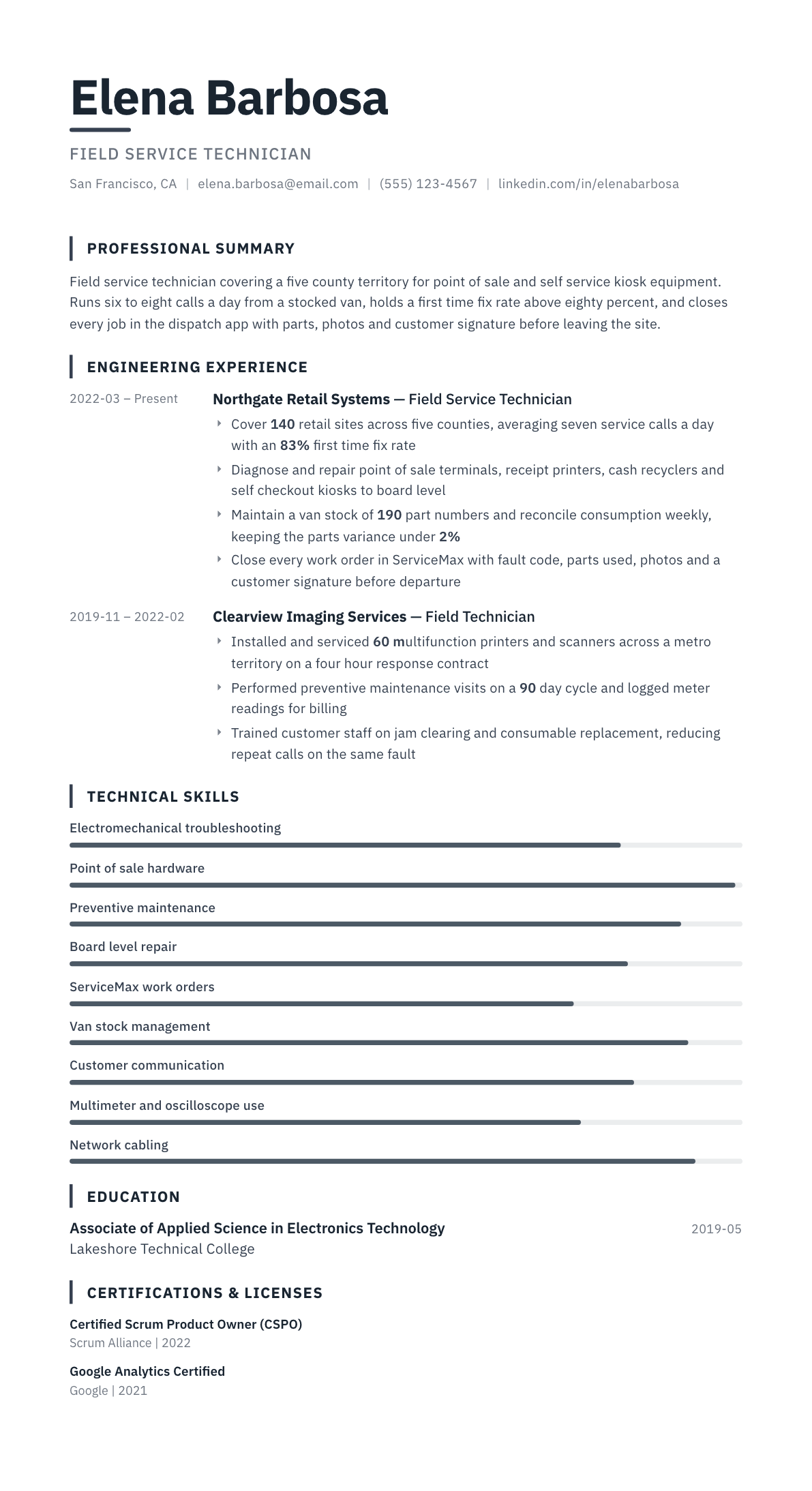
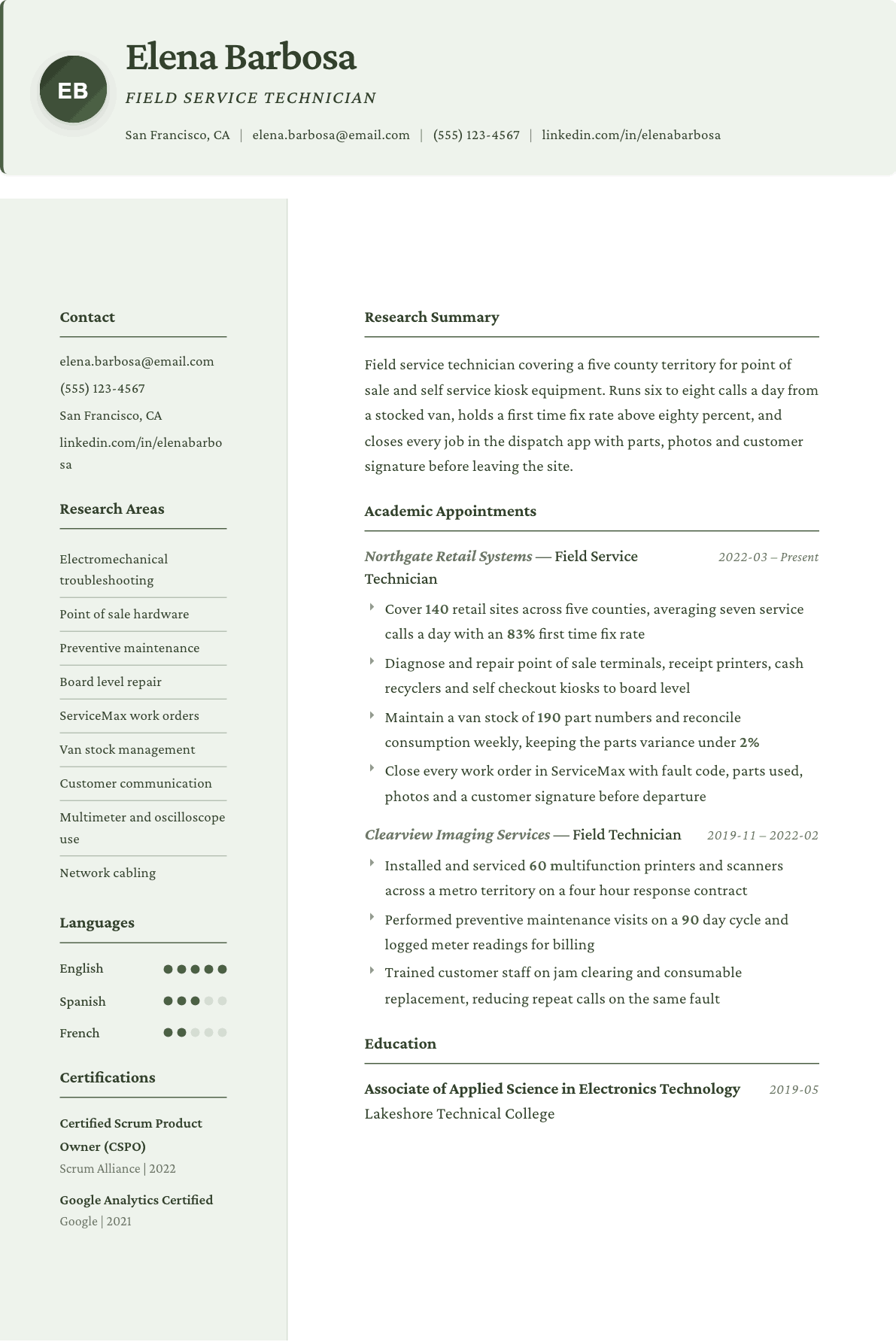
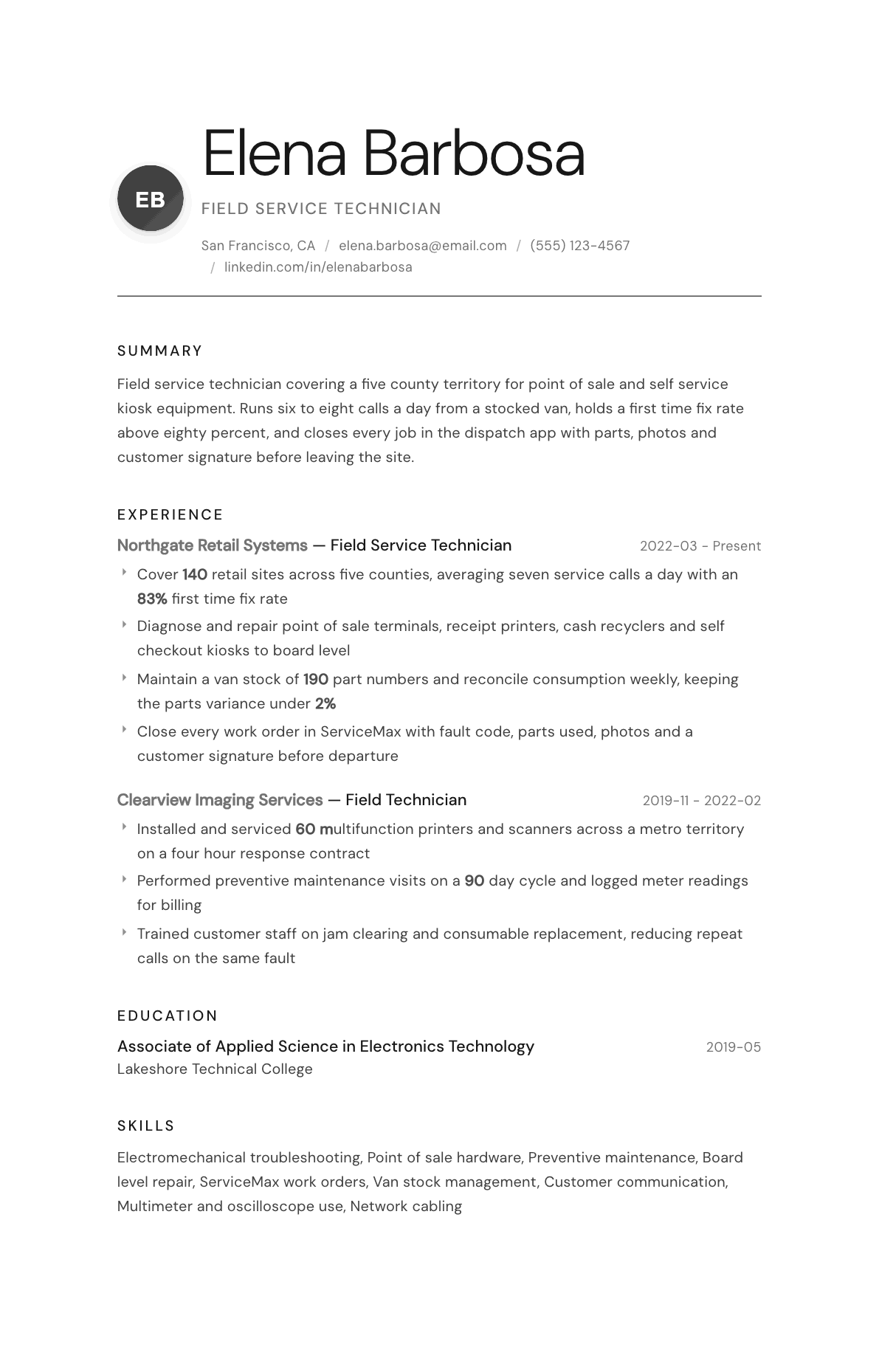
Example Field Service Technician summary
Field service technician with six years on the road, covering 140 retail sites across a five county territory. Runs seven calls a day at an 83% first time fix rate, repairs point of sale terminals and self checkout kiosks to board level, and manages a 190 part van stock with under 2% variance. Looking for a senior field or field trainer role with a manufacturer.
Skills to list on a Field Service Technician resume
- Field service and repair
- Electromechanical troubleshooting
- Board level diagnostics
- Preventive maintenance
- Point of sale and kiosk hardware
- Installation and commissioning
- Work order documentation
- Van stock and parts management
- Customer training on site
- Multimeter and oscilloscope use
- Network cabling and connectivity
- Route and schedule planning
- Safety compliance
- Firmware updates
What actually gets this resume read
- Put the territory size, site count and daily call volume in the first line of every field role.
- Give your first time fix rate and response time compliance, because dispatch managers hire on those two numbers.
- Name the equipment families you have worked on and say whether you repair to board level or swap modules.
- Mention van stock or trunk inventory management, since parts discipline is a real cost line for the employer.
- Include the field service platform you close work orders in, such as ServiceMax, Salesforce Field Service or Oracle.
- State your driver license class and any safety training such as OSHA 10, because both are screening filters.
How to write a field service technician resume
A field service technician works alone, in someone else's building, on a clock the customer is watching. The dispatch manager hiring you cannot supervise any of that. So the resume has to answer the questions supervision would normally answer: how many calls a day can you carry, how often do you fix it on the first visit, do you close the paperwork before you drive away, and does the customer want you back.
That is why first time fix rate is the most valuable number a field technician can put on paper. A second visit costs the employer the drive, the hours and the customer's patience, and every service organization tracks it. Candidates who quote it stand out immediately from those who write that they performed repairs and maintenance on customer equipment.
This guide covers the layout dispatch managers expect, how to write route, repair and paperwork discipline with real numbers, three example summaries across the field career, before and after bullets, and the questions technicians ask when they want to move to a manufacturer or into a lead role.
Format: one page, territory and equipment in the first six lines
One page unless you have more than ten years across several equipment families. Reverse chronological, with a short summary, a technical block naming the equipment you service and the field platform you close work in, then experience. Service organizations screen on equipment familiarity, so those product families need to appear early.
Include the practical facts a dispatcher needs. Driver license class, any commercial endorsement, whether you have worked an on-call rotation, and how far you are willing to travel or whether you can overnight. Those details decide interviews and candidates leave them off constantly.
- Header: name, city and state, phone, email, driver license class and clean record if applicable.
- Order: summary, certifications and safety training, equipment and platforms, experience, education.
- Name manufacturers whose training you have completed, since factory training is a hiring shortcut.
Summary: territory, call volume, first time fix, equipment
Three lines. The size of your territory in sites or counties, calls per day, first time fix rate, and the equipment families you service. Add whether you work from a stocked vehicle, because parts autonomy is a large part of what makes a technician productive.
Say whether your work is break-fix, preventive maintenance, installation and commissioning, or all three. These are different jobs with different hiring managers, and a candidate who has only done scheduled maintenance is a poor fit for an emergency response contract even if the equipment is identical.
Experience: the route, the fix, and the paperwork
Open each role with a scope line: territory, site count, contract type, response commitment. Then four or five bullets. One on volume and first time fix. One on the depth of your diagnostics, ideally naming the instruments and whether you repair to board or module level. One on installation or commissioning if you do it. One on parts and van stock. One on the customer relationship and the paperwork.
Diagnostics depth is where technicians undersell themselves. Say what you actually read: schematics, error and fault codes, multimeter and oscilloscope measurements, pressure or flow readings, firmware logs. A technician who traces a fault from a symptom to a component is paid differently from one who follows a decision tree, and the difference has to be visible.
Paperwork is not a small thing on a field resume. Work orders closed on site with fault code, parts consumed, labor time, photographs and a customer signature are what lets the employer invoice and honor warranty. Say that you close before you leave, because a large share of field service disputes come from technicians who do not.
- Volume and quality: calls a day, first time fix rate, response time compliance against the contract.
- Depth: fault codes read, instruments used, board or module level repair, firmware and calibration work.
- Discipline: van stock size, parts variance, work orders closed on site, preventive maintenance visits completed on schedule.
Van stock, parts and the cost side of the job
Parts inventory is real money sitting in a vehicle, and service managers watch it. Say how many part numbers you carry, how you reconcile consumption, and how you keep variance low. A technician who manages stock well fixes more on the first visit while tying up less inventory, and that is a rare combination worth stating plainly.
Warranty and returns belong here too. Correctly coded warranty claims, defective parts returned within the window, and accurate serial number capture protect margin on every job. Naming that work signals you understand the commercial side of a service call rather than only the technical one.
Safety, customer sites and the keywords the filter wants
Field technicians work in other people's risk environments: retail floors during trading, hospitals, plants with lockout requirements, roofs, confined spaces. List the safety training you hold with the issuing body and name any site induction regimes you have worked under. Employers screen on this because their insurance depends on it.
These postings recycle a narrow vocabulary: first time fix, preventive maintenance, corrective maintenance, installation and commissioning, work order, service level agreement, root cause, calibration, spare parts, escalation, customer site. Mirror the exact wording once in the summary and once in a bullet where you did the work.
Field Service Technician resume summary examples
First field role
Electronics technology graduate with an associate degree and two years in a bench repair shop, diagnosing power supplies and control boards to component level. Holds a clean driver record and OSHA 10 training. Comfortable reading schematics and using a multimeter and oscilloscope. Seeking a first territory-based field service seat.
Three years on the road
Field service technician covering 140 retail sites across five counties, running seven calls a day at an 83% first time fix rate. Repairs point of sale terminals, receipt printers and self checkout kiosks to board level, and closes every work order on site with fault code, parts, photographs and signature.
Senior or lead technician
Senior field service technician and regional lead, mentoring four technicians across a two state territory. Handles escalated faults the team cannot resolve, runs commissioning on new installations, wrote the fault code reference the region now uses, and holds the highest first time fix rate on the team.
Work experience bullets: before and after
Before: Performed repairs and maintenance on customer equipment.
After: Covered 140 retail sites across a five county territory, averaging seven service calls a day with an 83% first time fix rate against a four hour response contract.
Territory, daily volume, fix rate and the contracted response time are exactly the four numbers a dispatch manager tracks.
Before: Troubleshot equipment faults on site.
After: Diagnosed point of sale terminals, cash recyclers and self checkout kiosks from fault codes and multimeter readings, repairing power boards and sensor assemblies on site rather than swapping whole units.
Naming the equipment, the diagnostic method and the repair depth separates a real technician from a parts changer.
Before: Managed parts inventory in my vehicle.
After: Maintained a van stock of 190 part numbers, reconciled consumption weekly against closed work orders, and held parts variance under 2% while raising first visit resolution.
A part number count, a reconciliation habit and a variance figure show inventory discipline the employer pays for directly.
Before: Completed service reports after each job.
After: Closed every work order in the field platform before leaving site with fault code, parts consumed, labor time, photographs of the repair and a customer signature, so billing and warranty claims never waited on paperwork.
Listing what the closed job contains proves the administrative discipline that decides whether the employer gets paid.
Before: Trained customers on how to use equipment.
After: Showed store staff how to clear jams, replace consumables and read the two most common error codes at handover, which cut repeat calls on those faults across the territory.
Naming what you taught and the effect on repeat calls turns a courtesy into a measurable reduction in workload.
Hard skills
- Electromechanical fault diagnosis
- Board and component level repair
- Multimeter and oscilloscope measurement
- Schematic and wiring diagram reading
- Preventive maintenance schedules
- Installation and commissioning
- Firmware updates and calibration
- Point of sale and kiosk hardware
- Network connectivity troubleshooting on customer sites
- Work order closure in a field service platform
- Van stock and spare parts management
- Warranty claim and returns handling
- Route and schedule planning
Soft skills
- Working unsupervised all day
- Customer communication under pressure
- Time discipline across a route
- Judgment on when to escalate a fault
- Clear written job notes
- Safety awareness on unfamiliar sites
Certifications worth listing
- CompTIA A+ (CompTIA)
- Certified Electronics Technician (CET) (Electronics Technicians Association International)
- OSHA 10-Hour General Industry (Occupational Safety and Health Administration)
- EPA Section 608 Technician Certification (United States Environmental Protection Agency)
- Certified Automation Professional (International Society of Automation)
Mistakes that cost field service technician candidates the interview
- Leaving out first time fix rate, the one number every service organization uses to rank technicians.
- Describing the territory as large or busy instead of naming sites, counties and calls per day.
- Skipping the field service platform you close work in, when it is a direct keyword match on most postings.
- Saying you repaired equipment without ever stating whether you go to board level or swap modules.
- Omitting driver license class, travel range and on-call availability, which are practical screening filters.
- Ignoring parts and warranty discipline, which is where a service manager sees margin lost or protected.
- Listing safety training as a single word with no issuing body, so the reader cannot verify what you hold.
Field Service Technician resume questions
What is a good first time fix rate to put on a resume?
Quote whatever your dispatch reports actually showed rather than a number you think sounds strong, because interviewers ask how it was measured. If your employer never published one, describe repeat visits instead and explain how you kept them low.
Do I need a specific license for field service work?
A valid driver license and a clean record are near universal, and some employers require a commercial class or a trade license depending on the equipment. Electrical, refrigerant and gas work carry their own legal requirements, so list only credentials you genuinely hold.
How do I write a field service resume when I have worked on many different machines?
Group by equipment family rather than listing every model. Three or four families with the depth you reached in each reads far better than a long model list, and it lets a hiring manager match you to their fleet quickly.
Should I mention overnight travel and on-call rotations?
Yes, because coverage is often the reason a role stays open. State the rotation you have worked, how far you have traveled, and whether you can overnight, since a technician who has already proven that availability moves ahead of one who has not.
How do I move from a service contractor to a manufacturer role?
Lead with factory training you have completed, commissioning and installation work rather than break-fix alone, and any escalation cases where the manufacturer's own support relied on your findings. Manufacturers hire technicians who can represent the product, not only repair it.
Related resume examples
- Technical Support Specialist Resume example
- Maintenance Technician Resume example
- Desktop Support Technician Resume example
- Electronics Technician Resume example
- IT Intern Resume example
- Hardware Engineer Resume example