Cloud Engineer Resume Examples: the lines they read
Build a Cloud Engineer Resume Around Infrastructure You Own
By Mustafa Tarabya, founder of CVBooster · Published · Updated
A cloud engineer resume organized by platform, infrastructure as code, cost work and reliability, with a sample resume and a step-by-step writing guide.
Sample resumes for a cloud engineer
The same cloud engineer content laid out in three CVBooster templates, so you can see what the finished document looks like before you write a word.
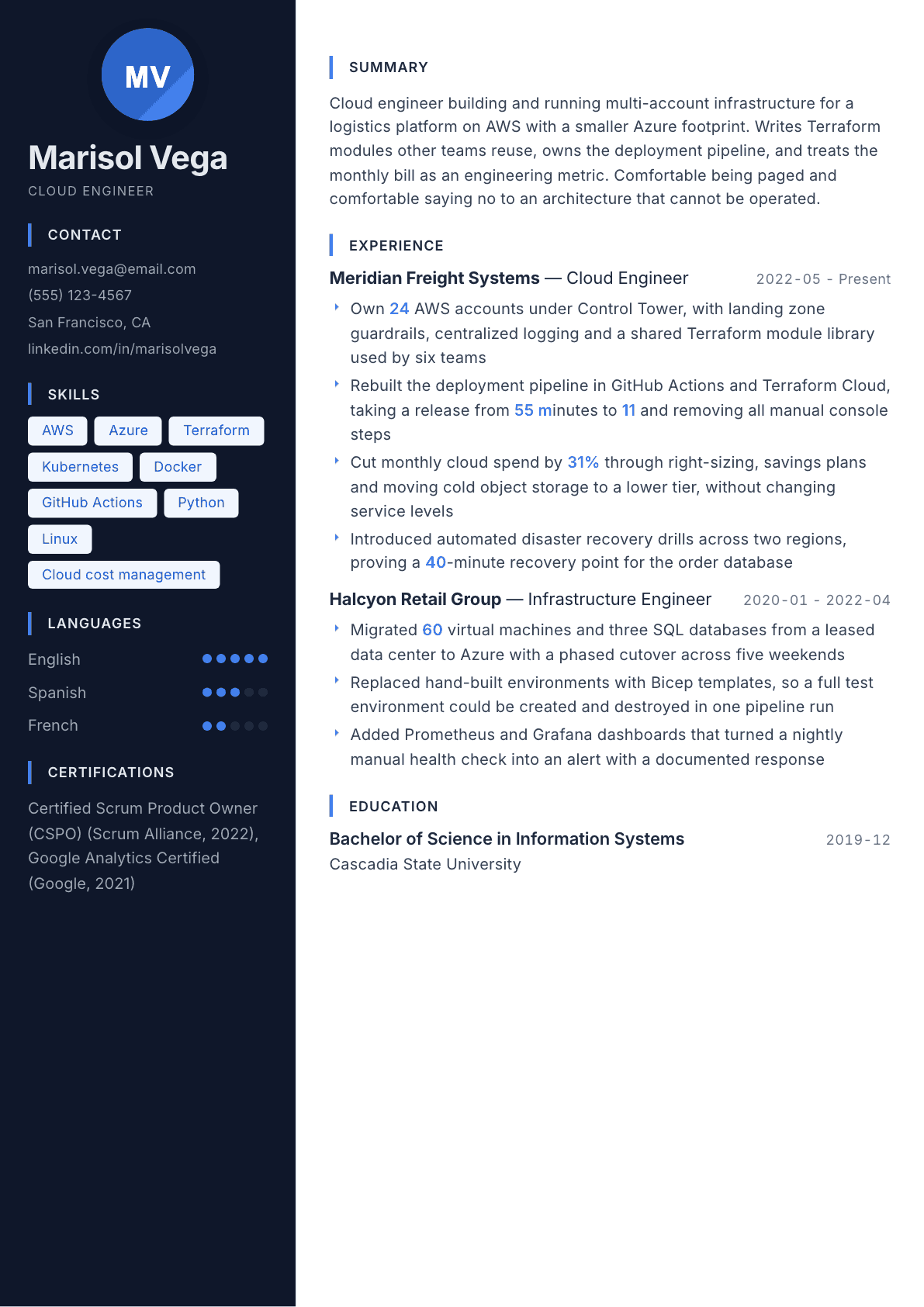
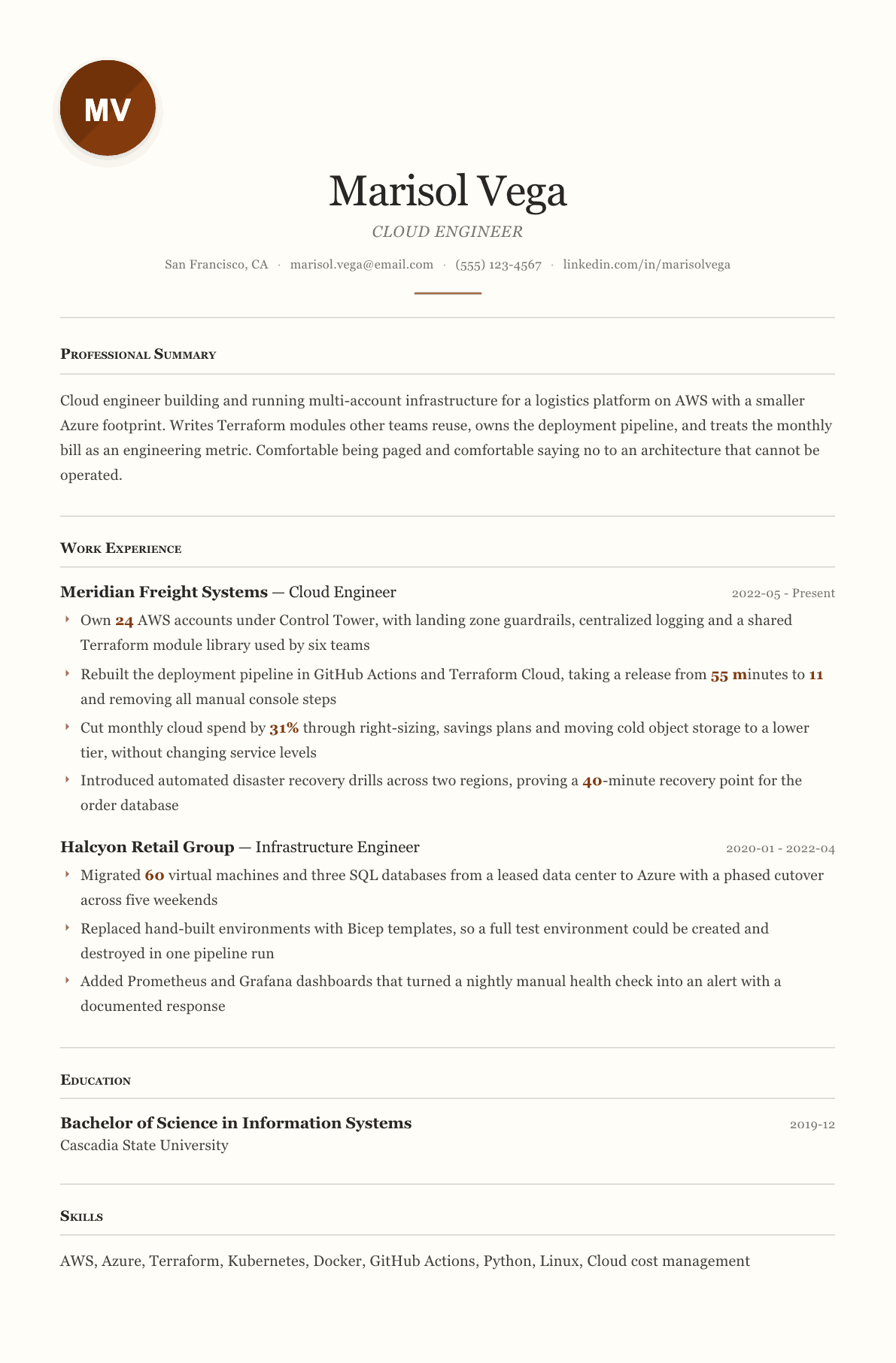
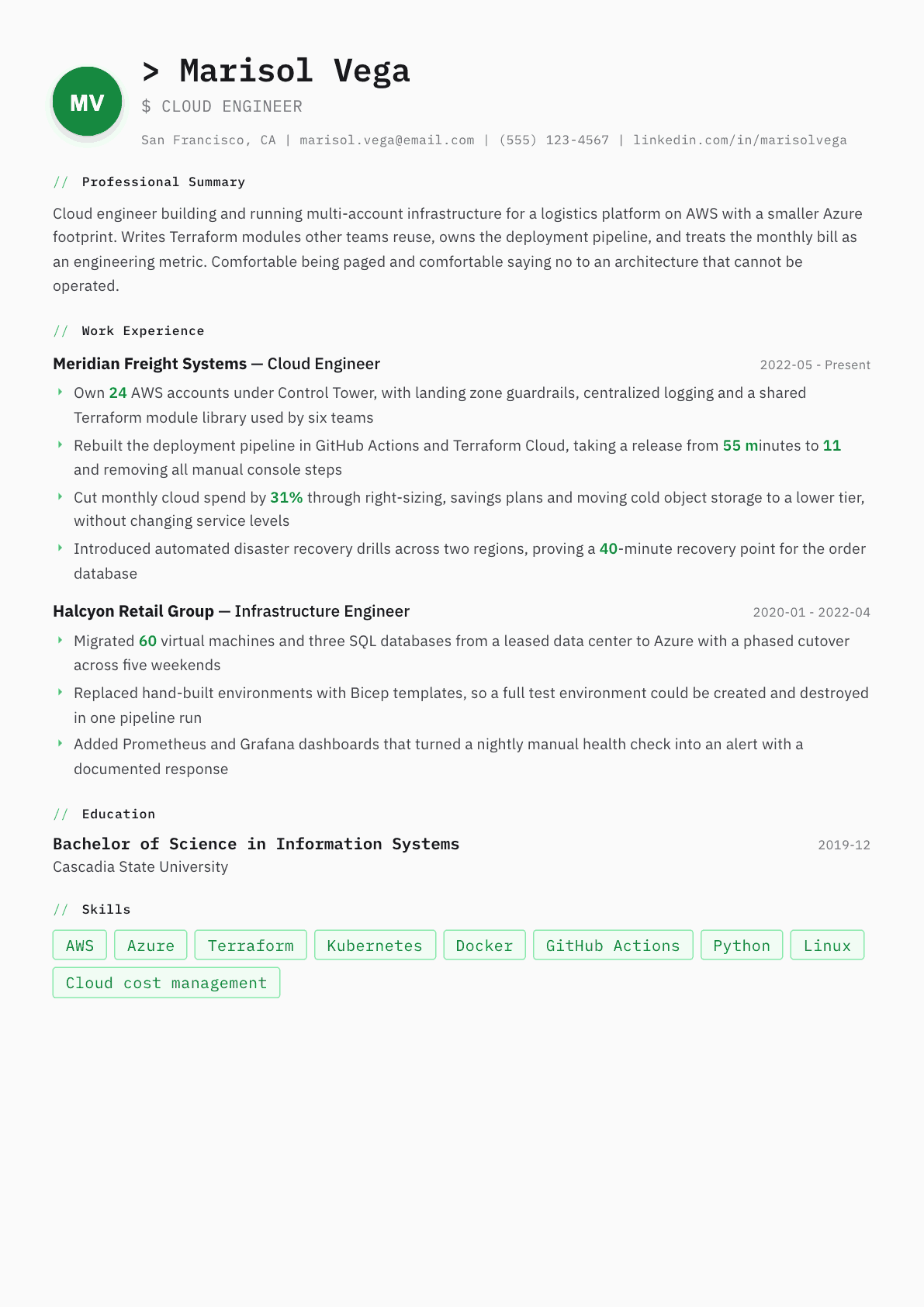
Example Cloud Engineer summary
Cloud engineer with six years designing and operating production infrastructure, primarily on AWS with Azure migration experience. Owns two dozen accounts under a governed landing zone and a Terraform module library used across six teams. Reduced release time from nearly an hour to eleven minutes and monthly spend by 31% without lowering service levels. Runs multi-region recovery drills instead of trusting an untested plan.
Skills to list on a Cloud Engineer resume
- AWS
- Microsoft Azure
- Terraform
- Infrastructure as code
- Kubernetes
- Docker
- CI/CD pipelines
- Linux administration
- Python scripting
- Networking and VPC design
- Identity and access management
- Cloud cost optimization
- Monitoring and observability
- Disaster recovery
- Security guardrails
What actually gets this resume read
- Pick a primary cloud and say so in the first line, because most postings screen on one platform before anything else.
- Describe your estate in countable units: accounts or subscriptions, environments, clusters, services and regions.
- Treat infrastructure as code as the core of the resume, naming the tool, the module count and who else consumes your modules.
- Give cost work a number, since a cloud engineer who reduced spend without hurting reliability gets read twice.
- Show reliability evidence such as recovery objectives you proved in a drill rather than objectives that only exist on paper.
- Keep certifications current and dated, because cloud credentials expire and a stale one raises a question in the screen.
How to write a cloud engineer resume
Cloud engineer is one of the least precise titles in technology, which is exactly why the resume has to be precise. In one company it means writing Terraform for a platform team, in another it means running the network and identity layer, in a third it means being the person who carries the pager when a region degrades. The screener is trying to work out which of those you are, and they give the top third of the page about fifteen seconds to say so.
The strongest signal is countable ownership. Accounts or subscriptions, environments, clusters, regions, pipelines, and the number of teams who consume what you build. The second signal is whether the infrastructure exists as code. An estate assembled through a web console by hand is not the same job as one described in modules with reviewed pull requests, and hiring managers can tell within two bullets.
What follows is the layout that fits this role, three summaries for different levels, rewritten bullets that show how much detail a cloud claim needs, and the questions that surface when engineers move here from systems administration or software work.
Format: one page early, two once you govern an estate
Reverse-chronological, single column, plain fonts. Put a platform line immediately under your name that states your primary cloud and your infrastructure as code tool, because those two facts decide most screening outcomes.
Resist listing forty service names. A tight block of the services you have run in production is more convincing than an inventory copied from a certification syllabus, and it leaves room for the outcomes underneath.
- Header: name, title, location, email, and the primary cloud plus current certifications.
- Order: summary, platform and tooling block, experience, certifications, education.
- Say clearly whether you are primary on one cloud and secondary on another, since almost nobody is equally deep in two.
Summary: platform, scope, and the constraint you manage
Name the cloud, the scale of what you own, and the constraint you are good at handling: cost, reliability, compliance or delivery speed. Those four constraints map neatly onto the four reasons companies open this role, and picking one makes you memorable.
Avoid opening with a list of certifications. They belong on the page, but a summary that leads with credentials instead of operated systems reads as study rather than practice.
Experience: infrastructure as code, cost, and reliability
Start with the estate. Number of accounts or subscriptions, environments, regions and workloads, plus how many engineering teams depend on you. Then cover three areas in turn, because virtually every posting asks about them: how infrastructure is defined, how spend is controlled, and how failure is handled.
For infrastructure as code, say what you wrote, who reuses it, and what manual step it eliminated. A shared module library used by six teams is a stronger claim than a personal Terraform repository, because it shows your work became the standard.
For reliability, prefer proof over policy. A recovery objective that has been tested in a drill is worth several paragraphs of architecture description, and a recovery objective that has never been tested is worth nothing.
- Estate line: accounts, environments, regions, workloads and consuming teams.
- Delivery: pipeline tool, release time before and after, manual steps removed.
- Cost: the mechanism used, right-sizing, commitments, storage tiering or cache policy, and the reduction achieved.
Security and governance: the part most candidates skip
Identity and guardrails now decide hiring at the senior end. Write about permission models, short-lived credentials, policy enforcement, network boundaries and logging as first-class work rather than as an afterthought under a general operations bullet.
If you have worked under an audit regime, name the framework and what you built to satisfy it. Compliance-shaped estates need engineers who have already lived inside those constraints, and they will pay attention to a candidate who has.
Keywords worth matching word for word
The recurring terms across postings are narrow: infrastructure as code, Terraform, Kubernetes, containers, CI/CD, landing zone, identity and access management, virtual network design, observability, disaster recovery, cost optimization and automation. Use the posting wording once in the tooling block and once in a bullet that carries a number.
Cloud Engineer resume summary examples
Moving in from systems work
Systems administrator moving into cloud engineering, with two years supporting a hybrid estate and a completed migration of 40 virtual machines to a public cloud. Writes Terraform for test environments, automates in Python, and holds an associate level cloud certification. Seeking a junior cloud engineer role on a platform team.
Four years in
Cloud engineer running production infrastructure across 12 accounts and two regions for a logistics platform. Owns the Terraform module library, the deployment pipeline and the alerting stack, and cut release time from 55 minutes to 11. Reduced monthly spend by 31% through right-sizing and storage tiering.
Senior or lead
Senior cloud engineer with eight years building governed multi-account estates for regulated employers. Designed a landing zone with centralized logging, policy guardrails and short-lived credentials now used by six teams, and proved a 40-minute recovery point through quarterly cross-region drills.
Work experience bullets: before and after
Before: Managed cloud infrastructure for the company.
After: Owned 24 accounts under a governed landing zone with centralized logging, policy guardrails and a shared Terraform module library used by six product teams.
Account count, governance and reuse tell a reader you operate a platform rather than a handful of resources.
Before: Set up CI/CD for deployments.
After: Rebuilt deployment in GitHub Actions and Terraform, taking a release from 55 minutes to 11 and removing every remaining manual console step.
The before and after time plus the removal of manual steps shows the pipeline changed how the team works.
Before: Helped reduce cloud costs.
After: Cut monthly spend 31% through instance right-sizing, one-year commitments and lifecycle rules on cold object storage, with no change to published service levels.
Three specific mechanisms and the service level caveat make the saving believable to a skeptical reader.
Before: Improved disaster recovery.
After: Introduced automated cross-region recovery drills each quarter, proving a 40-minute recovery point for the order database and correcting two gaps found on the first run.
A tested drill with a measured objective beats a recovery plan that exists only as a document.
Before: Migrated servers to the cloud.
After: Migrated 60 virtual machines and three databases from a leased data center across five weekend cutovers, with a rollback path rehearsed before each wave.
Volume, phasing and rehearsal give the migration the operational credibility a vague claim lacks.
Hard skills
- Terraform and infrastructure as code
- AWS
- Microsoft Azure
- Kubernetes and containers
- CI/CD pipelines
- Identity and access management
- Virtual network and subnet design
- Linux administration
- Python and Bash scripting
- Observability and alerting
- Backup and disaster recovery
- Policy and guardrail enforcement
- Cost analysis and commitments
- Secrets management
Soft skills
- Saying no to unoperable designs
- Writing architecture decision records
- Incident communication
- Partnering with application teams
- Cost conversations with finance
- Mentoring on infrastructure review
Certifications worth listing
- AWS Certified Solutions Architect, Associate (Amazon Web Services)
- Microsoft Certified: Azure Administrator Associate (Microsoft)
- HashiCorp Certified: Terraform Associate (HashiCorp)
- Certified Kubernetes Administrator (The Linux Foundation)
- Professional Cloud Architect (Google Cloud)
Mistakes that cost cloud engineer candidates the interview
- Claiming multi-cloud depth when your production hours are concentrated in one platform and the rest is coursework.
- Describing services without describing scale, so the reader cannot separate a demo project from a governed estate.
- Leaving infrastructure as code out of the bullets, which suggests the environment was assembled by hand.
- Presenting a recovery plan that has never been exercised as though it were a proven capability.
- Reciting a certification syllabus as a skills list rather than the services you have operated under load.
- Omitting identity and permission work, which is the area senior interviewers probe hardest.
Cloud Engineer resume questions
Should I put my certifications above my experience?
Only when you are early in the field and the credential is the strongest evidence you have. Once you have operated real infrastructure, experience goes first and certifications sit in their own short section where the filter still finds them.
How do I show cloud experience without a professional cloud job yet?
Build something small and operate it. A personal project with infrastructure defined in code, a pipeline that deploys it, monitoring that alerts, and a written note on what it costs per month demonstrates the habits employers screen for far better than a course list.
Is it better to specialize in one cloud or claim several?
Specialize, and mention the second platform honestly as secondary experience. Hiring teams need depth on the platform they run, and a resume that claims equal mastery of three clouds usually reads as inflated rather than versatile.
How much detail should I give about cost savings?
Enough that the mechanism is clear. Name what you changed, right-sizing, commitment purchases, storage tiering or traffic caching, and state that service levels held. A savings figure with no method behind it invites doubt in the interview.
What makes a cloud engineer resume look senior?
Evidence that other engineers depend on your work. Shared modules, a landing zone standard, guardrails that stop bad configurations before they ship, and drills you designed all show influence beyond your own tickets, which is what distinguishes senior scope.
Related resume examples
- Cloud Architect Resume example
- DevOps Engineer Resume example
- AWS Engineer Resume example
- Kubernetes Engineer Resume example
- Infrastructure Engineer Resume example
- Platform Engineer Resume example