Hardware Engineer Resume Examples: the lines they read
Build a Hardware Engineer Resume That Proves Board Bring-Up
By Mustafa Tarabya, founder of CVBooster · Published · Updated
A hardware engineer resume example with schematic, PCB layout and bring-up detail, the tools reviewers scan for, and a full writing guide.
Sample resumes for a hardware engineer
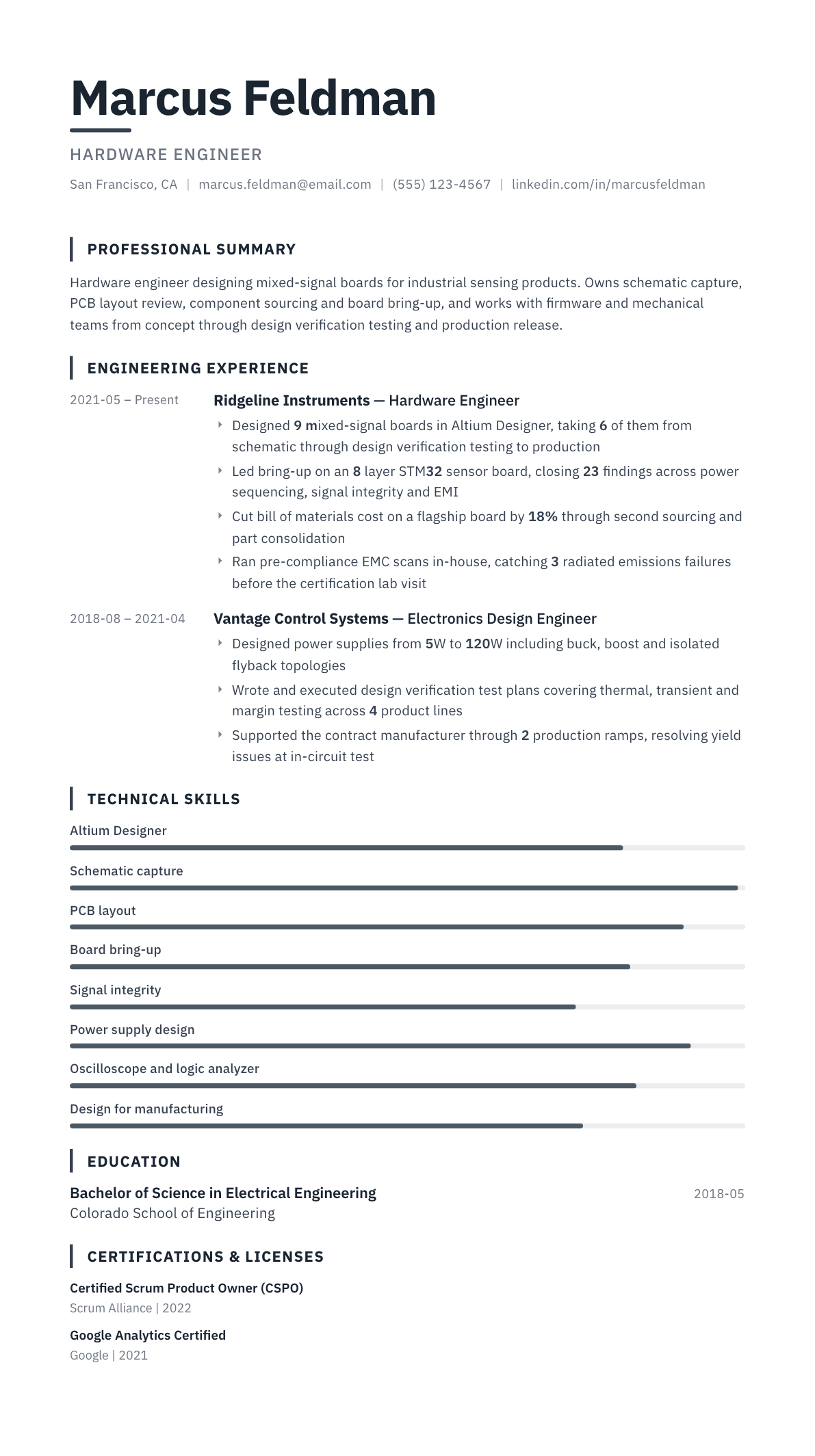
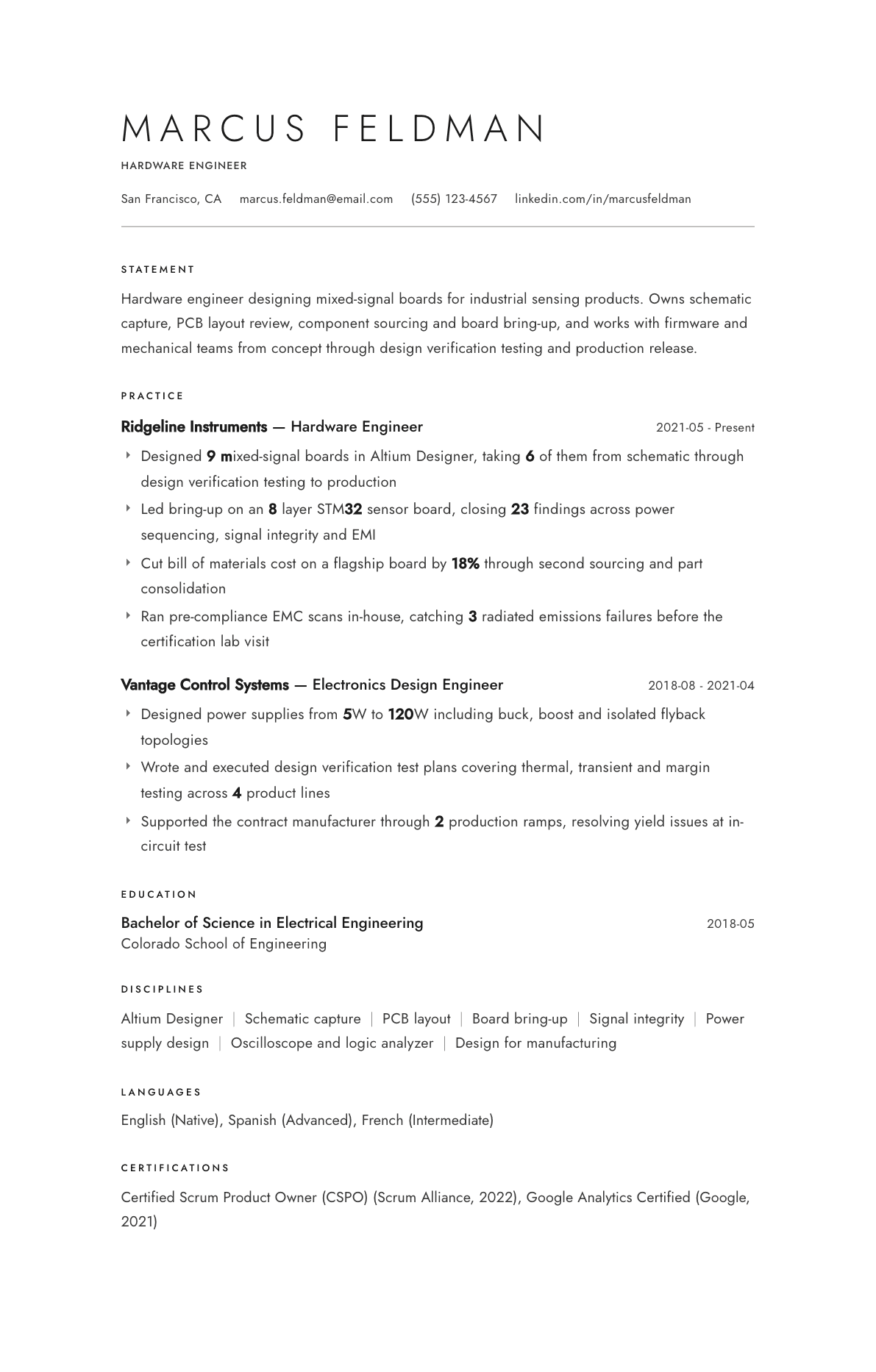
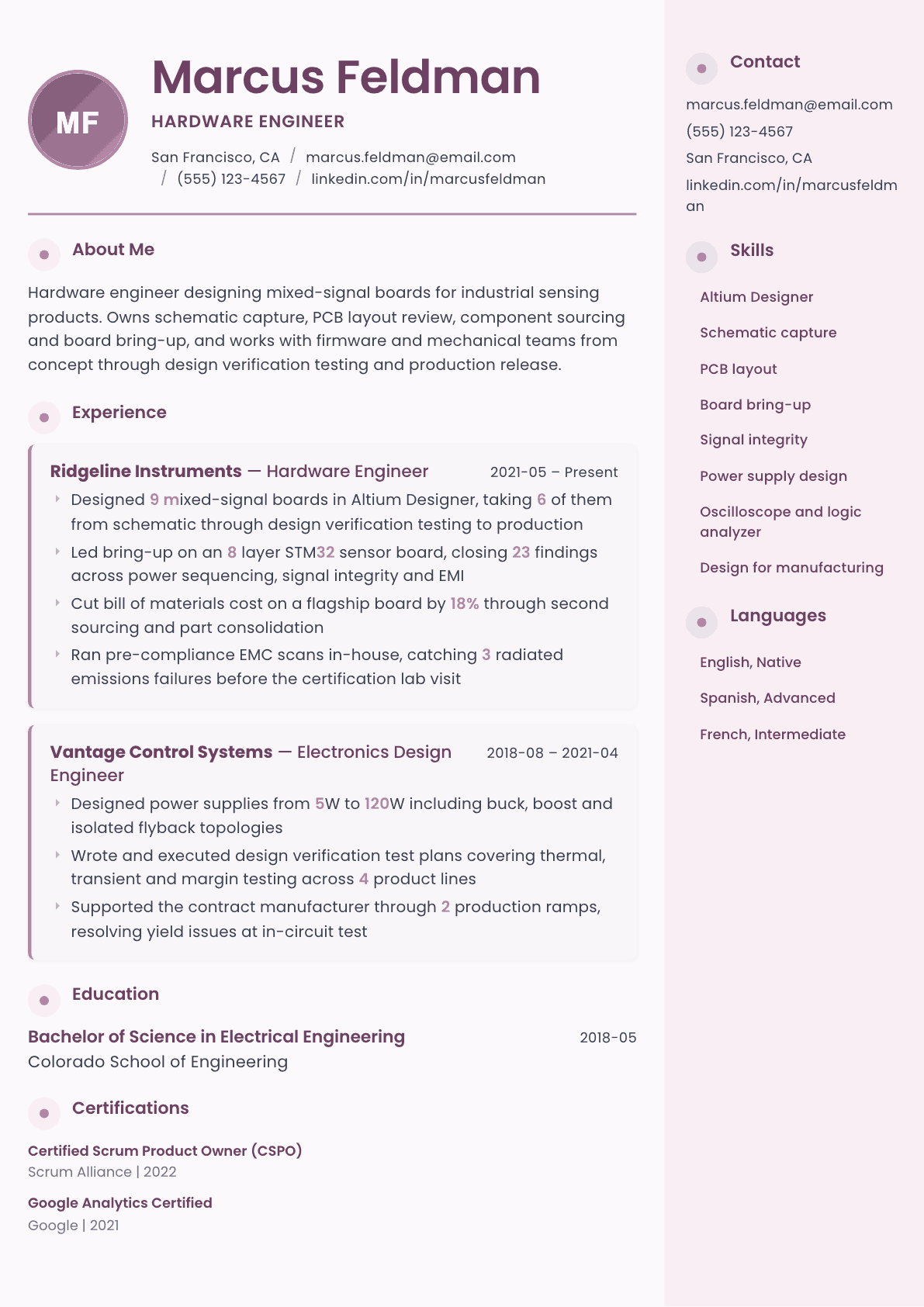
The same hardware engineer content laid out in three CVBooster templates, so you can see what the finished document looks like before you write a word.
Example Hardware Engineer summary
Hardware engineer with seven years designing mixed-signal and power boards for industrial instruments. Owns schematic capture in Altium, layout review, bring-up and design verification testing, and has taken six boards through production release. Cut bill of materials cost 18% on a flagship product and caught three radiated emissions failures before the compliance lab. Seeking a design role on a sensing or robotics platform.
Skills to list on a Hardware Engineer resume
- Schematic capture
- PCB layout
- Altium Designer
- Cadence Allegro
- KiCad
- Board bring-up
- Signal integrity
- Power supply design
- Analog circuit design
- Design for manufacturing
- EMC pre-compliance
- Design verification testing
- SPICE simulation
- Oscilloscope and logic analyzer
- Bill of materials management
- Failure analysis
What actually gets this resume read
- State how many boards you have taken to production, because a designer who has never survived a ramp reads differently.
- Name the EDA tool you actually use, since Altium, Cadence Allegro and KiCad are filtered on as hard keywords.
- Describe bring-up work concretely: layer count, processor, what failed, and how you found the fault.
- Include compliance experience by standard, such as EMC pre-compliance, IEC safety testing or FCC Part 15.
- Show the cost and manufacturability side, since bill of materials reduction and yield are what managers report upward.
- Separate analog, digital and power experience so a reviewer can match you to the specific opening.
How to write a hardware engineer resume
A hardware engineer resume is read by someone who has been burned by a board that worked on the bench and failed in the field. She is looking for one thing above all others: evidence that you have taken a design through the whole cycle, from schematic to layout review to bring-up to design verification to a production ramp, and that you were there when it went wrong. Anyone can draw a schematic in a course project. Far fewer people have stood at a contract manufacturer explaining why yield fell at in-circuit test.
The second thing she checks is domain. Hardware engineering splits into analog, digital, power, radio frequency and mixed-signal, and the boundaries are real. A power supply designer and a high-speed digital designer are not interchangeable, and a resume that lists circuit design without saying which kind forces the reviewer to guess low. Say the domain in the first three lines.
This guide covers the format, the summary, experience bullets that survive scrutiny from a design lead, the tools and standards worth naming, and the questions hardware engineers ask when they rewrite this document.
Format: one page early, two once you have shipped products
Reverse chronological, single column, plain fonts. One page through about six years, then a second page is justified when it holds boards, standards and production history rather than more responsibilities. Under your name, put a two-line technical profile naming your domain, your electronic design automation tool, and the product category you have worked in.
Add a short products or boards block if your history is spread across many designs. Three to six lines, each with the board, layer count, the processor or controller if relevant, and where it ended up. A design lead reads that block first and uses it to decide how deep to go in the phone screen.
- Header: name, title, city, phone, email, and LinkedIn.
- Order: profile, skills, experience, notable boards, education, certifications, patents if any.
- Under each job, one scope line: product type, team size, and where in the cycle you owned work.
Summary: domain, cycle coverage, and how many designs reached production
Three or four lines. Name the domain you design in, the product category, the phases you own, and the number of designs that reached production under you. That last number is the one senior reviewers weigh hardest, because a designer who has released six boards has absorbed lessons that no amount of prototype work teaches.
Name your tool honestly. Altium Designer, Cadence Allegro, Mentor Xpedition and KiCad shops rarely switch, and the tool line is a genuine filter rather than a formality. If you have used more than one seriously, list both, since that flexibility is worth something to a team migrating.
Experience: designs owned, bring-up detail, compliance and cost
Open each job with the scope: what the products were, your phase coverage, and who else was on the design. Then write bullets around the four things this field rewards, which are designs completed, bring-up and debug depth, compliance and verification, and cost and manufacturability.
Bring-up is where a reviewer looks for real capability. Do not write supported board bring-up. Write what the board was, how many layers, what the processor and power tree looked like, what failed, and how you found it. Power sequencing violations, a marginal clock, an unterminated high-speed trace, a ground loop caught with a differential probe: these are the details that let a lead calibrate your level in one line.
Compliance deserves its own bullet. Name the standard and where you sat in the process. Radiated and conducted emissions pre-compliance in-house, electrostatic discharge immunity testing, safety approval work, environmental and thermal qualification, and the certification lab visits you prepared. Hardware managers value people who catch failures before the lab because lab time is expensive and schedules are brittle.
Cost and manufacturability bullets are how you show commercial awareness. Bill of materials reduction, second sourcing during a component shortage, panelization and test point placement worked out with the contract manufacturer, and design for test coverage. These are the outcomes a hardware manager reports upward, so a resume that speaks in them reads as senior.
- Say how many designs you have taken to production, not how many you have worked on.
- One bring-up bullet with layer count, processor, and the specific fault you found.
- One compliance bullet naming a standard and the test.
- One cost or yield bullet with a number attached.
Skills and standards: split design, verification and manufacturing
Group the list. Design covers schematic capture, layout, the simulation tools, and the circuit domains you work in. Verification covers the bench instruments and the test disciplines: oscilloscopes and probing technique, network and spectrum analyzers, thermal imaging, margin and worst-case analysis. Manufacturing covers design for manufacturing, design for test, in-circuit and functional test, and contract manufacturer collaboration.
Instruments are worth naming because probing technique is a real skill. A candidate who mentions differential probes, current probes and a spectrum analyzer for pre-compliance is telling a reviewer she has debugged hard problems, which no adjective can do.
Keywords hardware postings use
These job descriptions reuse a stable vocabulary: schematic capture, PCB layout, Altium, Allegro, signal integrity, power integrity, DC to DC converter design, analog and mixed-signal, board bring-up, design verification testing, design for manufacturing, bill of materials, EMC, electrostatic discharge, thermal analysis, and contract manufacturer. Place each true one inside a bullet where it is doing work, and repeat the two or three most central ones in your profile block.
Hardware Engineer resume summary examples
New graduate
Electrical engineering graduate with two four-layer boards designed in KiCad, including a motor driver built for a senior capstone and brought up personally. Comfortable with oscilloscope debugging, SPICE simulation and soldering fine-pitch parts. Seeking a junior hardware engineer position in industrial or instrumentation products.
Four years designing
Hardware engineer with four years designing mixed-signal boards for industrial sensing, working in Altium Designer from schematic through design verification testing. Took six designs to production, led bring-up on an eight layer STM32 board, and cut bill of materials cost 18% through part consolidation and second sourcing.
Lead hardware engineer
Lead hardware engineer owning the electronics architecture for a product family across three factories. Sets the power tree, signal integrity and compliance strategy, reviews every layout, and mentors three engineers. Guided two products through certification with no failed lab visits and held first pass yield above prior generation levels.
Work experience bullets: before and after
Before: Designed printed circuit boards for company products.
After: Designed nine mixed-signal boards in Altium Designer, taking six from schematic through design verification testing to production release.
The count of designs that actually reached production is the clearest seniority signal a hardware resume can carry.
Before: Performed board bring-up and debugging.
After: Led bring-up on an eight layer STM32 sensor board, closing twenty-three findings across power sequencing, signal integrity and radiated emissions before design freeze.
Layer count, processor and the categories of defect let a reviewer judge the difficulty of the work.
Before: Reduced product cost.
After: Cut bill of materials cost on the flagship board by 18% through second sourcing regulators and consolidating four passive families into one.
A named mechanism behind the saving proves engineering judgment rather than a purchasing decision.
Before: Handled EMC testing for new products.
After: Ran radiated emissions pre-compliance scans in-house on a near-field bench setup, catching three failures and correcting them before the certification lab visit.
It shows the candidate prevented schedule loss, which is what a hardware manager is protecting.
Before: Worked with the contract manufacturer during production.
After: Supported two production ramps with the contract manufacturer, adding test points and revising panelization to resolve in-circuit test coverage gaps and stabilize first pass yield.
Specific manufacturing actions demonstrate that the candidate has survived a ramp rather than observed one.
Hard skills
- Schematic capture
- PCB layout and layout review
- Altium Designer
- Cadence Allegro
- Signal integrity and power integrity
- Analog and mixed-signal circuit design
- DC to DC converter design
- SPICE simulation
- Board bring-up and failure analysis
- Design verification testing
- EMC pre-compliance
- Design for manufacturing and test
Soft skills
- Cross-discipline work with firmware and mechanical
- Design review participation
- Supplier and contract manufacturer communication
- Clear failure documentation
- Schedule realism
Certifications worth listing
- IPC Certified Interconnect Designer (CID) (IPC)
- IPC Certified Interconnect Designer Advanced (CID+) (IPC)
- Certified IPC Specialist for IPC-A-610 (IPC)
- Professional Engineer License (State engineering licensing board)
Mistakes that cost hardware engineer candidates the interview
- Writing circuit design without naming the domain, so a reviewer cannot tell power expertise from high-speed digital.
- Counting projects worked on instead of designs released, which hides whether you have ever survived a production ramp.
- Describing bring-up in one generic phrase when the debug story is the most persuasive content available to you.
- Leaving compliance off the page entirely, even though schedule risk in this field usually lives at the test lab.
- Listing the electronic design automation tool only in a skills block, when it is the first filter most postings apply.
- Ignoring cost and yield, which are the terms in which hardware managers justify headcount to their own leadership.
Hardware Engineer resume questions
How do I show board bring-up experience on a hardware engineer resume?
Describe one board in detail: layer count, the processor or controller, the power tree, what failed during bring-up and how you isolated it. A single concrete debug story proves more capability than three lines listing bring-up as a responsibility.
Should a hardware engineer resume list specific test equipment?
Yes. Naming oscilloscopes, differential and current probes, spectrum and network analyzers, and thermal cameras tells a reviewer you have done real measurement work. Probing technique is a genuine skill that separates candidates who debug from candidates who only design.
Do I need a Professional Engineer license for hardware engineering roles?
Rarely. Product electronics companies almost never require it, though it can matter for consulting, public infrastructure or roles where you sign off on designs. Certifications from IPC on interconnect design are more commonly relevant to board level work.
How many pages should a hardware engineer resume be?
One page through roughly six years of experience. Beyond that a second page is reasonable if it holds a boards list, standards experience and production history. Avoid a third page, and never pad with course projects once you have released hardware.
Should I include patents and publications?
Include patents with the title and status, since hardware teams treat them as evidence of original design contribution. Publications matter mainly in research-heavy areas such as radio frequency and power electronics; elsewhere keep them to a short line rather than a full section.
Related resume examples
- Electrical Engineer Resume example
- Embedded Systems Engineer Resume example
- Firmware Engineer Resume example
- Computer Engineer Resume example
- Field Service Technician Resume example
- Business Intelligence Analyst Resume example