Game Developer Resume Examples: the lines they read
Level Up Your Career with a Game Developer Resume
By Mustafa Tarabya, founder of CVBooster · Published · Updated
Build an outstanding game developer resume showcasing your expertise in game engines, 3D graphics, and interactive gameplay systems with ATS-optimized formatting.
Sample resumes for a game developer
The same game developer content laid out in three CVBooster templates, so you can see what the finished document looks like before you write a word.
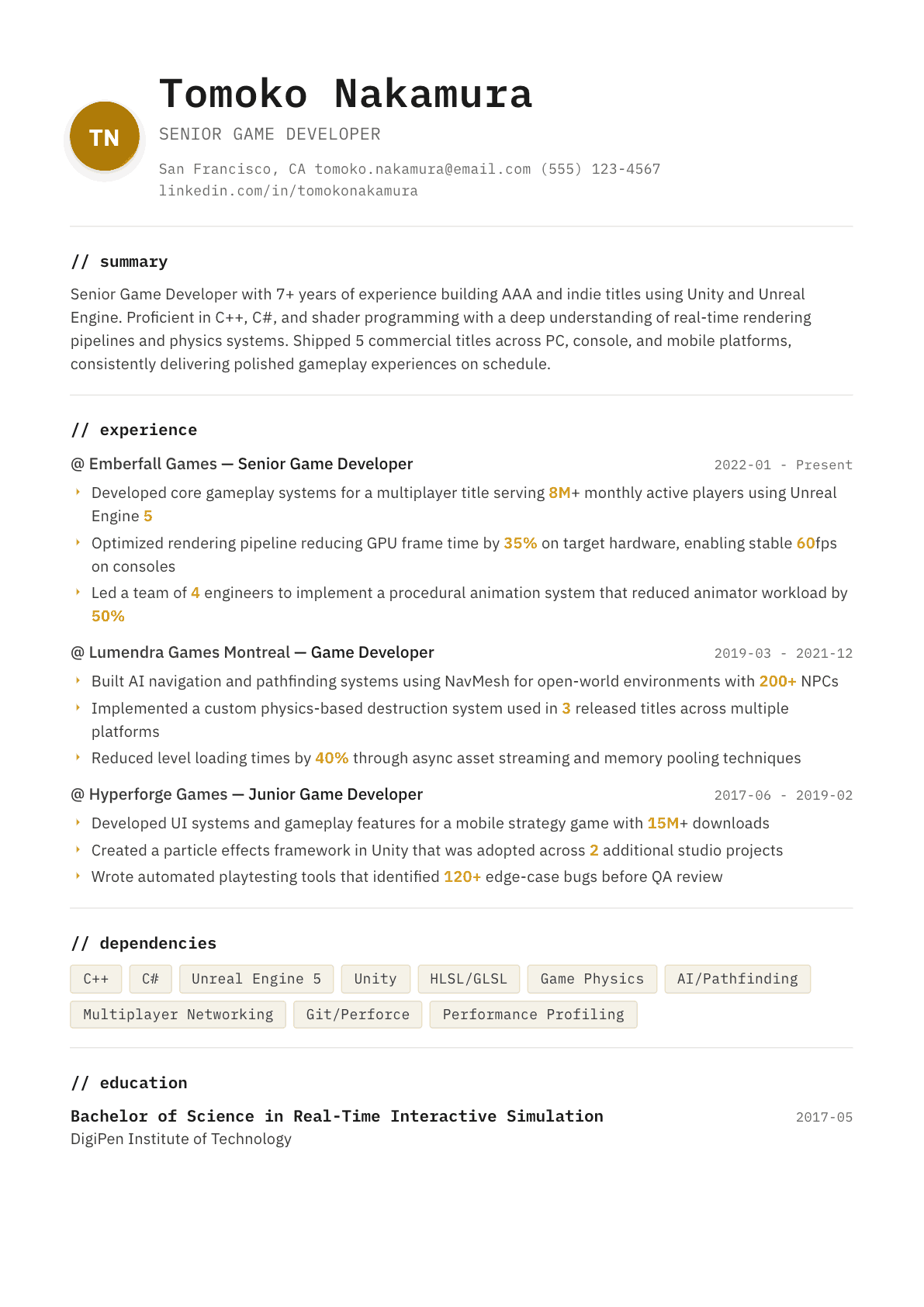
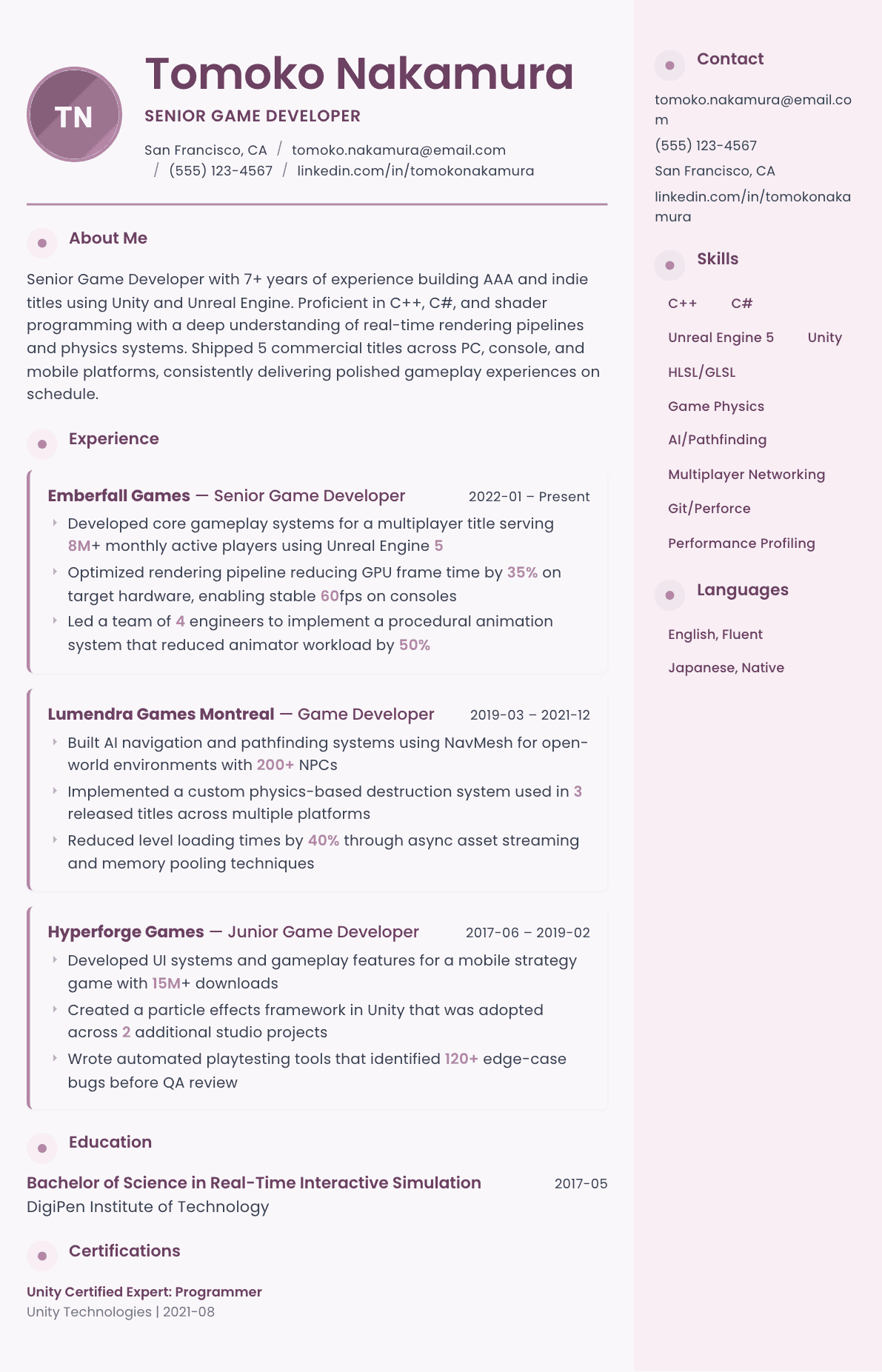
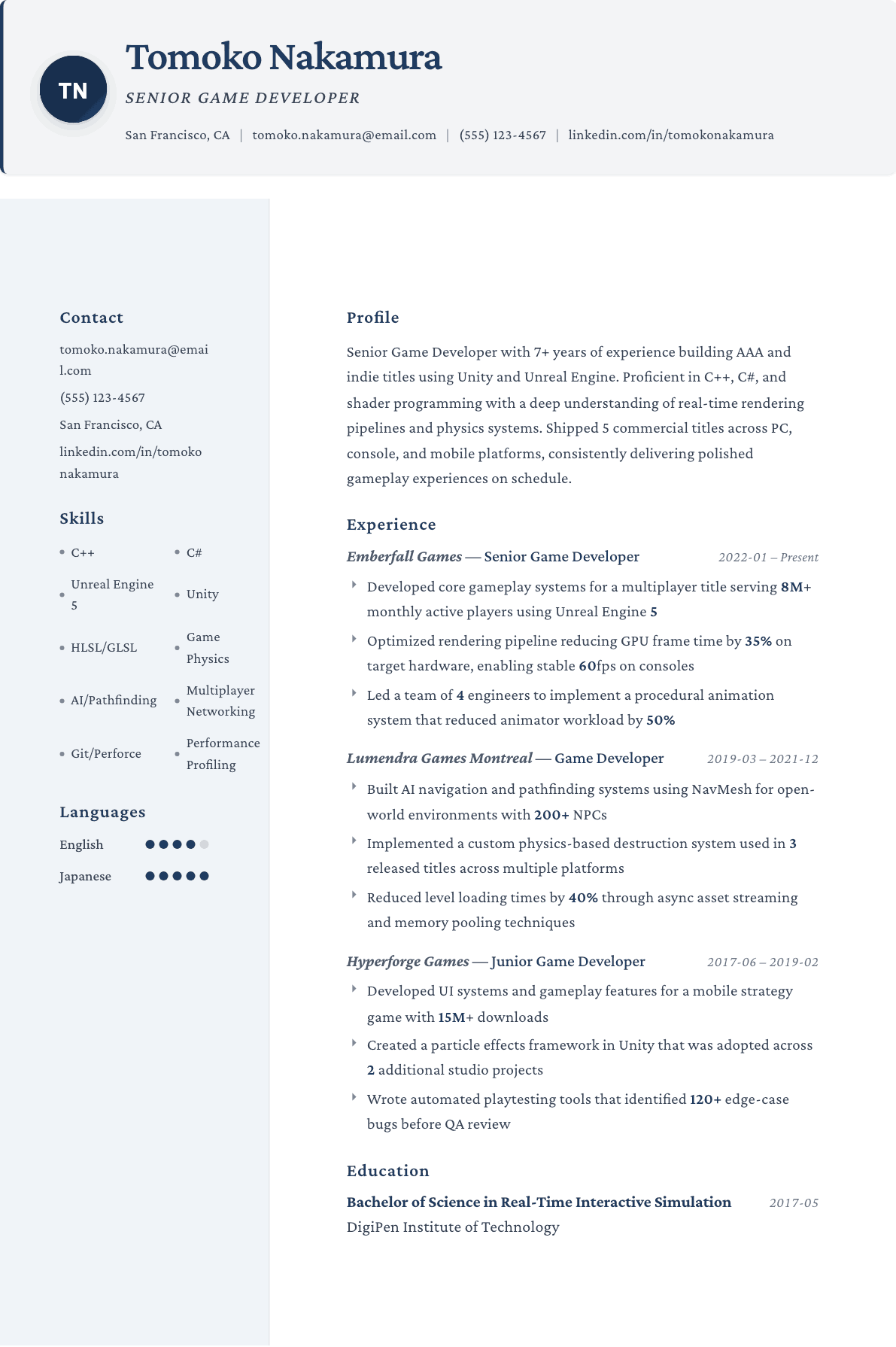
Example Game Developer summary
Game Developer with 7 years on AAA and indie titles in Unreal Engine and Unity, 5 of them released across PC, console, and mobile. Cut GPU frame time 35% to hold 60fps on console and leads gameplay systems for a multiplayer title with 8M monthly players. Strong in C++, shaders, and real-time rendering.
Skills to list on a Game Developer resume
- C++
- C#
- Unreal Engine
- Unity
- HLSL/GLSL Shaders
- Game Physics
- AI & Pathfinding
- Multiplayer Networking
- Version Control (Git/Perforce)
- Performance Profiling
- 3D Mathematics
- Procedural Generation
What actually gets this resume read
- Showcase shipped titles with player counts, downloads, or revenue figures to prove commercial impact.
- Highlight specific engine expertise: Unreal Engine 5 Blueprints, Unity DOTS, or custom engine work.
- Include performance optimization wins such as frame rate improvements, memory reduction, or load time gains.
- Mention platform-specific experience: PC, PlayStation, Xbox, Nintendo Switch, or mobile.
- Link to a portfolio, demo reel, or itch.io page to let your work speak for itself.
How to write a game developer resume
Game studios hire from a small, well-connected talent pool, and the person reading your resume is almost always a lead who will work beside you. That lead cares about two things above all: what you have released, and which discipline you own inside an engine. Gameplay, engine and tools, graphics, networking, and technical animation are separate hiring pipelines, and a resume that presents itself as a general game developer gets routed nowhere.
The second reality is that credits carry more weight than employers. A title that reached players, with your role and the platforms it ran on, is the strongest line you can write. If you have no released title yet, a finished small project with a downloadable build does the same job, because a lead can open it and see what you can do.
This guide covers how to lay out credits and projects, how to write about engine work so a technical lead believes you, three summaries covering a junior through a lead, rewritten bullets, and the portfolio questions that come up in every game hiring loop.
Format: credits near the top, portfolio link in the header
One page unless you have a long credit list, then two. Reverse chronological, single column, no heavy graphics. Save the visual identity for the portfolio; recruiters at larger studios run resumes through a parser and an art-directed layout loses your credits.
Put a portfolio or demo reel link in the header, and make sure it opens without an account. For a gameplay or engine role the link should reach code and a playable build, not only screenshots. A lead will spend two minutes on that build and decide most of the interview outcome there.
- Header: name, city, email, portfolio link, repository link, and a public profile if your work is on a game distribution page.
- Order: summary, shipped titles or projects with your role and platform, experience, skills by engine and language, education.
- Students and career changers replace the credits block with two finished projects, each with a build people can run.
Declare a discipline, then prove it
Say which kind of game developer you are in the first line. A gameplay programmer writing character controllers and combat, a tools programmer building the pipeline the artists live in, a graphics programmer writing shaders and render passes, a network programmer handling replication and rollback, and a technical designer scripting systems are hired by different leads with different tests.
Then match every bullet to that discipline. If you claim gameplay, the resume should talk about state machines, animation blending, hit reaction, camera behavior, input buffering and feel. If you claim tools, it should talk about editor extensions, asset import, build automation and how many hours a week you gave back to the content team.
Engine work: name the engine, the version and the layer
Unity and Unreal are not interchangeable on a resume. Say which one, and say how deep you went: C# gameplay scripts and ScriptableObjects, the job system and Burst, Unreal Blueprints, C++ gameplay classes, Gameplay Ability System, or engine source modification. Studios that build on modified engine source filter hard for candidates who have opened it.
Custom and in-house engines deserve their own line, because the ability to work without an editor safety net is rare. Say what part you owned: the renderer, the asset pipeline, the entity system, memory allocation, or the platform layer.
Performance, platforms and the numbers that count
Game programming is a performance discipline and the numbers are specific. Frame time in milliseconds rather than frames per second, draw calls, memory budget, load time, package size, and how close you got to the target on the weakest supported hardware. A bullet that says you improved performance without a millisecond figure looks like a bullet from someone who never opened a profiler.
List the platforms you have actually built and certified for. Console submission requirements, mobile thermal and battery constraints, and handheld memory limits are real work, and a candidate who has been through a certification process is worth more to a studio than one who has only built for a desktop machine.
- Name the profiler and the tools you used, such as the engine profiler, RenderDoc, or a platform vendor tool.
- State the target: a stable 60 frames on the base console, or a 33 millisecond budget on a mid-tier phone.
- If you worked in live operations on a released title, say the cadence of updates and what you owned in them.
Keywords studio recruiters search on
Game postings repeat a tight vocabulary: C++, C#, Unreal Engine, Unity, gameplay programming, shaders, HLSL, physics, animation, multiplayer replication, optimization, profiling, source control with Perforce or Git, and the platform names. Use the exact engine version family where it matters and put the words next to real work. Studios also search for genre experience, so name the genre you have released in when it matches the posting.
Game Developer resume summary examples
Junior gameplay programmer
Gameplay programmer with a released Unity title on a public storefront and a year of C# work on player controllers, combat state machines and camera behavior. Comfortable in the profiler, with a playable build and full source available for review.
Four years in
Gameplay programmer with four years in Unreal Engine C++ across two released console titles, owning traversal, combat feel and the ability system. Cut frame time on the base console from 21 to 15 milliseconds and took both titles through platform certification.
Lead game developer
Lead game developer with eleven years and five released titles across console and PC, running a gameplay team of six. Owns technical design from prototype to certification, works in modified engine source, and sets the performance budget the whole project is held to.
Work experience bullets: before and after
Before: Worked on gameplay features in Unity.
After: Built the player traversal system in Unity C#, including ledge detection, coyote time and input buffering, then tuned it across three playtest rounds until reported control complaints stopped appearing in feedback.
Named mechanics and an iteration loop show you understand feel, which is the whole job in gameplay programming.
Before: Optimized the game to run better.
After: Reduced frame time on the base console from 22 to 15 milliseconds by batching foliage draw calls, moving the visibility check off the main thread and cutting a redundant post-process pass.
Millisecond figures and three concrete techniques prove profiler work rather than a general claim of optimization.
Before: Made tools for the art team.
After: Wrote an Unreal editor tool that batch-validated and reimported character assets, replacing a manual checklist and giving the art team back roughly a day a week during production.
A tools bullet is only strong when it states the manual process removed and the time returned to the team.
Before: Implemented multiplayer functionality.
After: Implemented server-authoritative movement replication with client prediction and reconciliation for a four-player mode, keeping visible correction under 100 milliseconds at typical latency.
Naming the network model and the correction target shows real multiplayer engineering instead of using a template.
Before: Fixed bugs before release.
After: Closed 140 defects in the final milestone including two certification blockers on memory overrun during level streaming, both reproduced with the platform vendor tooling.
Certification blockers are the bugs studios fear, so saying you found and fixed them carries far more weight than a bug count alone.
Hard skills
- C++ for gameplay systems
- C# and Unity scripting
- Unreal Engine and Blueprints
- Gameplay Ability System
- Shader authoring in HLSL
- Physics and collision
- Animation state machines and blending
- Multiplayer replication and prediction
- Performance profiling and frame budgets
- Memory management
- Perforce and Git
- Editor and pipeline tooling
- Console platform certification
- Build automation
Soft skills
- Working with designers on feel
- Taking playtest feedback
- Milestone discipline
- Cross-discipline communication
- Prototyping fast then rewriting
- Mentoring juniors
Mistakes that cost game developer candidates the interview
- Presenting as a general game developer instead of naming gameplay, tools, graphics or network, so no lead recognizes you as their candidate.
- Linking a portfolio with screenshots and trailers only, when a programming lead wants a build to run and code to read.
- Writing performance bullets without milliseconds, draw calls or memory figures, which reads as though you never opened a profiler.
- Listing every engine and language ever tried, which hides the one engine you are genuinely productive in.
- Leaving platforms and certification off the resume, when console and mobile constraints are exactly what a studio is hiring against.
- Sending an art-directed resume layout to a large studio, where the parser drops the credit list that was the strongest part of the page.
Game Developer resume questions
Do I need a released title to get hired as a game developer?
No, but you need something a lead can play. A finished small game with a downloadable build, clean source and a short write-up of one hard problem you solved gives a reviewer the same evidence a credit does.
Should I list game jam projects on my resume?
One or two, if they are finished and playable, and only while you have limited professional credits. Say what you personally built, because jam entries are team work and a lead will assume the least unless you are specific.
Is Unity or Unreal better to feature?
Feature the one you are genuinely strong in and apply to studios using it. Trying to look equally capable in both usually leaves you looking shallow in each, and engine depth is what the technical interview probes.
How do I show work on a canceled project?
List it as unannounced or canceled with the platform and your discipline, and describe the systems you built. Cancellation is common in this industry and leads read it as normal risk rather than as a mark against you.
What does a game developer put on a resume with no studio experience?
Two completed projects with builds, the specific systems you wrote, a performance measurement, and any modding or open-source engine contributions. Depth on one project beats a long list of prototypes that were abandoned early.
Related resume examples
- Software Engineer Resume example
- Mobile App Developer Resume example
- Computer Vision Engineer Resume example
- Game Designer Resume example
- Frontend Developer Resume example
- Rust Developer Resume example