Mobile App Developer Resume Examples: what gets the call
Launch Your Career with a Mobile App Developer Resume
By Mustafa Tarabya, founder of CVBooster · Published · Updated
Build a polished mobile app developer resume showcasing your expertise in iOS, Android, or cross-platform development with published app store successes.
Sample resumes for a mobile app developer
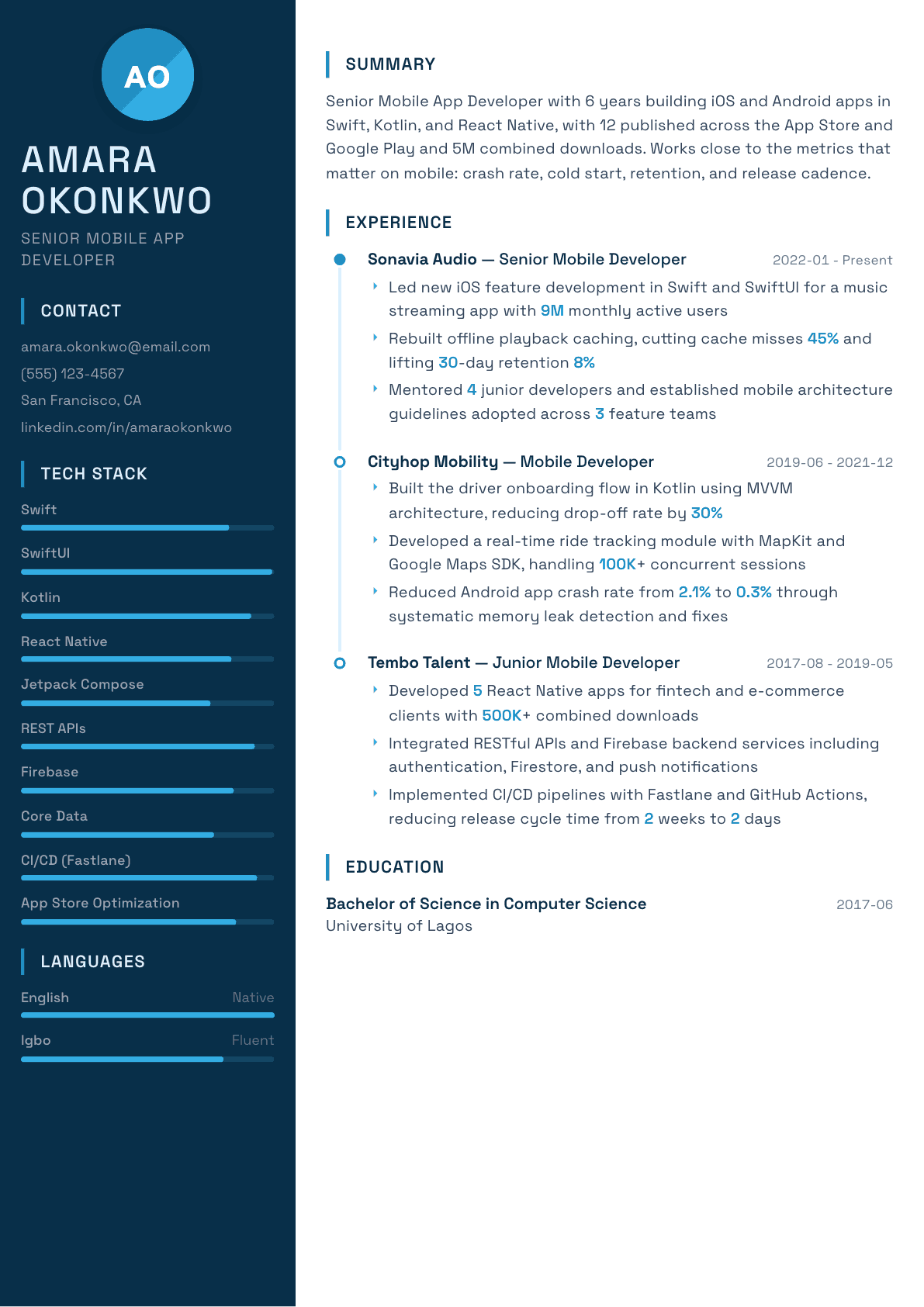
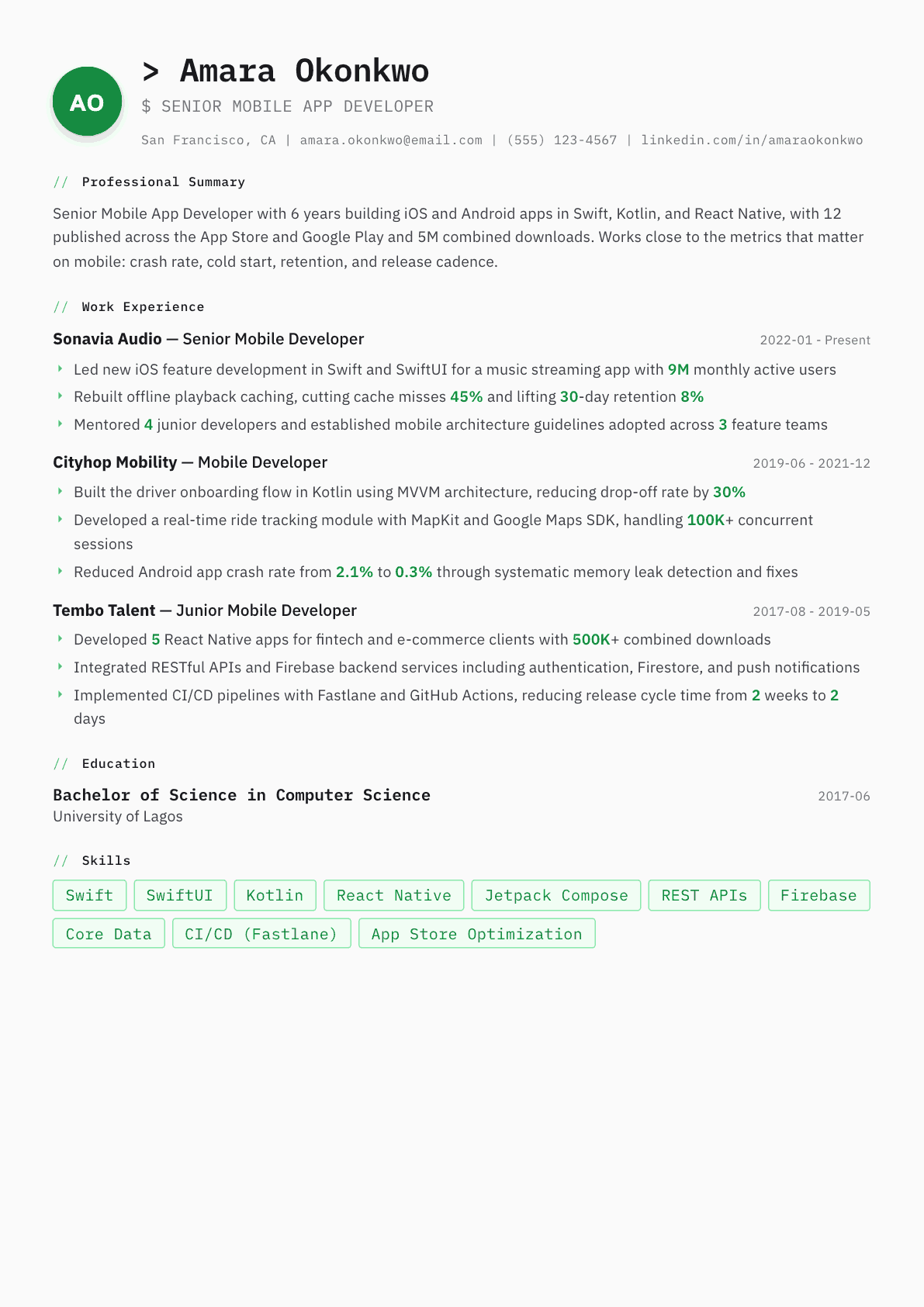
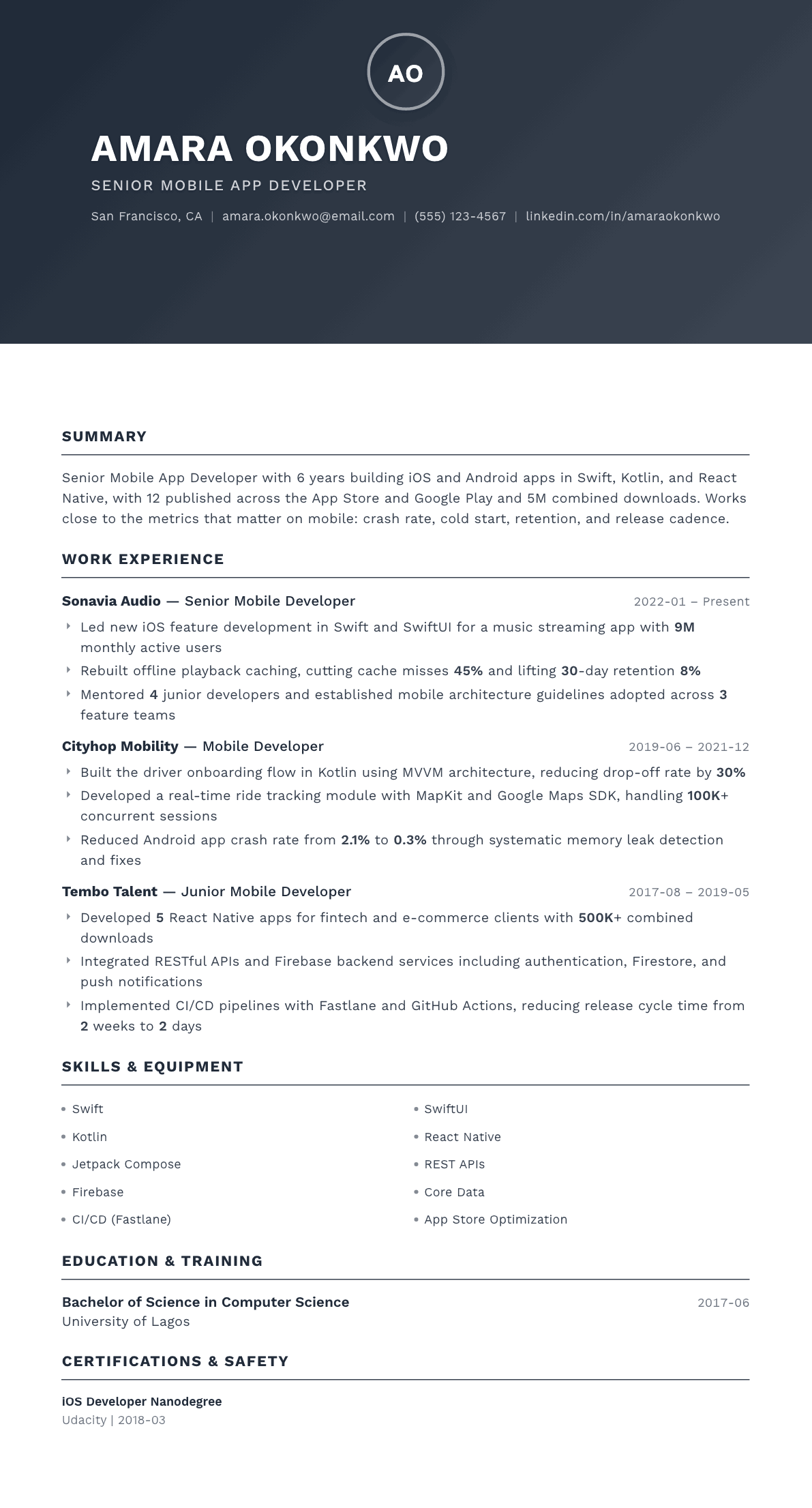
The same mobile app developer content laid out in three CVBooster templates, so you can see what the finished document looks like before you write a word.
Example Mobile App Developer summary
Mobile App Developer, 6 years across native iOS, native Android, and React Native, with 12 published apps and 5M combined downloads. Took one Android app from a 2.1% crash rate to 0.3% and cut release cycles from 2 weeks to 2 days with Fastlane and GitHub Actions.
Skills to list on a Mobile App Developer resume
- Swift
- SwiftUI
- Kotlin
- Jetpack Compose
- React Native
- Flutter
- REST APIs
- Firebase
- Core Data/Room
- CI/CD (Fastlane)
- App Store Optimization
- Unit/UI Testing
What actually gets this resume read
- Include App Store and Google Play metrics: downloads, ratings, active users, and revenue generated.
- Specify platform expertise: native iOS (Swift/SwiftUI), native Android (Kotlin/Compose), or cross-platform (React Native/Flutter).
- Highlight performance improvements: app size reduction, crash rate decrease, or launch time optimization.
- Mention CI/CD and release management experience with Fastlane, Bitrise, or App Center.
- Show UX awareness: accessibility compliance, design system implementation, or user research collaboration.
How to write a mobile app developer resume
A mobile app developer resume is judged against something no other engineering resume is judged against: a product the reader can download in thirty seconds. Before the hiring manager reaches your experience section she has often already opened the App Store or Google Play listing for an app you named, looked at the rating, scrolled the screenshots and read two reviews. Everything you claim is checkable, so vagueness is expensive here in a way it is not for backend roles.
The screener is answering three questions. Which platform do you actually own, native iOS in Swift and SwiftUI, native Android in Kotlin and Jetpack Compose, or a cross-platform stack like React Native or Flutter. Have you owned a release train end to end, including code signing, provisioning profiles, phased rollout and a rejected build you had to argue back through review. And can you keep an app healthy after launch, which means crash-free session rate, cold start time, binary size and battery cost.
This guide covers the section order that mobile managers expect, how to write the app portfolio block that most candidates leave out, three summaries for different career stages, before and after bullets, and the questions mobile developers ask when their resume reads like every other one in the queue.
Format: put the shipped apps where they cannot be missed
Reverse-chronological experience, one page under five years and two pages above it. The difference from a general software resume is a short block near the top, under the summary, listing the apps you have released publicly: app name, platform, your role, and one number that is true. Store links belong in the contact line as plain text, not as a wall of links inside bullets.
Keep the layout single column. Mobile roles attract designers and design-minded engineers who reach for two-column templates with icons, and those are exactly the layouts that resume parsers reorder. Save the visual craft for the portfolio site you name in the header.
- Header: name, title, city, phone, email, portfolio or personal site, and a public code profile if you have one worth reading.
- Order: summary, released apps, experience, skills by platform, education, certifications.
- Career changers and juniors move the released apps block above everything except the summary.
- Name the store presence plainly: App Store, Google Play, or an enterprise distribution channel such as internal MDM.
Summary: platform, years, app scale, one specialty
Three lines. State the platform first because most postings are single platform even when the title says mobile. Then the years, the scale of the largest app you have worked on measured in monthly active users or downloads, and the one thing you are unusually good at: offline sync, real time media, accessibility, in app purchase plumbing, or bringing a legacy Objective-C or Java codebase forward.
If you are pitching yourself as cross-platform, say which native side you are strongest on anyway. A team hiring a React Native developer still needs someone who can open Xcode when a native module breaks, and saying so removes the reader's main worry.
Experience: the app, the users, the release cadence
Each role gets a one-line context stub before the bullets: the app, the platform, the approximate user base and how often you released. A reader who sees a weekly release train for an app with millions of installs makes a completely different assumption about your discipline than one who sees a quarterly release of an internal tool.
Then bullets that name architecture and consequence. MVVM with Combine, unidirectional data flow, modularization into feature packages, a migration from UIKit to SwiftUI or from XML layouts to Compose. Follow each architectural claim with what it bought: build time, crash rate, feature lead time, or a team that could work in parallel without merge pain.
Include one bullet on the boring release work, because it separates people who have owned an app from people who have contributed to one. Certificate and provisioning management, Fastlane lanes, staged rollout and halt criteria, review rejections you resolved, and how you handled a bad build already in the wild.
The numbers a mobile manager actually checks
Downloads are the weakest number on a mobile resume because they measure marketing. The metrics that read as engineering are crash-free sessions, application not responding rate on Android, cold start and time to first frame, app size after thinning, memory footprint on low end devices, and the ratio of your own tests that run on real hardware rather than a simulator.
Name the tool you measured with. Firebase Crashlytics, Xcode Organizer and MetricKit, Android vitals in the Play Console, Sentry, or an internal telemetry pipeline. A number with a measurement source behind it survives an interview; a number without one gets probed and collapses.
- Crash-free session rate before and after your work, with the release it moved on.
- Cold start or time to interactive on a named low end test device, not a flagship.
- Binary size, especially if you cut it through asset thinning, dynamic delivery or dead code stripping.
- Release frequency and how much of the release runs without a human in the loop.
Skills: group by platform, then by layer
Do not present one long alphabetical list. Split it: iOS, Android, cross-platform, backend integration, and tooling. A reader hiring for Android scans for Kotlin, coroutines, Compose, Room, Hilt and Gradle, and a flat list buries all six between Swift and Firebase.
Under integration, name what your app talks to and how: REST, GraphQL, gRPC, WebSocket, push through APNs or Firebase Cloud Messaging, local persistence in Core Data, SwiftData, Room or SQLite, and the offline conflict strategy if you have one. Under tooling, name the release stack: Fastlane, Bitrise, Xcode Cloud, GitHub Actions, and the code signing approach you used.
Mobile App Developer resume summary examples
First mobile role
Android developer with two published Play Store apps built in Kotlin and Jetpack Compose, one with twelve thousand installs and a 4.5 rating. Comfortable with MVVM, Room, Retrofit and Compose testing. Computer science graduate looking for a first team role on a consumer product.
Four years in
iOS developer with four years on a consumer app with 2M monthly active users, releasing every two weeks. Led the UIKit to SwiftUI migration of the browse and search flows, raised crash-free sessions from 99.1% to 99.8%, and owns the Fastlane release pipeline and code signing.
Lead mobile engineer
Senior mobile engineer with nine years across native iOS and Android and three years leading a team of six. Modularized a 400k line codebase into feature packages, cut incremental build times by 60%, and set the mobile architecture and release standards used by four product squads.
Work experience bullets: before and after
Before: Developed features for the company mobile app.
After: Built the offline library and playback queue for an iOS music app in Swift and SwiftUI, keeping downloads usable through airplane mode and mid-session network loss for 1.4M weekly listeners.
It names the feature, the language, the failure case it handles and who felt it, so the reader can picture the actual work.
Before: Fixed bugs and improved app stability.
After: Traced a Kotlin coroutine leak in the ride tracking screen with LeakCanary and Android vitals, taking the crash rate from 2.1% to 0.3% across two releases.
The tool, the subsystem and the before and after turn generic maintenance into a diagnosis a manager can trust.
Before: Worked on app releases.
After: Owned the biweekly release train for both stores: Fastlane lanes, signing certificates, staged Play rollout with a halt threshold, and three App Store review rejections resolved without missing a release date.
Release ownership is the part most candidates omit, and naming rejections shows you have survived the process rather than watched it.
Before: Used CI/CD for mobile builds.
After: Moved iOS builds from a shared Mac mini to Xcode Cloud with cached dependencies and parallel test lanes, cutting pull request feedback from 38 minutes to 9.
The before state, the destination and the wait time developers actually feel make the improvement concrete.
Before: Made the app accessible.
After: Audited the checkout flow with VoiceOver and TalkBack, added accessibility labels and dynamic type support, and cleared 40 issues found in an external accessibility review before launch.
Named assistive technologies and an external review make an accessibility claim verifiable instead of aspirational.
Hard skills
- Swift and SwiftUI
- UIKit
- Kotlin and Jetpack Compose
- Android SDK and Gradle
- React Native
- Flutter and Dart
- Core Data and SwiftData
- Room and SQLite
- REST and GraphQL integration
- Push notifications (APNs, FCM)
- Fastlane and Xcode Cloud
- Crashlytics and MetricKit
- XCTest and Espresso
- App Store and Play Console release management
Soft skills
- Working with designers on interaction detail
- Release judgment under a store review clock
- Debugging from user reports and store reviews
- Explaining platform constraints to product owners
- Code review across two platforms
Certifications worth listing
- Meta iOS Developer Professional Certificate (Meta)
- Meta Android Developer Professional Certificate (Meta)
Mistakes that cost mobile app developer candidates the interview
- Listing an app without saying what you personally built in it, which invites the interviewer to assume you built the least interesting part.
- Naming a published app that is no longer in the store or has a one star average, without a line explaining what happened.
- Claiming both platforms equally when your commit history sits almost entirely on one of them, since the first technical screen will find the gap.
- Leading with download counts, which measure the marketing budget rather than your engineering.
- Leaving out code signing, provisioning and release ownership, the exact work a team hires a senior mobile developer to take over.
- Using an icon-heavy two-column template that parsers scramble, in a field where the reader will judge your taste from your portfolio anyway.
Mobile App Developer resume questions
Should I put my personal apps on a mobile developer resume?
Yes, if they are live and you can point at real usage or a real technical challenge. A side app with a hundred installs still proves you handled signing, store metadata, review and a crash report on hardware you do not control. Drop it once you have professional releases that show more.
How do I write a mobile resume when my apps are internal and not in a public store?
Describe the distribution honestly as enterprise or internal, then give the numbers you do have: field devices, technicians using it daily, offline requirements, device models supported. Internal apps often carry harder constraints than consumer ones, so name those constraints instead of hiding the lack of a store link.
Is cross-platform experience a weakness for native roles?
Only if it is all you show. Teams worry that a React Native or Flutter developer cannot debug into the native layer. Counter it directly by naming native modules you wrote, platform APIs you called and the Xcode or Android Studio work you did, so the reader sees a native engineer who also uses a cross-platform framework.
What metrics belong on a mobile app developer resume?
Crash-free session rate, application not responding rate, cold start time, app size, release frequency and test coverage on real devices. These are the numbers a mobile manager already watches every week, so they read as insider language rather than as marketing.
Do I need certifications to get a mobile developer job?
No. Hiring in this field is driven by released apps and code you can talk about. A certificate can help a career changer show structured learning, but it will never outweigh one live app with a clean architecture and a story about how you kept it stable.
Related resume examples
- Game Developer Resume example
- Software Engineer Resume example
- Frontend Developer Resume example
- iOS Developer Resume example
- Android Developer Resume example
- Flutter Developer Resume example