Computer Vision Engineer Resume Examples: free ATS score
Focus Your Career with a Computer Vision Engineer Resume
By Mustafa Tarabya, founder of CVBooster · Published · Updated
Design a powerful computer vision engineer resume highlighting your expertise in image recognition, object detection, and deep learning model deployment.
Sample resumes for a computer vision engineer
The same computer vision engineer content laid out in three CVBooster templates, so you can see what the finished document looks like before you write a word.
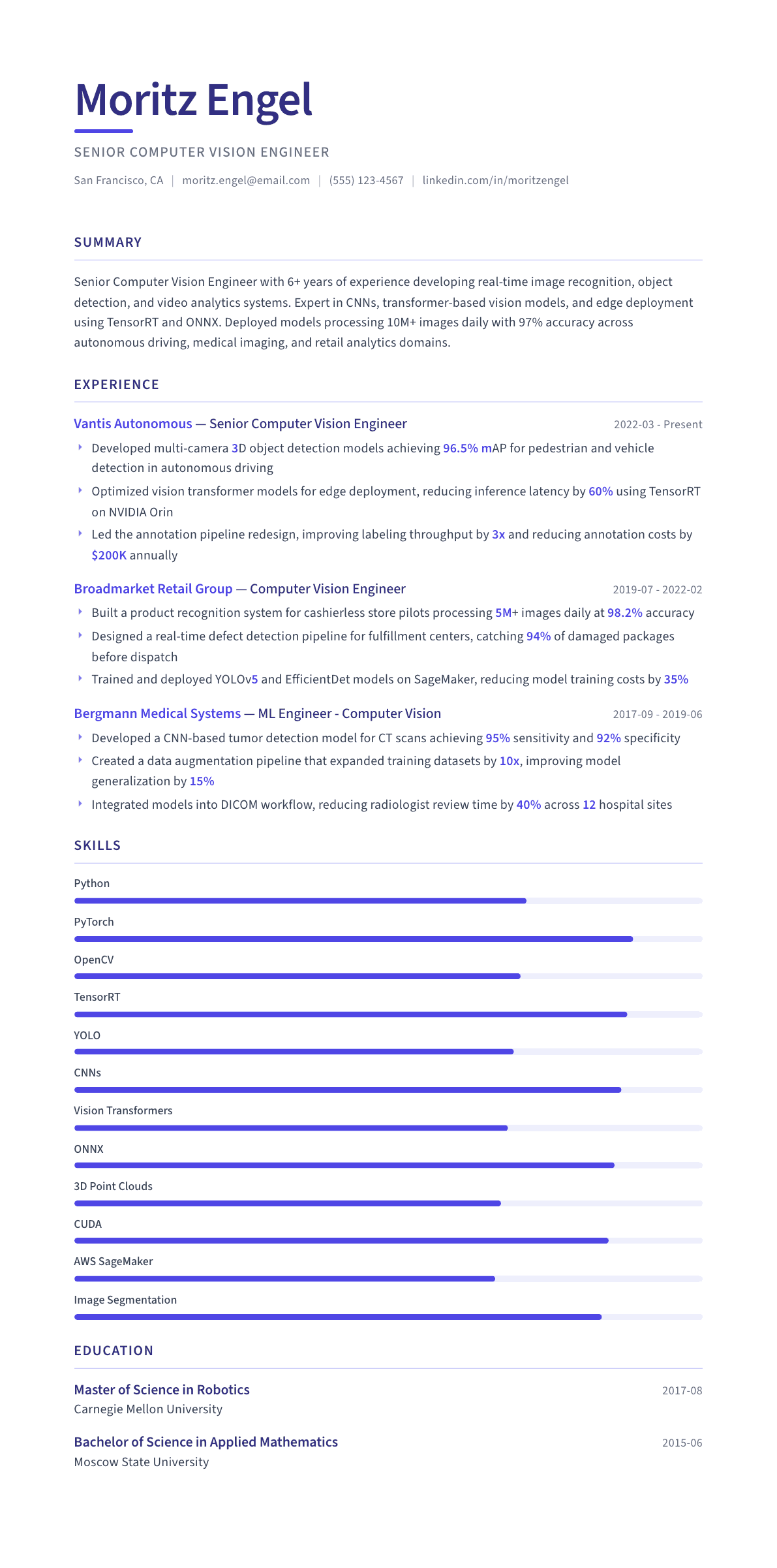
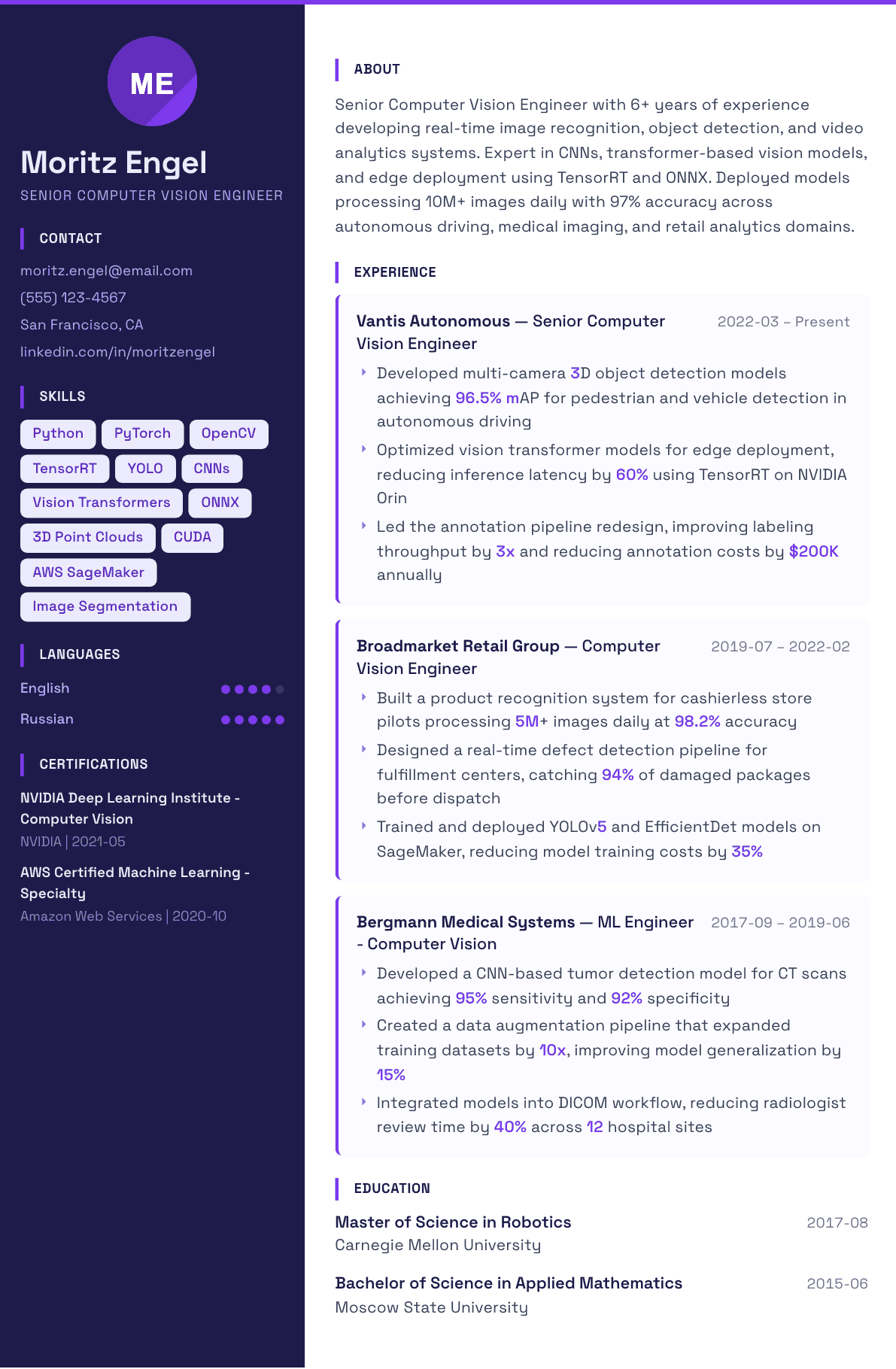
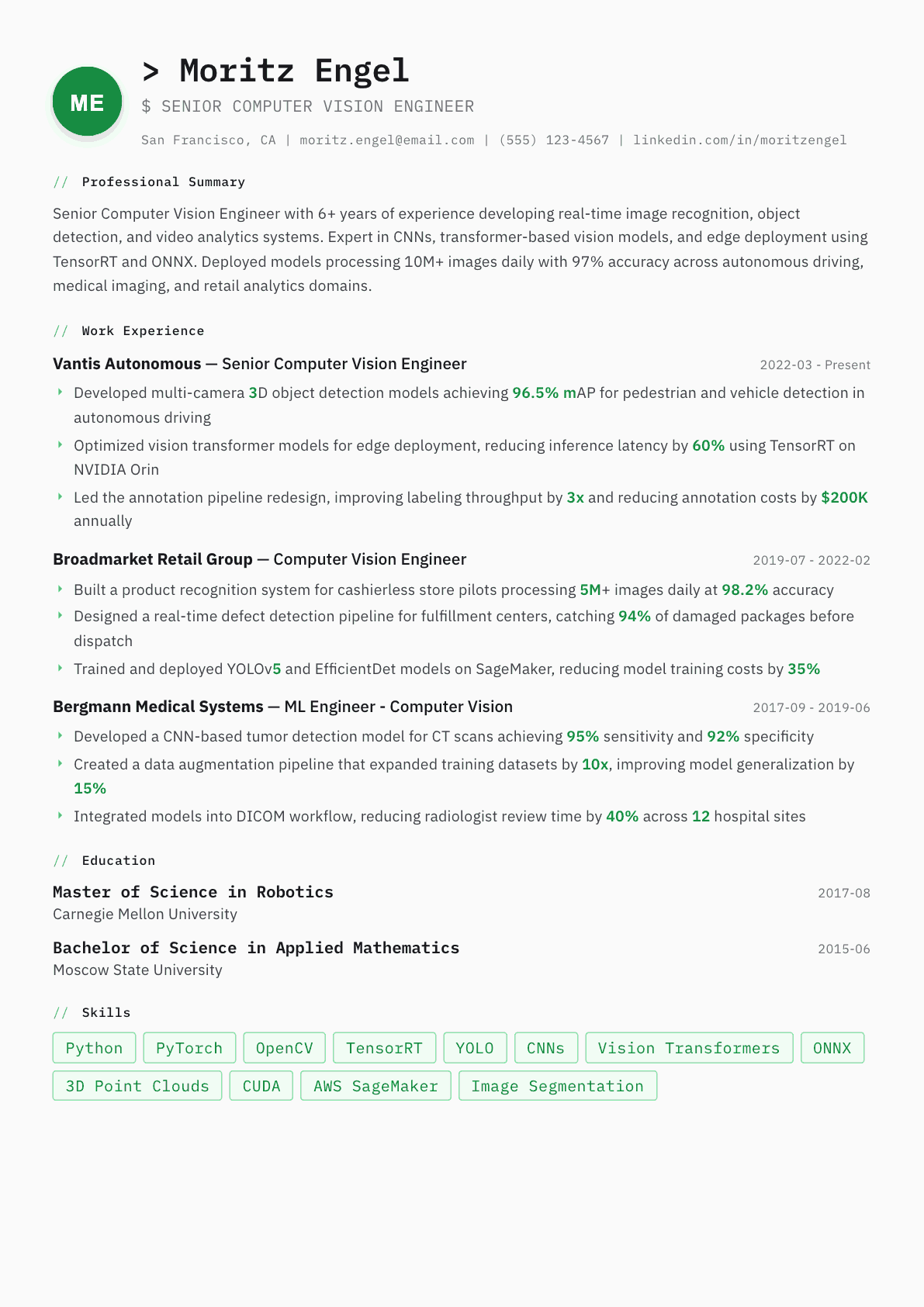
Example Computer Vision Engineer summary
Senior Computer Vision Engineer with 6 years of experience building real-time detection and recognition systems across autonomous driving, medical imaging, and retail domains. Deployed models processing 10M+ images daily at 97% accuracy and optimized vision transformers for edge inference with 60% latency reduction. Expert in PyTorch, OpenCV, TensorRT, and end-to-end ML pipelines.
Skills to list on a Computer Vision Engineer resume
- Python
- PyTorch/TensorFlow
- OpenCV
- TensorRT
- YOLO/SSD/R-CNN
- Vision Transformers
- Image Segmentation
- ONNX
- 3D Point Clouds
- CUDA
- AWS SageMaker
- Data Augmentation
What actually gets this resume read
- Specify model architectures you have worked with: YOLO, EfficientNet, ViT, Mask R-CNN, or custom designs.
- Quantify detection accuracy with metrics like mAP, precision, recall, F1, or AUC scores.
- Highlight edge deployment experience: TensorRT, ONNX Runtime, CoreML, or TFLite optimization.
- Include domain expertise: autonomous driving, medical imaging, retail analytics, or manufacturing.
- Mention dataset scale and annotation pipeline experience to show end-to-end ML ownership.
How to write a computer vision engineer resume
A computer vision engineer resume is read by someone who wants to know whether your models ever left a notebook. Almost every applicant can name architectures and list frameworks. Far fewer can describe the dataset they curated, the failure modes they chased, the metric they reported and the hardware the model finally ran on. The hiring lead is filtering for the second group in about thirty seconds.
Domain is the other filter. Autonomous driving, medical imaging, industrial inspection, retail analytics and document understanding share the same libraries and almost nothing else in terms of data, labeling economics, latency budgets and regulatory pressure. A page that never says which domain you worked in reads as generic to every one of them.
This guide covers how to write each section for vision work specifically, three summaries at the levels teams recognize, before-and-after bullets, and the questions engineers ask when moving in from general machine learning or from research.
Format: one page early, two once you have shipped models to production
Reverse chronological, single column, no images inside the document even though your work is visual. If you have a portfolio of demos or a paper list, put one link in the header and let the reader open it.
Where research and engineering both apply, keep publications in a short block near the end rather than at the top, unless the posting is explicitly a research scientist role. Product teams read the deployment evidence first.
- Header: name, title, location, email, GitHub, and one portfolio or publication link.
- Order: summary, technical skills, experience, selected projects, publications and patents, education.
- Name the accelerator you targeted somewhere on page one: a data center GPU, a Jetson module, a mobile neural engine or a vision accelerator.
Summary: domain, task, deployment target, metric
Three lines built from four facts: the domain you worked in, the vision task, where the model runs, and the metric you were held to. Detection and segmentation on thermal imagery for perimeter security at the edge is a sentence a hiring lead can place immediately.
If you are moving in from research, say what you have taken to production, even if it is small. If you are moving in from general machine learning, name the vision-specific work: annotation pipelines, augmentation strategy, calibration, or handling class imbalance in rare-object detection.
Experience: the data, the model, the evaluation, the deployment
Structure every substantial bullet around one of those four. Data bullets say how many images or frames, how they were labeled, who labeled them and what you did about label noise. Model bullets name the architecture family and what you changed: a backbone swap, an anchor redesign, a loss chosen for class imbalance, a transformer detector replacing a two-stage pipeline.
Evaluation bullets are where vision resumes usually collapse into a single accuracy figure. Report the metric the task actually uses: mean average precision at the intersection-over-union threshold your team used, precision and recall at the operating point, or intersection over union for segmentation. Say what the slice looked like too, because a model that fails at night or on one skin tone is a model that failed.
Deployment bullets name the runtime and the budget: TensorRT or ONNX Runtime or CoreML or TFLite, the precision you quantized to, the frames per second on the target device, and the memory ceiling. That is the part a product team cannot verify from a paper and therefore reads hardest.
The data section teams wish more candidates wrote
Most of the work in applied vision is dataset work, so give it space. Describe the collection setup, the annotation tooling and guidelines you wrote, the quality process, and the active learning or hard-negative mining loop that decided what to label next. An engineer who has run an annotation vendor and audited label quality is worth more than one who only trained on public benchmarks.
Say what you did about the long tail. Rare classes, occlusion, motion blur, glare, sensor variation and domain shift between sites are the problems that kill deployed vision systems, and naming your approach to one of them signals real production experience.
Skills: group them so a reader can scan the stack in one pass
Four groups. Frameworks and libraries: PyTorch, TensorFlow, OpenCV, torchvision, Albumentations. Model families: detection, segmentation, keypoint, tracking, vision transformers, multimodal encoders. Deployment: TensorRT, ONNX, CoreML, TFLite, CUDA kernels if you write them, Triton if you serve with it. Platform: the cloud training environment, experiment tracking, data versioning and orchestration.
Mirror the posting language once. A team asking for edge inference will search for quantization, pruning and latency, and one asking for perception will search for sensor fusion, point clouds and calibration.
Computer Vision Engineer resume summary examples
First vision role after a masters
Machine learning graduate with a thesis on small-object detection in aerial imagery. Trained and evaluated detection models on a forty thousand image annotated set, improved mean average precision 8 points over the baseline with tiling and copy-paste augmentation, and exported to ONNX for a Jetson demo.
Four years in applied vision
Computer vision engineer with 4 years in industrial inspection. Owns the defect detection stack end to end: collection rigs, annotation guidelines, model training in PyTorch and TensorRT deployment on the line, running at 45 frames per second with recall above 0.98 at the agreed operating point.
Lead or staff engineer
Staff computer vision engineer with 9 years across autonomous driving and robotics perception. Leads a team of 6 owning detection, tracking and calibration, cut edge inference latency 41% with quantization-aware training, and built the evaluation harness that gates every model release on slice metrics.
Work experience bullets: before and after
Before: Built an object detection model with high accuracy.
After: Trained a YOLO-family detector on one hundred twenty thousand annotated shelf images, reaching 0.82 mean average precision at 0.5 intersection over union, with per-class reporting so the two rare packaging types were tracked separately.
The dataset size, the exact metric and the rare-class breakdown replace an accuracy claim nobody can interpret.
Before: Deployed models to edge devices.
After: Converted the segmentation model to TensorRT with INT8 calibration and ran it on a Jetson Orin at 30 frames per second within a 4 GB memory budget, holding intersection over union within 1 point of the float baseline.
Runtime, precision, throughput, memory and the accuracy cost together describe a real edge deployment.
Before: Worked on data labeling for the training set.
After: Wrote the annotation guidelines and adjudication rules for a 6-person labeling team, added a consensus audit on 5% of tasks, and raised inter-annotator agreement enough to remove a persistent boundary bias in the masks.
Guidelines, audit sampling and an agreement outcome show ownership of data quality, not just consumption of labels.
Before: Improved model performance through experimentation.
After: Ran a structured ablation over backbone, input resolution and augmentation across 40 tracked experiments, and found that raising input resolution to 1280 recovered most of the loss on small objects at an acceptable latency cost.
A named ablation with a conclusion shows scientific method rather than undirected tuning.
Before: Monitored models in production.
After: Built the drift monitor comparing production image statistics and prediction confidence against the training distribution, which caught a camera firmware change that shifted color balance and triggered a retrain before recall dropped on the line.
A specific detected failure proves the monitoring was real and that you understood the vision-specific drift source.
Hard skills
- PyTorch
- TensorFlow and Keras
- OpenCV
- Object detection architectures
- Semantic and instance segmentation
- Vision transformers
- Multi-object tracking
- Camera calibration and geometry
- 3D point cloud processing
- TensorRT and ONNX Runtime
- Quantization and pruning
- CUDA programming
- Data augmentation pipelines
- Experiment tracking and data versioning
Soft skills
- Framing a vision problem from a vague product request
- Writing annotation guidelines
- Explaining model limits to product owners
- Failure analysis discipline
- Working with hardware and firmware teams
- Reviewing research for practical value
Certifications worth listing
- NVIDIA Deep Learning Institute: Fundamentals of Deep Learning (NVIDIA)
- AWS Certified Machine Learning Specialty (Amazon Web Services)
- Microsoft Certified: Azure AI Engineer Associate (Microsoft)
Mistakes that cost computer vision engineer candidates the interview
- Reporting a single accuracy number for a detection or segmentation task, which tells a vision lead you have not used the task metric.
- Naming architectures without naming the dataset. Anyone can fine-tune a published model on a public benchmark.
- Leaving out the deployment target, so the reader cannot tell whether the model ran on a server rack or a battery-powered camera.
- Skipping the data work entirely, when annotation strategy and label quality are most of an applied vision job.
- Listing every paper you have read as a skill. Familiarity with a method is not experience with it.
- Ignoring the domain. Medical imaging and retail analytics hire on different evidence and a domain-free page persuades neither.
- Pasting a results table into the resume as an image, which parsers drop and reviewers cannot read.
Computer Vision Engineer resume questions
Do I need publications to get a computer vision engineer job?
No, unless the posting is a research scientist role. Product teams weight deployed systems, evaluation rigor and latency work above paper count. One or two publications help, but a model running on a device helps more.
How do I show computer vision work if my datasets were confidential?
Describe the scale, the imaging modality, the task and the metric without the customer name or sample images. Then add a public project, a competition placement or an open-source contribution so the reviewer has something they can open.
Should I list Kaggle competitions on a computer vision resume?
List them if you placed well or if the competition matches the target domain, with the placement and the approach in one line. A long list of entries without results reads as practice rather than achievement.
How much MLOps should a computer vision engineer show?
Enough to prove your model survived contact with production: training reproducibility, dataset versioning, an evaluation harness that gates releases, and monitoring for drift. Full platform ownership is a different job, but zero of it is a red flag.
Is classical image processing still worth listing?
Yes. Calibration, geometric transforms, morphological operations and classical tracking still solve production problems faster and cheaper than a network. Teams working with fixed cameras or constrained hardware actively look for it.
Related resume examples
- AI Research Scientist Resume example
- Machine Learning Engineer Resume example
- NLP Engineer Resume example
- Data Scientist Resume example
- MLOps Engineer Resume example
- Software Engineering Intern Resume example