Head of Marketing Resume Examples: the lines they read
Head of Marketing Resume Example That Reads as a Leader
By Mustafa Tarabya, founder of CVBooster · Published · Updated
Head of marketing resume example written out in full: team, budget and pipeline scope, leadership bullets, three summaries, keywords and a writing guide.
Sample resumes for a head of marketing
The same head of marketing content laid out in three CVBooster templates, so you can see what the finished document looks like before you write a word.
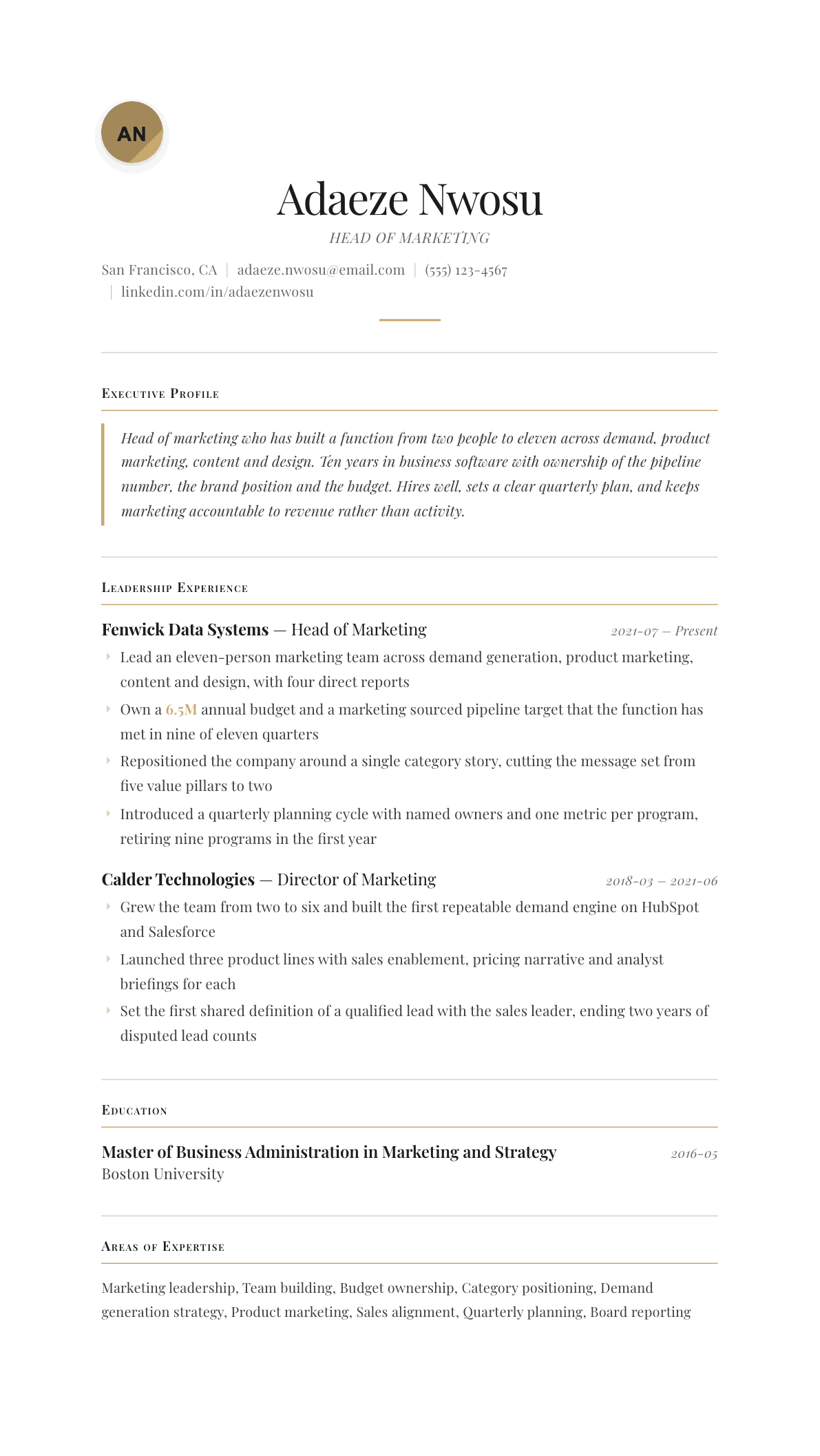
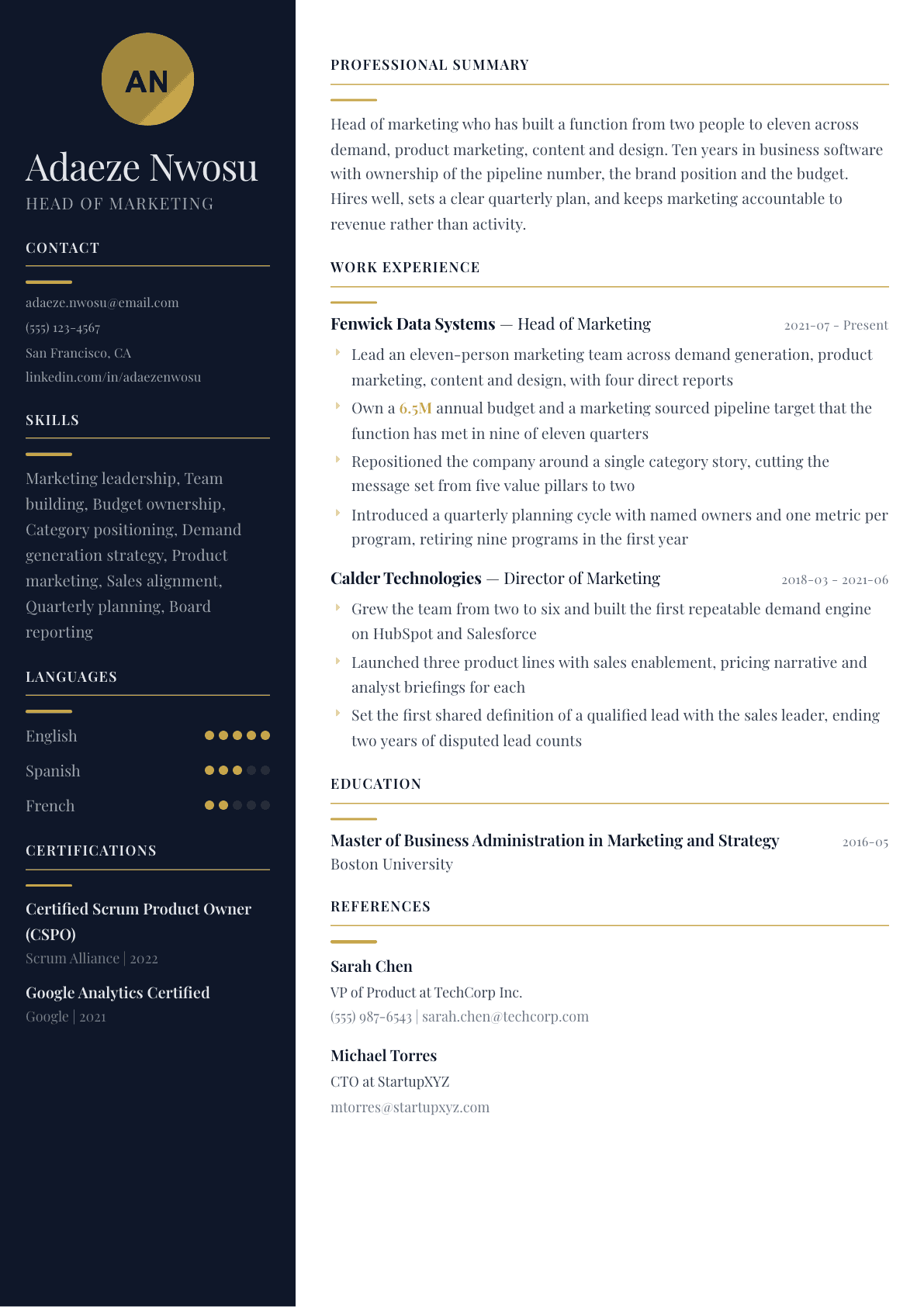
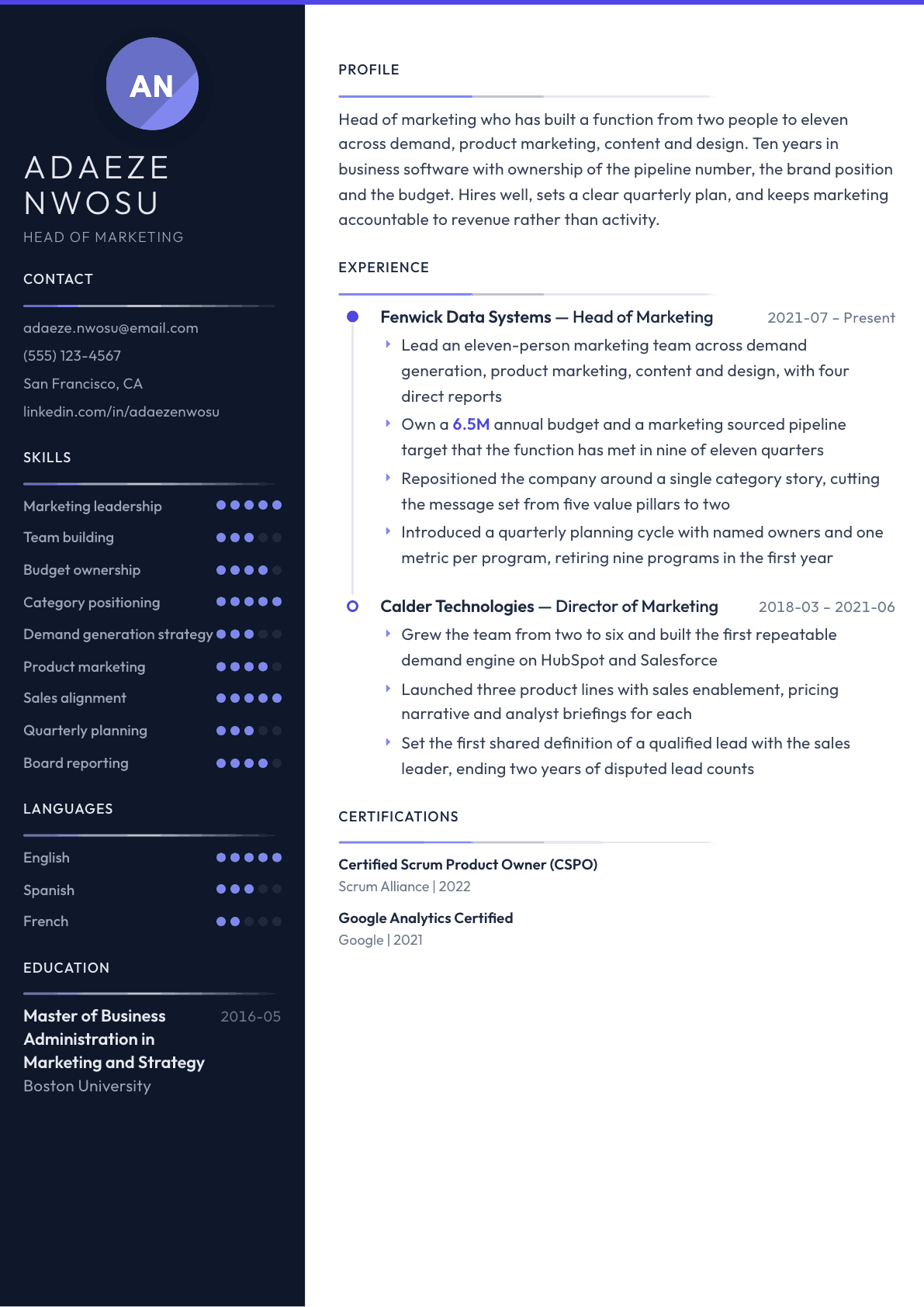
Example Head of Marketing summary
Head of marketing with ten years in business software, currently leading an eleven-person team across demand generation, product marketing, content and design on a budget above six million. Owns the sourced pipeline number and has met it in most quarters since taking the seat. Repositioned the company around one category story, installed a quarterly planning rhythm with named owners, and retired the programs that could not defend a metric.
Skills to list on a Head of Marketing resume
- Marketing leadership
- Team building and hiring
- Budget ownership
- Category positioning
- Brand strategy
- Demand generation strategy
- Product marketing
- Sales and marketing alignment
- Quarterly planning
- Marketing operations
- Analyst relations
- Pricing narrative
- Board reporting
- Agency management
What actually gets this resume read
- Open with the scope you carried: team size, budget, revenue or pipeline number, and how many functions reported to you.
- Show that you hired and developed people, because a head of marketing is judged on the bench they leave behind.
- Name the positioning work you led, since senior marketing hiring turns on whether you can define a category story.
- Give the operating rhythm you installed: planning cycles, program reviews, the metric each program had to defend.
- Include what you stopped, not only what you launched, because pruning is the clearest signal of a leader with priorities.
- Match the stage of the company you are applying to, since building a first team differs from running an established one.
How to write a head of marketing resume
A head of marketing resume is usually read by a founder or a chief executive rather than another marketer. That changes what belongs on the page. Channel craft matters far less than three things a company leader can evaluate: what you were accountable for, what you built, and what you decided not to do. Tactical detail that would impress a marketing peer often reads as noise to the person who will hire you.
The role also carries an ambiguity worth resolving early. In a company of forty people the head of marketing writes the positioning and sometimes the email. In a company of four hundred she runs directors and never touches a campaign. Both are legitimate, but they are different jobs, and a resume that hides which one you did will get filtered by both.
This guide covers how to lead with scope, how to write leadership bullets that show judgment rather than activity, how to present the function you built, a head of marketing resume written out in full, and the questions marketing leaders ask when their resume is not reaching the shortlist.
Format: scope block first, two pages maximum
Reverse chronological, two pages at most, with the earliest roles compressed to a line each. Directly under each employer, write a scope block: team size and structure, direct reports, budget owned, the revenue or pipeline number you were accountable for, and the company stage and size. A chief executive can size you from that block alone.
Resist the campaign gallery. A head of marketing resume that lists launches, taglines and channel results reads as a manager resume with a bigger title on top. The launches belong as evidence beneath the leadership decisions, not as the structure of the page.
- Scope block per employer: team, reports, budget, number owned, company stage.
- Sections: summary, leadership experience, functional strengths, education.
- Compress anything before your first leadership role into one or two lines.
- Keep the page readable by a non-marketer, since one will read it.
Summary: accountability, team, and the change you led
Three or four lines. The scope you carry, the function you built or inherited, and the single most important change you led. A summary that opens with strategic marketing leader with a proven track record could describe anyone at any company and gets skimmed past.
Name the company stage you fit. Building a first marketing team from two people is a different capability from professionalizing an established twenty-person function, and leaders hire for the transition they are actually in. Saying which one you are good at is a filter that works in your favor.
Experience: the function you built, the rhythm you set, the things you stopped
Start each role with the state you inherited and the state you left. Two people and no reporting to eleven people and a quarterly plan. No agreed lead definition to a shared funnel model with sales. That framing lets a reader see the delta rather than a snapshot, and delta is what a hiring board is buying.
Hiring and development deserve real space. Roles you opened, how you structured the team, people you promoted, retention through a difficult period. A head of marketing is judged in part on the bench she leaves behind, and almost nobody writes that down clearly.
Then the judgment bullets. Positioning work you led and the message set you cut. The operating rhythm you installed and what each program had to defend. The programs, agencies or channels you retired. Pruning is the clearest available proof that you set priorities rather than accumulating activity.
- Open each role with the before and after state of the function.
- Name roles you hired, people you promoted, and how the team was structured.
- Describe the planning cadence and the metric each program had to defend.
- List what you stopped and the reasoning that ended it.
Functional strengths: breadth without pretending to be everywhere
A leader is expected to cover brand, demand, product marketing, communications and operations, but nobody is deep in all five. Say where your depth is and where you hire for it. Naming your own gap and how you fill it reads as maturity to an executive audience and as honesty to the marketers you would inherit.
Keep the systems list short and strategic: the automation and customer relationship platforms your team runs, the reporting model you hold everyone to, and any agency structure you manage. Tool depth is a manager credential, not a leadership one.
Keywords executive screens look for
Postings for this seat repeat a leadership vocabulary: marketing leadership, marketing strategy, team building, budget ownership, pipeline accountability, positioning, brand strategy, product marketing, sales alignment, marketing operations, agency management, annual planning. Attach each to a scope figure rather than a claim, because search firms and founders both scan for scale before anything else.
Head of marketing resume example, start to finish
A head of marketing resume reads best when every role opens with scope and every bullet is a decision. The sample below is for a leader moving from a growth-stage software company to a larger one. The person and companies are invented, so keep the order and replace each line with your own scope, team and results.
- Header: Helena Marsh, Head of Marketing. City, phone, email, LinkedIn profile.
- Summary: Head of marketing who built a B2B software marketing function from three people to fourteen across demand, product marketing and brand. Owns the marketing budget and the pipeline target agreed with sales, reports to the chief executive, and is strongest at the stage where a founder-led company needs its first real planning rhythm.
- Current role, Head of Marketing, Northvale Software. Scope: fourteen people, four direct reports, the full marketing budget, the marketing-sourced pipeline target, a Series B company.
- Rebuilt positioning around one buyer after interviews on lost deals; cut the message set from five audiences to two and retrained the sales team on the new story.
- Installed a quarterly plan in which every program defended one pipeline metric; retired two agencies and one paid channel that could not.
- Hired the first product marketing lead and promoted two team members into manager roles; kept the team intact through a reorganization.
- Previous role, Director of Demand Generation, Ferrow Analytics: ran paid, email and events with a team of five; built the shared lead definition with sales operations.
- Earlier roles, Marketing Manager and Marketing Coordinator, one line each. Education: Bachelor of Business Administration, marketing.
Head of Marketing resume summary examples
First leadership seat
Marketing manager stepping up to lead a three-person team at a growing software company. Built the first repeatable demand engine on HubSpot and Salesforce, set the first shared definition of a qualified lead with the sales leader, and now owns the annual plan and budget.
Head of marketing, mid-size company
Head of marketing leading an eleven-person function across demand generation, product marketing, content and design, with four direct reports and a 6.5M budget. Owns the sourced pipeline target and has met it in nine of eleven quarters, after repositioning the company around a single category story.
Two-time head of marketing
Marketing leader who has run the function twice, first building a team from two people to six and then from six to twenty-two through a move upmarket. Owns brand, demand and product marketing together, and has installed the quarterly planning rhythm at both companies.
Work experience bullets: before and after
Before: Led the marketing team and managed the marketing budget.
After: Led an eleven-person function across demand generation, product marketing, content and design with four direct reports and a 6.5M annual budget.
Team composition, reporting structure and budget give a chief executive the scope she needs in a single line.
Before: Developed the company positioning and messaging.
After: Led a repositioning around a single category story, cutting the message set from five value pillars to two and rewriting the website, sales deck and analyst briefing around it.
Naming what was removed and where the new story landed shows a decision rather than a workshop.
Before: Grew the marketing team and hired new roles.
After: Grew the team from two to eleven over three years, opened the first product marketing and marketing operations roles, and promoted two managers from within.
Growth path, the roles created and internal promotions show you built a bench rather than filled seats.
Before: Improved marketing planning and reporting.
After: Introduced a quarterly planning cycle in which every program carried one named owner and one metric, and retired nine programs that could not defend theirs in the first year.
The mechanism plus the number of programs cut proves a real operating rhythm with consequences.
Before: Worked closely with the sales team to drive revenue.
After: Agreed a shared qualified lead definition and funnel model with the sales leader, ending two years of disputed lead counts and putting one pipeline number in the weekly revenue meeting.
A specific artifact and the dispute it resolved make sales alignment verifiable instead of aspirational.
Hard skills
- Marketing leadership
- Annual and quarterly planning
- Budget ownership
- Pipeline accountability
- Category positioning
- Brand strategy
- Demand generation strategy
- Product marketing
- Marketing operations
- Sales and marketing alignment
- Agency management
- Hiring and team design
- Analyst and press relations
- Pricing and packaging input
Soft skills
- Prioritization
- Coaching and development
- Executive communication
- Decisiveness under incomplete information
- Influence without authority
- Comfort saying no
Certifications worth listing
- Pragmatic Institute Foundations Certification (Pragmatic Institute)
- Google Analytics Certification (Google)
- HubSpot Marketing Software Certification (HubSpot Academy)
Mistakes that cost head of marketing candidates the interview
- Structuring the page around campaigns, which makes a leader read like a senior manager.
- Leaving out team size and budget, the two facts a founder uses to size a candidate immediately.
- Never naming a decision to stop something, so the resume reads as accumulation rather than prioritization.
- Claiming depth in every function instead of stating where you are strong and where you hire.
- Ignoring company stage when the transition you are good at is the real hiring criterion.
- Writing for a marketing audience when the reader is usually a chief executive or a founder.
Head of Marketing resume questions
What is the difference between a head of marketing and a marketing director?
Accountability rather than seniority alone. A head of marketing owns the whole function, the budget and usually a revenue or pipeline number, and reports to the chief executive. A director typically owns a discipline inside a larger function and reports to a vice president.
What should a head of marketing resume show first?
Scope, before any campaign. Under each employer give the team size, direct reports, budget owned, the pipeline or revenue number you answer for and the company stage. Then three or four decisions: positioning you changed, the planning rhythm you installed, what you stopped, and who you hired or promoted.
Should I include the revenue number my marketing contributed?
Yes, if you can state it honestly and explain the model. Sourced pipeline or sourced revenue with the attribution approach named is credible. Influenced revenue on its own invites skepticism, because almost any deal can be described as marketing influenced.
How do I position myself if my team was small?
Own it and pair it with breadth. Leading a four-person team where you also wrote the positioning, ran the agency and built the reporting is genuinely attractive to companies at the same stage. Trying to sound larger than you were is easy to unpick in a reference call.
Do I need an MBA to become a head of marketing?
No. It helps in some corporate environments and matters very little in software and consumer companies, where scope and results decide. If you have one, keep it to a line. If you do not, spend the space on budget, team and the numbers you carried instead.