VP of Marketing Resume Examples: the lines they read
Craft a VP of Marketing Resume Built for the Executive Shortlist
By Mustafa Tarabya, founder of CVBooster · Published · Updated
VP of marketing resume example with growth, org and budget bullets, the executive signals recruiters look for, keywords, and a writing guide.
Sample resumes for a vp of marketing
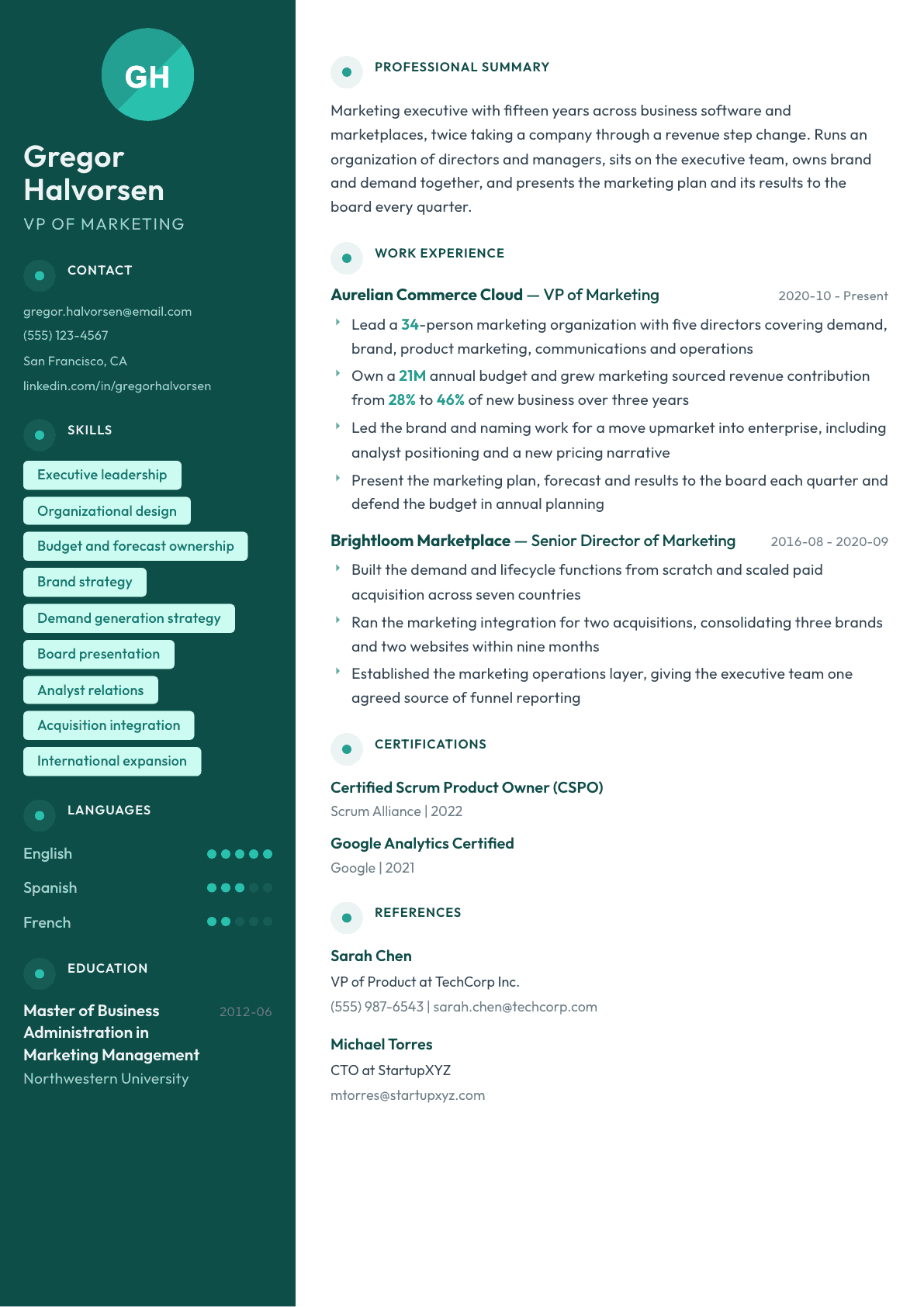
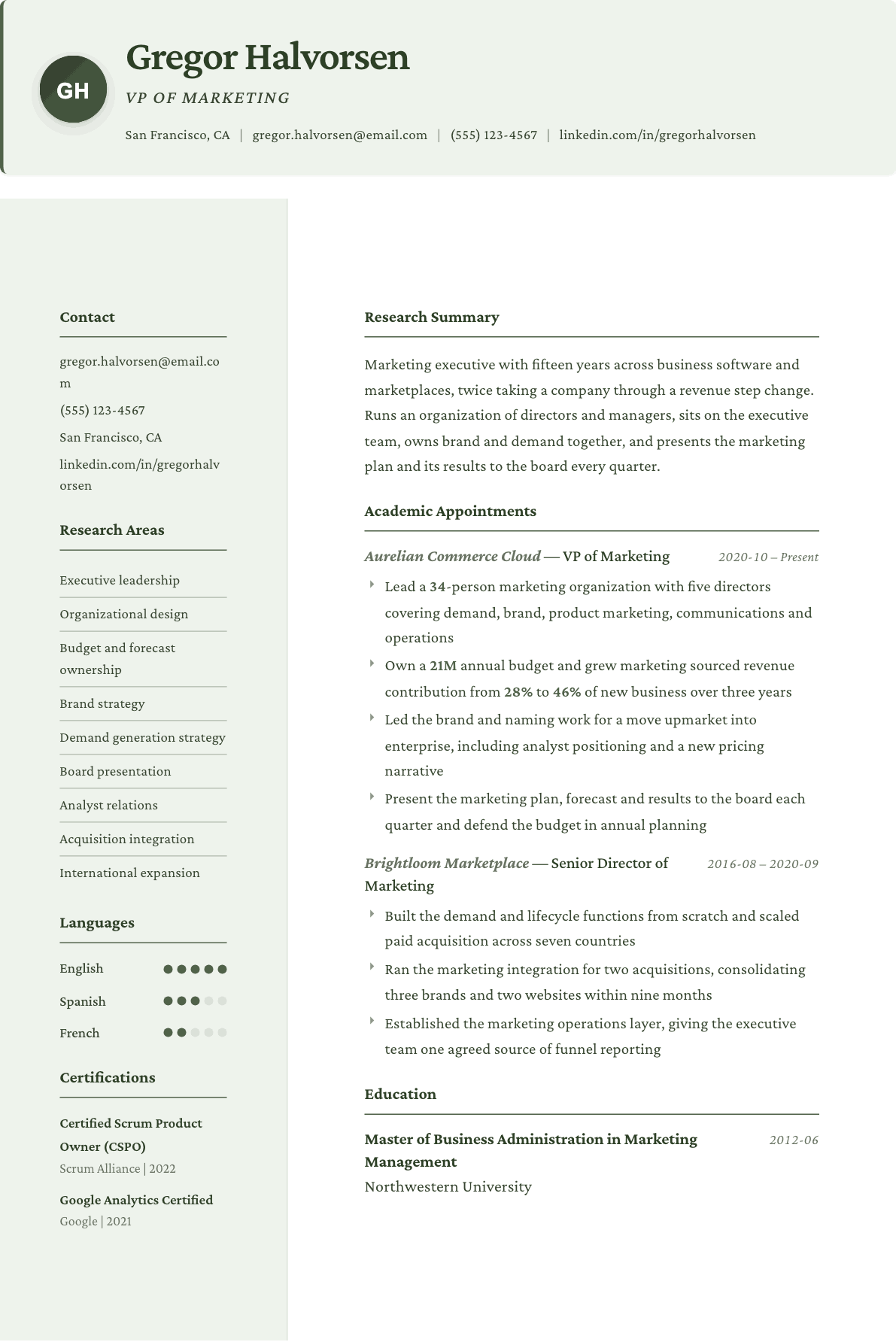
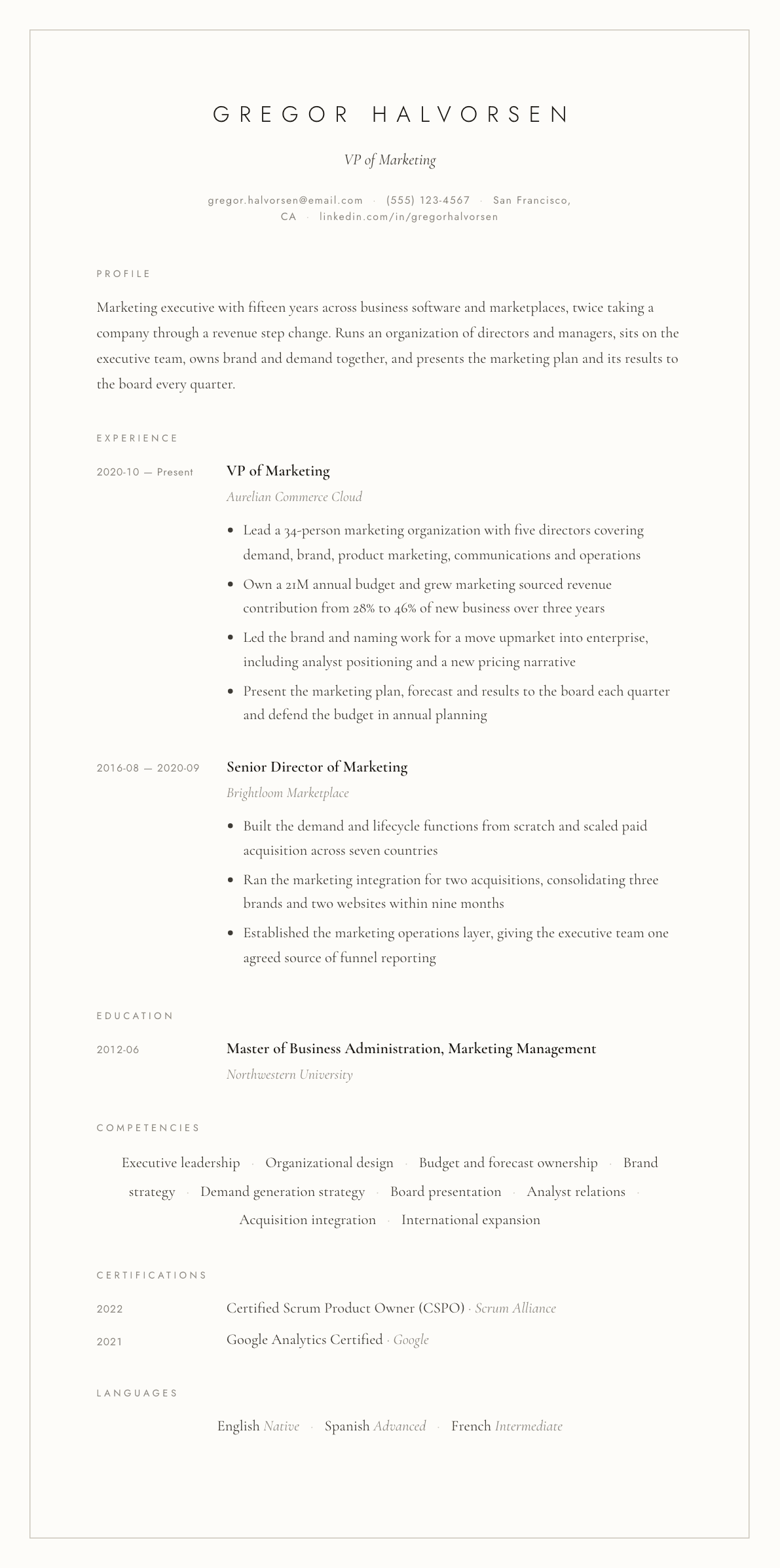
The same vp of marketing content laid out in three CVBooster templates, so you can see what the finished document looks like before you write a word.
Example VP of Marketing summary
Marketing executive with fifteen years in business software and marketplaces, currently leading a thirty-four person organization with five directors and a budget above twenty million. Raised marketing sourced revenue contribution from under a third of new business to nearly half while leading a move upmarket into enterprise. Presents plan, forecast and results to the board quarterly, and has integrated marketing through two acquisitions.
Skills to list on a VP of Marketing resume
- Executive leadership
- Organizational design
- Budget and forecast ownership
- Revenue contribution modeling
- Brand strategy
- Category creation
- Demand generation strategy
- Product marketing leadership
- Communications strategy
- Analyst relations
- Board presentation
- Acquisition integration
- International expansion
- Executive hiring
- Pricing strategy
What actually gets this resume read
- State the size of the organization you ran and how many directors reported to you, because span of control is the first filter.
- Tie marketing to revenue contribution, not lead volume, since executive search screens on business outcomes.
- Include board and executive team work explicitly, because a VP who has never presented to a board reads as a director.
- Name the inflection you led: a move upmarket, a rebrand, an international launch, or an acquisition integration.
- Show organizational design decisions, such as functions you created, merged or outsourced, and why you made the call.
- Keep the first third of the page strategic and push tactical detail into the earlier roles further down.
How to write a vp of marketing resume
At the vice president level the resume stops being an application and becomes a briefing document. It is read by an executive search partner, a chief executive and often a board member, each of whom spends under two minutes on it. They are looking for span of control, the business inflection you led, and whether your numbers connect to revenue rather than to marketing activity.
The most common failure at this level is a resume that is simply a bigger version of a director resume. Longer bullet lists, more channels, more tools. Search partners discount that instantly, because a vice president is hired to design an organization, allocate capital and carry a forecast, not to run more programs than the last person.
This guide covers what an executive scope block should contain, how to write about organizational and commercial decisions, how to handle board-facing work on paper, and the questions marketing executives ask when a search process stalls at the resume stage.
Format: two pages, an executive scope block, no tool inventory
Two pages is standard and expected. Lead each role with a scope block: organization size, the leaders reporting to you, the budget, the revenue or contribution number you carried, the company revenue scale, and the ownership structure if it is relevant. Private equity backed, venture backed and public companies run marketing differently, and search partners screen on that.
Cut the tool inventory entirely, or reduce it to the systems your organization standardized on. A vice president listing platform certifications signals someone who has not yet made the jump from doing to directing.
- Scope block per role: organization size, direct leaders, budget, number carried, company scale.
- Sections: executive summary, leadership experience, board and executive contribution, education.
- Compress everything before your director years into a two-line career note.
- State the ownership structure and stage of each company you led marketing at.
Executive summary: the inflection you have led twice
Four lines at most. State the size of organization you run, the commercial number you carry, and the inflection you are known for: a move upmarket, a category redefinition, an international expansion, a rebrand through a merger, a turn from founder-led selling to a repeatable engine. Executive hiring is pattern hiring, and the pattern is the point.
If you have led that inflection more than once, say so explicitly. Search partners are trying to reduce risk, and a leader who has done the same transition twice at different companies is materially less risky than one who did it once and may have been carried by circumstance.
Experience: organization design, capital allocation, and commercial outcomes
Organization design comes first. Functions you created, merged or outsourced, the leaders you hired, the layers you removed, and what the structure was solving for. A reader wants to see that you can shape a team around a strategy rather than inherit one and defend it.
Capital allocation comes second. Budget size is table stakes; the interesting content is how you moved it. A reallocation between brand and demand, a decision to bring a function in-house, an agency roster you consolidated, a market you chose not to enter. Each of those is a decision a board would have discussed.
Commercial outcomes come third and must be expressed in business terms: contribution to new business, win rate movement, average deal size, market share position, or the pipeline coverage ratio you maintained. Marketing-internal metrics belong in the interview, not on an executive page.
- Name the leaders you hired and the functions you created or retired.
- Show one reallocation decision with the reasoning and the outcome.
- Express results as contribution to revenue, deal size, win rate or market position.
- Include integration or expansion work with the timeline you delivered it in.
Board and executive contribution: say it plainly
Executive search screens explicitly for board exposure, so give it a named place on the page. The cadence you presented at, what you owned in the pack, the annual planning and budget defense, and any diligence or fundraising work you supported. A vice president who has never presented to a board reads to a search partner as a director with a generous title.
Peer relationships matter too. Working agreements with the chief revenue officer, product leadership and finance are the everyday substance of the role. One line describing how you ran the marketing and sales operating agreement is worth more than a paragraph of strategy language.
Keywords search firms scan for
Executive marketing searches use a consistent vocabulary: marketing executive, organizational design, revenue contribution, budget ownership, category creation, brand strategy, go to market strategy, demand generation strategy, product marketing leadership, analyst relations, board presentation, acquisition integration, international expansion, executive hiring. Anchor each to a scope figure, because search partners build a shortlist from scale before they read a single achievement.
VP of Marketing resume summary examples
First executive seat
Senior director stepping into a vice president role, currently leading fourteen people across demand, brand and product marketing at a venture backed software company. Built the marketing operations layer that gave the executive team one agreed funnel model, and now presents the marketing forecast in the quarterly business review.
Vice president, growth stage company
Vice president of marketing leading a thirty-four person organization with five directors and a 21M budget. Raised marketing sourced contribution from just over a quarter to nearly half of new business across three years while leading the brand and pricing work behind a move upmarket into enterprise accounts.
Two-company executive
Marketing executive with fifteen years across business software and marketplaces, twice taking a company through a revenue step change. Has run organizations above thirty people, integrated marketing through two acquisitions, expanded into seven countries, and presented plan and results to a board every quarter for six years.
Work experience bullets: before and after
Before: Led the marketing organization and reported to the CEO.
After: Led a thirty-four person marketing organization with five directors across demand, brand, product marketing, communications and operations, on a 21M annual budget.
Organization size, leader count, functional span and budget are what a search partner uses to shortlist.
Before: Contributed to company revenue growth through marketing.
After: Grew marketing sourced contribution from 28% to 46% of new business over three years, with the attribution model agreed jointly by marketing, sales operations and finance.
A contribution figure with an agreed model behind it survives the scrutiny that an unqualified growth claim will not.
Before: Repositioned the brand for the enterprise market.
After: Led the brand, naming and pricing narrative for a move upmarket into enterprise, including analyst positioning and a new segmentation of the target account list with sales leadership.
Naming the components of the move shows an executive program rather than a marketing campaign.
Before: Managed marketing during two company acquisitions.
After: Ran the marketing integration for two acquisitions, consolidating three brands and two websites within nine months while protecting inbound volume through the transition.
A timeline and a protected metric turn integration work into evidence of executing under real constraint.
Before: Presented marketing updates to the board.
After: Presented the marketing plan, forecast and results to the board each quarter and defended the annual budget against the operating plan alongside finance.
Naming what you presented and what you defended distinguishes ownership from attendance at the meeting.
Hard skills
- Executive leadership
- Organizational design
- Budget and forecast ownership
- Revenue contribution modeling
- Go to market strategy
- Category creation
- Brand strategy
- Product marketing leadership
- Communications strategy
- Analyst relations
- Board presentation
- Acquisition integration
- International expansion
- Pricing strategy
Soft skills
- Executive presence
- Capital allocation judgment
- Hiring senior leaders
- Peer negotiation with revenue and product
- Communicating uncertainty to a board
- Long horizon prioritization
Mistakes that cost vp of marketing candidates the interview
- Writing a longer director resume instead of an executive one built on scope and decisions.
- Listing platforms and certifications, which signals a leader still operating at the doing level.
- Omitting board and executive team contribution, one of the explicit screens in executive search.
- Using marketing-internal metrics where a board would expect revenue, win rate or market position.
- Failing to name the ownership structure and stage of each company, which search partners match on.
- Claiming a company outcome without describing the marketing decisions that contributed to it.
VP of Marketing resume questions
How long should a VP of marketing resume be?
Two pages. One page forces you to cut the scope and organizational detail that decides this hire, and three pages signals an inability to prioritize. Compress everything before your director years into a short career note at the end.
Should a marketing executive resume include a board section?
Give board work a clear place, either as a short section or as consistent bullets in each role. Name the cadence, what you owned in the pack, and any fundraising or diligence support. Search partners screen for this explicitly and rarely infer it.
How do I show impact when marketing results were shared with sales?
Use jointly agreed measures and say they were agreed. Sourced contribution, pipeline coverage and win rate on marketing-originated opportunities all carry weight when you name the model and who signed off on it, which is exactly how a board would have seen the number.
Does company stage matter more than industry at executive level?
Usually yes. Moving between adjacent industries is common, but moving from a large established company to an early venture backed one is where executives most often struggle. Make your stage experience explicit so the match is judged on the dimension that actually predicts fit.
What should I do about a short tenure in an executive role?
Include it with the dates and a one-line reason if the reason is structural: an acquisition, a funding failure, a change of chief executive. Search partners see short executive tenures constantly. An unexplained gap invites a worse assumption than the truth usually deserves.