Maintenance Mechanic Resume Examples: what gets the call
Write a Maintenance Mechanic Resume That Names the Machines
By Mustafa Tarabya, founder of CVBooster · Published · Updated
Maintenance mechanic resume example, keywords and writing guide covering hydraulics, pneumatics, gearboxes, alignment and welding repair.
Sample resumes for a maintenance mechanic
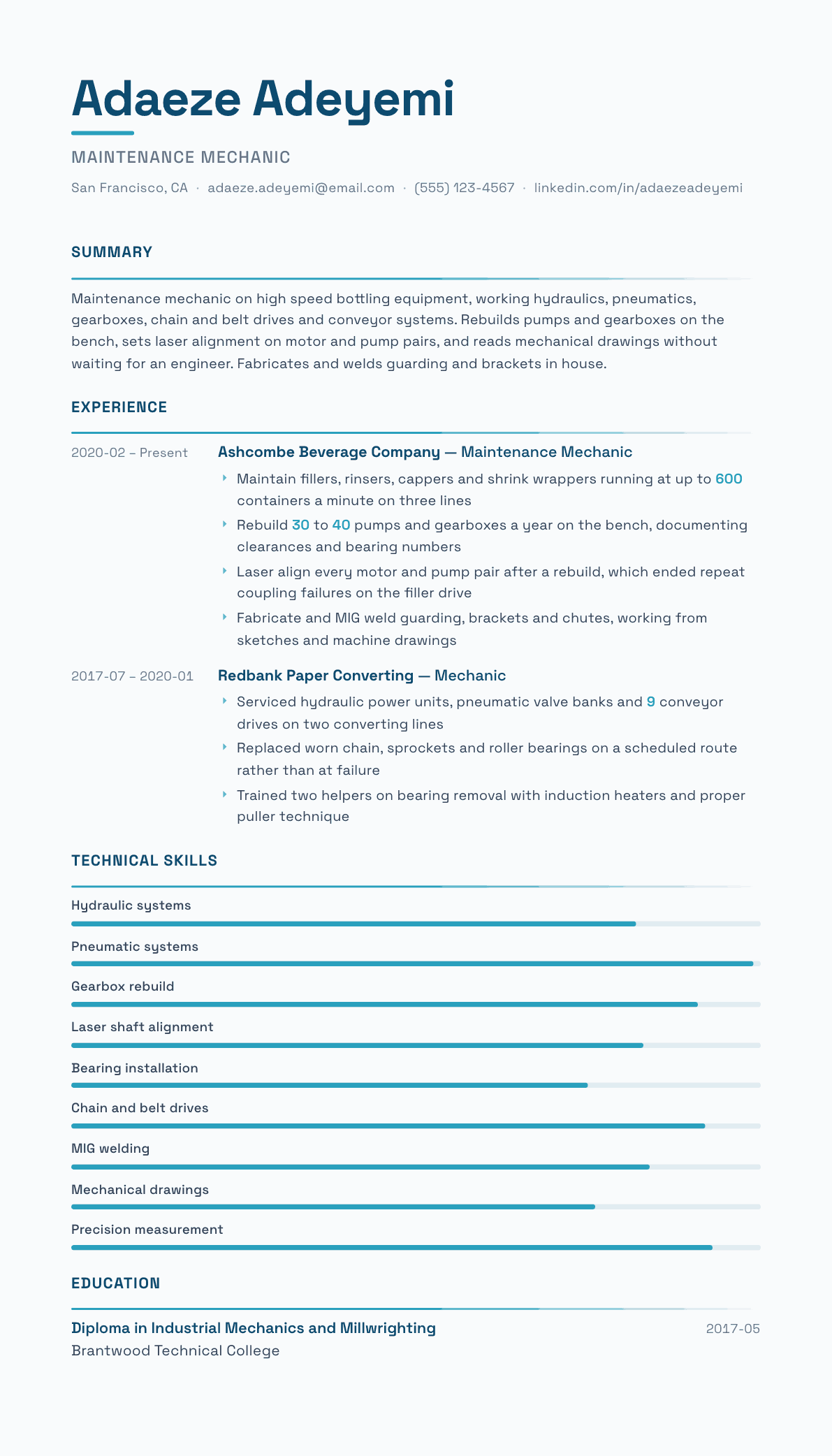
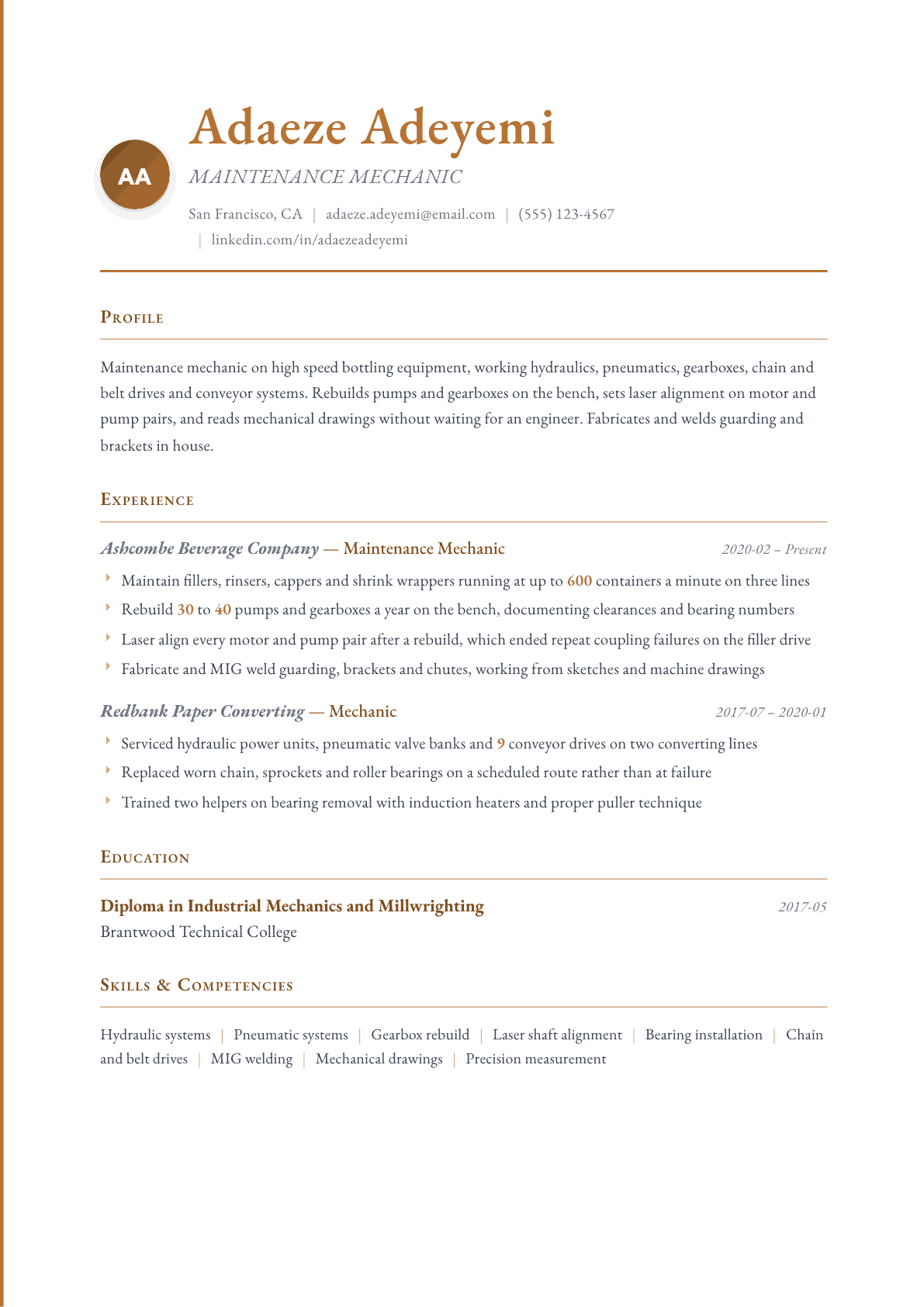
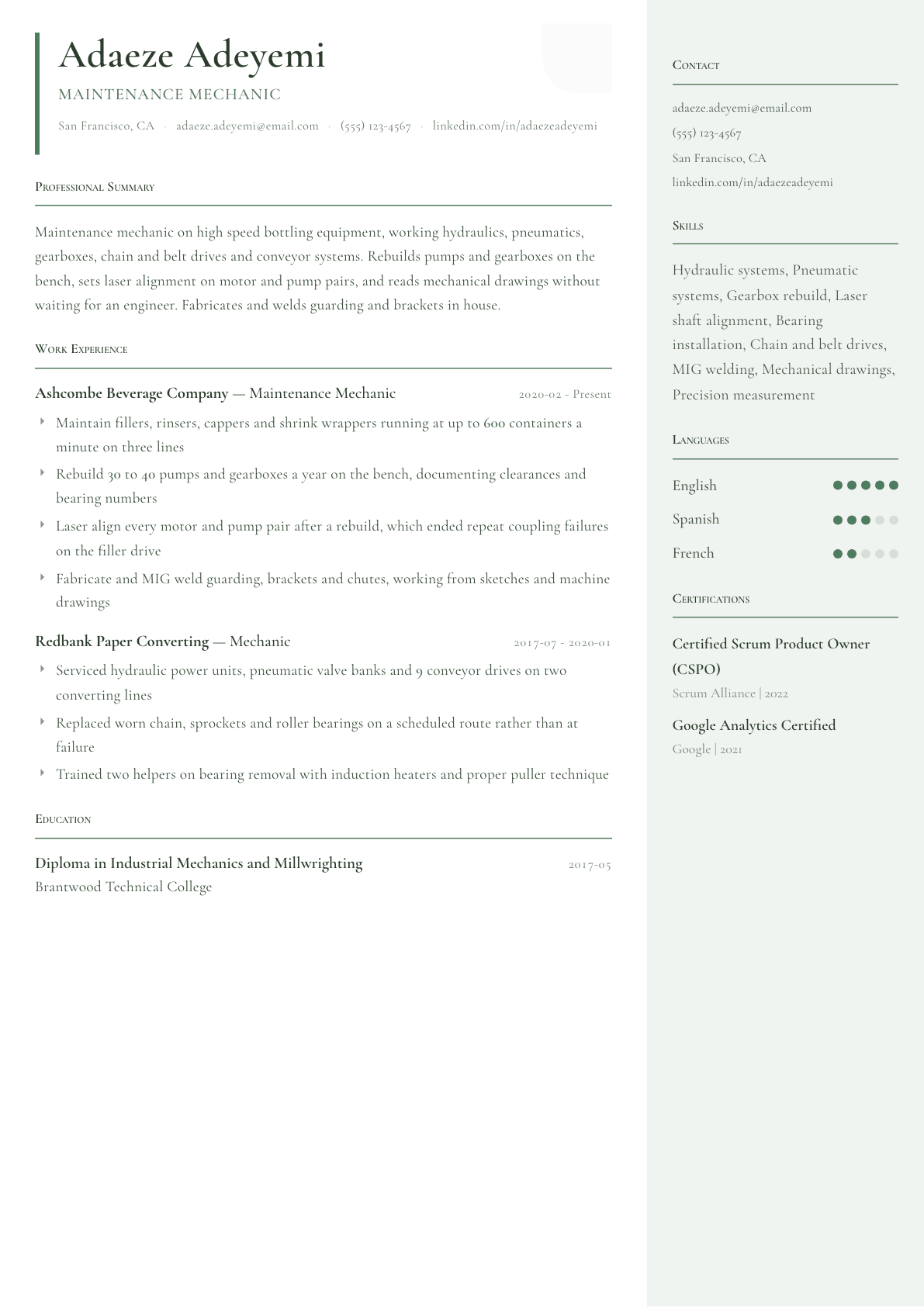
The same maintenance mechanic content laid out in three CVBooster templates, so you can see what the finished document looks like before you write a word.
Example Maintenance Mechanic summary
Maintenance mechanic with six years on high speed bottling and converting equipment, covering hydraulics, pneumatics, gearboxes, chain and belt drives and conveyor systems. Rebuilds pumps and gearboxes on the bench with clearances recorded, laser aligns every motor and pump pair, and fabricates guarding and brackets with MIG and stick welding. Reads mechanical and hydraulic prints and documents every repair in the work order system.
Skills to list on a Maintenance Mechanic resume
- Hydraulic troubleshooting and repair
- Pneumatic valves and actuators
- Pump and gearbox rebuilding
- Laser and dial indicator alignment
- Bearing and seal replacement
- Chain, belt and gear drives
- Conveyor systems
- MIG and stick welding
- Cutting torch and plasma
- Precision measurement tools
- Mechanical and hydraulic prints
- Vibration and heat checks
- Lockout tagout
- CMMS work order documentation
What actually gets this resume read
- Name the machines you maintain by type and by speed, because a mechanic on slow equipment reads differently.
- List your rebuild work with volumes: pumps, gearboxes, valves, and what you record on each one.
- Say whether you align with dial indicators, a laser kit, or both, and which brand of kit you know.
- Show your fabrication and welding processes, since plants value a mechanic who does not wait on a shop.
- Give your precision measurement tools by name, from micrometers and bore gauges to dial indicators.
- Mention the drawings you read: mechanical assemblies, hydraulic schematics, pneumatic circuit diagrams.
- Include your lockout tagout discipline and any confined space or hot work permits you hold.
How to write a maintenance mechanic resume
A maintenance mechanic is hired for hands and judgment. The person reading your resume, usually a maintenance supervisor who came up the same way, is trying to picture you in front of a stopped machine at three in the morning with a gearbox howling and a production lead behind you. He wants to know what you would open, what you would measure, and whether the repair would still be holding a month later.
That picture never forms from a resume that says "performed mechanical repairs on production equipment". It forms from machine names, speeds, rebuild counts, alignment methods and measuring tools. A mechanic who writes that he laser aligns every motor and pump pair after a rebuild has told a supervisor more in one line than most candidates manage in a page.
This guide covers the layout supervisors scan, how to write rebuild and troubleshooting work with real specifics, the certifications worth listing for this trade, the mistakes that make an experienced mechanic look green, and the questions mechanics ask when moving between industries.
Format: one page, equipment block near the top, welding and measuring called out
One page, reverse chronological. Under the contact line, put an equipment block naming the machine families you have maintained: fillers and cappers, extruders, presses, conveyors, packaging equipment, pumps and compressors. A supervisor matches that block against his own floor before he reads anything else.
Give fabrication its own line rather than burying it. A mechanic who can MIG weld a guard, cut with a torch and make a bracket saves a plant days of waiting on an outside shop, and plenty of adverts are written specifically to find that person.
- Equipment block: machine families, and the line speeds or capacities where they matter.
- Systems block: hydraulics, pneumatics, gear drives, chain and belt drives, conveyors, bearings and seals.
- Fabrication line: welding processes you run, cutting methods, and whether you work from sketches or prints.
- Measuring line: micrometers, dial indicators, bore gauges, feeler gauges, laser alignment kit.
- Safety line: lockout tagout, confined space, hot work permits, fall protection.
Summary: machines, systems, rebuilds, precision
Three lines. What machines you maintain and at what speed, which systems you work across, how much bench rebuild work you carry, and how you set precision. A mechanic whose summary mentions alignment and clearances signals a level of care that separates him from someone who replaces parts until the noise stops.
If you came from a millwright or shipboard background, say so early. Those routes carry rigging, precision leveling and heavy assembly skills that many plants want and cannot assume from a general maintenance title.
Experience: what you opened, what you measured, what stopped happening
Head each job with the plant type, the number of lines and the shift you worked. Then write bullets that follow the actual work: the machines maintained and their speeds, the rebuild volume and what you record on each one, the alignment practice, the fabrication, and the failure you stopped from repeating.
That last category is where mechanics undersell themselves badly. Almost every experienced mechanic has ended a recurring failure: a coupling that kept shearing, a seal that kept weeping, a chain that kept stretching because the takeup was wrong. Write it as the fault, the cause you found, the fix, and the fact that it did not come back. That is the most convincing bullet a mechanic can put on a page.
Include documentation. A mechanic who writes bearing numbers, clearances and torque values into the work order is building the plant a history, and supervisors who have inherited undocumented machines value that more than they usually say.
- Machines maintained with speed or capacity, and the number of lines they sit on.
- Bench rebuild volume per year and what you measure and record on each rebuild.
- Alignment practice: dial indicator or laser, tolerance held, and what improved after you started.
- A recurring failure you ended, with the root cause and the corrective action.
- Fabrication and welding output: guards, brackets, chutes, frames, and whether you designed or copied them.
Precision, prints and the habits that separate trades
Precision measurement is the clearest signal of a trained mechanic. Say which tools you use and what you use them on: micrometers on shaft journals, bore gauges on housings, feeler gauges on chain slack, dial indicators on runout. A supervisor reading that knows you were taught properly.
Print reading deserves a sentence too. Mechanical assembly drawings, hydraulic schematics and pneumatic circuit diagrams are three different skills, and claiming all three is fine only if you can trace a circuit on a whiteboard in the interview. Claim the ones you truly read and leave the rest for later.
Skills and keywords a maintenance mechanic posting screens on
Postings for this role repeat the same terms: hydraulics, pneumatics, gearboxes, bearings, conveyors, alignment, welding, blueprint reading, preventive maintenance, lockout tagout, millwright. Mirror the exact words from the advert once in a block and once in a bullet that shows the work.
Keep electrical claims honest. Many mechanics reset a drive, change a proximity sensor or replace a motor and stop there. Writing that boundary clearly is better than implying you troubleshoot controls, because the phone screen will find out and honesty here reads as trade discipline.
Maintenance Mechanic resume summary examples
Apprentice or first year
Industrial mechanics graduate with 1800 program hours and a first year on a converting floor, working conveyor drives, chain and sprocket changes and bearing replacement under a journeyman. Trained on micrometers, dial indicators and induction heaters. Seeking a full mechanic seat on packaging or process equipment.
Six years in
Maintenance mechanic on high speed bottling equipment running up to 600 containers a minute, covering hydraulics, pneumatics, gearboxes and conveyor drives. Rebuilds 30 to 40 pumps and gearboxes a year with clearances recorded, laser aligns every motor and pump pair, and MIG welds guarding and brackets in house.
Lead mechanic
Lead maintenance mechanic on a three-line plant, setting the rebuild standards and signing off precision work for four mechanics. Ended repeat coupling failures on the filler drive by correcting soft foot and alignment practice, and wrote the bench procedures that new mechanics are trained against.
Work experience bullets: before and after
Before: Repaired production machinery as needed.
After: Maintained fillers, rinsers, cappers and shrink wrappers running up to 600 containers a minute across three lines, working nights with no engineer on site.
Machine names, line speed and the absence of backup show the level of equipment and independence involved.
Before: Rebuilt pumps and gearboxes.
After: Rebuilt 30 to 40 pumps and gearboxes a year on the bench, recording bearing numbers, endplay and backlash on each unit so failures could be traced later.
A yearly count plus the measurements recorded proves both volume and the discipline behind the work.
Before: Aligned motors and pumps after repairs.
After: Laser aligned every motor and pump pair after rebuild and corrected soft foot before final tightening, which ended the repeat coupling failures on the filler drive.
The method, the extra step and the failure it eliminated turn a routine task into a demonstrated result.
Before: Did some welding and fabrication.
After: Fabricated and MIG welded machine guarding, transfer chutes and mounting brackets from sketches and assembly drawings, keeping the work in house instead of waiting on an outside shop.
Naming what you built and what it saved gives the fabrication skill a business reason to be on the page.
Before: Followed safety procedures during repairs.
After: Applied lockout tagout on every energy source including stored hydraulic and pneumatic pressure, and verified zero energy before opening any guard on a running line.
Stored energy and verification are the specifics that show a trained isolation habit rather than a policy quote.
Hard skills
- Hydraulic system troubleshooting and repair
- Pneumatic valves, cylinders and air preparation
- Pump and gearbox rebuilding
- Laser and dial indicator shaft alignment
- Bearing and seal installation
- Chain, belt and gear drive maintenance
- Conveyor systems and takeups
- MIG and stick welding
- Oxyacetylene and plasma cutting
- Precision measurement tools
- Mechanical and hydraulic print reading
- Rigging and heavy equipment moves
- Lockout tagout and stored energy control
Soft skills
- Diagnosing from sound, heat and vibration before opening anything
- Working steadily with a production lead standing behind you
- Writing a repair note the next mechanic can use
- Knowing when a temporary fix is acceptable and when it is not
- Teaching a helper without doing the job for them
Certifications worth listing
- Certified Maintenance and Reliability Technician (CMRT) (Society for Maintenance and Reliability Professionals)
- Journeyworker Industrial Maintenance Mechanic (United States Department of Labor Office of Apprenticeship)
- AWS Certified Welder (American Welding Society)
- OSHA 10-Hour General Industry (Occupational Safety and Health Administration)
Mistakes that cost maintenance mechanic candidates the interview
- Describing machines generically instead of naming the equipment families and their speeds.
- Leaving rebuild work as a single word when volume and recorded measurements are what prove the skill.
- Never mentioning alignment, which is the fastest way for a supervisor to place your training level.
- Claiming controls troubleshooting when your actual boundary is drive resets and sensor changes.
- Omitting fabrication and welding, even though it is often the reason one mechanic is chosen over another.
- Writing safety as a policy statement rather than as the isolation steps you take before opening a guard.
Maintenance Mechanic resume questions
What is the difference between a maintenance mechanic and a millwright?
Millwright work leans toward installation, precision leveling, rigging and alignment of new equipment, while a maintenance mechanic keeps installed machines running day to day. Many people do both, so name the work rather than arguing about the title on the page.
How do I show troubleshooting ability on paper?
Write one fault as a short story inside a bullet: the symptom, what you measured, the cause you found and the corrective action. Supervisors reading dozens of resumes remember the candidate who showed a diagnosis instead of listing systems.
Should I list every machine brand I have worked on?
List the ones a hiring plant is likely to run and group the rest by type. Brand names help when they match, but a long list of unfamiliar equipment reads as filler, and the machine family plus speed usually communicates more.
Do I need a welding certification for a maintenance mechanic job?
Not usually, but holding one moves you ahead when a plant wants guarding and brackets made in house. If you weld without certification, say which processes you run and what you have fabricated so the skill is still visible.
How do I move into a plant from automotive or heavy equipment work?
Lead with the transferable systems: hydraulics, drivetrains, bearings, seals, diagnostics and precision measurement. Then add any conveyor, pump or compressor work you have done, and be direct that packaged production equipment is new ground you expect to cover quickly.
Related resume examples
- Mechanic Resume example
- Industrial Maintenance Technician Resume example
- Maintenance Technician Resume example
- Welder Resume example
- Heavy Equipment Mechanic Resume example
- Auto Mechanic Resume example