Horticulturist Resume Examples: the lines they read
A Horticulturist Resume That Names Your Plants and Your Systems
By Mustafa Tarabya, founder of CVBooster · Published · Updated
Horticulturist resume example, keyword list and writing guide covering plant collections, propagation, IPM programs, greenhouse and soils work.
Sample resumes for a horticulturist
The same horticulturist content laid out in three CVBooster templates, so you can see what the finished document looks like before you write a word.
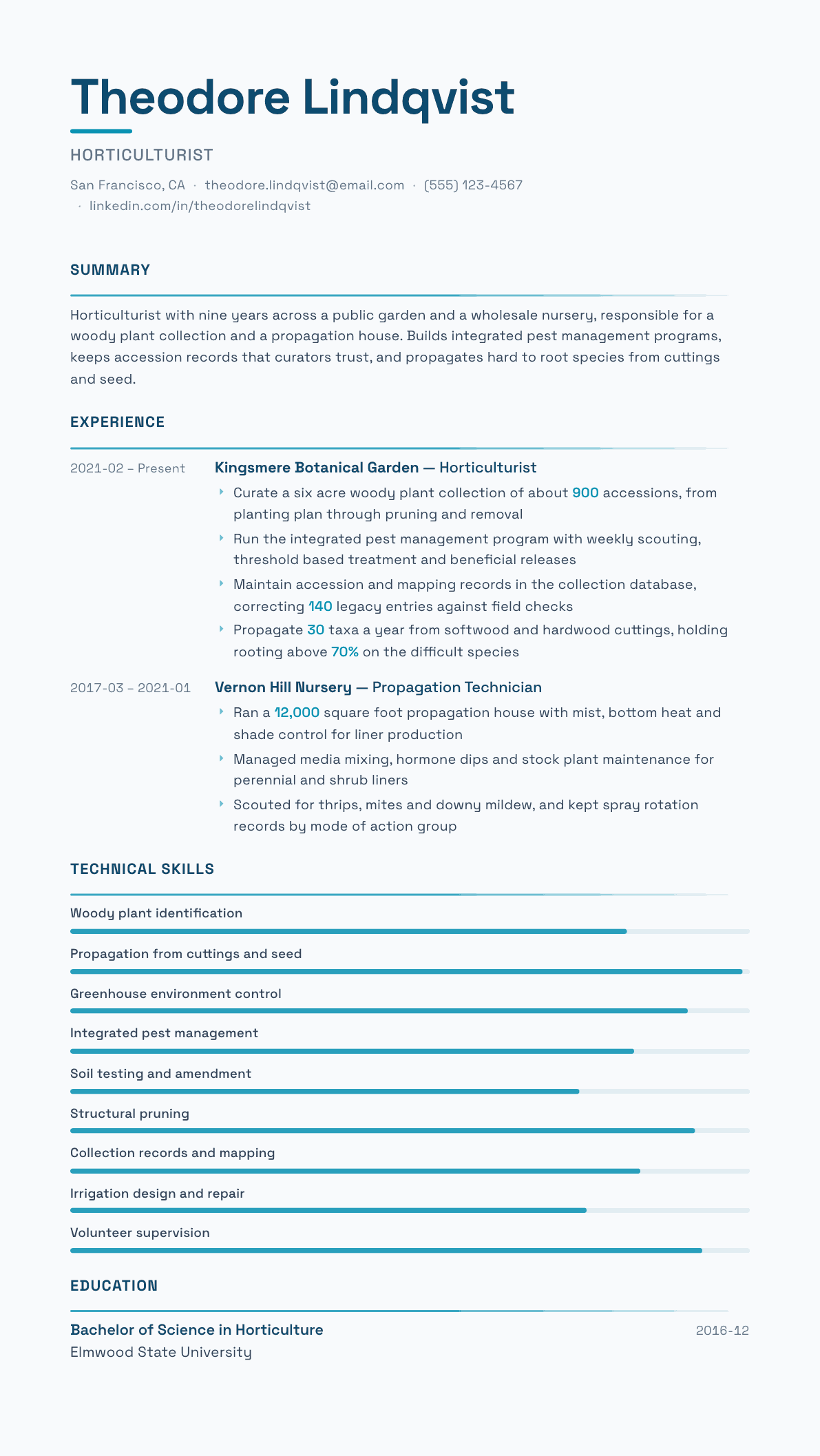
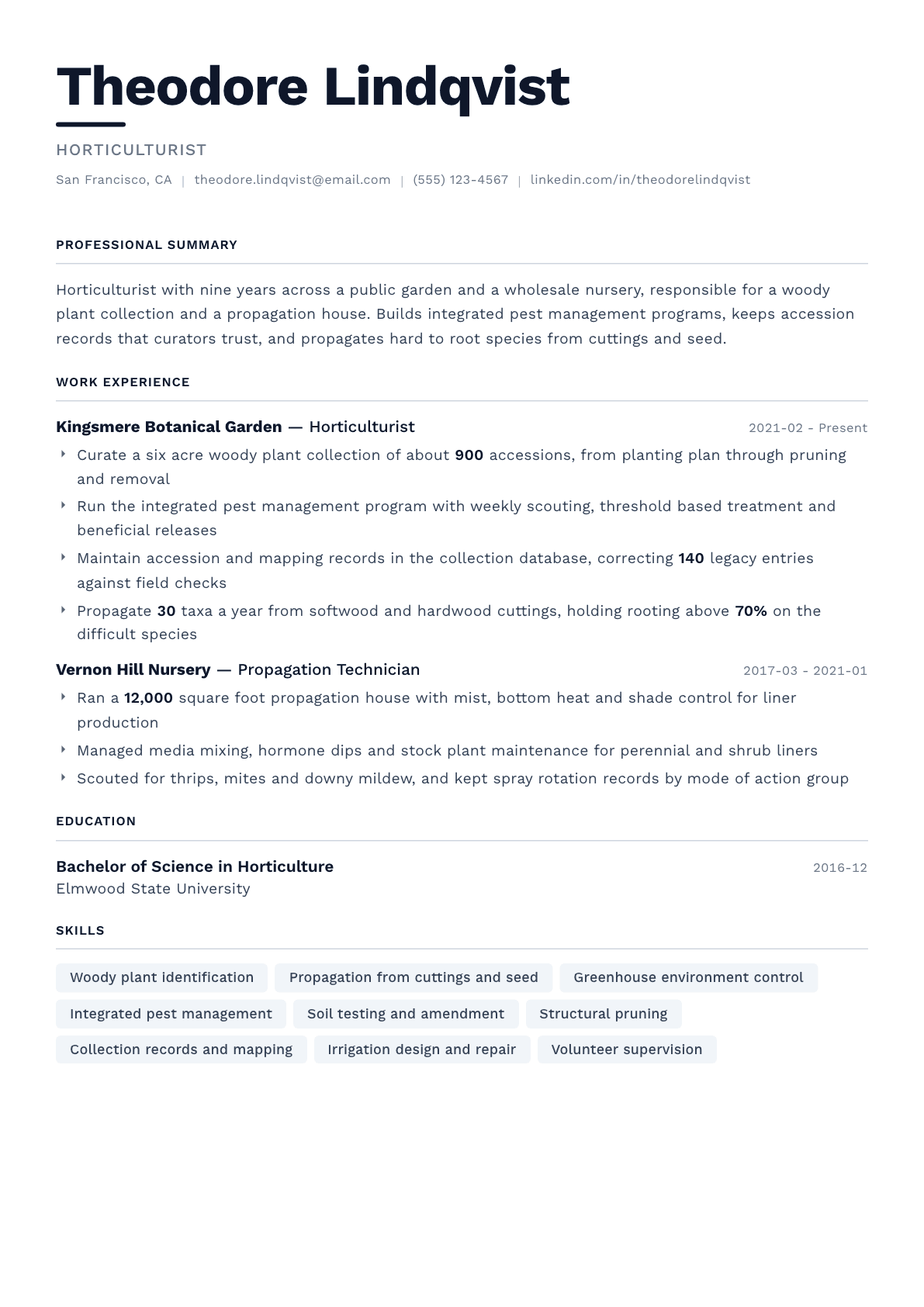
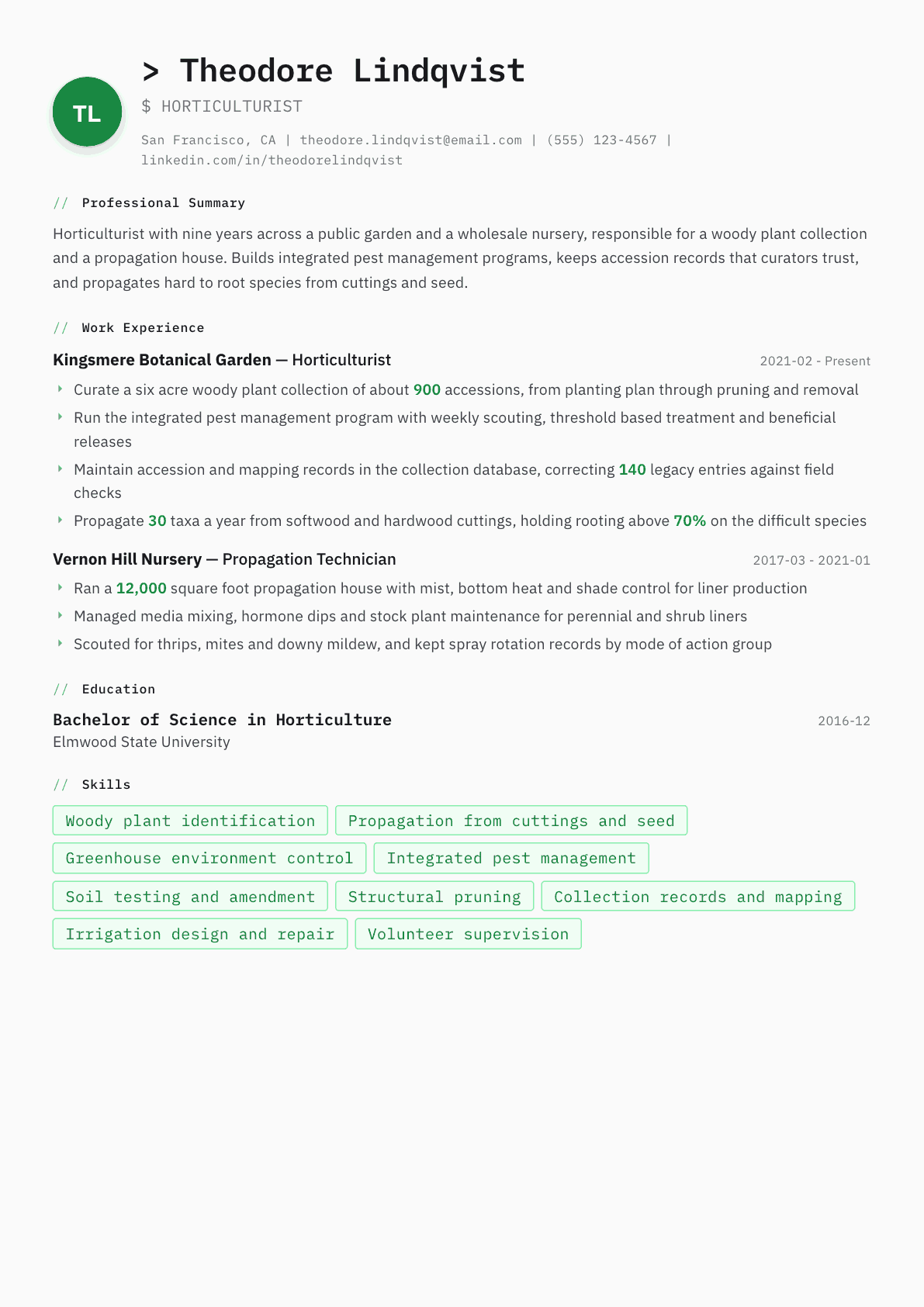
Example Horticulturist summary
Horticulturist with nine years split between a public garden and a wholesale nursery, currently curating a six acre woody collection of about nine hundred accessions. Runs a threshold based pest management program with weekly scouting, propagates difficult taxa from cuttings at strong rooting rates, and keeps accession records clean enough for curatorial use. Comfortable leading volunteers and rebuilding neglected beds from soil up.
Skills to list on a Horticulturist resume
- Plant identification and taxonomy
- Propagation from cuttings
- Seed collection and germination
- Greenhouse climate control
- Media and substrate mixing
- Integrated pest management
- Soil testing and fertility programs
- Structural and renewal pruning
- Irrigation installation and repair
- Collection accession records
- Planting design and bed renovation
- Nursery liner production
- Pesticide application and record keeping
- Volunteer and crew supervision
- Plant health diagnostics
What actually gets this resume read
- Name the plant groups you actually know, whether woody ornamentals, alpines, succulents or edible perennials.
- Show the size of what you have cared for in acres, beds or house square footage rather than in adjectives.
- Describe your integrated pest management practice, including scouting rhythm, thresholds and rotation by mode of action.
- Give propagation results as rooting or germination rates on named species, since that number is hard to fake.
- List the records systems you keep, from accession databases to spray logs and soil test histories.
- Add public facing work like tours, plant sales and volunteer supervision if you are applying to a garden.
How to write a horticulturist resume
Horticulturist covers a wide territory. The same title sits on a public garden curator managing a woody collection, a nursery propagator filling liner trays, a greenhouse grower running climate and nutrition, and a park specialist rebuilding beds. Whoever reads your resume works in one of those worlds and needs to know within a few lines which one you come from.
The second thing they look for is plant knowledge that can be tested. Horticulture is a field where an interviewer may walk you around a garden and ask what things are, so a page full of general statements about plant care sets up a conversation you will lose. Name taxa, name systems and name results.
This guide covers the layout, the summary, how to write propagation and pest management experience with real numbers, how to handle records and public work, and the questions horticulturists ask when moving between nurseries, gardens and grounds departments.
Format: setting, plant groups and scale near the top
One page for most horticulturists, two once you have curated collections or managed production for many years. The block under your name should say the setting you come from, the plant groups you know, and the scale you have handled in acres, beds or greenhouse area.
Then arrange the page by what you do rather than by season: plant care and collections, propagation and production, pest and disease management, then records, design and people. A hiring curator or grower can find their own priority quickly instead of reading through a calendar of tasks.
- Opening block for a horticulturist: setting, plant groups by name, area or accession count and the climate zone you have worked.
- Four working groups: plant care and collections, propagation and production, plant health, then records and public or crew work.
- Each employer entry gives the site type, the area you were responsible for and whether you worked alone or led a crew.
- Keep a plant list line, naming the genera you are strongest on rather than claiming general plant knowledge.
Summary: what you grow, how much of it, and what you own
Three lines. The setting and years, the plant groups and the area, then the thing you personally own. That might be a collection, a propagation house, the pest management program or the planting design for a section of the site.
Add one line that shows judgment rather than labor. Rescuing a declining collection, moving a nursery off a failing pest program or bringing a difficult species into reliable production all do this. It is the difference between someone who maintains plants and someone who improves them.
Propagation and production: give the rates
Propagation is where a horticulturist becomes verifiable. Say what you propagate and how: softwood, semi ripe and hardwood cuttings, division, grafting, layering, seed with any stratification or scarification required, and tissue culture if you have done it. Then give rooting or germination rates on named taxa, because the rate is what a grower is buying.
Describe the environment you control. Mist intervals, bottom heat, shade levels, ventilation, media recipe and hormone treatment are the levers, and a candidate who names them reads as someone who has diagnosed a bad batch rather than only followed a schedule.
On the production side, give throughput: liners a season, containers potted, taxa in the range and the losses you hold shrinkage to. A nursery manager reads shrinkage the way a factory manager reads scrap.
- Propagation bullet: method, taxa count and rooting or germination rate on the difficult species.
- Environment bullet: mist, bottom heat, shade and media, with the problem each setting solved.
- Production bullet: units produced a season, taxa in the range and shrinkage held.
- Stock plant bullet: how you maintain mother stock and keep material clean.
Plant health, soils and the pest program
Write pest and disease work as a program, not a reaction. Scouting cadence, what you scout with, the thresholds you act on, biological controls you release, rotation by mode of action group, and how you record it. Anyone can spray. A horticulturist who can explain why they did not spray is more valuable.
Soils and nutrition deserve the same treatment. Soil tests and what you changed because of them, substrate recipes and their drainage behavior, fertigation rates, pH and electrical conductivity monitoring in containers. These are the details that separate a trained horticulturist from an enthusiastic gardener.
Records, public work and the keywords a hiring manager scans
Public gardens run on records. Accession numbers, mapping, provenance, condition assessments and deaccession decisions are core work, and a candidate who has corrected a legacy database or verified plantings against field checks has done something a curator will immediately value. Nurseries have their own records: inventory, availability lists and spray logs.
Postings reuse a stable vocabulary: propagation, integrated pest management, plant identification, greenhouse production, irrigation, pruning, soil fertility, accession records, plant health, container production and landscape renovation. Use the posting words in your skills block, then show each one inside a bullet. If you do tours, plant sales, teaching or volunteer supervision, give those a short block too, since garden roles are partly public jobs.
Horticulturist resume summary examples
Horticulture graduate
Horticulture graduate with two seasons as a seasonal gardener and a greenhouse assistant, covering propagation, potting, irrigation and bed maintenance. Identifies common woody and herbaceous ornamentals on sight, scouts weekly for mites and aphids, and holds a pesticide applicator credential.
Nine years in
Horticulturist with nine years split between a public garden and a wholesale nursery, curating a six acre woody collection of about 900 accessions. Runs a threshold based pest management program, propagates difficult taxa from cuttings at strong rooting rates, and keeps accession records clean enough for curatorial use.
Curator or head grower
Head grower with sixteen years in container and collection horticulture, directing six staff across three greenhouse ranges and 40 field acres. Sets the production plan and the plant health program, developed protocols for four hard to root natives, and mentors interns through a structured season.
Work experience bullets: before and after
Before: Cared for plants throughout the garden.
After: Curated a six acre woody plant collection of about 900 accessions, from planting plan and siting through structural pruning, condition assessment and removal decisions.
Area, accession count and the full span of decisions describe a curator rather than a gardener.
Before: Propagated plants from cuttings.
After: Propagated 30 taxa a year from softwood and hardwood cuttings under mist with bottom heat, holding rooting above 70% on species the nursery had previously bought in.
A rate on named difficulty, plus the sourcing it replaced, turns propagation into a business result.
Before: Sprayed for pests when they appeared.
After: Ran weekly scouting with sticky cards and threshold based treatment, releasing predatory mites in the propagation house and rotating products by mode of action group.
It describes a program with monitoring, thresholds and resistance management instead of a reaction.
Before: Kept records of the plant collection.
After: Corrected 140 legacy accession entries against field verification and remapped two beds, so the collection database now matches what is actually growing.
A record count and a verification method prove curatorial work that a curator can trust.
Before: Worked with volunteers in the garden.
After: Trained and directed a weekly volunteer group of twelve on pruning standards and bed renovation, writing task sheets that kept the work consistent between sessions.
Volunteer work counts when it shows a standard and a system, not just supervision.
Hard skills
- Plant identification and taxonomy
- Softwood and hardwood cutting propagation
- Seed collection, stratification and germination
- Grafting, budding and division
- Greenhouse climate and irrigation control
- Media formulation and container nutrition
- Integrated pest management and scouting
- Biological control releases
- Soil testing and fertility programs
- Structural and renewal pruning
- Irrigation installation and repair
- Accession records and collection mapping
- Container and field nursery production
- Planting design and bed renovation
- Pesticide application and record keeping
Soft skills
- Patience with plants that take years to judge
- Careful observation before intervention
- Teaching identification to staff and volunteers
- Writing notes another grower can follow
- Explaining a plant loss without defensiveness
Certifications worth listing
- Certified Horticulturist (American Society for Horticultural Science)
- ISA Certified Arborist (International Society of Arboriculture)
- Commercial Pesticide Applicator License (State Department of Agriculture)
Mistakes that cost horticulturist candidates the interview
- Leaving the setting vague so a nursery cannot tell whether you come from production or from a garden.
- Claiming broad plant knowledge without naming a single genus you are genuinely strong on.
- Writing propagation without rooting or germination rates, which is the one number growers compare.
- Presenting pest control as spraying rather than as scouting, thresholds and resistance management.
- Skipping records work, which is a large part of any collection or production job.
- Ignoring the public side of garden roles, including tours, plant sales and volunteer supervision.
Horticulturist resume questions
How do I move from a nursery to a public garden?
Translate production skill into collection language. Propagation, plant health and irrigation all transfer, so lead with those, then show any records or mapping work you have done. Add evidence of public facing capability, because gardens hire people who can talk to visitors.
Do I need a horticulture degree?
Many roles list one, but strong practical experience with named plant knowledge, propagation rates and a pesticide credential competes well. If you lack the degree, consider a recognized horticulturist or arborist certification, since it gives a hiring manager something external to trust.
How should I show plant knowledge on paper?
Name the plant groups you know best and the number of taxa you have grown or curated. A short line naming your strongest genera is more convincing than a general claim, and it also steers the interview toward plants you can actually discuss in depth.
Is landscape maintenance experience useful here?
Yes, especially for grounds and park roles. Pruning, irrigation, planting and soil work all count. Present it as horticultural practice rather than as maintenance, and add any plant health or propagation work that lifts it above routine grounds keeping.
What should I do about seasonal gaps in my history?
State the seasonal nature plainly, since it is normal in this field, and show what you did between contracts. Winter greenhouse work, tool maintenance, coursework or a certification all fill the gap and read as someone who stays in the trade year round.
Related resume examples
- Landscaper Resume example
- Landscape Designer Resume example
- Farm Manager Resume example
- Forestry Worker Resume example
- Environmental Scientist Resume example
- Farm Worker Resume example