Forestry Worker Resume Examples: the lines they read
Write a Forestry Worker Resume That Proves Saw and Safety Skill
By Mustafa Tarabya, founder of CVBooster · Published · Updated
Forestry worker resume example, keyword list and writing guide covering chainsaw work, planting, thinning, fire training and equipment.
Sample resumes for a forestry worker
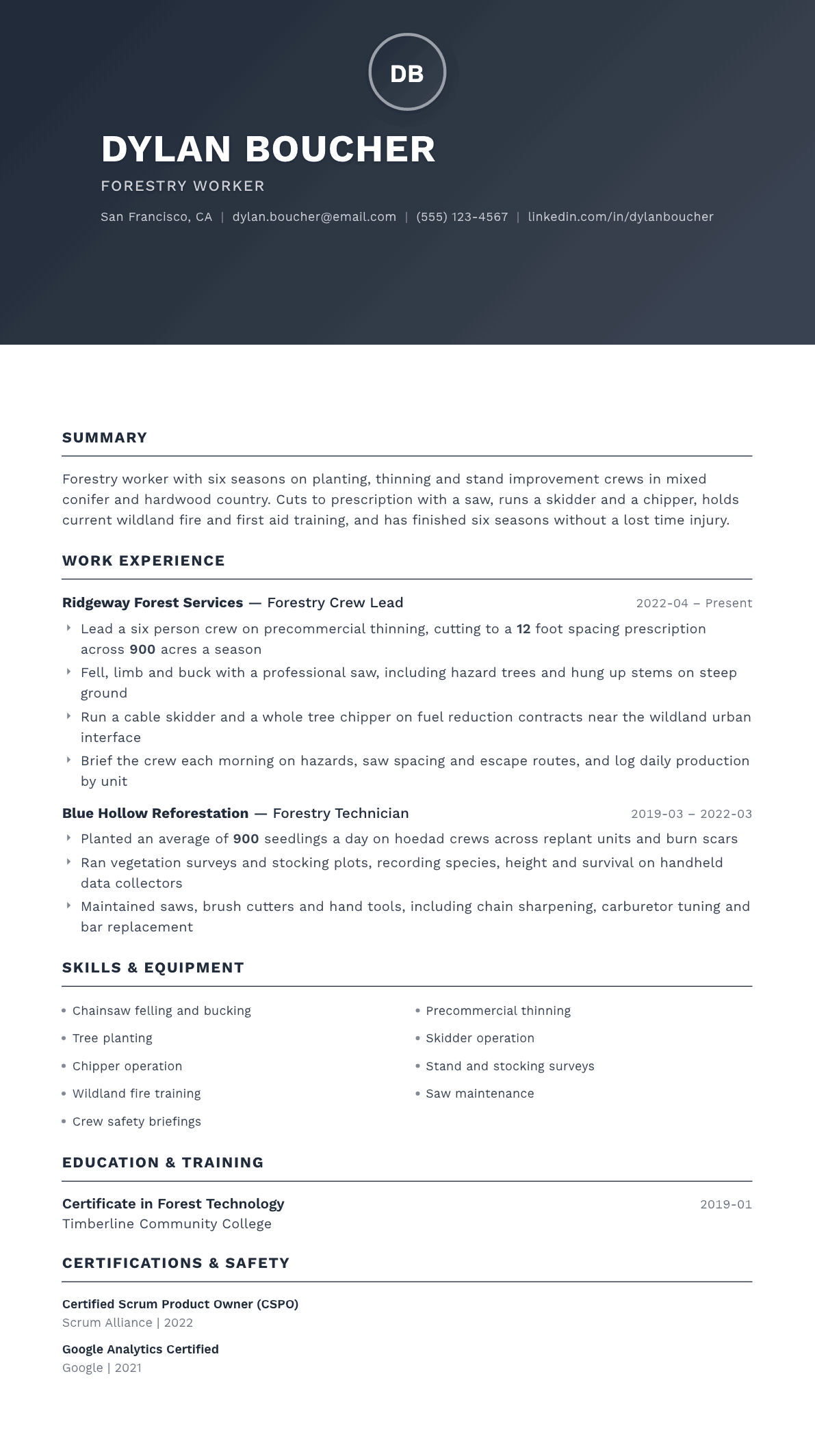
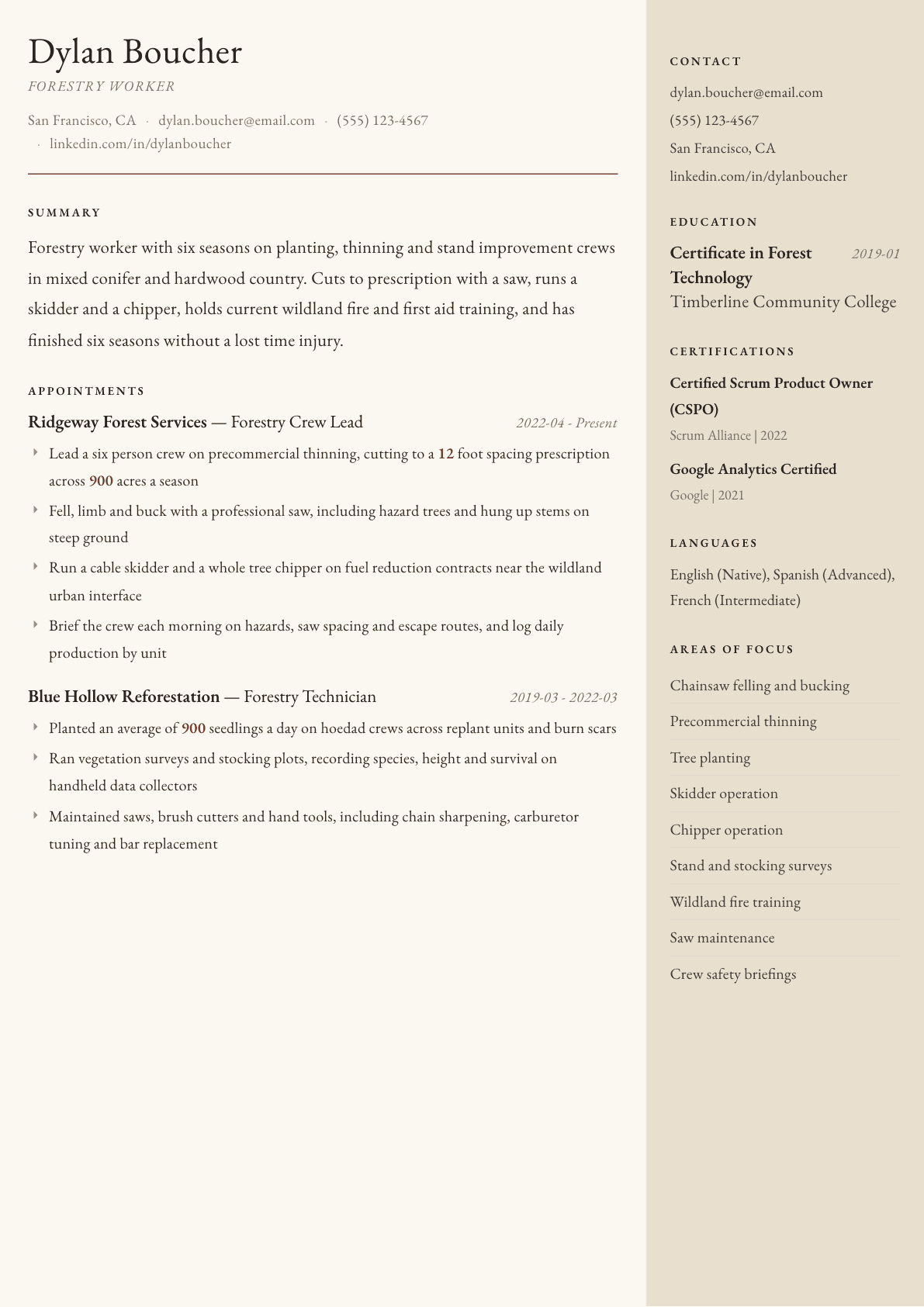
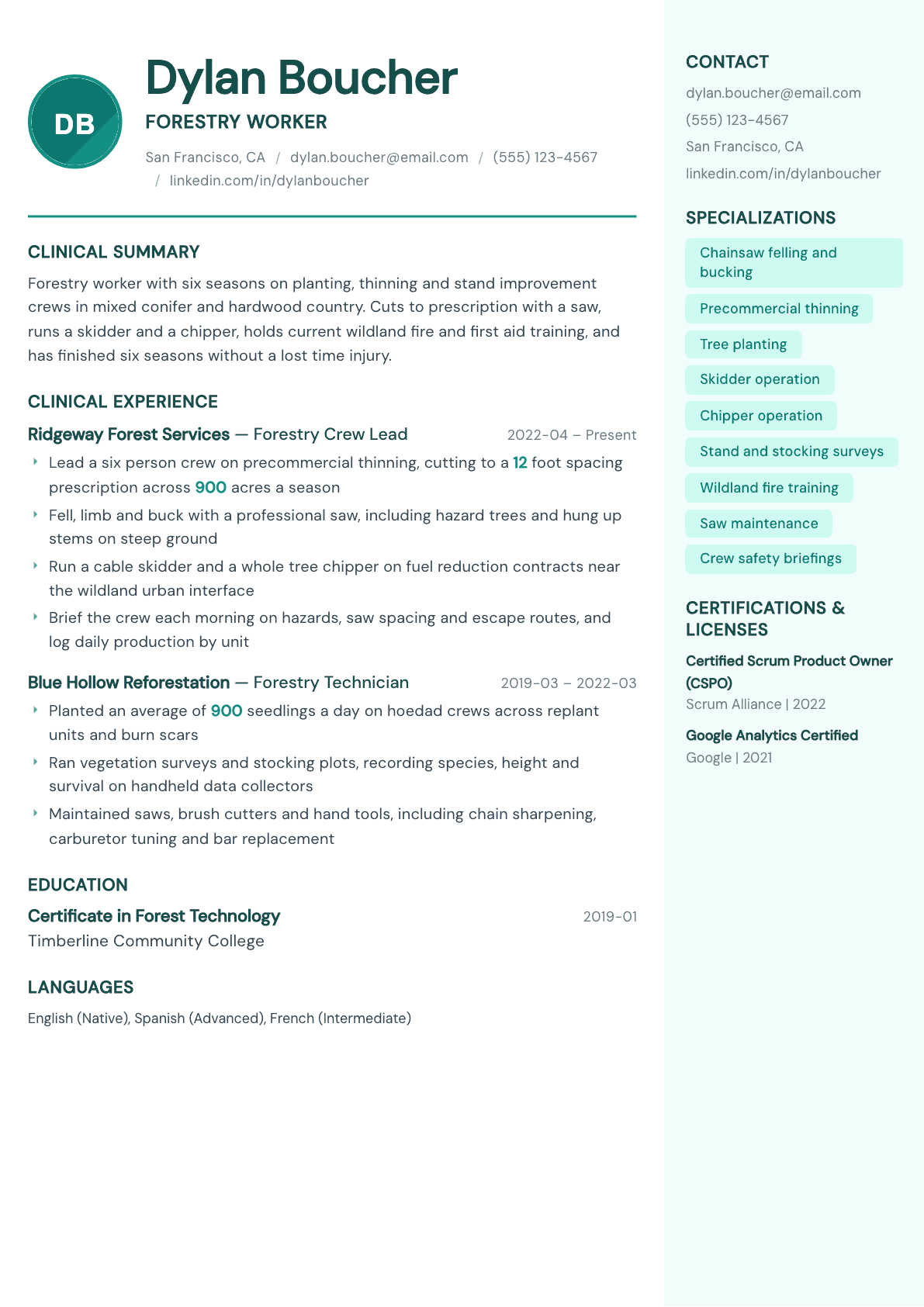
The same forestry worker content laid out in three CVBooster templates, so you can see what the finished document looks like before you write a word.
Example Forestry Worker summary
Forestry worker with six seasons on planting, thinning and fuel reduction crews in mixed conifer and hardwood stands. Leads a six person crew cutting to prescription on steep ground, runs a cable skidder and a whole tree chipper, and collects stocking plot data that agency foresters accept. Holds current wildland fire chainsaw and remote first aid training with six seasons and no lost time injury.
Skills to list on a Forestry Worker resume
- Chainsaw felling and bucking
- Hazard tree removal
- Precommercial and commercial thinning
- Tree planting and seedling handling
- Brush cutting and mastication
- Skidder and forwarder operation
- Chipper and grinder operation
- Fuel reduction treatments
- Stand exams and stocking plots
- GPS and handheld data collection
- Herbicide application in forestry
- Chain sharpening and saw repair
- Wildland fire suppression support
- First aid in remote settings
- Crew leadership and daily briefings
What actually gets this resume read
- Put your saw training and fire qualifications near the top, because contractors screen on cards before anything else.
- Say what forest type and terrain you have worked, since steep ground and flat plantation work are different jobs.
- Give production numbers such as seedlings a day, acres thinned or cords cut, because crews are paid on them.
- Name the equipment you run by type: skidder, forwarder, feller buncher, chipper, brush cutter and masticator.
- State your safety record plainly, including seasons without a lost time injury and the briefings you lead.
- List your survey and data skills if you run plots, since agencies value a cutter who can also collect clean data.
How to write a forestry worker resume
Forestry work is contract work with a hard safety edge. A crew boss or contractor reading your application is deciding whether to put a saw in your hands on a slope where a mistake hurts someone. That is why the training cards come first, the production numbers come second, and everything else on the page comes a long way behind.
The word forestry also covers a lot of ground. Planting crews, thinning crews, fuel reduction contracts, timber falling, stand surveys and equipment operation are different trades that share a title. A resume that does not say which of them you have done makes a contractor guess, and contractors do not guess about saw work.
This guide shows how to build the page around saw skill, safety credentials, terrain, production rates and equipment, with summaries for a first season planter, an experienced cutter and a crew lead, plus answers to the questions that come up when moving between contractors and agency work.
Format: cards and saw experience in the top block
One page, plain and printable, because it may be read on a tailgate. The block under your name lists your chainsaw training, first aid, any wildland fire qualifications and your driver license class. Contractors screen on those cards before they read a single job.
Directly below, state the work types you have done and the terrain. Planting, precommercial thinning, commercial thinning, fuel reduction, hazard tree removal, timber falling and stand surveys are separate lines. Terrain matters just as much, because steep ground and hot weather sort crews faster than any other factor.
- Top block for a forestry worker: chainsaw training level, first aid and fire cards, and driver license class with any medical card.
- Second block: work types performed, terrain worked and the forest types you know.
- Each employer entry names the contractor or agency, the contract type, the crew size and the season length you completed.
- Keep an equipment line separate: saws, brush cutters, skidders, forwarders, chippers and anything you have run on a unit.
Summary: seasons, saw level, terrain and safety record
Two or three lines. Seasons completed, the saw work you are qualified for, the terrain and forest type, and your safety record stated as a fact rather than a promise. Seasons without a lost time injury is the strongest single line a forestry worker can put on a page.
If you can lead a crew, say so with the crew size and what you were responsible for. Contractors are usually short of people who can run a unit, keep production up and give a morning briefing that actually changes behavior.
Production and saw work: numbers a contractor pays on
Forestry crews are paid on production, so production is what belongs in your bullets. Seedlings planted a day, acres thinned a season, cords cut, units completed or plots collected. Give the number with the conditions, because a thousand seedlings on flat ground and six hundred on a steep burn scar are not the same day.
Saw work needs detail. Say whether you fell, limb and buck, whether you handle hung up stems and hazard trees, what bar length you run and how you handle leaners and side lean on a slope. Then mention your maintenance: chain sharpening, depth gauge filing, carburetor tuning and bar dressing, because a cutter who keeps a saw right loses less of the day.
Prescriptions matter as much as speed. Cutting to a spacing standard, leaving the right species, protecting residual stems and hitting a target basal area are what separates a professional from someone who is fast. Say what standard you cut to and who inspected it.
- One bullet with a daily or seasonal production rate and the terrain it was achieved on.
- One bullet on saw skill: what you fell, the hazards you handle and the maintenance you do yourself.
- One bullet on prescription: the spacing or retention standard and how the unit inspected.
- One bullet on equipment: the machines you have operated and on what kind of contract.
Safety, fire and the credentials block
Keep every card in one block with the issuing body and the year you last refreshed it. Chainsaw training level, first aid and CPR with any wilderness or remote endorsement, fire qualifications, defensive driving and any respirator or herbicide credential all belong there. A contractor copies this straight into a project file.
Then show safety as practice. Morning briefings, saw spacing between cutters, escape route planning, hazard tree identification and the personal protective equipment you insist on. Crews with genuine safety culture read those lines carefully because they are trying not to hire the person who cuts corners on the last unit of the day.
Surveys, data and the keywords in agency postings
If you run plots, say so. Stand exams, stocking surveys, survival counts, fixed radius and variable plots, tree measurement and handheld data collection make you useful to agencies and consulting foresters as well as to cutting contractors. A cutter who can also collect clean data has two seasons of work available instead of one.
Postings reuse a compact vocabulary: chainsaw, falling, bucking, precommercial thinning, timber stand improvement, fuel reduction, hazard trees, reforestation, hoedad, stocking survey, skidder, chipper and wildland urban interface. Mirror the words the posting uses. Also state travel and camp tolerance honestly, since much of this work happens far from home for weeks at a time.
Forestry Worker resume summary examples
First planting season
Forestry worker with one full reforestation season on hoedad crews, averaging 700 seedlings a day on replant units. Holds current first aid and CPR, basic chainsaw training and a clean driving record. Comfortable with camp work, long travel and steep ground, and looking for a thinning crew seat.
Six seasons
Forestry worker with six seasons on planting, thinning and fuel reduction crews in mixed conifer and hardwood stands. Cuts to prescription on steep ground, runs a cable skidder and a whole tree chipper, and holds current wildland fire chainsaw and remote first aid training with no lost time injury.
Crew lead
Forestry crew lead with eleven seasons and four years running a six person saw crew on thinning and interface fuel contracts. Handles hazard tree removal, sets daily production targets against unit maps, delivers the morning hazard briefing, and has closed every contract on schedule without a recordable injury.
Work experience bullets: before and after
Before: Cut trees as part of a forestry crew.
After: Cut precommercial thinning units to a 12 foot spacing prescription across 900 acres a season, including hung up stems and hazard trees on steep ground.
The prescription, the acreage and the terrain tell a contractor exactly what you can be assigned.
Before: Planted trees during the season.
After: Planted an average of 900 seedlings a day on hoedad crews across replant units and burn scars, keeping survival counts within the contract standard.
A daily rate paired with survival quality proves speed that the client actually accepted.
Before: Operated heavy equipment in the woods.
After: Ran a cable skidder and a whole tree chipper on fuel reduction contracts near the wildland urban interface, working close to structures and public roads.
Naming the machines and the setting shows both capability and awareness of the risk around it.
Before: Made sure the crew worked safely.
After: Briefed a six person crew each morning on hazards, saw spacing and escape routes, and closed six seasons with no lost time injury on my units.
A briefing routine attached to a real record is safety evidence rather than a safety claim.
Before: Collected data in the field sometimes.
After: Ran vegetation surveys and stocking plots on handheld collectors, recording species, height and survival so agency foresters could accept the units without a recheck.
It shows data work that held up to review, which opens agency and consulting contracts.
Hard skills
- Chainsaw felling, limbing and bucking
- Hazard tree and hung up stem removal
- Precommercial and commercial thinning
- Tree planting and seedling handling
- Brush cutting and mastication
- Skidder and forwarder operation
- Chipper and grinder operation
- Fuel reduction and interface treatments
- Stand exams and stocking plots
- Handheld data collection and mapping
- Forestry herbicide application
- Chain sharpening and saw repair
- Wildland fire suppression support
- Remote area first aid
Soft skills
- Steady output in heat, cold and rain
- Watching the cutter working below you
- Living in camp with a crew for weeks
- Calling a hazard even when it slows the unit
- Bringing a new hand up to pace without pushing them into risk
Certifications worth listing
- S-212 Wildland Fire Chain Saws (National Wildfire Coordinating Group)
- Wilderness First Aid and CPR (American Red Cross)
- S-130 and S-190 Wildland Firefighter Training (National Wildfire Coordinating Group)
Mistakes that cost forestry worker candidates the interview
- Burying training cards at the bottom when they are the first thing a contractor screens for.
- Saying you have forestry experience without naming planting, thinning, falling or survey work.
- Leaving out production rates, which is how crews are quoted and paid.
- Ignoring terrain, so a contractor cannot tell whether you have worked steep ground.
- Claiming saw skill with no mention of hazard trees, prescriptions or your own saw maintenance.
- Hiding travel and camp limits until the offer, when a contractor needs to plan crews weeks ahead.
Forestry Worker resume questions
Which certifications matter most for forestry crew work?
Chainsaw training at the level the contract requires, current first aid and CPR with a remote endorsement where crews work far from a road, and wildland fire cards if any of the work touches fuels. A valid driver license and clean record often matter as much.
How do I get onto a thinning crew from planting?
Get formal saw training, then ask for saw time on the units you are already on. Document the acres you cut and the spacing standard you held. Contractors move planters onto saws every season, but only the ones who can show a prescription they hit.
Does agency work want a different resume than contract work?
Somewhat. Agencies weigh data collection, plot work, written records and fire qualifications more heavily, while contractors weigh production and saw skill. Keep both sides on the page and lead with whichever the posting emphasizes.
How do I show a safety record honestly?
Give seasons worked and injuries on your units plainly, and describe the routines behind the record such as briefings, spacing and escape routes. If something did happen, be ready to explain what changed afterward, because crew bosses respect that more than a spotless claim.
What if my seasons are broken up across contractors?
That is normal in this trade and does not need excusing. Group short contracts under a single seasonal heading with the years, name each contractor and the work type, and let the total seasons and production numbers carry the page.
Related resume examples
- Wildland Firefighter Resume example
- Horticulturist Resume example
- Heavy Equipment Operator Resume example
- Landscaper Resume example
- Environmental Scientist Resume example
- Farm Worker Resume example