Farm Worker Resume Examples: free ATS score and gap list
Write a Farm Worker Resume That Shows Crops and Equipment
By Mustafa Tarabya, founder of CVBooster · Published · Updated
Farm worker resume example, keyword list and writing guide covering crops, harvest pace, tractor work, irrigation and safety training.
Sample resumes for a farm worker
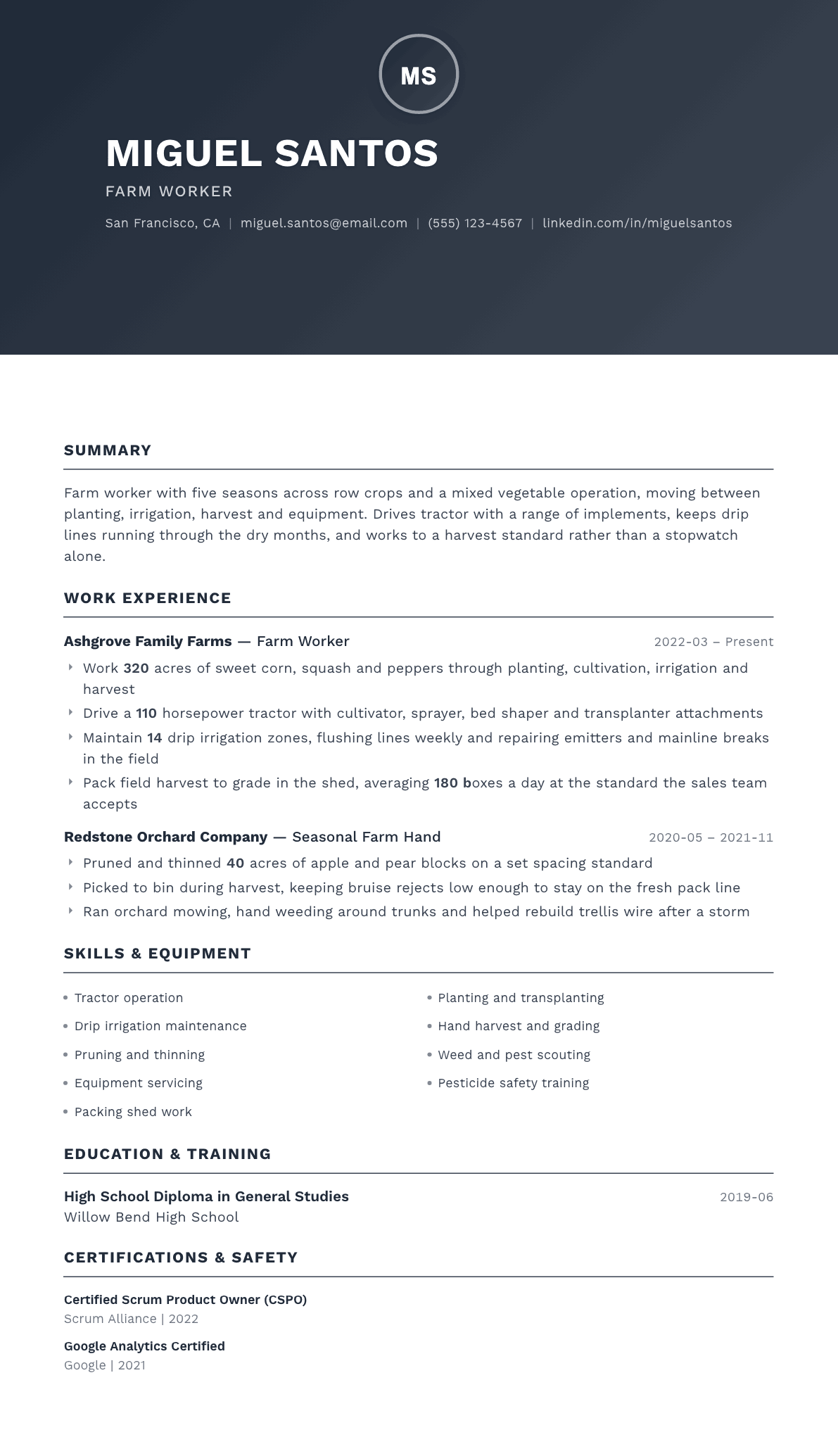
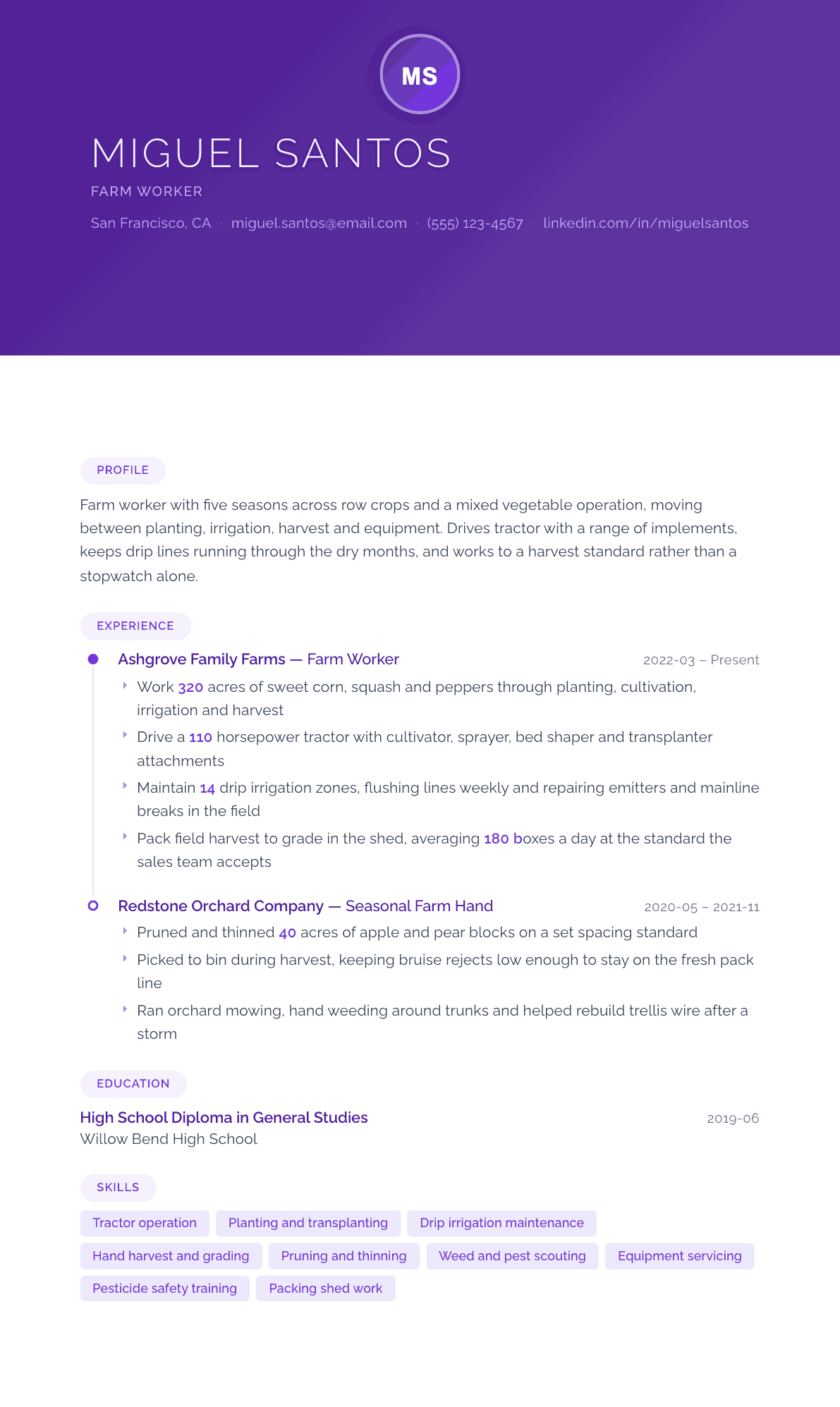
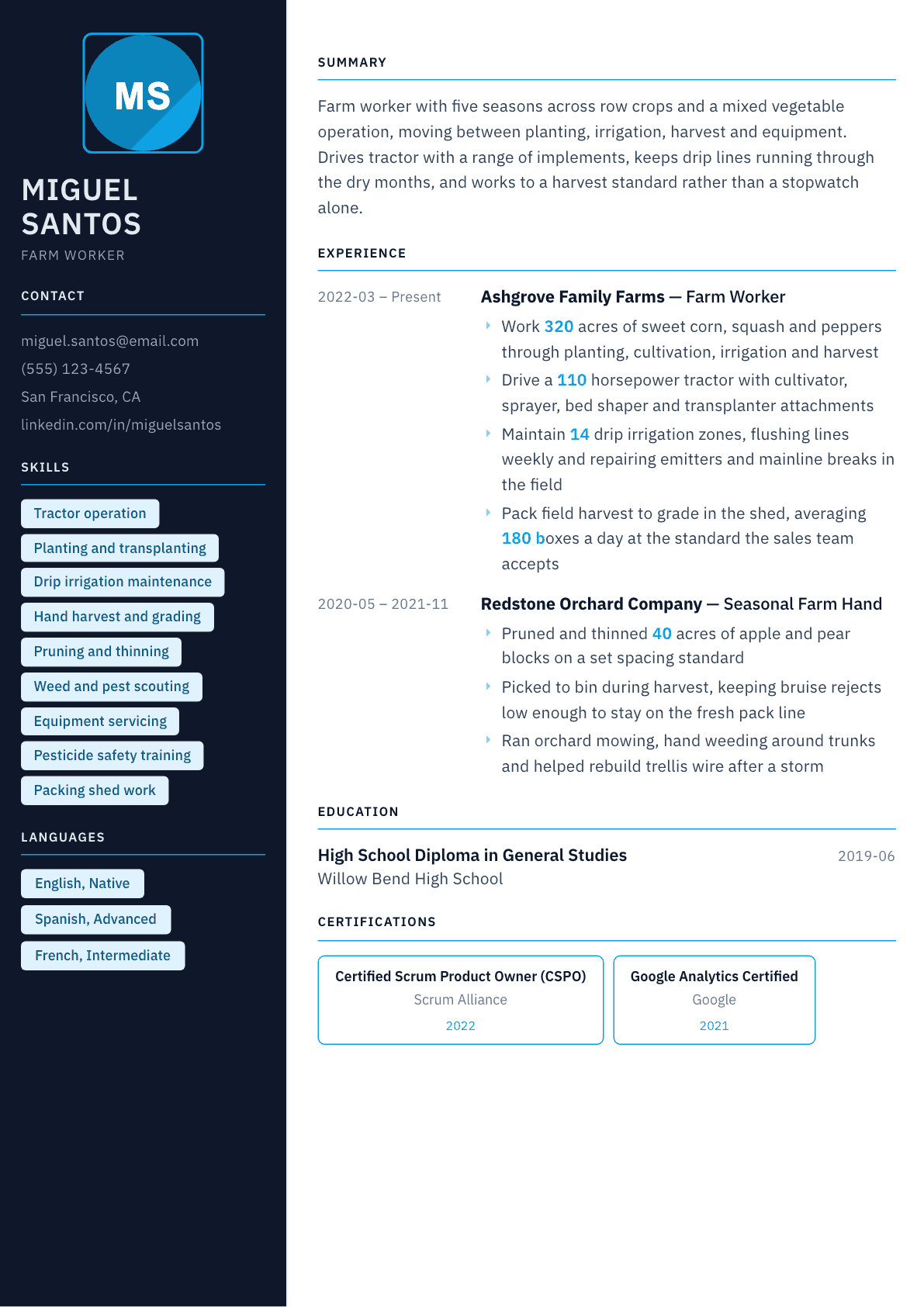
The same farm worker content laid out in three CVBooster templates, so you can see what the finished document looks like before you write a word.
Example Farm Worker summary
Farm worker with five seasons across row crops and orchard blocks, moving between planting, irrigation, harvest and equipment as the calendar demands. Runs a mid size tractor with cultivator, sprayer and transplanter, maintains fourteen drip zones through the dry months, and packs harvest to a grade standard the sales side accepts. Holds current pesticide safety training and is looking for year round work with a mixed vegetable grower.
Skills to list on a Farm Worker resume
- Row crop planting
- Transplanting and seeding
- Tractor and implement operation
- Drip and sprinkler irrigation
- Hand harvest and field grading
- Pruning and thinning
- Weeding and cultivation
- Pest and disease scouting
- Spray equipment handling
- Packing shed and grading lines
- Greenhouse and nursery work
- Livestock feeding and checks
- Fence and trellis repair
- Basic equipment maintenance
- Food safety and hygiene practice
What actually gets this resume read
- Name every crop you have worked, because a grower hiring for berries reads corn experience differently.
- Give acreage and your daily harvest pace, since a farm manager schedules crews from exactly those two numbers.
- List equipment by size and implement, from tractor horsepower to the sprayer, mower and transplanter you have run.
- Say what irrigation you maintain, whether drip, overhead sprinkler or furrow, and who fixes it when it breaks.
- Put pesticide safety training and any applicator credential where a supervisor sees it immediately.
- Add year round skills like welding, fence repair or greenhouse work if you want more than a seasonal offer.
How to write a farm worker resume
Farm work is hired fast and often by the person who will be standing next to you in the field. A crew boss or farm manager reading your application wants three things: the crops you have handled, the equipment you can be trusted with, and whether you will still be there in week eight when the easy part of the season is over.
A page that says "performed general farm duties" answers none of that. Farms are specific places. Sweet corn is not strawberries, a hoedad crew is not a packing shed, and a person who has kept drip irrigation running through a dry August is worth more than one who has only picked. Say which farm you have actually been on.
This guide covers how to build a farm worker resume around crops, acreage, equipment and pace, with summaries for a first season worker, someone with several seasons and a crew lead, plus rewritten bullets and answers to the questions seasonal workers ask when they want year round work.
Format: crops and equipment above everything else
One page, and simple. A crew boss may be reading it on a phone in a truck, so the first block after your name should list the crops you have worked and the equipment you can operate. Those two lines decide whether the rest of the page gets read at all.
Keep the layout plain: no columns, no shading, no small type. If you work in more than one language, say so near the top with your level in each, because on many crews the person who can pass instructions between the boss and the crew becomes the lead within a season.
- First block for a farm worker: crops worked by name, then tractors and implements you have run.
- Second block: seasons worked, the tasks you cover, and whether you are available for the whole season or part.
- Each employer entry names the farm type, the acreage and the tasks you did there from planting through harvest.
- Keep a short line for certificates and cards: pesticide safety, forklift authorization, first aid and a driver license class.
Summary: seasons, crops, equipment, availability
Two or three lines is plenty. Say how many seasons you have worked, the crops, the equipment you run and what you are available for. Availability matters more here than in almost any other job, because a farm building a crew is solving a calendar first.
If you are looking for year round work, say it and back it with the off season skills you have: pruning, greenhouse work, equipment maintenance, fencing, welding or livestock chores. Farms keep the workers who are useful in February, not only the ones who are fast in August.
Experience: pace, acreage and the tasks nobody wants to teach twice
The fastest way to make a farm resume credible is a rate. Boxes packed a day, seedlings planted a day, rows thinned an hour, bins picked a shift. Crews are scheduled and often paid on those numbers, so a worker who knows their own pace reads as someone who has kept it.
Then show the tasks that take training. Setting up and repairing drip lines, running a transplanter without leaving gaps, calibrating a sprayer, pruning to a spacing standard, grading fruit to a pack line specification. Anyone can be shown how to weed, but a manager pays more for the person who can fix a mainline break before the water bill doubles.
Equipment gets its own bullet. Tractor horsepower, the implements you have run, whether you can hitch and set depth yourself, and any experience with harvesters, mowers, sprayers or loaders. Say plainly what you have not run rather than letting a manager assume.
- One bullet with a harvest or planting rate and the quality standard you held while doing it.
- One bullet on irrigation: the system type, the maintenance you do and what you can repair in the field.
- One bullet on equipment by size and implement, including hitching, depth setting and daily servicing.
- One bullet on quality work such as grading, pruning to standard or scouting for pests and disease.
Safety, chemicals and food safety practice
Pesticide safety training belongs where a supervisor sees it. If you hold an applicator credential, name it and the category. If you work under someone else's license, say that you follow restricted entry intervals and know how to read a label, because that is what a farm needs from a handler.
Food safety has become part of the job on any farm selling to a packer or a retailer. Handwashing rules, harvest container hygiene, illness reporting and traceability labeling all show up in audits, and a worker who mentions them is a worker who will not cost the farm a finding.
Skills, keywords and being straight about the work
Postings recycle simple language: planting, transplanting, irrigation, weeding, cultivation, pruning, thinning, harvesting, grading, packing, loading, tractor operation and general labor. Mirror the words the posting uses so a phone screen finds them, then show each one inside a bullet.
Physical honesty helps you as much as the farm. Lifting weight, hours on your feet, heat, early starts and weekend harvest work are all facts of the job. A worker who states what they can do reliably tends to get placed better than one who agrees to everything and lasts three weeks.
Farm Worker resume summary examples
First season
Reliable worker with one full vegetable season covering planting, hand weeding, irrigation checks and harvest on a mixed farm. Comfortable with early starts, heat and repeat lifting, and trained in pesticide safety and harvest hygiene. Available for a full season and looking to learn tractor work.
Five seasons
Farm worker with five seasons across row crops and orchard blocks, moving between planting, irrigation, harvest and equipment as the calendar demands. Runs a mid size tractor with cultivator, sprayer and transplanter, maintains drip zones through the dry months, and packs to a grade standard buyers accept.
Crew lead
Farm crew lead with nine seasons and three years directing a harvest crew of fourteen. Sets the daily pick order, trains new hands on grade standards, tracks bin counts against the packer schedule, and keeps the safety briefing and hygiene records the farm needs at audit time.
Work experience bullets: before and after
Before: Picked and packed vegetables during harvest.
After: Packed field harvest to grade in the shed at an average of 180 boxes a day, holding rejects low enough to stay on the fresh pack line.
A daily rate paired with a quality standard shows both speed and care, which is how crews are judged.
Before: Helped with the watering.
After: Maintained 14 drip irrigation zones, flushing lines weekly and repairing emitters and mainline breaks in the field without waiting for a technician.
Irrigation repair is a paid skill, and naming zone count and repair type proves you have it.
Before: Drove the tractor when needed.
After: Ran a 110 horsepower tractor with cultivator, bed shaper, sprayer and transplanter, hitching and setting depth without supervision.
Horsepower and implement list tell a manager exactly what he can assign you on day one.
Before: Pruned trees in the orchard.
After: Pruned and thinned 40 acres of apple and pear blocks to the farm spacing standard, keeping bruise rejects low through the fresh pack season.
Acreage plus a standard turns an ordinary task into a measurable contribution.
Before: Followed safety rules on the farm.
After: Worked as a trained pesticide handler under the farm license, observing restricted entry intervals and logging every application in the spray record.
Naming the training and the record keeping is checkable where a claim about following rules is not.
Hard skills
- Row crop planting and transplanting
- Tractor operation with mounted implements
- Drip and sprinkler irrigation maintenance
- Hand harvest and field grading
- Pruning, thinning and training
- Weeding and mechanical cultivation
- Pest and disease scouting
- Sprayer handling and label compliance
- Packing shed and grading line work
- Greenhouse and nursery tasks
- Livestock feeding and daily checks
- Fence, trellis and irrigation repair
- Daily equipment servicing
- Harvest hygiene and traceability labeling
Soft skills
- Keeping pace through the last hour of a shift
- Following a grade standard without being watched
- Passing instructions between a boss and a crew
- Showing up through heat, rain and early starts
- Speaking up before a small equipment problem grows
Certifications worth listing
- Worker Protection Standard Pesticide Safety Training (United States Environmental Protection Agency)
- Powered Industrial Truck Operator Certification (Occupational Safety and Health Administration)
- Adult First Aid and CPR (American Red Cross)
Mistakes that cost farm worker candidates the interview
- Writing "general farm duties" instead of naming crops, tasks and the equipment you have run.
- Leaving out your harvest or planting pace, which is the number crews are actually scheduled on.
- Hiding irrigation and repair skills that would move you off the minimum rate.
- Failing to state availability, so a farm cannot tell whether you cover the whole season.
- Skipping pesticide safety training and hygiene practice, both of which show up in farm audits.
- Claiming every piece of equipment rather than saying honestly what you have and have not driven.
Farm Worker resume questions
How do I get year round work instead of seasonal?
Build and advertise off season skills. Pruning, greenhouse propagation, equipment maintenance, welding, fencing and livestock chores fill the winter months on most operations. A worker who is useful when there is no harvest is the one a farm keeps on payroll.
Does a resume even matter for farm work?
For a day crew, often not. For a farm that wants a steady worker, an equipment operator or a lead, it matters a lot. One clear page showing crops, equipment, pace and references saves the manager a risky hire and usually starts you above the base rate.
What if I have never worked on a farm before?
Show the parts of your history that transfer: outdoor work, warehouse lifting, construction labor, landscaping, driving or anything with early starts and long shifts. Then be clear about what you want to learn and how long you are available, because farms train willing people every season.
Should I list references on a farm resume?
Yes, with a phone number, and ask permission first. Farming hires on word of mouth more than most industries, and a crew boss who can call your last supervisor before lunch will often decide before anyone else has been interviewed.
How do I show that I am reliable?
With facts rather than adjectives. Seasons completed at the same farm, being asked back, the shift pattern you kept and the daily rate you held all say reliable. So does a clean record on equipment and a supervisor willing to take a call about you.
Related resume examples
- Farm Manager Resume example
- Horticulturist Resume example
- Landscaper Resume example
- Agricultural Engineer Resume example
- Food Production Worker Resume example
- Forestry Worker Resume example