Food Runner Resume Examples: free ATS score and gap list
Food Runner Resume Examples That Show Ticket Time Discipline
By Mustafa Tarabya, founder of CVBooster · Published · Updated
Food runner resume sample with ticket times, expo detail and allergen handling, plus the skills and keywords restaurant managers look for.
Sample resumes for a food runner
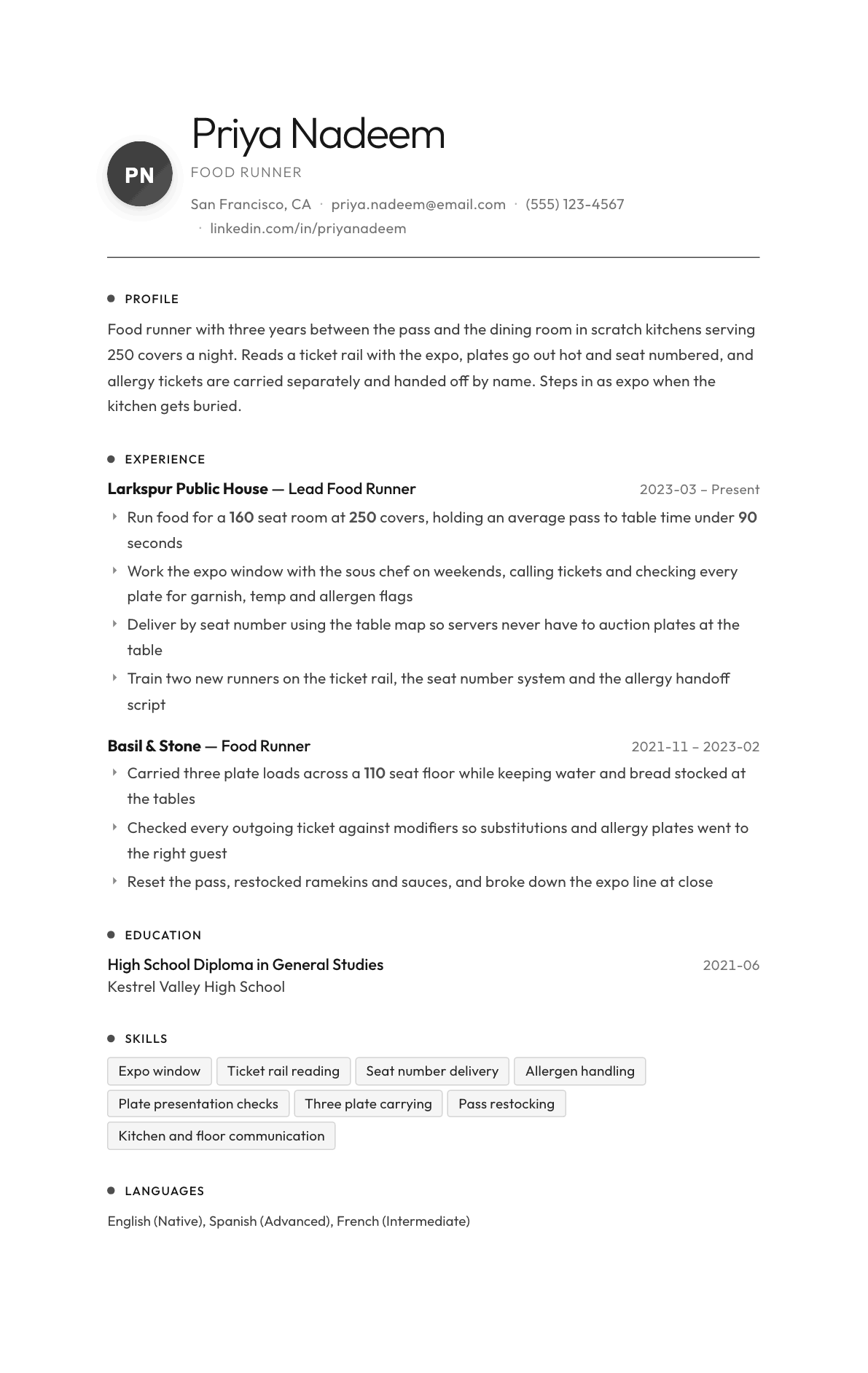
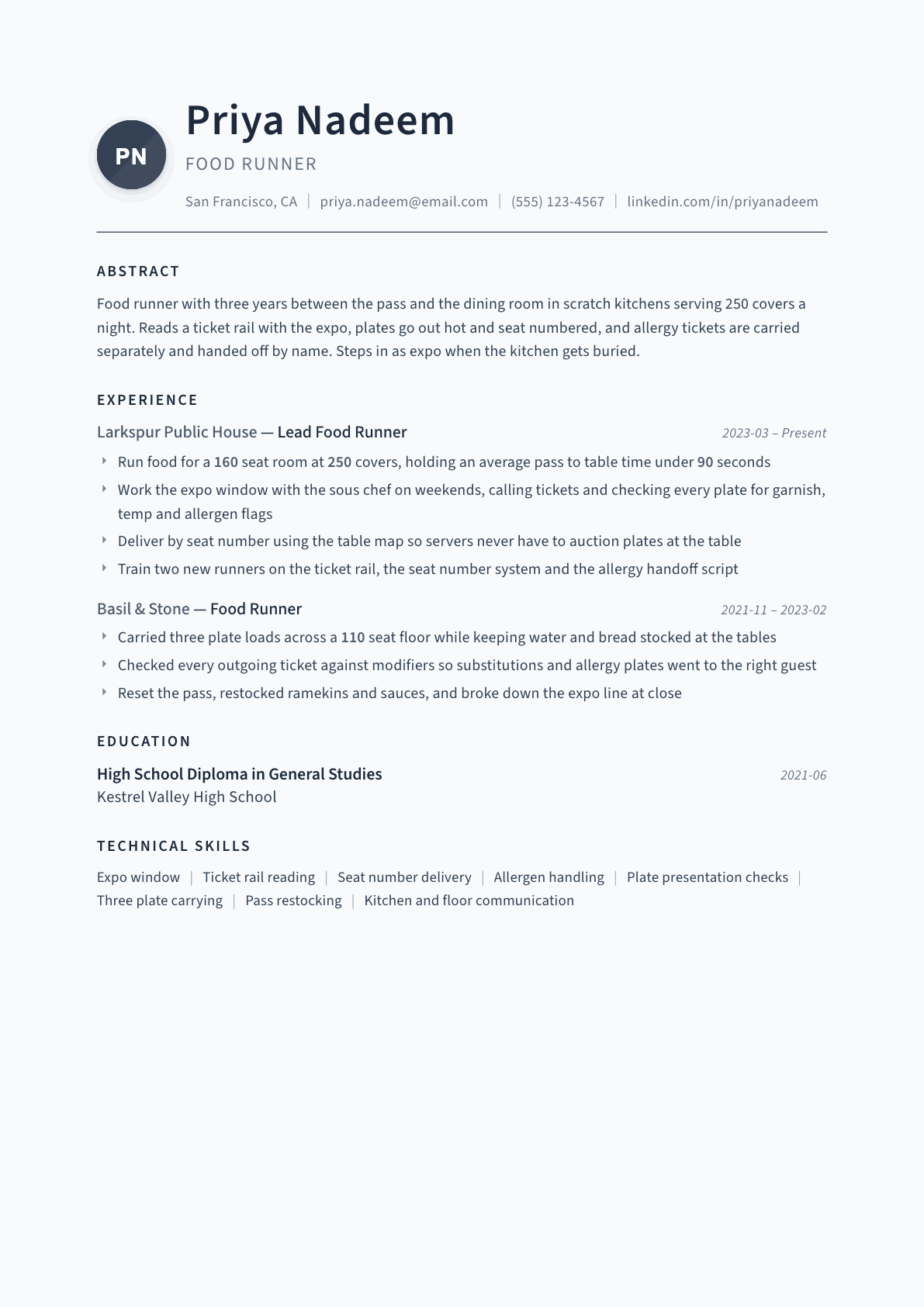
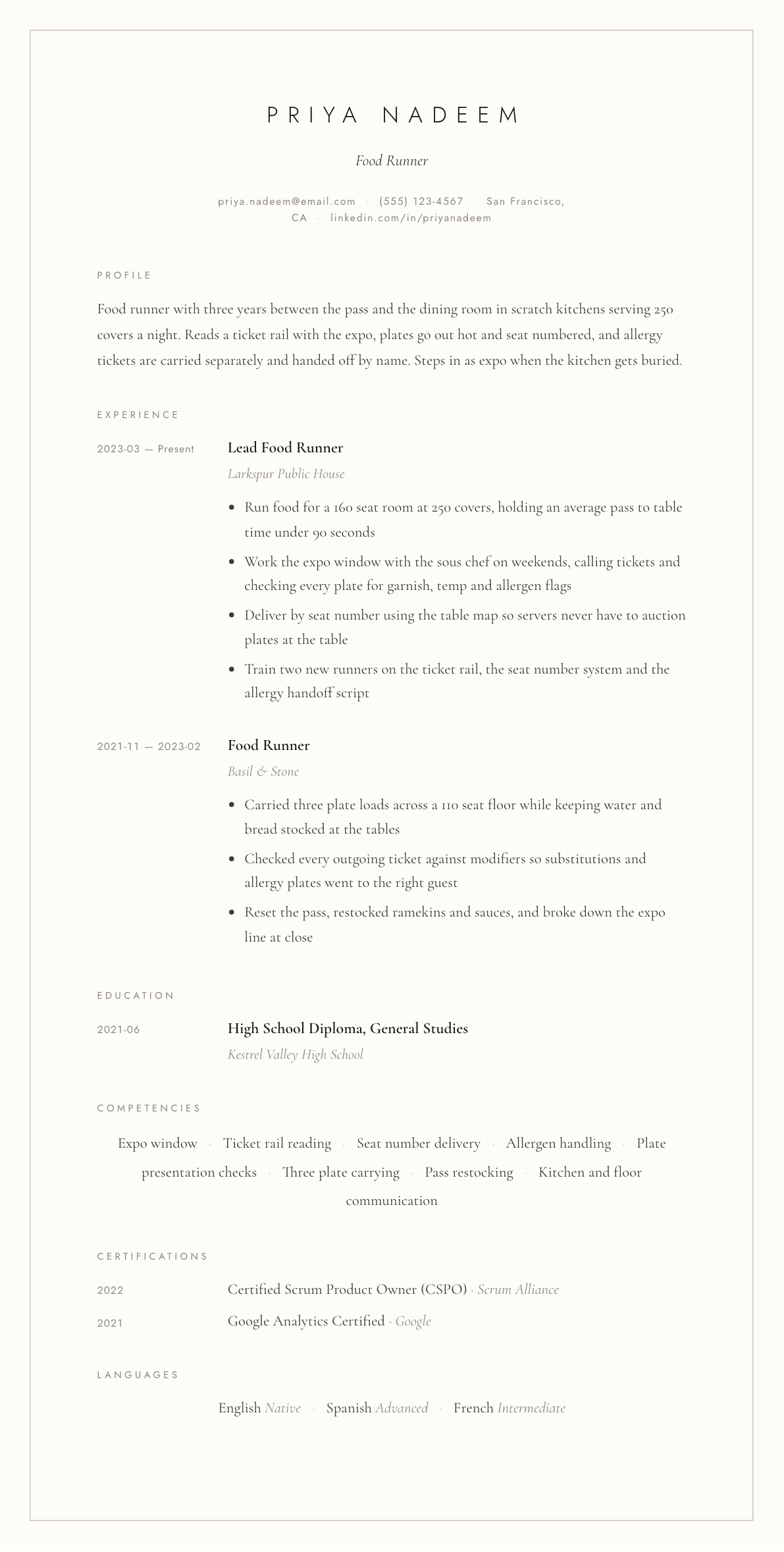
The same food runner content laid out in three CVBooster templates, so you can see what the finished document looks like before you write a word.
Example Food Runner summary
Food runner with two years between a scratch kitchen pass and a 140 seat dining room. Delivers by seat number, checks every plate for temperature, garnish and modifiers before it leaves the window, and carries allergy tickets separately with a verbal handoff. Covers the expo window on weekend service and trains new runners on the ticket rail. Food handler card current.
Skills to list on a Food Runner resume
- Food running
- Expediting
- Ticket rail reading
- Seat number service
- Allergen awareness
- Plate presentation
- Tray and multi plate carrying
- Pass organization
- Kitchen communication
- Table maintenance
- Menu and modifier knowledge
- Sanitation standards
- Opening and closing duties
What actually gets this resume read
- Put a pass to table time or a cover count in your first bullet, because speed and accuracy are the whole job.
- Say that you deliver by seat number, since auctioning plates at the table is the habit managers most want gone.
- Describe how you handle allergy tickets, including the separate carry and the verbal handoff to the guest.
- Mention expo experience if you have any, because a runner who can call tickets is worth a senior rate.
- Name the menu style you ran: raw bar, wood fire, tasting menu and steakhouse each demand different plate handling.
- Include your food handler card and note whether you can carry three plates or use a tray in a tight room.
How to write a food runner resume
The food runner stands in the one place where the kitchen and the dining room actually meet, and the chef and the general manager both have an opinion about who gets that job. The chef wants somebody who reads a ticket rail, checks a plate before it leaves the window and never lets a hot dish sit under the lamp. The manager wants somebody who delivers by seat number so the server is not auctioning entrees at the table while the food cools.
A resume that answers both is unusual. Most applications say delivered food to tables and assisted servers, which tells the reader nothing about pace, accuracy or allergen handling. The versions that get an interview carry a pass to table time, a cover count, a seat number system and a clear description of how an allergy ticket is carried and handed off.
This guide walks through the layout, the summary, the experience bullets and the skills block for a food runner, with example summaries at three stages, before and after bullets drawn from the phrasing applicants really use, and the questions that come up when you want the expo window next.
Format: one page, kitchen facing detail near the top
One page, reverse chronological, single column. The people reading it are a chef and a manager between services, so the page has to be scannable standing up. Skip the objective and the design flourishes and spend the top third on volume, station and accuracy.
The header carries name, city, phone, email, availability and your food handler card. Add a line for the menu styles you have run, such as wood fire, raw bar or tasting menu, because plate handling is genuinely different in each and a chef will look for it.
- Header: name, city and state, phone, email, availability, food handler card.
- Order: summary, experience, skills, education, certifications.
- Name the cuisine and service style of every restaurant so the reader can picture the plates.
Summary: pass to table time, covers, and the seat number habit
The first sentence should carry the volume: the seat count of the room and the covers on a peak night. The second should carry accuracy: delivery by seat number, plate checks at the window, allergen handling. Together those two sentences describe both halves of the job in about forty words.
If you have worked the expo window, say so in the summary rather than burying it in a bullet. A runner who can call tickets is a different hire at a different rate, and chefs look for that phrase specifically when they are short at the pass.
Experience: the rail, the window, and the handoff
Open each job with the kitchen and the room: scratch kitchen, 160 seats, 250 covers on a Saturday. Then use the bullets to show the sequence you own. Reading the rail with the expo, checking temperature, garnish and modifiers before a plate leaves the window, carrying the load across the floor, and delivering by seat number using the table map so nobody has to ask whose fish this is.
Allergy tickets deserve their own bullet. Describe the actual practice: the plate carried separately, the verbal handoff by name to the guest, and the confirmation with the server. Chefs read that line closely because a mishandled allergen is the one service error nobody laughs about later.
Add a bullet on what you do between runs. Restocking ramekins and sauces, resetting the pass, breaking down the expo line at close, keeping water and bread stocked on the floor. A runner who fills the gaps is the runner who gets trained on expo.
Skills: expediting, carrying, and menu knowledge
Hard skills for a runner are ticket rail reading, expediting, seat number service, allergen awareness, plate presentation checks, tray and multi plate carrying, pass organization and menu and modifier knowledge. State how many plates you can carry and whether you use a tray in a tight room, because that is a physical fact a manager needs and cannot guess.
Menu knowledge belongs here too. A runner who can answer a question about a sauce or a cooking temperature at the table saves the server a trip, and chefs consider that the difference between someone carrying plates and someone working service.
- Expediting and ticket rail reading, listed separately, because they are hired for separately.
- Carrying capacity: three plates, trays, stairs, patios, tight service corridors.
- Allergen and modifier handling, named as a practice rather than an awareness.
Getting the first runner job and the route out of it
A high school diploma is enough. If you are coming from bussing, counter service or the dish pit, lead with the parts that transfer: pace during a rush, plate handling, sanitation, working next to cooks. If you are coming from outside restaurants entirely, use any job with timed delivery and accuracy, such as a warehouse pick line, a coffee bar or catering setup.
The path forward from runner splits two ways, and your page should point at the one you want. Toward expo and the kitchen, emphasize ticket calling, temperature checks and time at the pass. Toward serving, emphasize menu knowledge, guest interaction and point of sale. Trying to signal both at once makes the page read as unfocused, so pick the direction of the posting you are answering.
Food Runner resume summary examples
Coming from bussing
Busser of one year moving into a food runner role, already carrying trays and resetting tables through 200 cover services in an 80 seat cafe. Knows the menu and the modifiers, holds a current food handler card, and is available nights, weekends and holidays.
Two years running food
Food runner with two years between a scratch kitchen pass and a 140 seat dining room. Delivers by seat number, checks every plate for temperature, garnish and modifiers before it leaves the window, and carries allergy tickets separately with a verbal handoff to the guest.
Lead runner and expo
Lead food runner with three years in scratch kitchens serving 250 covers, holding pass to table time under 90 seconds in a 160 seat room. Works the expo window with the sous chef on weekends, calling tickets and checking every plate, and has trained two runners on the rail and the allergy handoff.
Work experience bullets: before and after
Before: Delivered food from the kitchen to the tables.
After: Ran food for a 160 seat room at 250 covers, holding average pass to table time under 90 seconds across a two level dining room.
A timed number and a room description turn the job title into a performance a chef can compare.
Before: Made sure guests got the right dishes.
After: Delivered by seat number using the table map so servers never auctioned plates at the table, and confirmed modifiers against the ticket before leaving the window.
Naming the seat number system addresses the exact habit managers are trying to eliminate.
Before: Handled allergy orders carefully.
After: Carried allergy tickets separately from the rest of the load and handed each plate to the guest by name, confirming the restriction with the server before setting it down.
A described procedure is verifiable; careful handling is a claim anyone can write.
Before: Helped the expo when needed.
After: Worked the expo window with the sous chef on weekend service, calling tickets and checking every plate for temperature, garnish and allergen flags before it went out.
Specifying what you checked and who you worked beside shows real time at the pass rather than occasional help.
Before: Trained the new food runners.
After: Trained two new runners on the ticket rail, the seat number system and the allergy handoff script, then shadowed their first weekend services.
Curriculum and follow through show you can hand a standard to someone else, which is what makes a lead.
Hard skills
- Food running
- Expediting
- Ticket rail reading
- Seat number service
- Allergen handling
- Plate presentation checks
- Tray and multi plate carrying
- Pass organization and restocking
- Menu and modifier knowledge
- Table maintenance
- Sanitation standards
- Opening and closing duties
Soft skills
- Kitchen and floor communication
- Speed without panic
- Memory for tickets and tables
- Composure at the window
- Attention to plate detail
- Reliability on peak shifts
Certifications worth listing
- ServSafe Food Handler (National Restaurant Association)
- ServSafe Allergens (National Restaurant Association)
Mistakes that cost food runner candidates the interview
- Writing delivered food to tables, a sentence that describes the title and leaves out every fact a chef checks.
- Skipping the seat number system, when auctioning plates at the table is the habit managers most want gone.
- Treating allergen handling as an attitude instead of describing the separate carry and the verbal handoff.
- Leaving out expo experience, which is the detail that moves a runner to a senior rate.
- Never naming the menu style, so a chef cannot tell whether you have handled raw bar plates or wood fired steaks.
- Omitting how many plates you can carry, a physical fact that decides whether you can hold a station on a busy floor.
Food Runner resume questions
What is the difference between a food runner and an expediter?
A runner carries plates from the pass to the guest by seat number. An expediter stands at the window calling tickets, sequencing courses and checking every plate before it leaves. Many runners learn expo on slower shifts and list both once they have done it.
How do I show speed on a food runner resume?
Give a pass to table time, a cover count and the size of the room. Those three numbers together let a chef estimate your pace. Avoid words like fast and efficient on their own, because every applicant uses them and none of them can be checked.
Do food runners need any certification?
A food handler card is required in many jurisdictions and expected almost everywhere, and allergen training is increasingly asked for in restaurants with heavy modification. List both with the issuing program and keep the dates current.
Can a food runner job lead to cooking?
Yes, and it is one of the more common routes into a kitchen. Time at the expo window teaches ticket sequencing and plate standards, so lead with those bullets and add any prep or garde manger cover you have done when you apply for a line position.
Should I list every restaurant I have run food for?
List the ones that show volume, menu style or a promotion, and group anything short or seasonal into one earlier line. A chef would rather see two well described kitchens than six job titles with no covers, no room size and no detail.
Related resume examples
- Restaurant Manager Resume example
- Chef Resume example
- Busser Resume example
- Line Cook Resume example
- Server Resume example
- Waiter Resume example