Peer Support Specialist Resume Examples: free ATS score
Write a Peer Support Specialist Resume That Uses Lived Experience Well
By Mustafa Tarabya, founder of CVBooster · Published · Updated
Peer support specialist resume sample showing how to frame lived experience, recovery credentials, group work and documentation duties.
Sample resumes for a peer support specialist
The same peer support specialist content laid out in three CVBooster templates, so you can see what the finished document looks like before you write a word.
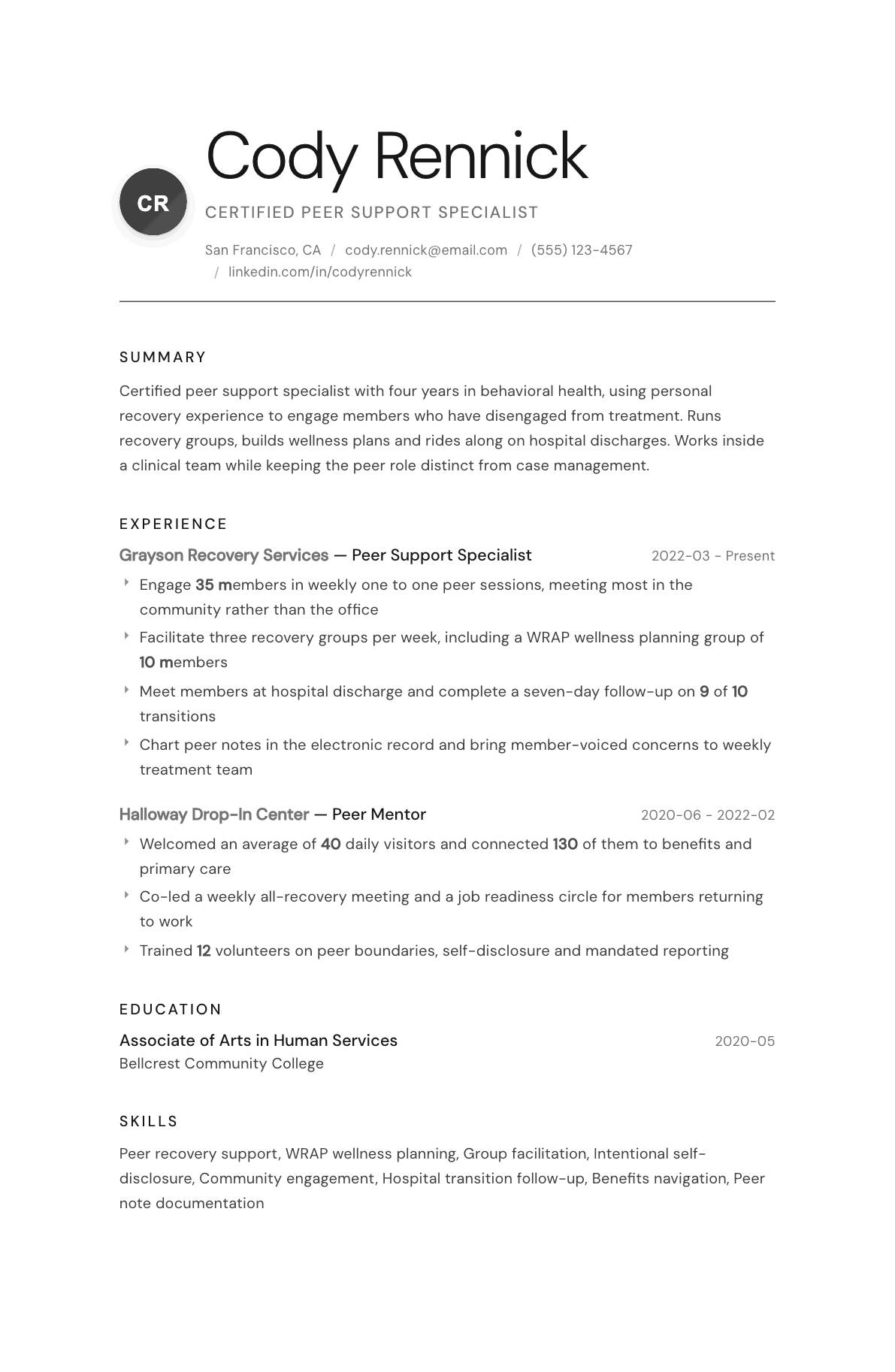
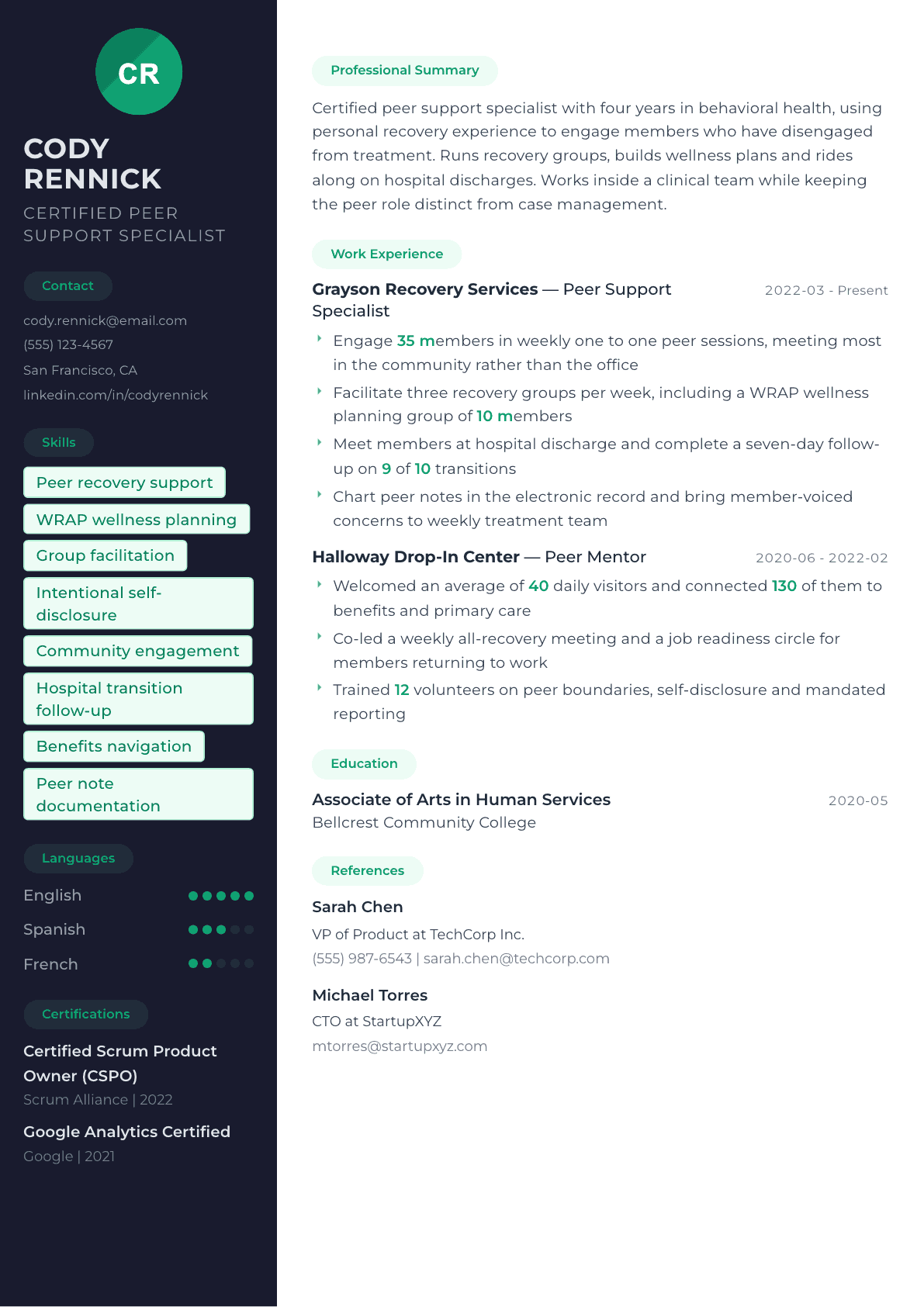
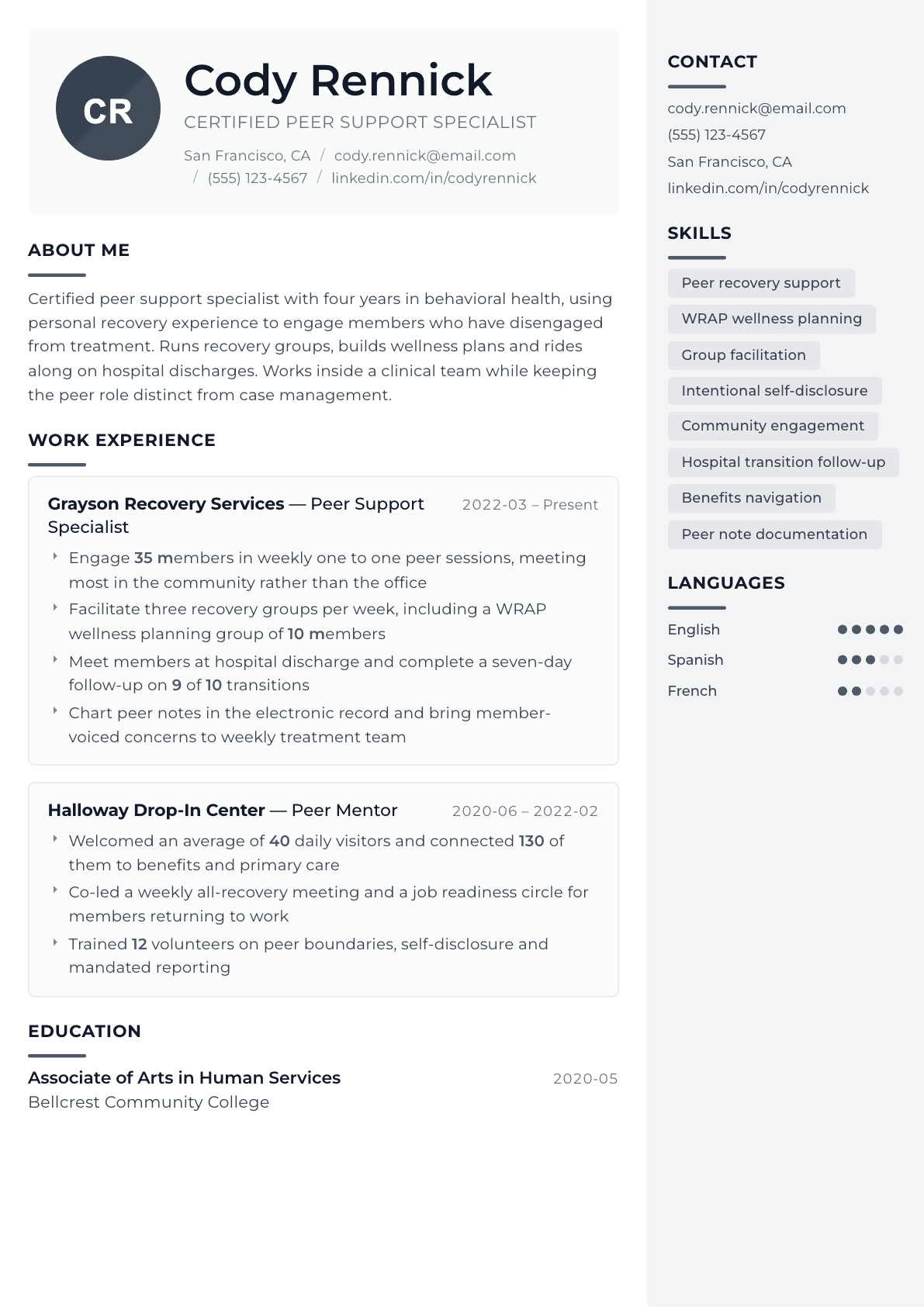
Example Peer Support Specialist summary
Certified peer support specialist with four years in behavioral health, engaging members who had disconnected from care by meeting them in the community. Carries 35 members, facilitates three recovery groups a week and completes seven-day follow-up after hospital discharge. Uses disclosure deliberately, holds the peer boundary inside a clinical team and documents billable peer notes.
Skills to list on a Peer Support Specialist resume
- Peer recovery support
- Intentional peer support
- WRAP wellness planning
- Recovery group facilitation
- Intentional self-disclosure
- Motivational interviewing
- Harm reduction
- Community engagement
- Hospital discharge follow-up
- Benefits navigation
- Crisis de-escalation
- Boundary setting
- Treatment team collaboration
- Peer note documentation
What actually gets this resume read
- Say you are a certified peer specialist in the first line, and name the state or national body that certified you.
- Frame lived experience as a working tool, describing how you use disclosure to engage members, not as a personal story.
- Count engagement: members carried, sessions per week, groups facilitated and follow-up completion after discharge.
- Show where the peer role sits beside clinicians, since employers screen for candidates who hold that boundary well.
- Name the recovery models you practice, such as WRAP or intentional peer support, with the training that backs them.
- Include documentation duties, because peer notes are billable in many programs and supervisors check that skill.
How to write a peer support specialist resume
Peer support is the only behavioral health position where personal recovery is a job requirement, and that makes the resume harder to write, not easier. Say too little and a hiring manager cannot tell you qualify. Say too much and the page turns into a personal story instead of a professional document. The line between those two is the whole craft.
The person hiring you already believes in peer support, because they wrote a position for it. What they are unsure about is whether you can hold the role inside a clinical team: engage members without becoming their case manager, disclose deliberately rather than reflexively, sit in treatment team meetings and speak for the member's perspective, and finish notes that the program can bill.
This guide shows how to write lived experience as working knowledge, with example summaries for a newly certified specialist, an experienced one and a peer supervisor, before and after bullets, and the questions people ask when they turn recovery into a career.
State the certification and the setting before anything else
Peer roles are credentialed. Put the exact title your state or national body issues in the header line and in a credential block: certified peer specialist, peer recovery support specialist, or the wording your program uses. Include the issuing body, the year cycle for renewal if the renewal is current, and any specialty endorsement such as forensic, youth or family peer support.
Then name the setting, because peer work varies enormously across them. Assertive community treatment, a crisis stabilization unit, a drop-in center, a hospital transition team, a recovery community organization and a jail reentry program all use peers, and all use them differently. Write the setting into the job line so the reader knows which one you have carried.
- Credential block: certification title, issuing body, and any endorsement such as forensic or family peer support.
- Job line: program type, the members carried, and whether contacts happen in the office or in the community.
- Note supervision structure, since peer roles are often supervised by a clinician plus a peer supervisor.
Write lived experience as method, not as memoir
The resume should show that you use your recovery deliberately. Instead of narrating what happened to you, describe the practice: intentional self-disclosure to build connection with a member who has refused every clinician, sharing a specific recovery strategy that worked for you, and knowing when disclosure serves the member rather than you.
A single line that names the population you connect with best is enough and is genuinely useful to a hiring manager. Someone who has navigated the same court, hospital or benefit system a member is facing brings knowledge no training can supply. Say that, then move on to what you do with it.
Engagement numbers, group work and follow-up
Give the size of the group you engage: members carried, one to one sessions per week, groups facilitated and the curriculum each group follows. Wellness recovery action planning, all-recovery meetings, double trouble in recovery groups and job readiness circles each imply different training, so name them.
Then show the engagement work that programs value most, which is reaching people who have already dropped out. Members re-engaged after missed appointments, hospital discharge meetings attended, and the follow-up contact you completed inside the program window are the outcomes that get a peer position renewed. Report them with the same discipline a clinician would.
Boundaries, documentation and the treatment team
Every peer supervisor has watched someone slide into doing case management, lending money, or carrying a member emotionally until they burned out. Show the opposite with a concrete example: handing a housing task back to the case manager, using supervision after a hard disclosure, or keeping contact inside program hours. This single line separates a trained peer from an enthusiastic one.
Documentation belongs beside it. Peer services are billable in many states, which means the note has to connect to the service definition and the recovery plan. Say which record system you charted in, that you closed notes on time, and how you brought the member perspective into treatment team without breaking the trust the member gave you.
- Name your record system, note turnaround, and whether your service was billed.
- Show one boundary decision in concrete terms rather than claiming strong boundaries.
- Describe your role in treatment team, case review or crisis planning meetings.
Training, models and the vocabulary programs search for
Peer postings repeat a specific vocabulary: recovery oriented, person centered, strengths based, self-determination, wellness planning, natural supports, harm reduction, whole health and stigma reduction. Use each where it describes real practice. Stacked as a list they mean nothing, and hiring managers in this field are unusually good at spotting borrowed language.
List the models you have trained in with the training provider: intentional peer support, wellness recovery action planning, whole health action management, motivational interviewing and any state core curriculum. Add trauma-informed and de-escalation training, which most peer settings require.
Peer Support Specialist resume summary examples
Newly certified specialist
Certified peer support specialist with a year at a drop-in center, welcoming an average of 40 daily visitors and connecting 130 of them to benefits and primary care. Co-leads an all-recovery meeting, uses disclosure deliberately to engage new members, and completed the state core peer curriculum.
Four years in the role
Certified peer support specialist with four years in community behavioral health, carrying 35 members and meeting most of them outside the office. Facilitates three recovery groups weekly including wellness planning, completes seven-day follow-up after hospital discharge, and charts billable peer notes on time.
Peer supervisor
Peer supervisor with eight years across drop-in, crisis stabilization and assertive community treatment settings, now supervising six peer specialists. Built the hospital transition workflow, runs monthly reflective supervision on disclosure and boundaries, and represents member voice on the agency quality committee.
Work experience bullets: before and after
Before: Used my lived experience to help clients in recovery.
After: Engaged 35 members who had disconnected from treatment, using intentional self-disclosure about my own hospital and benefits experience to open the first conversation.
Turning lived experience into a named engagement method shows practiced skill rather than personal history.
Before: Ran groups for people in recovery.
After: Facilitated three groups a week including a wellness recovery action planning group of ten members, tracking plan completion and adjusting the curriculum pace to the group.
The curriculum, group size and tracking prove you can carry a group rather than open the room for one.
Before: Followed up with members after they left the hospital.
After: Met members at hospital discharge, rode with them to the first outpatient appointment, and completed the seven-day follow-up contact on nine of ten transitions.
Naming the transition steps and a completion rate converts follow-up from an intention into a measured practice.
Before: Maintained appropriate boundaries with members.
After: Handed housing paperwork tasks back to the assigned case manager, kept contact inside program hours, and used reflective supervision after difficult disclosures.
Three specific decisions demonstrate boundaries in a way that the phrase itself never can.
Before: Wrote notes about my peer sessions.
After: Charted peer notes in the electronic record tied to each member's recovery goals, closed them within the billing window, and passed two chart reviews without a returned note.
Linking notes to goals and a billing window shows the documentation discipline that keeps peer positions funded.
Hard skills
- Peer recovery support
- Intentional peer support practice
- Wellness recovery action planning
- Recovery group facilitation
- Intentional self-disclosure
- Motivational interviewing
- Harm reduction practice
- Hospital discharge transition support
- Benefits and entitlement navigation
- Crisis de-escalation
- Billable peer note documentation
- Treatment team participation
Soft skills
- Boundary holding
- Nonjudgmental listening
- Hope building
- Self-care and supervision use
- Advocacy for member voice
- Patience with repeated setbacks
Certifications worth listing
- National Certified Peer Specialist (NCPS) (Mental Health America)
- National Certified Peer Recovery Support Specialist (NCPRSS) (NAADAC, the Association for Addiction Professionals)
- Wellness Recovery Action Plan Facilitator (Copeland Center for Wellness and Recovery)
- Mental Health First Aid (National Council for Mental Wellbeing)
Mistakes that cost peer support specialist candidates the interview
- Writing the resume as a recovery narrative, which moves the reader out of hiring mode and into an emotional response you cannot control.
- Leaving the certification title vague when programs are funded against a specific credential and must verify it.
- Describing the work as case management, which makes a supervisor worry the peer role will collapse into paperwork.
- Claiming strong boundaries with no example, in a field where boundary failures are the leading reason peers leave.
- Ignoring documentation, when unbilled peer sessions are what get a peer position cut in the next budget cycle.
- Listing recovery language as a keyword block without a single practice behind it, which experienced peer supervisors spot immediately.
Peer Support Specialist resume questions
How much of my personal recovery should I put on a peer support resume?
Enough to establish that you meet the lived experience requirement and to name the systems you know from the inside. Skip diagnoses, dates and events. Describe how you use disclosure with members instead, because that is the professional skill being hired.
Which certification do peer support employers ask for?
Most states run their own certified peer specialist credential, and some employers accept national credentials instead. List whatever you hold with its issuing body and note reciprocity if you certified in another state, since transfer rules differ.
How is a peer support specialist different from a case manager?
A case manager coordinates services and holds the plan. A peer walks alongside the member, uses shared experience to build trust and supports self-determination. Showing that you know the difference is one of the strongest things your resume can do.
Can I get a peer role without formal work history?
Yes. Volunteer facilitation, mutual aid group leadership, drop-in center hours and advisory board service all count as experience when written with dates, an organization and numbers. Add your certification training hours to show the professional preparation behind it.
What should the skills section include for a peer specialist?
The recovery models you were trained in, group curricula you facilitate, the record system you chart in, de-escalation training, and the populations you engage best. Keep clinical terminology out, since a peer resume that reads clinical raises role confusion questions.
Related resume examples
- Social Worker Resume example
- Case Manager Resume example
- Addiction Counselor Resume example
- Community Health Worker Resume example
- Life Coach Resume example
- Family Support Worker Resume example