Affiliate Marketing Manager Resume Examples: free score
Build an Affiliate Marketing Manager Resume That Drives Revenue
By Mustafa Tarabya, founder of CVBooster · Published · Updated
Create a performance-focused affiliate marketing manager resume with partner recruitment, commission optimization, and revenue attribution skills that e-commerce and SaaS companies seek.
Sample resumes for a affiliate marketing manager
The same affiliate marketing manager content laid out in three CVBooster templates, so you can see what the finished document looks like before you write a word.
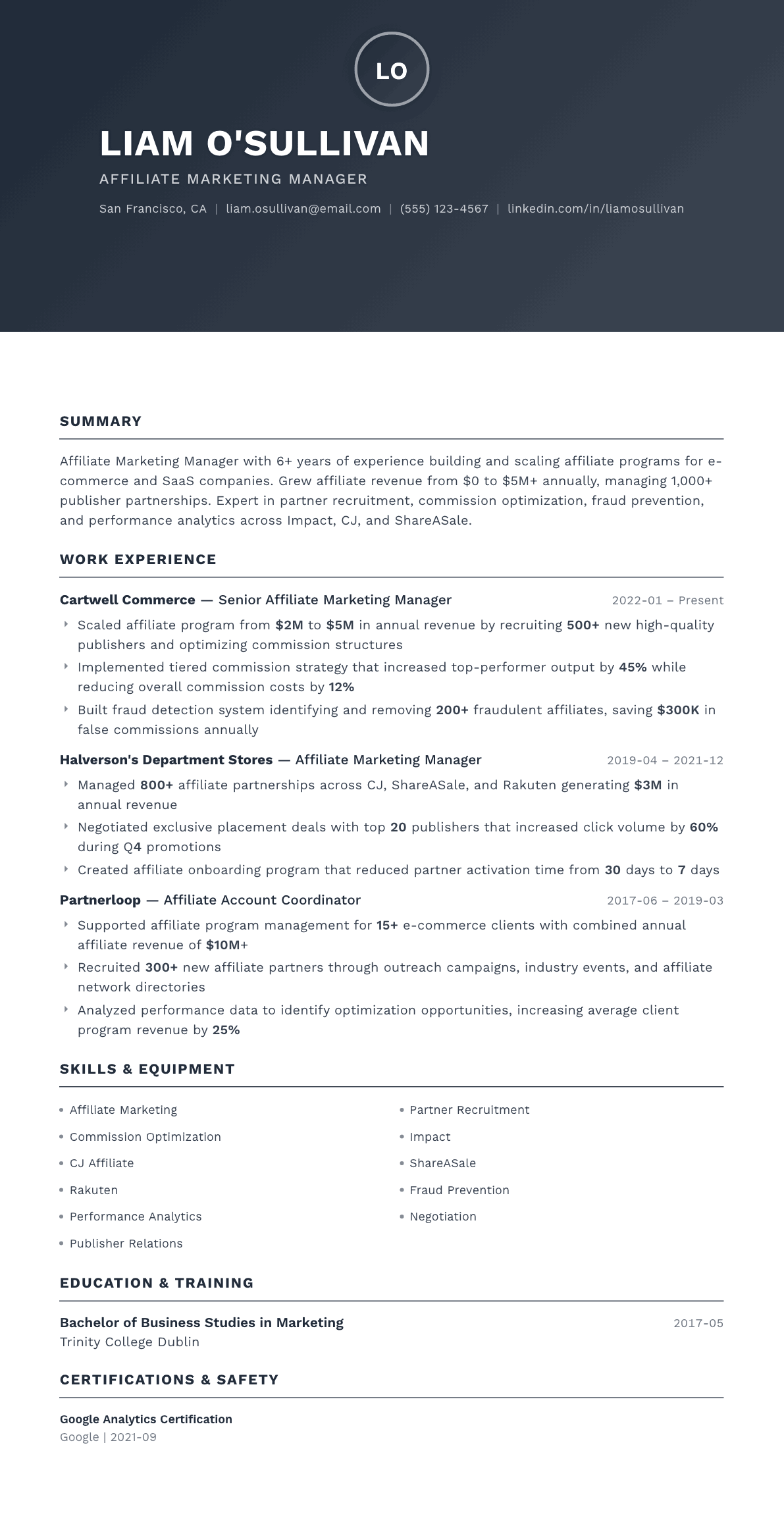
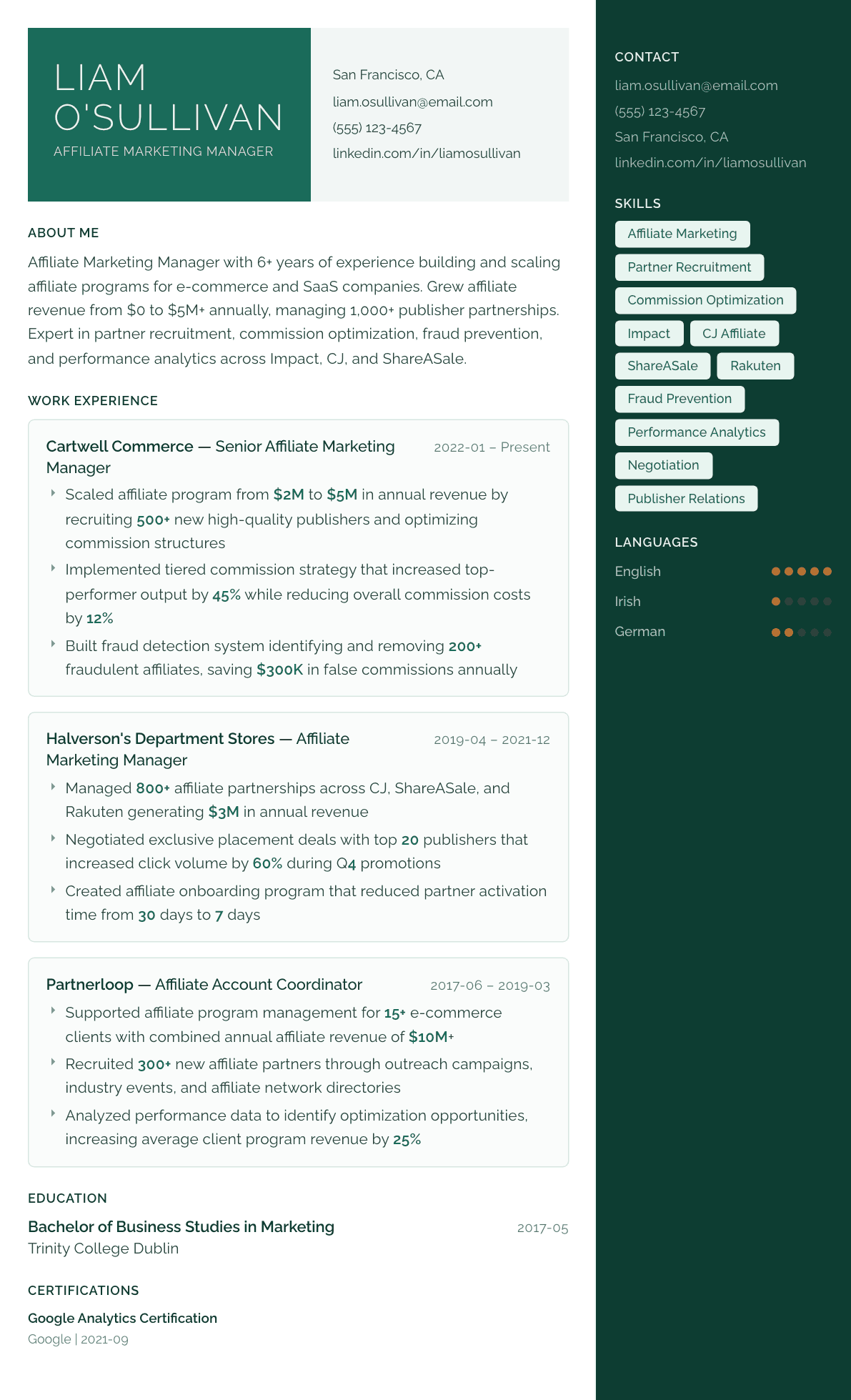
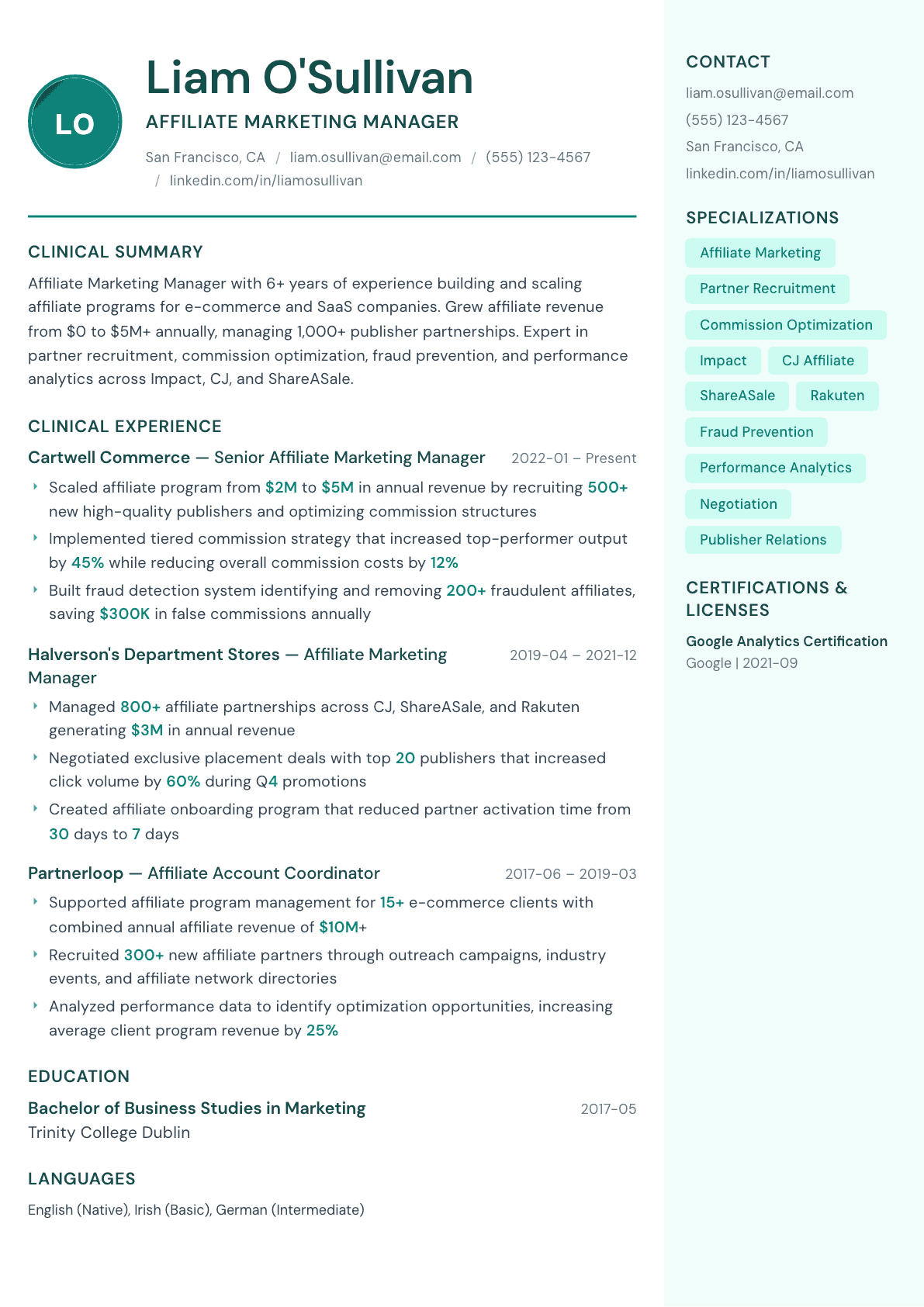
Example Affiliate Marketing Manager summary
Performance-driven Affiliate Marketing Manager with 6 years of experience scaling affiliate programs to $5M+ in annual revenue. Recruited and managed 1,000+ publisher partnerships across Impact, CJ, and ShareASale. Expert in commission optimization, fraud prevention, and strategic partner development. Seeking a senior role building affiliate programs from the ground up.
Skills to list on a Affiliate Marketing Manager resume
- Affiliate Marketing
- Partner Recruitment
- Commission Optimization
- Impact
- CJ Affiliate
- ShareASale
- Rakuten
- Awin
- Fraud Prevention
- Performance Analytics
- Publisher Relations
- Negotiation
- Revenue Attribution
- Program Strategy
What actually gets this resume read
- Quantify program revenue: total affiliate revenue managed, YoY growth, and number of active publishers.
- Highlight partner recruitment success: number of partners recruited and quality/performance of those partnerships.
- Showcase commission optimization: how you structured tiers, tested rates, and balanced revenue vs. cost.
- List affiliate platforms: Impact, CJ Affiliate, ShareASale, Rakuten, Awin, Partnerize.
- Include fraud prevention experience, as this is increasingly important for affiliate program management.
- Demonstrate strategic thinking: how you segmented partners, identified top performers, and scaled programs.
How to write a affiliate marketing manager resume
Affiliate marketing sits awkwardly between partnerships and performance media, and the resume has to satisfy both readings. The hiring manager wants to know whether you can recruit partners who would not otherwise promote the brand, and whether you can tell the difference between revenue the program created and revenue it merely intercepted on the way to checkout.
That second point is the whole craft. A program full of coupon extensions and loyalty apps can look excellent on a network dashboard while adding almost nothing the business would not have earned anyway. Managers who understand incrementality, commission tiering by partner type and fraud controls are the ones companies fight over, and the resume needs to prove you are one of them.
This guide covers the section order affiliate and partnerships leaders expect, how to write about partner recruitment and commission economics, three summaries from coordinator to program lead, before and after bullets, and the terms that recur in these postings.
Format: program scale and platforms in the first inch
One page up to about six years, reverse chronological, single column. Immediately below the header, put a program block: the networks and platforms you have run programs on, the partner types you have managed, and the scale of the programs by partner count and revenue contribution.
Keep the layout plain. Partnerships teams are small and often screen quickly, and the fastest way to be read is to make the platform names and partner categories findable without scrolling.
- Header: name, city, phone, email, and a note if you have run programs in more than one market or currency.
- Order: summary, networks and partner types, experience, certifications and training, education.
- For each role, say whether you were brand side, agency side, or at a network or platform, since those are three different vantage points.
Summary: partner mix, revenue contribution, and program health
Three lines. The years, the categories you have worked in, the partner mix you have built, and the revenue the program contributed. Say whether you inherited a program or launched one, because building from nothing and optimizing an established program are different skills.
Add one line on program health rather than only size. Active partner rate, share of revenue outside the top few partners, or new partner contribution shows a manager who thinks about concentration risk. A program where a handful of publishers carry everything is fragile and every senior reader knows it.
Experience: recruitment, commission design, and what you removed
Give each entry a context line: the business model, the categories, the program scale, and the tools. Then write bullets across the three parts of the job. Recruitment means how you found and activated partners: outreach volume, content publishers, review sites, comparison and cashback partners, creators, newsletters and technology partners.
Commission design is where the economics live. Describe tiering by partner type, new customer bonuses, category-specific rates, exclusion of certain traffic sources, and how you kept payouts sustainable against margin. If you moved a program from a flat rate to a differentiated structure, that is a strong bullet because it changes what the program attracts.
The third part is hygiene, and most candidates skip it. Removing fraudulent and trademark-bidding partners, tightening terms on branded search and coupon injection, deduplicating against paid media, and testing whether a partner type is incremental at all. Naming what you turned off is often more impressive than what you added.
Measurement, attribution and fraud
Attribution is the recurring argument in this role. Show that you can hold your ground: how the program was credited relative to paid search and email, whether last-click or a rules-based model was used, and any tests you ran to estimate incremental contribution. Reviewers want a manager who can defend the budget without overstating the case.
Fraud and compliance deserve their own bullets: monitoring for cookie stuffing, trademark bidding violations, unauthorized coupon codes, and partners misrepresenting the brand. Include how you enforced terms and what you recovered or prevented, described qualitatively when the numbers are confidential.
Skills, tools and the words affiliate postings repeat
The vocabulary is consistent: affiliate program management, partner recruitment, publisher relations, commission structure, tracking and attribution, network management, performance analysis, contract negotiation, and partner onboarding. Mirror the phrasing of the posting once in your skills block and once inside a bullet.
Name the systems: the affiliate networks and software as a service partnership platforms you have administered, the analytics suite, the tag or tracking setup you validated, and any spreadsheet or reporting layer you built for payout reconciliation. Tracking validation is a genuine differentiator, because a program with broken postbacks quietly loses partners.
Affiliate Marketing Manager resume summary examples
Affiliate coordinator
Affiliate coordinator with 2 years supporting retail programs on two networks, handling partner applications, creative and link updates, monthly payout reconciliation and performance reporting. Ran outreach to content publishers and newsletters, activating 60 new partners in the first year.
Program manager, five years
Affiliate marketing manager with 5 years running programs for subscription and retail brands, managing several hundred active partners across content, cashback and creator segments. Redesigned commission tiers to reward new customer acquisition, lifting revenue from non-coupon partners by 35%.
Head of partnerships
Partnerships leader with 9 years owning affiliate and publisher programs across two markets, accountable for revenue contribution, partner economics and compliance. Rebuilt tracking and deduplication with the analytics team, removed low-quality partners, and grew the share of revenue outside the top ten partners.
Work experience bullets: before and after
Before: Recruited new affiliate partners for the program.
After: Recruited and activated 300 partners across review sites, niche newsletters and creator channels through targeted outreach, with a structured onboarding sequence that got new partners to first sale within a month.
The partner types, the recruitment method and the activation milestone show a repeatable process rather than a headcount.
Before: Optimized commission rates to improve program profitability.
After: Replaced a flat commission with tiers by partner type and a new customer bonus, which raised content publisher revenue while holding blended payout against margin steady.
The structural change and the two-sided outcome show commercial thinking, not a rate cut.
Before: Monitored the program for fraudulent activity.
After: Audited partner traffic monthly for trademark bidding, coupon injection and cookie stuffing, removed the partners in breach of terms, and rewrote the program agreement to close the loopholes they used.
The named abuse patterns and the terms rewrite prove enforcement rather than observation.
Before: Worked with top affiliates to grow revenue.
After: Negotiated placement calendars with the top twenty publishers ahead of peak trading, agreeing editorial slots and exclusive codes in exchange for temporary rate uplifts tied to volume commitments.
A negotiation with terms on both sides is evidence of partner management, unlike a friendly relationship.
Before: Reported on affiliate performance every month.
After: Built a monthly program review covering revenue by partner type, active partner rate, new partner contribution and deduplicated orders against paid search, presented to marketing leadership.
The specific measures show you report on program health, which is what leadership actually needs to decide funding.
Hard skills
- Affiliate program management
- Partner recruitment and outreach
- Commission structure design
- Network and platform administration
- Tracking and postback validation
- Attribution and deduplication
- Fraud detection and terms enforcement
- Payout reconciliation
- Publisher and creator negotiation
- Performance reporting
- Contract and terms drafting support
- Promotional calendar planning
Soft skills
- Relationship building with publishers
- Negotiation under margin constraints
- Saying no to a bad partner
- Clear onboarding communication
- Cross-team work with analytics and finance
- Patience with slow-building partnerships
Certifications worth listing
- Google Analytics Certification (Google Skillshop learning platform)
- Professional Certified Marketer, Digital Marketing (American Marketing Association)
- HubSpot Inbound Marketing Certification (HubSpot Academy)
- Digital Marketing Professional Certification (Digital Marketing Institute)
Mistakes that cost affiliate marketing manager candidates the interview
- Reporting program revenue with no view of incrementality, which invites the reader to assume coupon partners were doing the work.
- Counting recruited partners without ever mentioning how many became active and produced a sale.
- Leaving out the commission structure, the single clearest evidence that you understand program economics.
- Ignoring fraud and terms enforcement, one of the few areas where an affiliate manager clearly protects revenue.
- Failing to say whether you built the program or inherited it, which changes how every number should be read.
- Listing networks as logos without saying what you actually administered inside them.
Affiliate Marketing Manager resume questions
How do I prove affiliate revenue was incremental?
Describe any test you ran, such as pausing a partner type in one market, comparing deduplicated orders against paid search, or measuring new customer share by partner segment. Even a partial test shows you think about incrementality rather than assuming credit.
Should I list every affiliate network I have used?
List the ones you administered directly and say what you did inside them, such as approving partners, setting commission rules, uploading creative and reconciling payouts. A long logo list without responsibilities reads as exposure rather than ownership.
How is an affiliate manager different from a partnerships manager?
Affiliate work is commission-based and measured per transaction, while partnerships can include co-marketing, integrations and revenue share deals with no click tracking. If a posting uses the partnerships title, add any business development work you have done alongside the affiliate program.
What if my program was small?
Small programs still show craft. Describe how you recruited the first partners, what commission structure you chose and why, how you validated tracking, and what the program contributed relative to other channels. Building from nothing is a skill larger employers specifically look for.
Do I need technical skills for this role?
You need enough to be dangerous: reading a tracking link, checking that a postback fires, understanding cookie windows and deduplication rules, and pulling your own reports. You do not need to write code, but a manager who cannot debug tracking will lose partners quietly.