Injection Molding Operator Resume Examples: free score
Build an Injection Molding Operator Resume Around Cycle Time
By Mustafa Tarabya, founder of CVBooster · Published · Updated
Injection molding operator resume example, keywords and guide covering press tonnage, cycle time, mold changes, short shots, flash and regrind control.
Sample resumes for a injection molding operator
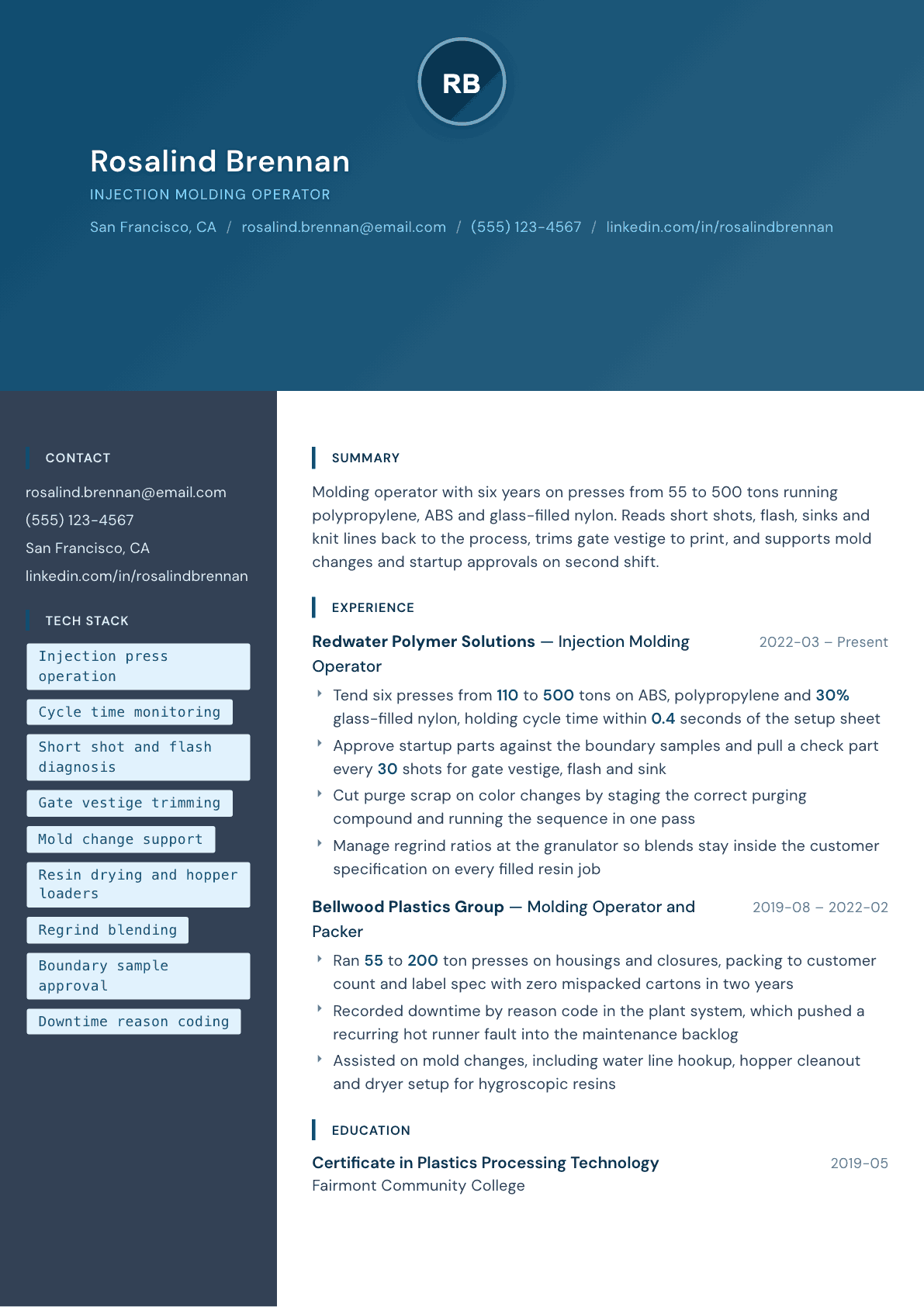
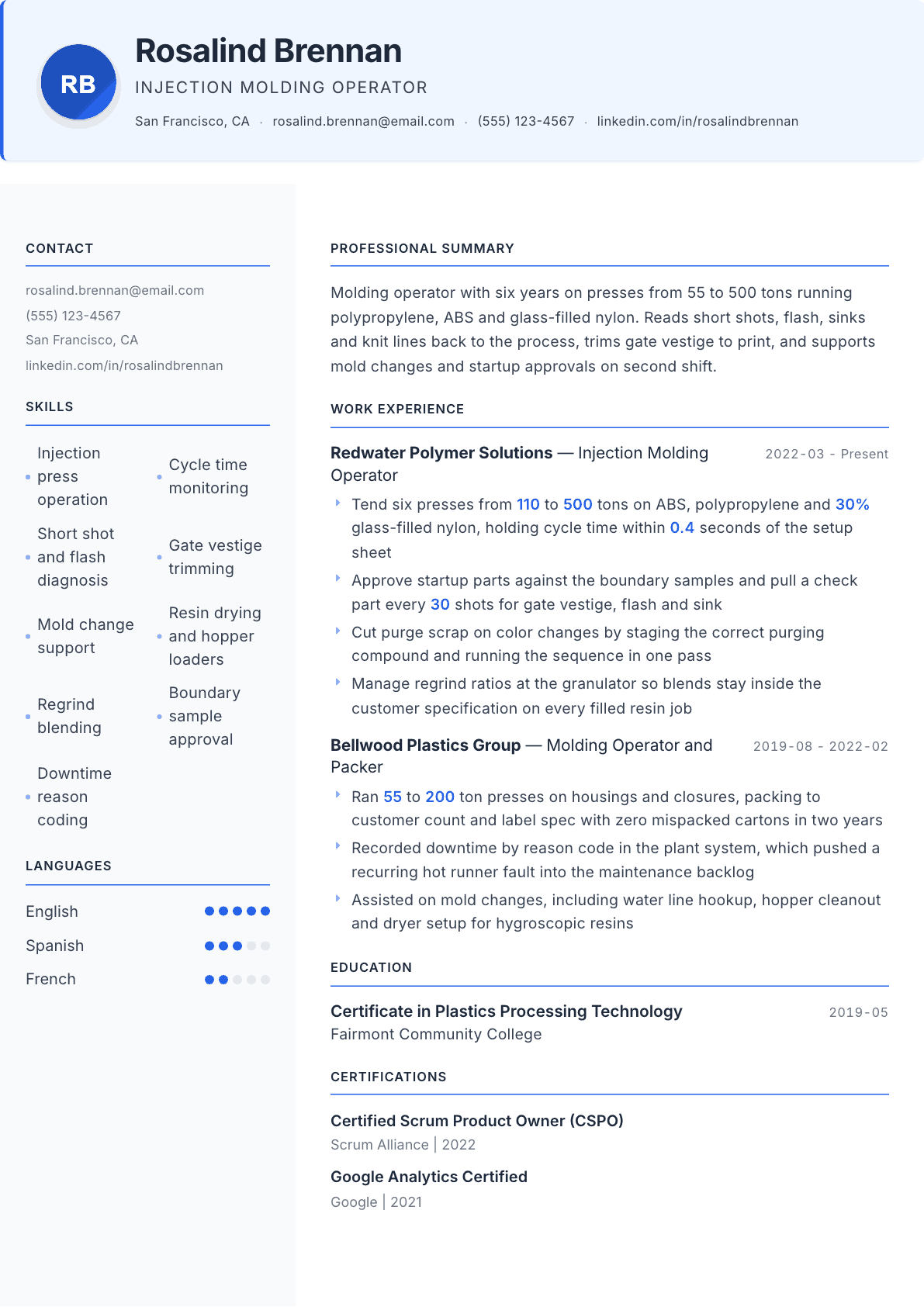
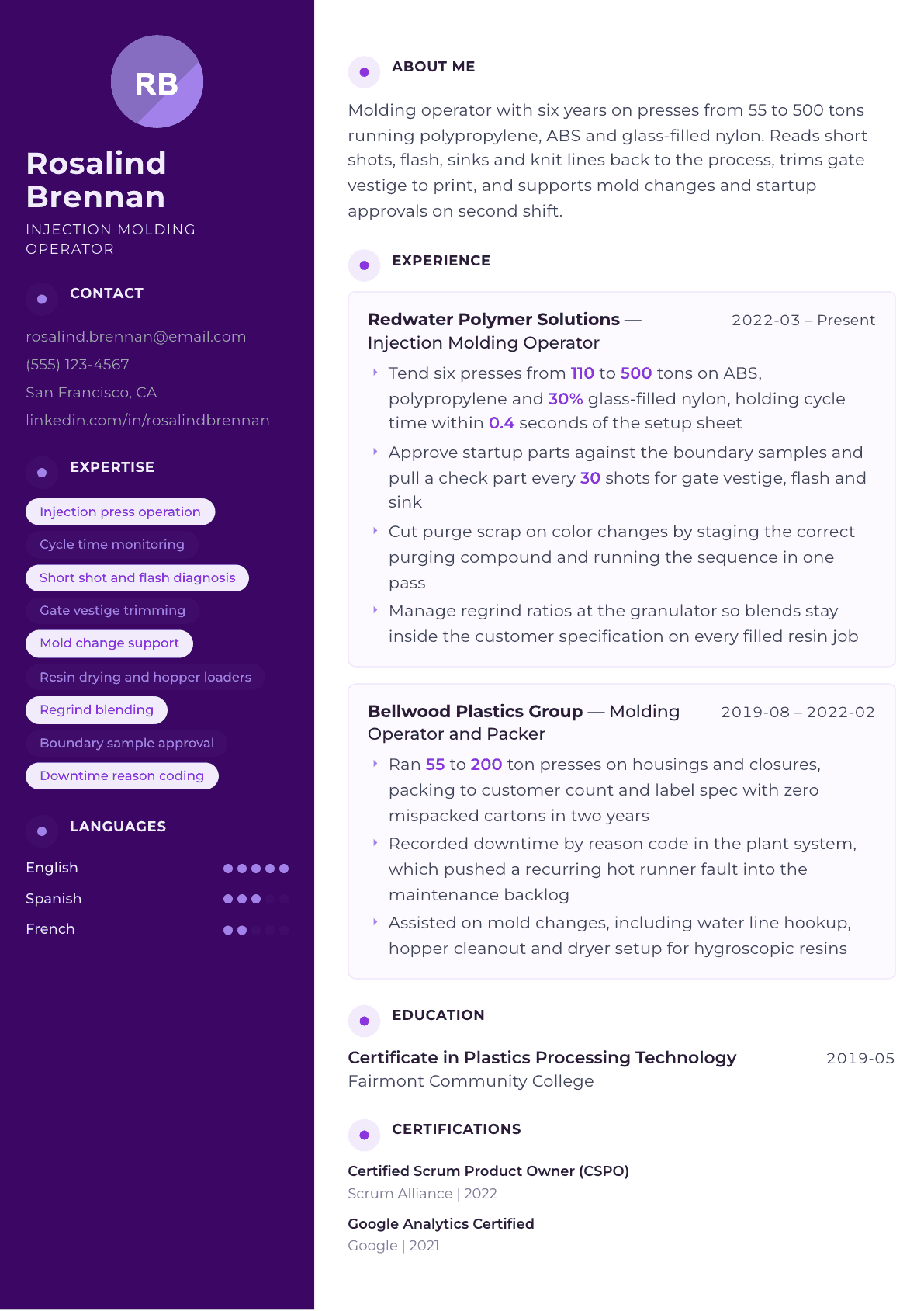
The same injection molding operator content laid out in three CVBooster templates, so you can see what the finished document looks like before you write a word.
Example Injection Molding Operator summary
Injection molding operator with six years on presses from 55 to 500 tons running polypropylene, ABS and glass-filled nylon. Holds cycle time within a fraction of a second of the setup sheet, approves startup parts against boundary samples, and reads short shots, flash, sinks and knit lines back to the process instead of only sorting them out. Supports mold changes including water lines, dryer setup and hopper cleanout, and keeps regrind blends inside customer specification.
Skills to list on a Injection Molding Operator resume
- Injection molding press operation
- Cycle time control
- Setup sheet compliance
- Short shot and flash recognition
- Sink and knit line diagnosis
- Gate vestige and degating
- Mold change assistance
- Resin drying and desiccant dryers
- Hopper loaders and material handling
- Regrind and blend ratios
- Purging and color changes
- Boundary sample judgment
- Packing to customer spec
- Downtime reason coding
- Robot and sprue picker tending
What actually gets this resume read
- List press tonnage range and the resins you have run, because filled nylon is a different job from polypropylene.
- Show that you read defects back to the process: a short shot and a sink point at different causes.
- Say whether you approve startup parts against boundary samples or hand that judgment to a technician.
- Give your cycle time discipline in seconds against the setup sheet rather than claiming attention to detail.
- Name your part of the mold change: water lines, hopper cleanout, dryer setup or crane work.
- Include regrind handling, since blend control is where a molding plant quietly loses customer approvals.
How to write a injection molding operator resume
A molding supervisor filling an operator seat is protecting cycle time and tooling. She has presses that must keep running at the setup sheet values, molds worth more than the machines around them, and customers who reject parts for flash a millimeter long. Your resume is read against that, not against a general idea of factory work.
The weakest injection molding operator resumes describe the job as taking parts off a press and putting them in a box. The strongest ones show that you understand a molded part is a record of the process: a short shot, a sink, a burn mark and a knit line each point at a different setting. Operators who can read that are the ones a plant keeps.
This guide sets out the section order molding plants expect, how to write the summary, what belongs in each job, the defect and material vocabulary that gets a resume through a screen, before and after bullets, and the questions operators ask when they aim at a process technician seat.
Format: press and resin block first, then jobs
One page, reverse chronological, with a press and material block sitting under your name. Two lines are enough: the tonnage range you have tended and the resins you have run. Polypropylene, ABS, polycarbonate, acetal and glass-filled nylon behave differently at the machine and a supervisor sorts candidates by that list before she reads anything else.
Then the jobs, each opened with the plant type and the number of presses you covered. A custom molder with frequent mold changes and a captive plant running the same tool for months want different halves of your history, and the reader should not have to work out which one you came from.
- Press and material block: tonnage range, machine makes if you know them, resins including filled grades.
- Auxiliary equipment named separately: dryers, hopper loaders, chillers, granulators, conveyors, sprue pickers.
- Each job showing presses covered per operator and whether the cell is manual, robot assisted or fully automatic.
- A short defect line naming what you can identify and correct versus what you escalate to a technician.
Summary: tonnage, resins, cycle discipline, judgment
Four facts in three lines: years at the press, tonnage range, resin families, and whether you approve startup parts against boundary samples. That last item is the judgment call a molding plant is really buying, because an operator who can hold or release a run keeps bad parts out of the customer box without waiting for a technician.
If you have handled color changes, purging sequences and regrind blending, put it in the summary rather than burying it. Material control is where molders lose money quietly, and an operator who talks about regrind ratios sounds like someone who has been trusted with the granulator.
Experience: cycle, defects, materials, mold changes
Open each job with press count, tonnage and the part types, then write bullets in four groups. Cycle discipline comes first: holding the machine to the setup sheet, watching for creeping cycle time, and reporting a drift rather than absorbing it. Give a tolerance in seconds if you tracked one.
Defect work comes second and carries the most weight. Name what you catch and what you do about it: short shots traced to fill, flash traced to clamp or venting, sinks traced to pack and hold, burn marks traced to venting or injection speed, splay traced to wet material. Say which corrections you are authorized to make yourself.
Material handling is third: dryer setup and dew point for hygroscopic resins, hopper loader troubleshooting, purge sequences on color change and regrind blend ratios against the customer allowance. Mold change support is fourth: water lines, crane or magnetic clamping, hot runner connections, first shot approval and the cleanup that follows.
Packing, secondary work and the numbers a molder tracks
Molding operators are also the last set of eyes before the box. Say how you pack: count per carton, layer patterns, moisture barrier bags, label and lot code verification. A mispacked or mislabeled carton reaches the customer as a quality escape even when every part inside is good.
For numbers, use scrap rate, parts per hour against the standard, downtime by reason code and the count of quality escapes from your press. Secondary operations belong here too: degating, trimming, ultrasonic welding, pad printing, insert placement and assembly, all of which change the value of an operator on a mixed floor.
Words a molding posting screens for
Molding job posts repeat a narrow set of terms: tonnage, cycle time, setup sheet, short shot, flash, sink, splay, knit line, gate vestige, sprue, runner, regrind, purge, dryer, boundary samples and mold change. Use them where you did the work, and use them the way a molder does rather than translating them into general manufacturing language.
Name your resins with grade detail where you have it. Glass-filled nylon, high impact polystyrene and medical grade polycarbonate each imply different handling, drying and cleanliness rules, and an operator who lists them accurately signals plant experience that no adjective can supply.
Injection Molding Operator resume summary examples
New to molding
Plastics processing certificate holder with 8 months tending 55 to 110 ton presses on polypropylene and ABS. Trained in degating, boundary sample comparison, dryer setup and carton packing to spec. Seeking a full time injection molding operator role on a rotating shift.
Five years in
Injection molding operator with 5 years on 110 to 500 ton presses running ABS, polypropylene and 30% glass-filled nylon. Holds cycle time within half a second of the setup sheet, approves startup parts against boundary samples, and manages regrind blends inside customer allowance.
Senior operator moving to process
Senior molding operator with 10 years across custom and captive plants, covering eight presses to 800 tons. Diagnoses short shots, sinks, splay and burn marks back to process causes, leads mold changes including hot runner hookup, and trains new operators on startup approval.
Work experience bullets: before and after
Before: Removed parts from machines and packed them.
After: Tended six presses from 110 to 500 tons, degating and packing to customer carton count and label spec with no mispacked cartons reported in two years.
Press count, tonnage and a packing accuracy record turn a passive task into a measurable one.
Before: Watched for defects during production.
After: Pulled a check part every 30 shots against boundary samples for flash, sink and gate vestige, and held two runs for a technician when cycle time drifted past the setup sheet value.
A sampling interval and a hold decision show judgment rather than passive watching.
Before: Helped with mold changes.
After: Supported mold changes on 300 to 500 ton presses including water line hookup, hot runner connection, hopper cleanout and dryer setup for hygroscopic resins.
Naming the steps proves you did the work rather than stood beside the technician doing it.
Before: Managed regrind for the department.
After: Ran granulator regrind blending on filled resin jobs, holding ratios inside the customer allowance and keeping color changes to one purge pass with the correct compound.
Blend control and purge efficiency are cost lines a molding plant watches closely.
Before: Kept production running smoothly.
After: Logged downtime by reason code every shift, which surfaced a recurring hot runner fault and moved it into the maintenance backlog before it stopped a customer order.
The outcome shows why disciplined logging matters instead of asserting reliability.
Hard skills
- Injection press tending across tonnage ranges
- Setup sheet and cycle time compliance
- Boundary sample approval
- Short shot, flash and sink diagnosis
- Splay, burn and knit line recognition
- Degating and gate vestige control
- Mold change support
- Resin drying and dew point checks
- Hopper loaders and material conveying
- Regrind blending and granulator operation
- Purging and color change sequences
- Secondary operations and insert placement
- Packing, labeling and lot code checks
- Downtime reason coding
Soft skills
- Holding a run rather than hoping a defect is a one off
- Working a hot floor for a full shift without losing check rhythm
- Passing a press over with the real story at shift change
- Asking a technician the right question instead of guessing at settings
- Keeping pace when one press in the cell goes down
Certifications worth listing
- Master Molder I (RJG, Inc.)
- Certified Production Technician (CPT) (Manufacturing Skill Standards Council)
Mistakes that cost injection molding operator candidates the interview
- Describing the job as packing parts, which erases every technical judgment an injection molding operator actually makes.
- Omitting tonnage and resin families, the two filters a molding supervisor applies before reading further.
- Naming defects without the causes, so the reader cannot tell whether you sort parts or understand the process.
- Leaving regrind, purging and dryer work off the page when material control is where molders lose margin.
- Claiming mold change experience without listing a single step of the change you performed.
- Writing a resume for a custom molder and a high volume captive plant as if changeover skill mattered equally to both.
Injection Molding Operator resume questions
How much process knowledge should an operator resume claim?
Claim what you are authorized to adjust and no more. Listing the defect causes you can identify is honest and valuable, while implying you set barrel profiles or pack pressures without approval will be tested in the first technical interview question.
Does machine brand experience matter to a molding plant?
It helps, because control interfaces differ enough that a familiar brand shortens the learning curve. Name the makes you have run, then add that you read the setup sheet and machine screen rather than relying on memory of one controller layout.
How do I get from operator to process technician?
Build the resume around diagnosis and setup support rather than tending. Show the defects you traced to causes, the mold changes you performed, dryer and dew point work, and any scientific molding training. Technicians are hired on troubleshooting evidence, not seniority.
Should I list the parts I molded?
List the part families and industries rather than customer names bound by confidentiality. Automotive interior trim, medical disposables and consumer closures each carry different tolerance and cleanliness expectations, and naming yours tells a supervisor which quality culture you already work inside.
What if my plant ran fully automatic cells with little handling?
Say so plainly and shift the emphasis to monitoring, sampling and auxiliary equipment. An operator covering eight automatic presses is managing dryers, loaders, robots and quality sampling across a large floor, which is a stronger story than a manual cell with two machines.
Related resume examples
- Machine Operator Resume example
- Production Operator Resume example
- Manufacturing Engineer Resume example
- Process Operator Resume example
- Packaging Operator Resume example
- Printing Press Operator Resume example