Printing Press Operator Resume Examples: free ATS score
A Printing Press Operator Resume That Proves Color Control
By Mustafa Tarabya, founder of CVBooster · Published · Updated
Printing press operator resume example with offset, flexo and digital keywords, plus a guide to makeready, waste and color density evidence.
Sample resumes for a printing press operator
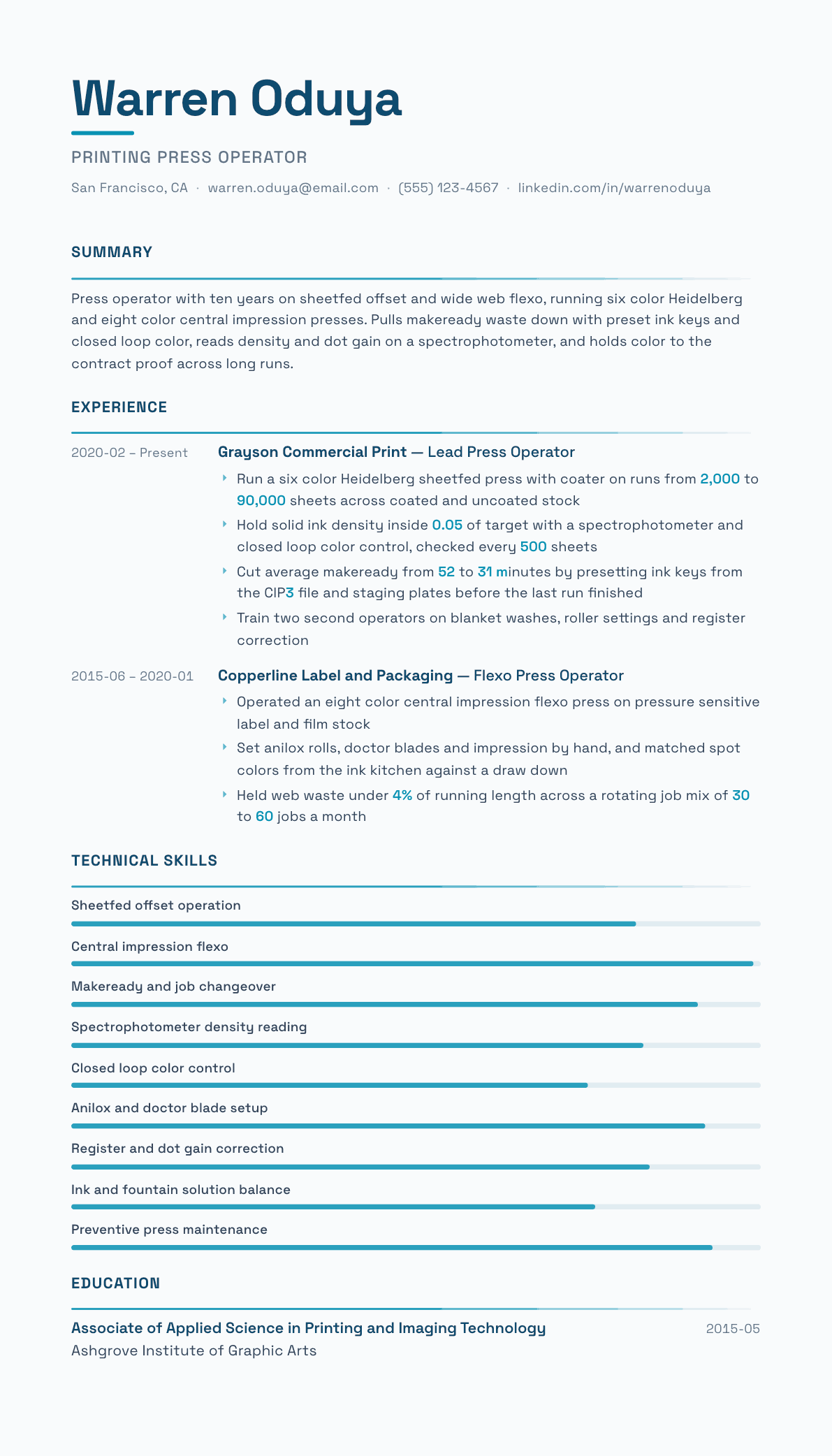
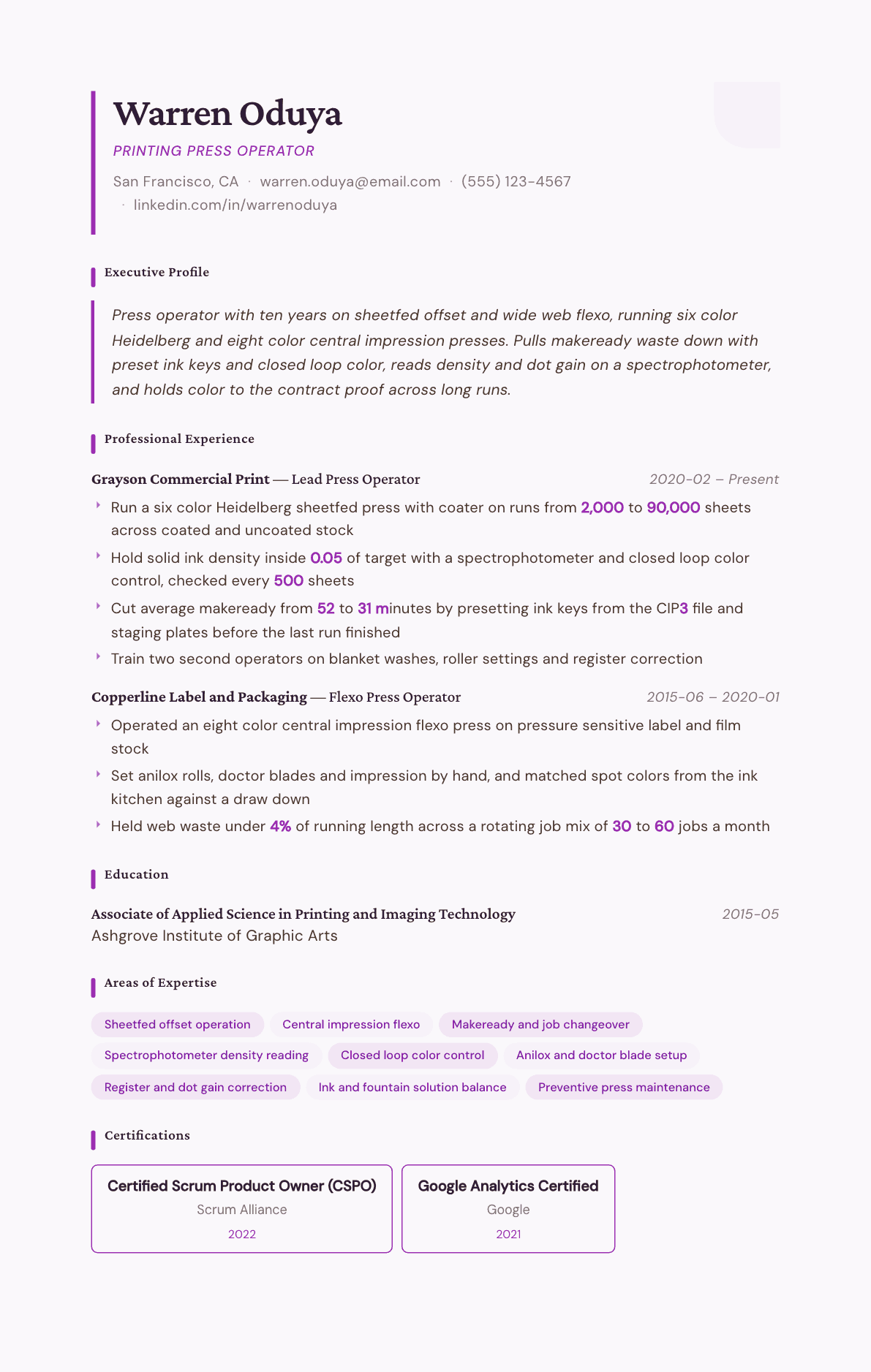
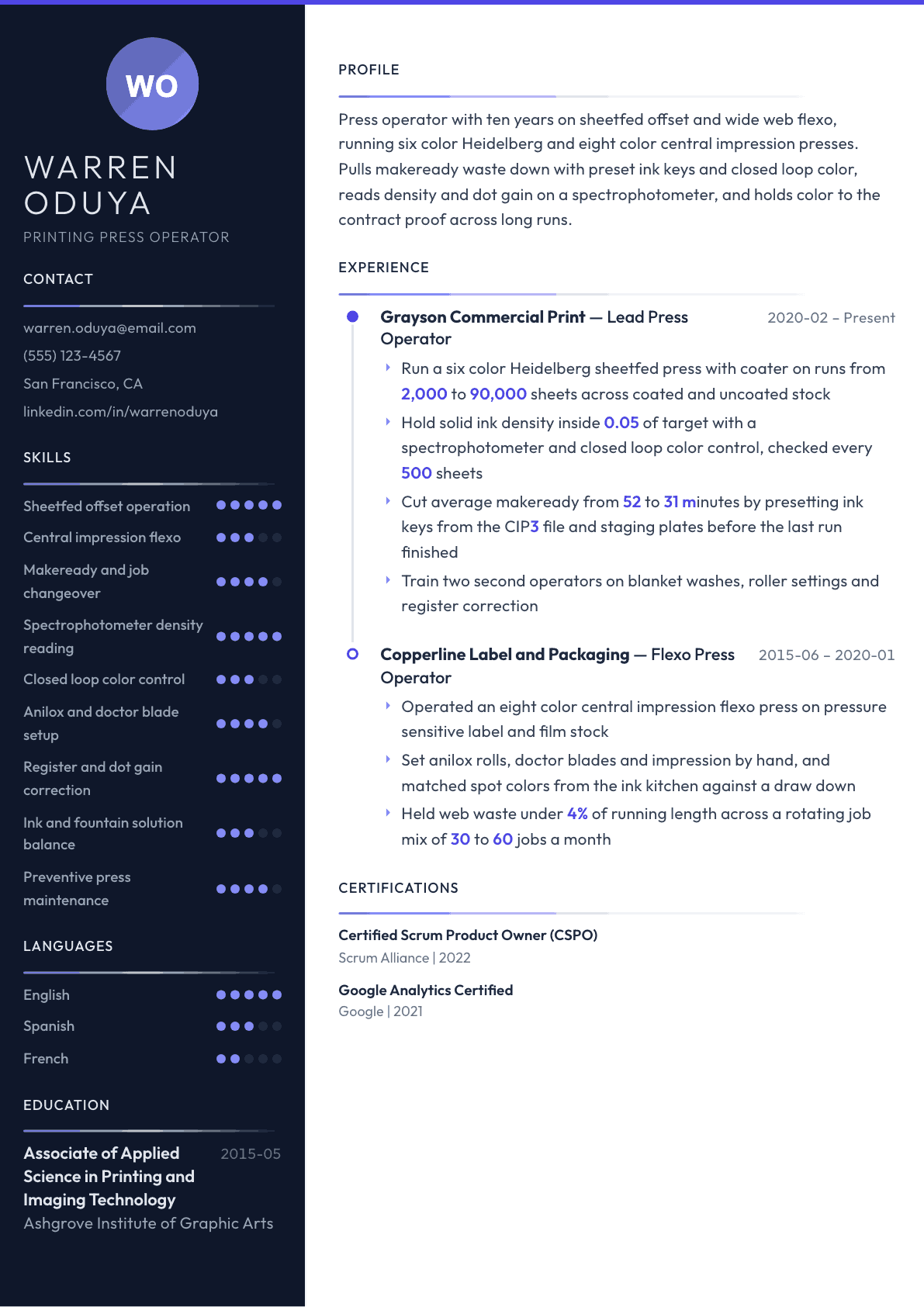
The same printing press operator content laid out in three CVBooster templates, so you can see what the finished document looks like before you write a word.
Example Printing Press Operator summary
Printing press operator with ten years on six color sheetfed offset and eight color central impression flexo, running coated and uncoated stock, film and pressure sensitive labels. Holds solid ink density inside 0.05 of target using a spectrophotometer and closed loop color, and pulled average makeready from 52 to 31 minutes by presetting ink keys off the CIP3 file. Trains second operators on washes, roller settings and register correction.
Skills to list on a Printing Press Operator resume
- Sheetfed offset press operation
- Web offset operation
- Flexographic press operation
- Digital press operation
- Makeready and changeover
- Ink key presetting from CIP3
- Spectrophotometer and densitometer use
- Dot gain and register control
- Anilox roll and doctor blade setup
- Blanket and roller maintenance
- Fountain solution and pH control
- Spot color matching and draw downs
- Substrate and stock handling
- Waste and spoilage tracking
- Plate mounting and imaging
- Preventive maintenance schedules
What actually gets this resume read
- Name the press make, the number of units and the format, because that is how a plant matches you to its floor.
- Give your makeready time before and after any change you made, since makeready is where a plant loses money.
- State your waste rate as a share of run length and say how you measure it.
- Show how you control color: densitometer or spectrophotometer, target values, and how often you pull a sheet.
- Separate offset, flexo, digital and screen work, because a hiring manager reads them as different trades.
- List the substrates you have run, from uncoated text weight to film and pressure sensitive label stock.
How to write a printing press operator resume
A print plant manager reading an operator resume is doing arithmetic. Every minute of makeready is a minute the press is not earning, every sheet of waste is stock he already paid for, and every color complaint is a reprint he eats. So the questions behind his reading are narrow: how fast can you get up to color, how much do you waste getting there, and how tightly do you hold it once you are running.
That is why the vague version fails. "Operated printing presses and ensured quality output" could describe a helper who never touched the ink keys. A press operator page has to say which press, how many units, what format, what substrates, what your makeready time looks like and how you measure color. Those facts are the trade.
This guide covers how to structure the page around presses rather than employers, how to write makeready and waste numbers that a plant can trust, how to describe color control properly, and how to handle a career that spans offset, flexo and digital equipment.
Format: lead with the presses, not the job titles
One page for most operators, two if you have run several distinct press families over a long career. Directly under your contact details, put a press block: make, number of units, format or web width, coater or tower configuration, and the console or color control system. That block is the fastest way for a plant manager to decide whether to keep reading.
Then experience, one job per employer, with the plant type named. Commercial sheetfed, publication web, label and packaging flexo, corrugated, folding carton and digital production are different businesses with different rhythms, and a manager wants to know which floors you have stood on.
- Contact line: name, phone, email, city, and the shift pattern you can work, since presses run nights.
- Press block: make, unit count, sheet size or web width, coater, and the control system by name.
- Substrate list: coated and uncoated stock, board, film, pressure sensitive label, corrugated.
- Experience per employer with plant type, run lengths and job mix per month.
- Color and quality block: instruments, target values and any color process you have worked to.
Makeready: the number the plant actually buys
Makeready is the operator metric. Give your average changeover time on a named press and job type, and if you improved it, give the before and after with the method. Presetting ink keys from the prepress file, staging plates and stock before the previous job ends, standardizing wash sequences, keeping a fingerprint for each stock and ink combination: these are the levers, and naming the one you pulled is what makes the number believable.
Tie makeready to waste, because the two move together. Sheets to color, or web waste as a share of run length, tells a manager how disciplined your approach is. Include how you count it, since a plant that measures waste at the delivery and one that measures from the roll stand are counting different things.
Color control: instruments, targets and how often you check
Color is where operators separate. Say what you measure with, what you measure against and how frequently. A spectrophotometer reading solid ink density and delta E against a contract proof, checked at a set sheet interval, is a controlled process. Eyeballing against an OK sheet is not, though plenty of plants still work that way and there is no shame in saying so.
Name the things you adjust and why: ink key profiles, fountain solution conductivity and pH, blanket packing, impression setting, dot gain curves, anilox volume and doctor blade angle on flexo. Add any standardized color process you have worked under, and any print condition or profile you have been fingerprinted to, because plants selling into brand work need operators who understand that a target is a number and not an opinion.
On flexo, be specific about the parts of the job that are yours: mounting plates to register, setting anilox and impression, matching spot colors from the ink kitchen against a draw down, and controlling viscosity through the run. Those steps are where flexo quality is won and lost.
- Instrument used and what it reads: density, delta E, dot area, gray balance.
- Target values and the tolerance you hold against them.
- Check frequency, expressed in sheets or in running length.
- The adjustments you make and their effect on the sheet.
- Any color standard or characterization data you have worked to.
Maintenance, safety and running the crew
Presses are maintained by the people who run them. List what you do: blanket washes and changes, roller settings and durometer checks, impression cylinder cleaning, lubrication rounds, dampening system cleaning, anilox cleaning cycles, and the scheduled preventive tasks you sign off. A plant that sees maintenance on your page reads a longer press life.
If you lead a crew, say how many second operators and helpers you direct and what you train them on. Add safety plainly: lockout tagout for washes and blanket changes, guarding discipline, solvent and ink handling, and any record of running without a recordable incident. Nip points on a running press are unforgiving, and a manager notices operators who talk about guards without prompting.
Crossing between offset, flexo and digital
If you have run more than one technology, present them as separate competencies rather than blending them, because a plant hires for one and treats the other as a bonus. The transferable part is color judgment, makeready discipline and mechanical feel, so say that explicitly when applying outside your main technology.
Digital deserves the same specificity as the others. Name the engine family, the front end and the substrates, and describe calibration and profiling routines rather than treating a digital press as a large office printer. Plants moving work between litho and digital want operators who can hold color across both, and that is a strong line to have on the page.
Printing Press Operator resume summary examples
Second operator
Press assistant with two years feeding and delivering on a four color sheetfed press, mounting plates, washing blankets and pulling sheets for the operator to read. Trained on densitometer checks and stock changeovers, with a graphic arts certificate covering color theory and prepress workflow.
Running the press
Press operator with ten years on six color sheetfed offset and eight color central impression flexo, running coated stock, film and pressure sensitive labels. Holds solid ink density inside 0.05 of target with a spectrophotometer, and pulled average makeready from 52 to 31 minutes by presetting ink keys.
Lead operator
Lead press operator with nineteen years across sheetfed, web and flexo equipment, running a three shift press crew and the plant color standard. Fingerprints each press and stock combination, sets ink key profiles for the prepress team, and trains second operators through to full operator qualification.
Work experience bullets: before and after
Before: Operated a printing press to produce customer jobs.
After: Ran a six color Heidelberg sheetfed press with in line coater on runs from two thousand to ninety thousand sheets across coated, uncoated and board stock.
Press configuration, run length range and substrates let a plant match you to its own floor immediately.
Before: Maintained good color quality on all jobs.
After: Held solid ink density inside 0.05 of target using a spectrophotometer and closed loop color control, pulling and reading a sheet every five hundred impressions against the contract proof.
The tolerance, the instrument and the check interval describe a controlled process instead of a hopeful one.
Before: Reduced setup time on the press.
After: Cut average makeready from 52 to 31 minutes by presetting ink keys from the prepress file and staging plates and stock before the previous job finished.
A before and after with the two specific methods behind it converts directly into press hours a manager can sell.
Before: Kept waste low.
After: Held web waste under 4% of running length across 30 to 60 label jobs a month by standardizing wash sequences and matching spot colors against a draw down before the press started.
Waste as a share of run length, with a job volume and a method, is a figure a plant can audit.
Before: Trained new employees on the press.
After: Trained two second operators through to full operator qualification on blanket washes, roller settings, impression adjustment and register correction.
Naming the qualification outcome and the specific skills taught shows real crew development rather than informal help.
Hard skills
- Sheetfed offset press operation
- Web offset press operation
- Flexographic press operation
- Digital production press operation
- Makeready and job changeover
- Ink key presetting from prepress data
- Spectrophotometer and densitometer measurement
- Dot gain, gray balance and register control
- Anilox roll and doctor blade setup
- Fountain solution conductivity and pH control
- Blanket, roller and impression maintenance
- Spot color matching and draw downs
- Plate mounting and register setting
- Substrate handling and stock changeovers
- Waste and spoilage tracking
Soft skills
- Staying calm when a job is late and the color is not right
- Reading a sheet the same way at the start and end of a night shift
- Handing over mid run with notes the next operator can use
- Pushing back on a job that will not run as prepared
- Keeping helpers busy and safe around a running press
Certifications worth listing
- G7 Expert (Idealliance)
- Color Management Professional (Idealliance)
- OSHA 10-Hour General Industry (OSHA Training Institute)
- Powered Industrial Truck Operator Certification (OSHA Training Institute)
Mistakes that cost printing press operator candidates the interview
- Naming the employer but not the press, so a plant manager cannot tell whether you have run anything like his equipment.
- Giving no makeready time, which is the operator number a print plant buys before any other.
- Talking about color quality without an instrument, a target value or a check interval behind it.
- Merging offset, flexo and digital into one blur when plants hire for one technology at a time.
- Leaving out substrates, which hides whether you have run film and label stock or only coated sheets.
- Skipping press maintenance, when the tasks an operator signs off decide how long the equipment holds tolerance.
Printing Press Operator resume questions
How do I write about a press I ran years ago that the industry has moved past?
Keep it, but put it in a short earlier career line rather than in your main press block. Old equipment teaches mechanical feel that transfers, and a manager will read it as depth as long as your current platforms are clearly the ones at the top of the page.
Is it worth listing run lengths?
Yes, because short run work and long run work are almost different jobs. A shop doing many short jobs a day needs an operator whose strength is changeover speed, while a long run plant needs one who holds color steady for hours. Give the range so the fit is obvious.
What if my plant never tracked my waste or makeready?
Describe the practices you used instead: presetting from prepress data, staging the next job, sequencing washes, checking against a proof at set intervals. A manager can judge discipline from method, and inventing a figure you cannot support is the fastest way to lose credibility.
Should a press operator mention prepress knowledge?
If you have it, yes, because operators who understand imposition, trapping, plate curves and file preparation solve problems at the console instead of stopping the press. Keep it to a line or two so it supports your press experience rather than competing with it.
How do I move from commercial print into packaging?
Lead with color control and substrate handling, then address the differences directly: register tolerance across a web, ink adhesion on film, and brand color matching under a specification. Naming what you would need to learn reads as credible rather than weak.
Related resume examples
- Machine Operator Resume example
- Press Operator Resume example
- Production Operator Resume example
- Print Designer Resume example
- Injection Molding Operator Resume example
- Manufacturing Technician Resume example