Government Contractor Resume Examples: read this first
Write a Government Contractor Resume That Maps to the Contract
By Mustafa Tarabya, founder of CVBooster · Published · Updated
Government contractor resume example, keyword list and guide covering contract vehicles, labor categories, clearances, CPARS and task orders.
Sample resumes for a government contractor
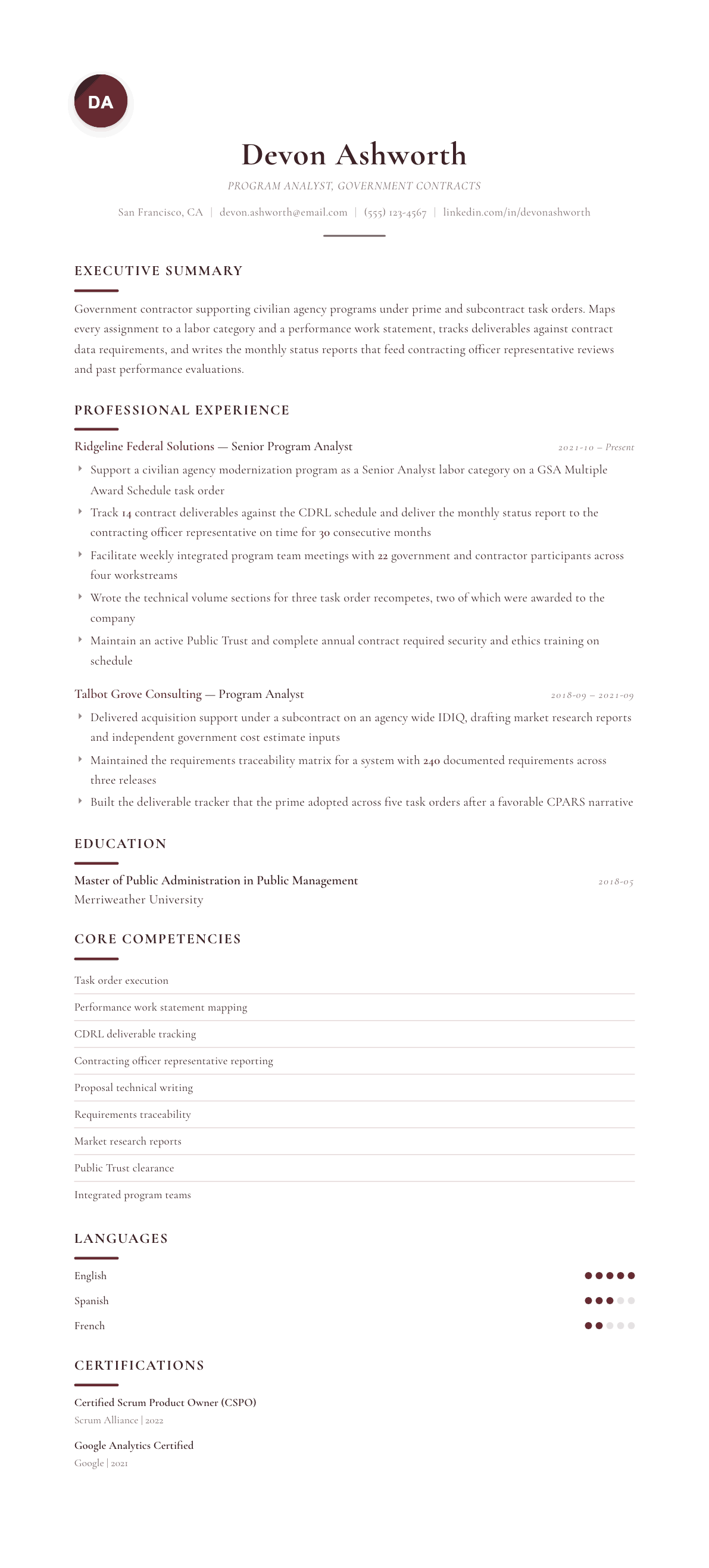
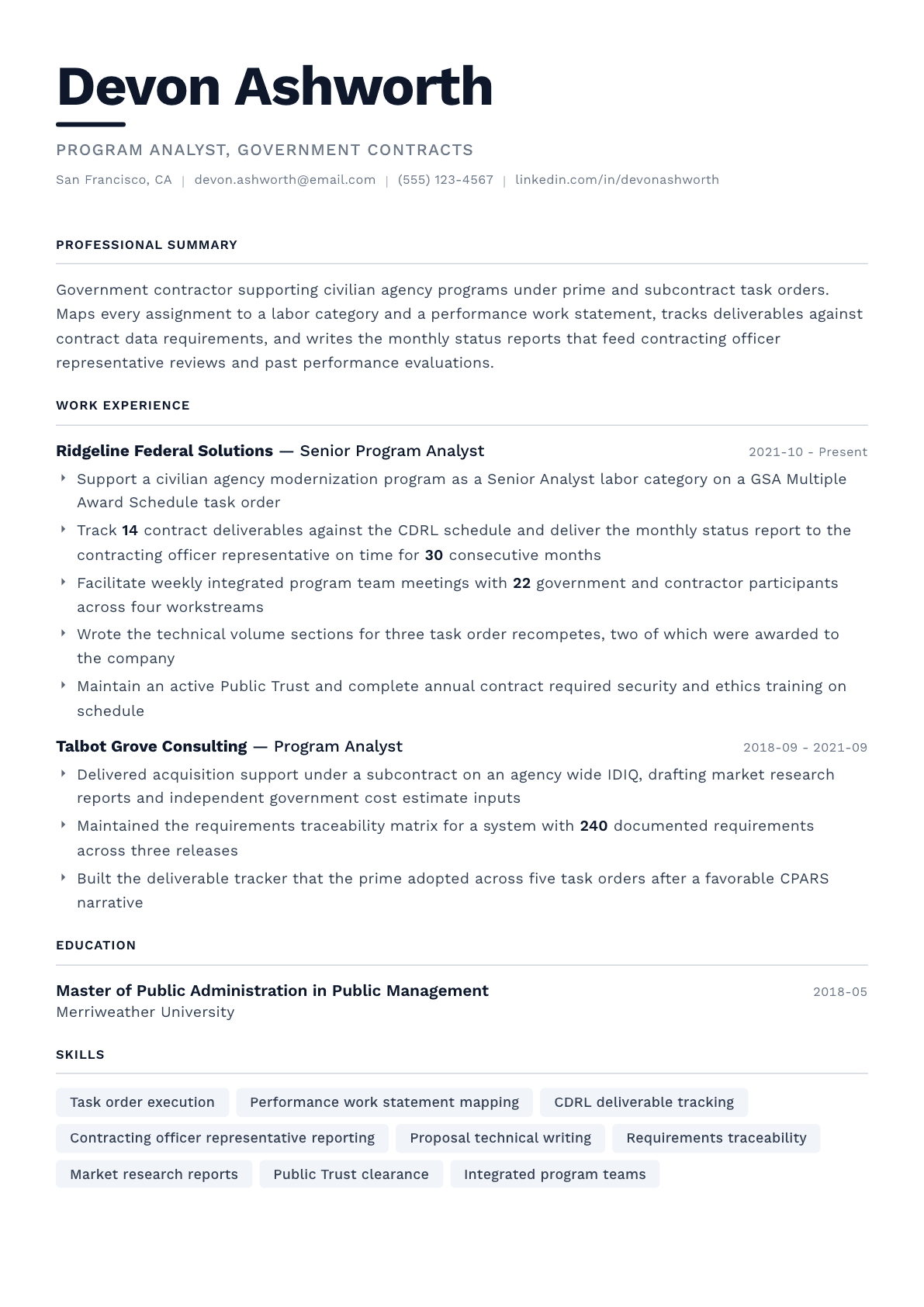
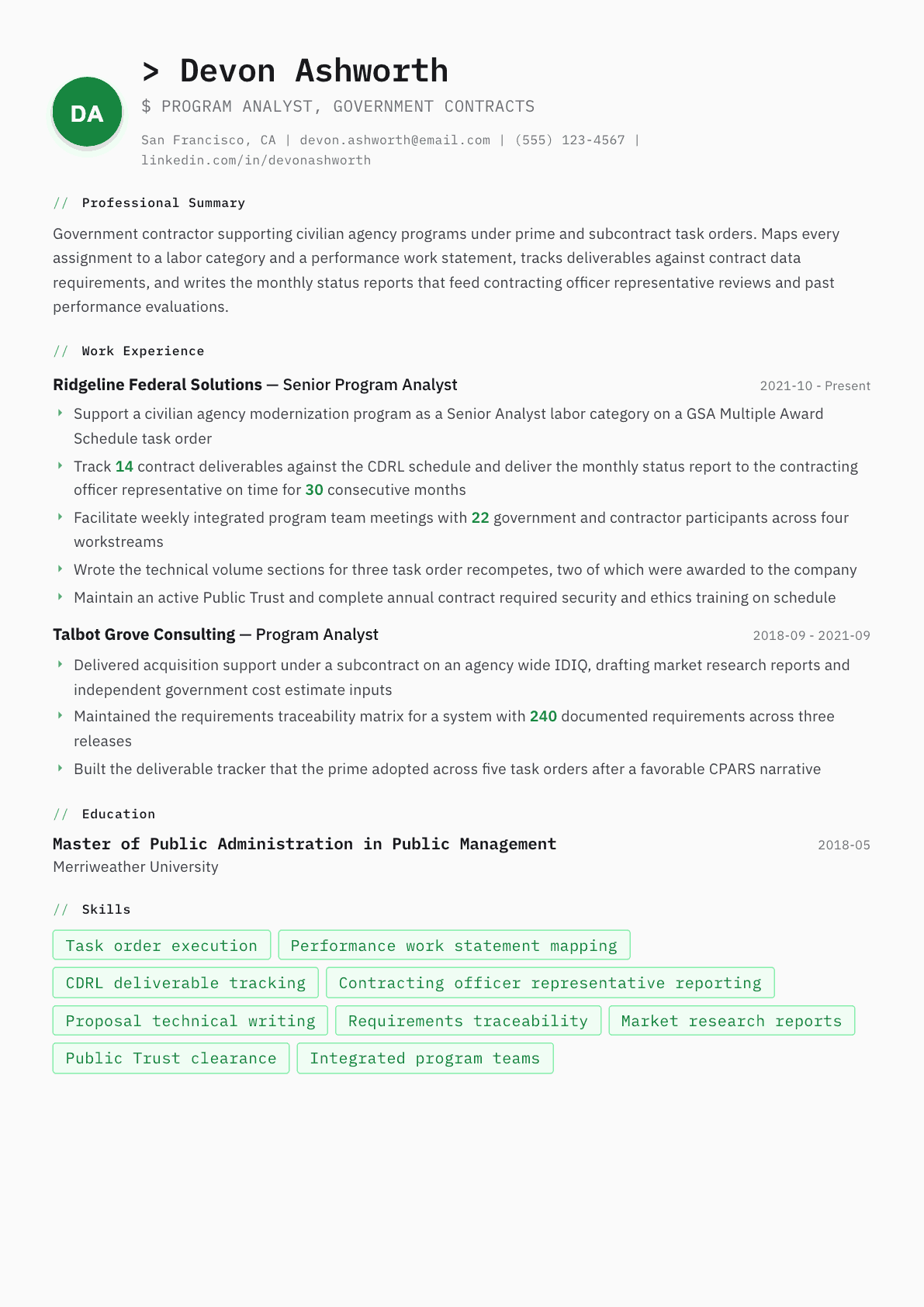
The same government contractor content laid out in three CVBooster templates, so you can see what the finished document looks like before you write a word.
Example Government Contractor summary
Government contractor supporting civilian agency programs under prime and subcontract task orders, currently billing to a senior analyst labor category on a Multiple Award Schedule order. Tracks contract deliverables against the CDRL schedule, files the monthly report the contracting officer representative reviews, and facilitates an integrated program team spanning four workstreams. Wrote technical volume content for three recompetes and holds an active Public Trust.
Skills to list on a Government Contractor resume
- Federal contract support
- Task order and IDIQ execution
- GSA Multiple Award Schedule
- Performance work statement analysis
- Contract deliverable and CDRL tracking
- Contracting officer representative liaison
- CPARS and past performance narratives
- Proposal and technical volume writing
- Market research and cost estimate inputs
- Requirements traceability matrix
- Integrated program team facilitation
- Subcontractor coordination
- Security clearance maintenance
- Earned value reporting inputs
- Federal Acquisition Regulation familiarity
What actually gets this resume read
- Name the contract vehicle and the agency for every assignment, because a hiring manager staffs against a specific task order.
- State your labor category and the years of experience it required, since that is how a proposal team prices you.
- List your clearance level and its status, and never guess, because an inaccurate clearance line ends the process.
- Show deliverables against the CDRL schedule and on time performance, which is what a past performance review measures.
- Say whether you sat on the prime or a subcontract, because scope and access differ and reviewers ask.
- Include proposal work you contributed to and whether the recompete was won, since capture support is billable value.
How to write a government contractor resume
A government contractor resume has an unusual job: it has to satisfy a company recruiter, a capture manager pricing a bid, and often a contracting officer representative who will review the key personnel package. Each of those three reads for something different, and the resume that gets staffed answers all three without becoming a novel.
The recruiter wants the clearance and the labor category. The capture manager wants years of experience that map to a labor category description so you can be priced into a proposal. The government reviewer wants evidence that you have performed the exact scope in the performance work statement. Miss the labor category framing and a technically strong candidate becomes unpriceable.
This guide covers how to structure experience around contracts and task orders rather than employers, how to write clearance and deliverable lines that hold up, how to claim proposal contributions honestly, three summaries by level, and rewritten bullets that speak the language a bid team uses.
Format: contract first, employer second
Head each position with the agency and program you supported, then the contract vehicle, then your employer. A reader in this market cares first about whose mission you served. Naming the employer alone tells them nothing, because the same company holds work across a dozen unrelated agencies.
Two pages is standard and three is acceptable for a technical role with many programs. Keep it plain, because your resume will be pasted into a proposal template that strips formatting, and any table or column you build will need rework at the worst possible moment.
- Header: name, city, clearance level and status, and the labor categories you have been billed under.
- Position heading: agency and program, contract vehicle and type, prime or subcontract, employer, dates.
- Add a separate block for training and certifications the contract required you to maintain.
Clearance: exact, current, and never guessed
State the level and the status in plain terms, such as an active Public Trust or a Secret clearance with a current investigation date. Do not write the phrase clearable, do not imply a level you were sponsored for but never granted, and never list the details of an investigation beyond what a company asks for.
A clearance line that turns out to be wrong ends a candidacy immediately and can create a problem for the company that submitted you. If your clearance has lapsed, say when it was last active and whether it remains in scope for reinstatement.
Experience: scope, deliverables, and the record you kept
Write against the performance work statement. Contractors are paid to deliver specified outputs on a schedule, so bullets that name the deliverable, the frequency and the on time record are worth more than a description of general support. A monthly status report delivered to a contracting officer representative for thirty straight months is a stronger claim than years of program experience.
Track deliverables by the contract data requirements list where one exists. Say how many items you carried, how you tracked them, and whether the program passed its reviews. If a past performance evaluation contained a favorable narrative about work you did, describe your contribution without quoting confidential scoring.
Meetings are real work in this market. Facilitating an integrated program team across government and contractor participants, running a technical exchange, or preparing read ahead material for a program review are all billable and all under described on most resumes.
Proposal and capture contributions
Companies value staff who can write. Say which volume you contributed to, whether the work was a recompete or a new pursuit, and what happened at award. Be precise about your role: drafting technical approach content, providing past performance write ups, building a staffing matrix and reviewing for compliance against the instructions are all different contributions.
Never claim a win you only supported at the edges, because in this industry the capture manager who ran that bid is two conversations away from your interviewer. Contributed technical approach sections to three recompetes, two awarded, is both modest and verifiable.
Vehicles, acquisition vocabulary and keywords
Name the vehicle type accurately: a Multiple Award Schedule order, an indefinite delivery indefinite quantity contract, a blanket purchase agreement, a firm fixed price task order or a time and materials order. Contract type changes how a program is run, and getting the term wrong signals that you sat outside the work.
Vocabulary a bid team scans for: task order, performance work statement, statement of objectives, contract deliverable, contracting officer representative, past performance, subcontract management, market research, independent government cost estimate, requirements traceability and the Federal Acquisition Regulation. Use them where they describe something you actually did.
Government Contractor resume summary examples
First contractor role
Program analyst supporting acquisition work under a subcontract on an agency wide indefinite delivery contract. Drafts market research reports, maintains a requirements traceability matrix covering 240 documented requirements, and holds a favorable Public Trust determination with all contract required training current.
Four years on contract
Senior program analyst billing to a senior analyst labor category on a Multiple Award Schedule task order supporting a civilian agency modernization program. Tracks 14 contract deliverables against the requirements schedule and has delivered the monthly status report to the contracting officer representative on time for 30 consecutive months.
Task order lead
Task order lead managing 11 contractor staff across four workstreams on a civilian agency program, accountable for deliverable quality, staffing plans and monthly reporting. Wrote technical approach content for three recompetes and holds an active Secret clearance and the Project Management Professional credential.
Work experience bullets: before and after
Before: Supported a federal agency program as a contractor.
After: Supported a civilian agency modernization program as a senior analyst labor category on a Multiple Award Schedule task order, working alongside government staff across four workstreams.
The agency, the labor category and the vehicle let a capture manager price you into a bid without a phone call.
Before: Produced monthly reports for the customer.
After: Tracked 14 contract deliverables against the requirements schedule and delivered the monthly status report to the contracting officer representative on time for 30 consecutive months.
Deliverable count and an unbroken on time record are the performance evidence a past performance review captures.
Before: Attended and led program meetings.
After: Facilitated weekly integrated program team meetings with 22 government and contractor participants, issuing read ahead materials and tracking action items to closure.
Participant count and the materials produced show facilitation rather than attendance.
Before: Helped write proposals for new business.
After: Wrote technical approach sections for three task order recompetes and built the staffing matrix for each, with two of the three awarded to the company.
Naming the sections, the artifact and the outcome makes a capture contribution specific and checkable.
Before: Created a tracking tool that the team used.
After: Built the deliverable tracker the prime adopted across five task orders, giving each program manager a single view of due dates, reviewers and submission status.
Adoption beyond your own task order shows the tool solved a real program management problem.
Hard skills
- Task order and delivery order execution
- Performance work statement analysis
- Contract deliverable tracking
- Contracting officer representative liaison
- Past performance narrative preparation
- Proposal and technical volume writing
- Market research reporting
- Independent cost estimate inputs
- Requirements traceability matrix
- Integrated program team facilitation
- Subcontractor coordination
- Earned value reporting inputs
- Federal Acquisition Regulation familiarity
- Security clearance and training compliance
Soft skills
- Working the line between government and contractor roles
- Discretion with sensitive program information
- Writing for a government reviewer
- Adaptability across program transitions
- Client relationship management
- Reliability under a fixed deliverable schedule
Certifications worth listing
- Project Management Professional (PMP) (Project Management Institute)
- Certified Federal Contracts Manager (CFCM) (National Contract Management Association)
- Certified Professional Contracts Manager (CPCM) (National Contract Management Association)
- Certified ScrumMaster (CSM) (Scrum Alliance)
Mistakes that cost government contractor candidates the interview
- Leading with the employer instead of the agency and program, which hides the mission experience a bid team is buying.
- Overstating a clearance, the fastest way to end a candidacy and damage the submitting company at the same time.
- Leaving out the labor category, which forces a capture manager to guess how to price you into a proposal.
- Describing support generally without naming a deliverable, a schedule or an on time record.
- Claiming a contract win you did not contribute to, in a market small enough that the capture lead will be asked.
- Publishing contract values or evaluation scoring that a company treats as competition sensitive.
Government Contractor resume questions
Should I name the agency I supported on a contractor resume?
Yes for unclassified civilian work, because agency familiarity is a large part of your value. For sensitive programs, describe the customer at the level your company allows, such as a defense customer or an intelligence community customer, and keep the scope description generic.
What is a labor category and why does it belong on my resume?
A labor category is the priced position on a contract, with a defined education and years of experience requirement. Naming the ones you have billed under lets a capture manager confirm you qualify and slot you into a bid without an extra round of questions.
How do I write about work under a subcontract?
Say plainly that you sat on a subcontract and name the prime if disclosure is permitted. Scope and access differ between prime and subcontract positions, and reviewers ask. Being clear about it protects you from an awkward correction during an interview.
Does a contractor resume need to look like a federal resume?
No. A federal resume is written for a government human resources rating panel, while a contractor resume is written for a company and often a proposal template. Keep it two to three pages, structured by contract, with deliverables and outcomes rather than hours per week.
How should I handle a gap between contracts?
Name it honestly as a contract transition or a program that ended, which is a normal event in this market and understood by every hiring manager in it. Add any certification, clearance maintenance or training you completed during the gap to show continuity.
Related resume examples
- Contract Specialist Government Resume example
- Procurement Officer Resume example
- Contract Manager Resume example
- Program Manager Resume example
- Government Employee Resume example
- Intelligence Officer Resume example