Product Owner Resume Examples: free ATS score and gap list
Craft a Product Owner Resume That Shows Backlog Ownership
By Mustafa Tarabya, founder of CVBooster · Published · Updated
Product owner resume examples, agile keywords and a writing guide covering backlog refinement, acceptance criteria, stakeholder work and delivered outcomes.
Sample resumes for a product owner
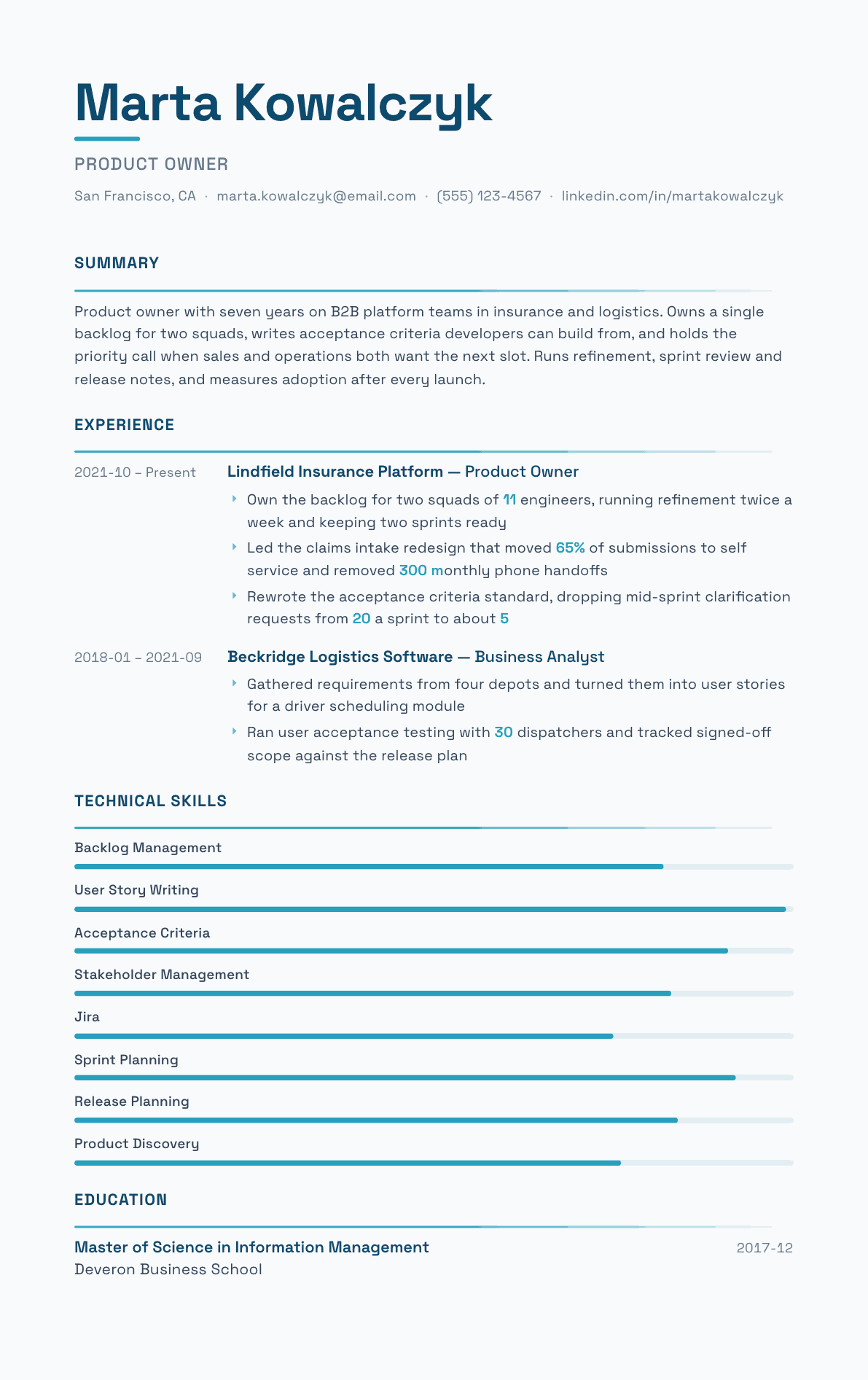
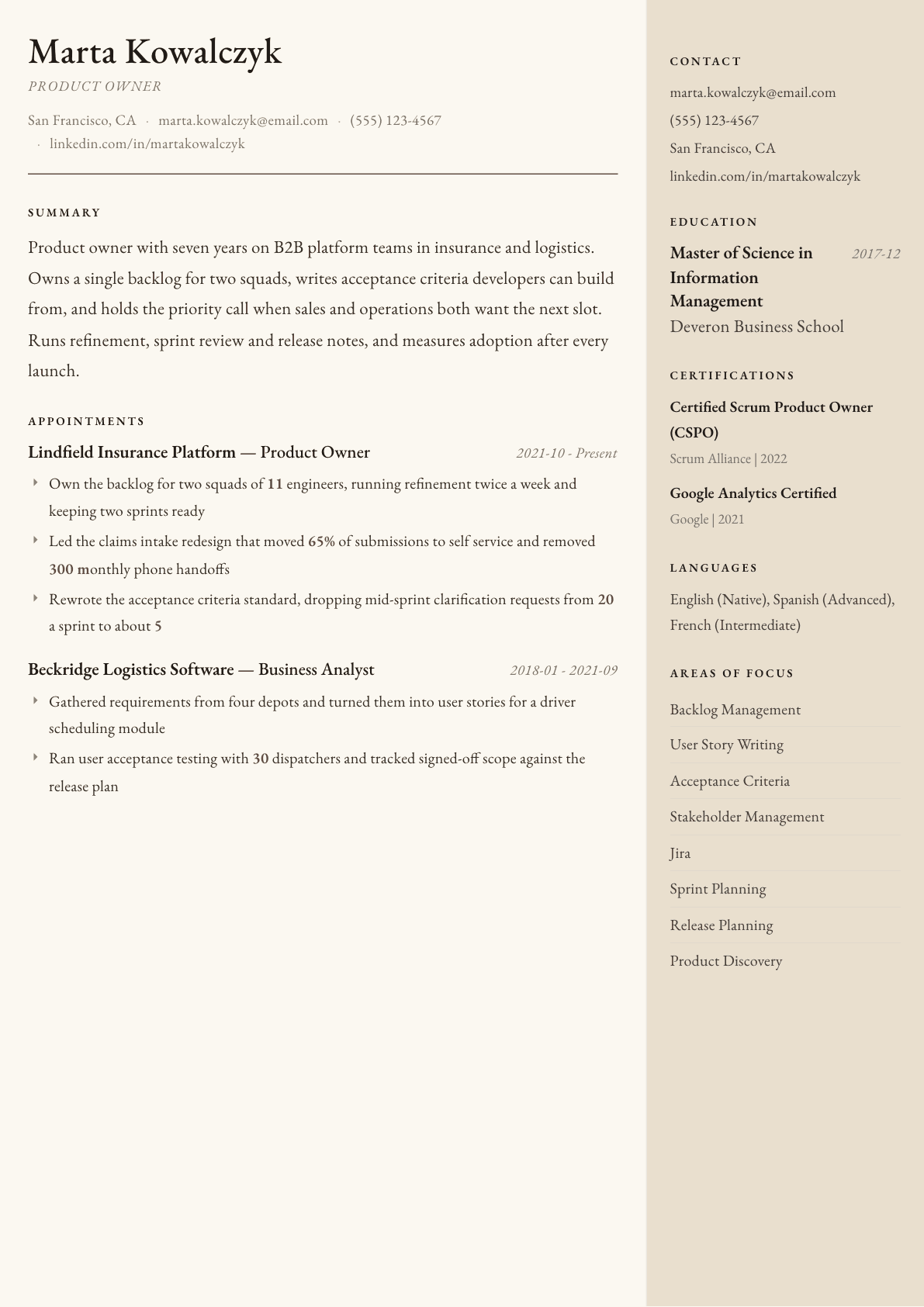
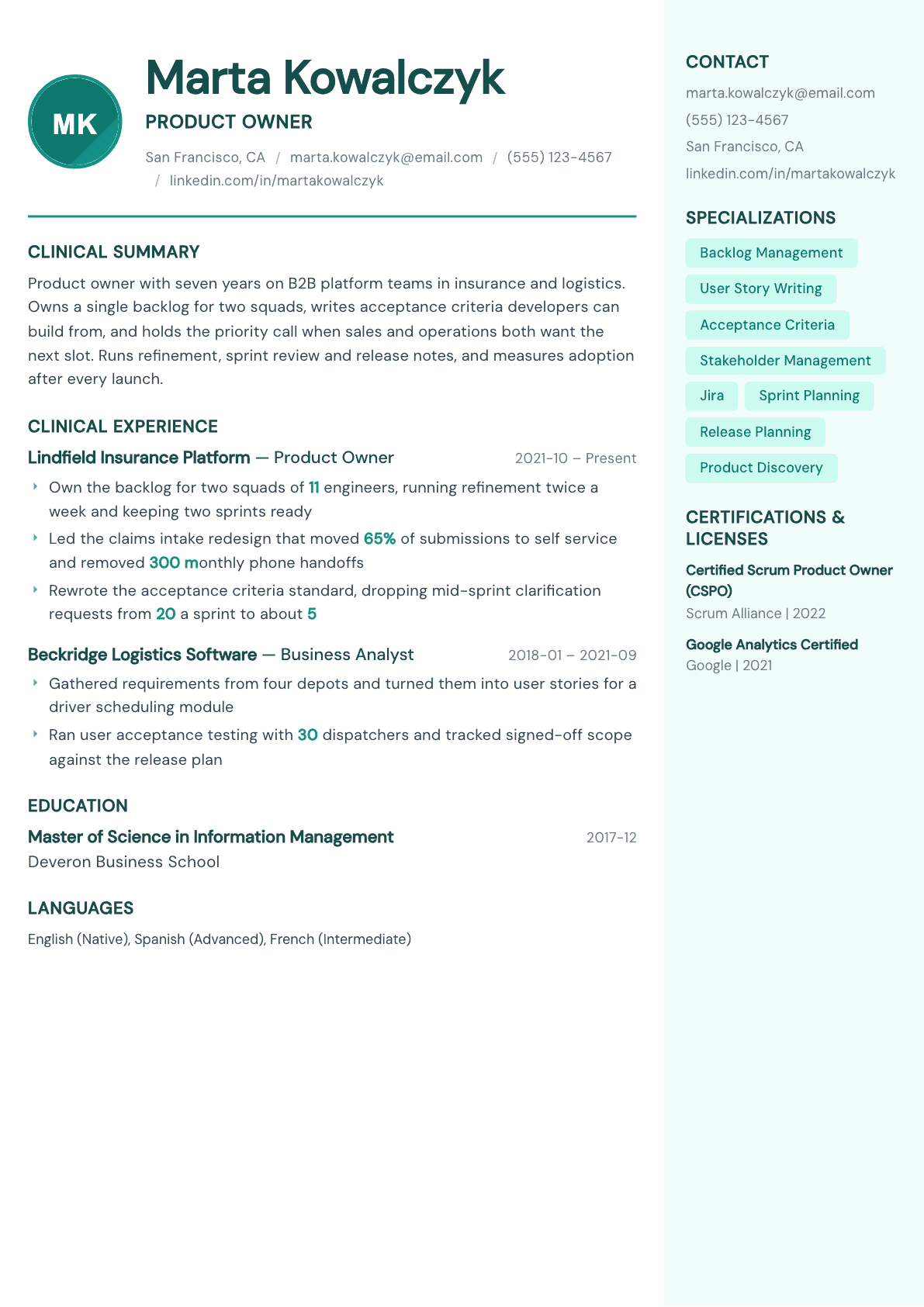
The same product owner content laid out in three CVBooster templates, so you can see what the finished document looks like before you write a word.
Example Product Owner summary
Product owner with seven years on B2B platform teams in insurance and logistics, owning a single backlog across two squads. Writes acceptance criteria engineers build from without a clarification thread, runs refinement and review, and holds the priority call between sales and operations. Recent work moved most claims intake to self service and removed hundreds of monthly phone handoffs.
Skills to list on a Product Owner resume
- Backlog Management
- User Story Writing
- Acceptance Criteria
- Backlog Refinement
- Sprint Planning
- Release Planning
- Stakeholder Management
- Product Discovery
- Roadmap Communication
- Jira
- Confluence
- User Acceptance Testing
- Requirements Analysis
- Prioritization Frameworks
- Agile Delivery
- Product Analytics
What actually gets this resume read
- Say how many teams and engineers your backlog feeds, because owning one squad differs from owning three.
- Show the outcome of a release, not the release itself: adoption, handling time, error rate or revenue path.
- Prove your writing quality with a fact such as fewer mid-sprint clarifications after you changed the story standard.
- Name the ceremonies you run and the ones you only attend, since screeners check whether you are the decision maker.
- Describe how you handle competing stakeholders, because saying no with a reason is the core of the job.
- Keep the domain visible: insurance, logistics or payments knowledge is often the reason one candidate wins.
How to write a product owner resume
The hardest part of a product owner resume is proving you were the decision maker. Hundreds of applications describe backlog grooming, story writing and stakeholder communication, and every one of them could have been written by a business analyst who attended the same meetings. The hiring manager is trying to work out whether you set priority or transcribed it.
She checks three things. How many teams your backlog fed, whether the outcomes you claim are business outcomes rather than release notes, and whether you can point to a decision you made that somebody senior disagreed with. Those are the signals of ownership.
Below is a structure that surfaces those signals: the section order, how to write about backlog and acceptance criteria without sounding like a certification handbook, three summaries by level, before and after bullets, and the questions product owners ask when they move between industries or toward a product manager title.
Format: outcomes above process, two pages maximum
Reverse chronological, one page early and two once you have several products behind you. Keep a plain single column layout so the recruiting system reads the whole thing, and use the space you save for outcome bullets rather than a skills graphic.
Under each role add a scope line: the product, the number of squads and engineers your backlog fed, the user base, and the domain. That line is what tells a reader whether you have operated at their scale.
- Header: name, title, city, phone, email, and agile certifications on one line.
- Order: summary, core competencies, experience, certifications, education.
- Scope line per role: product, squads and engineers, users served, industry domain.
Summary: domain, scope, and the call you own
Three lines. State the domain, the number of teams, and the decision you hold. A product owner in insurance claims who owns a single backlog for two squads and settles priority between sales and operations has described the whole job in one sentence.
Do not open with agile vocabulary. Ceremonies are the same everywhere, so leading with them wastes the strongest position on the page. Lead with the domain and the outcome, then let the process detail follow inside the experience section.
Experience: backlog, criteria, prioritization, outcomes
Backlog bullets should describe the mechanics you own: refinement cadence, how far ahead the backlog is ready, how you handle technical debt against feature work, and how you keep the ready state without stalling delivery. Managers ask about the debt split in almost every interview because it reveals your relationship with engineering.
Acceptance criteria are where you can prove writing quality with a fact. If clarification requests dropped after you changed the standard, that is the strongest available evidence that your stories are buildable. Very few candidates ever measure it.
Prioritization bullets should name the tension and the resolution. Two departments wanting the same slot, a regulatory deadline against a revenue feature, or a rewrite against a customer commitment. Name the framework only if you truly used it, then say what you decided and what happened.
Outcome bullets are the ones that get you hired. Adoption after launch, handling time removed, error rate, retention, conversion, or a manual process that stopped. A release is an output. What changed for the business afterward is the outcome, and it belongs in the first bullet of each role.
Stakeholders and discovery: show the harder half
Say who your stakeholders were by function and seniority, and how often you met them. Working with an operations director and a compliance lead is meaningfully different from working with an internal team lead, and the resume should not flatten the two.
Discovery deserves its own bullets when you do it: customer interviews, usage data review, support ticket analysis, and how a finding changed the roadmap. Product owners who only receive requirements from elsewhere have a narrower job, and hiring managers can tell within two questions.
- Stakeholder map by function, with the cadence you held with each group.
- Discovery inputs you used and one roadmap change that came from them.
- A decision you made against pressure, with the reasoning you gave at the time.
- How you communicated the roadmap and handled a commitment you had to move.
Certifications and keywords
Scrum credentials are widely requested and cheap to verify, so list them with the issuing body. Where a company runs a scaled framework, the matching certification helps clear the filter. Do not stack five overlapping credentials; two current ones read better than a shelf.
Recurring posting terms include backlog refinement, acceptance criteria, definition of done, sprint review, release planning, stakeholder management, prioritization and roadmap. Use them once each where they carry real work behind them.
Product Owner resume summary examples
Analyst stepping into the role
Business analyst moving into product ownership after two years writing requirements for a driver scheduling module. Ran user acceptance testing with 30 dispatchers, wrote the story set for two releases, and now owns refinement for a single squad. Certified as a professional scrum product owner.
Seven years, two squads
Product owner with seven years on B2B platform teams in insurance and logistics, owning one backlog across two squads of 11 engineers. Led a claims intake redesign that moved 65% of submissions to self service, and rewrote the acceptance criteria standard to cut mid-sprint clarifications.
Lead product owner
Lead product owner with eleven years across payments and insurance platforms, coordinating four product owners and a shared roadmap. Runs quarterly planning with engineering and operations leadership, owns the intake process for regulatory work, and mentors new owners through their first release cycle.
Work experience bullets: before and after
Before: Managed the product backlog for the team.
After: Owned a single backlog feeding two squads of 11 engineers, running refinement twice a week and keeping two sprints of ready work ahead of delivery.
Team size, cadence and the ready horizon show the mechanics you actually run rather than a title responsibility.
Before: Wrote user stories and acceptance criteria.
After: Rewrote the acceptance criteria standard with the tech lead, cutting mid-sprint clarification requests from about 20 a sprint to 5 within two months.
Measuring clarification requests is rare and it directly proves the stories were buildable as written.
Before: Launched a new claims feature.
After: Led the claims intake redesign that moved 65% of submissions to self service and removed around 300 phone handoffs a month from the operations team.
The second half converts a launch into a business outcome the operations director can confirm.
Before: Worked with stakeholders to prioritize work.
After: Held the priority call between sales commitments and operations debt, publishing the reasoning in a weekly note so both directors saw the tradeoff before it was made.
Naming the tension and the transparent method proves you decided rather than collected opinions.
Before: Ran agile ceremonies with the team.
After: Ran refinement, sprint review and release notes for two squads, and moved review to a demo with real customer accounts so feedback came from usage rather than slides.
Changing how a ceremony works shows ownership, while attending the standard set shows attendance.
Hard skills
- Backlog management and refinement
- User story and acceptance criteria writing
- Prioritization frameworks
- Release planning
- Roadmap communication
- Product discovery and interviews
- Product analytics review
- User acceptance testing
- Jira and Confluence
- Requirements analysis
- Definition of ready and done
- Regulatory and compliance intake
Soft skills
- Saying no with a reason
- Negotiating between departments
- Written clarity under ambiguity
- Facilitating a room with senior people
- Coaching engineers on user context
- Holding a decision when it is questioned
Certifications worth listing
- Professional Scrum Product Owner I (Scrum.org)
- Certified Scrum Product Owner (Scrum Alliance)
- SAFe Product Owner and Product Manager (Scaled Agile)
- Professional Scrum Product Owner II (Scrum.org)
Mistakes that cost product owner candidates the interview
- Describing ceremonies in place of decisions, which makes the reader assume someone else set priority.
- Reporting releases as achievements without the adoption or operational change that followed.
- Leaving out team count and engineer count, so a hiring manager cannot place your scope.
- Listing every prioritization framework you have read about instead of the one you actually applied.
- Hiding the domain, when insurance, payments or logistics knowledge is often the deciding factor.
- Using the same resume for product owner and product manager postings, which are staffed differently in most companies.
Product Owner resume questions
What is the difference between a product owner and a product manager on a resume?
Product owner emphasizes backlog ownership, acceptance criteria and delivery with a specific team. Product manager emphasizes market discovery, positioning and outcome ownership across a product line. Tailor the summary and the first bullet of each role to whichever the posting describes.
How do I show that I owned prioritization rather than passed it along?
Describe a specific conflict, what you decided, the reasoning you published and what happened next. One concrete example of holding a decision under pressure is worth more than any list of frameworks.
Do I need a scrum certification to get product owner interviews?
Many postings list one, so holding a current credential clears filters and costs little. It will not carry an application on its own, because interviews focus on outcomes, stakeholder handling and how you write acceptance criteria.
What metrics belong on a product owner resume?
Adoption, task completion, handling time, error and rework rates, retention, and manual work eliminated. Avoid velocity and story point figures, since they vary per team and tell a hiring manager nothing about business value.
How do I move into product ownership from a business analyst role?
Show where you already made calls: scope you cut, requirements you challenged, and acceptance criteria you owned end to end. Add a certification, then name the transition explicitly in the summary so the reader routes your application correctly.
Related resume examples
- Scrum Master Resume example
- IT Project Manager Resume example
- IT Business Analyst Resume example
- Technical Program Manager Resume example
- Implementation Specialist Resume example
- Engineering Manager Resume example