IT Manager Resume Examples: free ATS score and gap list
Information Technology Manager Resume Built on Uptime and Team Results
By Mustafa Tarabya, founder of CVBooster · Published · Updated
An information technology manager resume example with service desk metrics, infrastructure keywords, and a guide to team, budget and vendor scope.
Sample resumes for a it manager
The same it manager content laid out in three CVBooster templates, so you can see what the finished document looks like before you write a word.
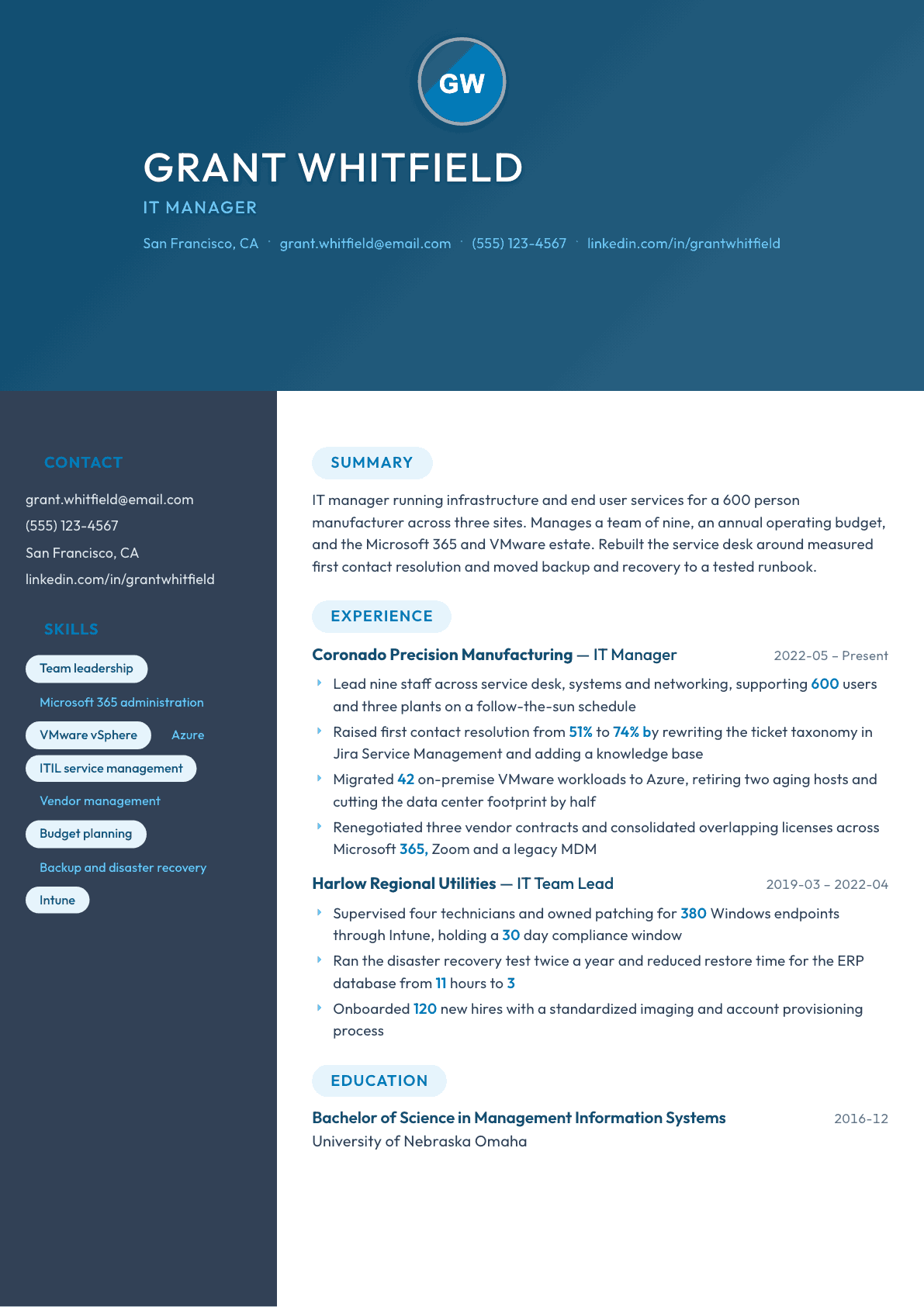
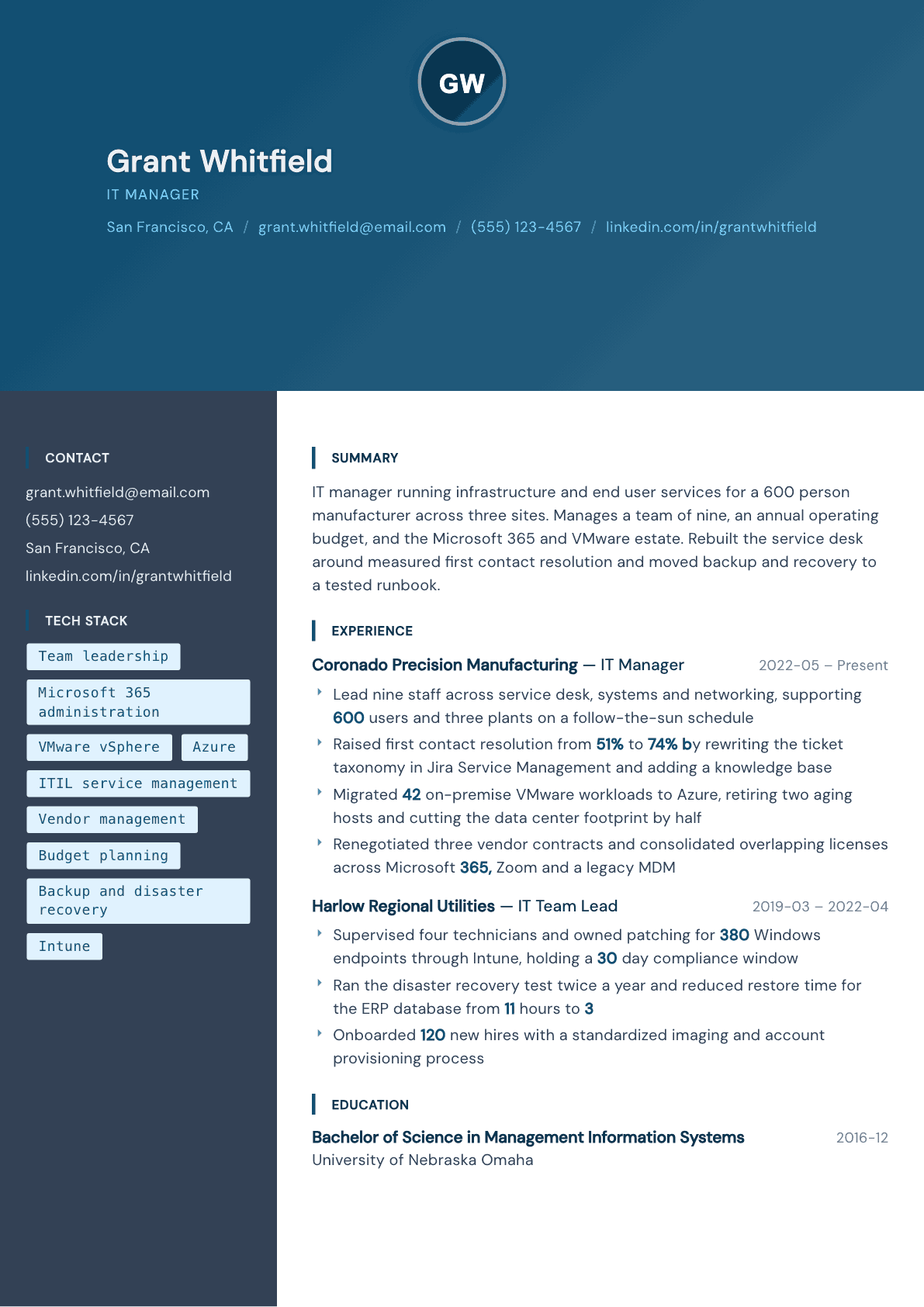
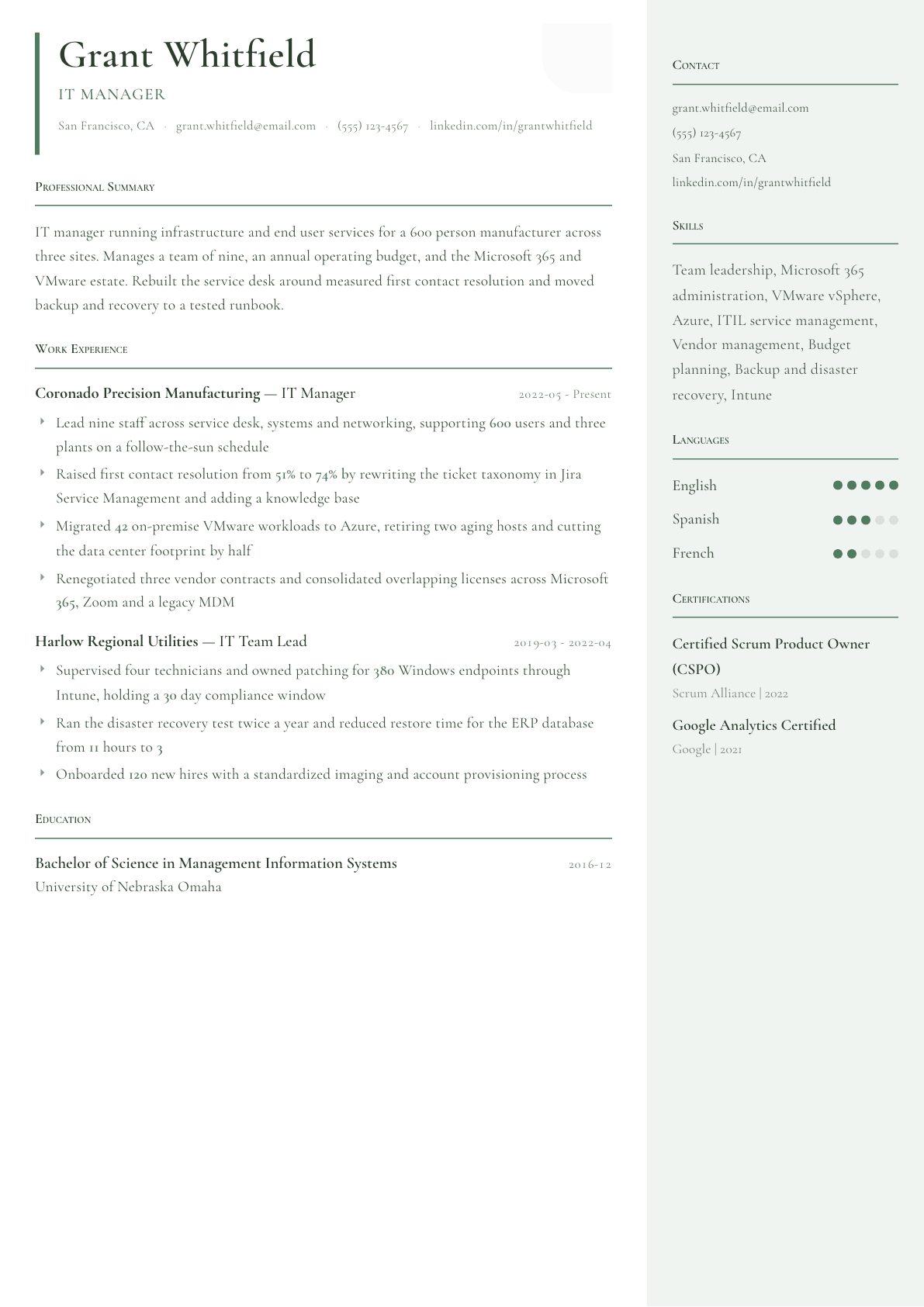
Example IT Manager summary
IT manager with seven years leading infrastructure and end user support, currently responsible for nine staff, 600 users and three manufacturing sites. Raised first contact resolution from 51% to 74%, migrated 42 VMware workloads to Azure, and holds a tested recovery runbook that restores the ERP database in under three hours. Seeking an IT manager role at a multi-site organization where I can own both the roadmap and the operating budget.
Skills to list on a IT Manager resume
- IT team leadership
- Service desk management
- ITIL processes
- Microsoft 365 administration
- Active Directory and Entra ID
- VMware vSphere
- Azure and hybrid cloud
- Network administration
- Backup and disaster recovery
- Endpoint management with Intune
- Vendor and contract management
- IT budgeting
- Change management
- Security awareness and patching
- Project delivery
What actually gets this resume read
- Lead with span of control: how many staff report to you, how many users you support, and how many sites.
- Pair every team result with a service metric such as first contact resolution, ticket backlog or uptime.
- Name the stack you actually administer, from the hypervisor to the identity provider to the ticketing tool.
- Show budget and vendor work, because managers are hired to control spend as much as to keep systems running.
- Give one project bullet with dates, scope and outcome so the reader can see you finish things, not just maintain them.
- Keep hands-on tasks in the earlier roles and reserve the current role for leadership, planning and vendor scope.
How to write a it manager resume
An IT manager resume has to answer a question that a technical resume never does: how much can this person carry without the wheels coming off? The reader is usually a director, a chief operating officer or a business owner who has lived through a bad hire in this seat. They want span of control, service quality, and evidence that you have made decisions about money and vendors, not just about servers.
Most candidates for this job send an upgraded engineer resume. It lists platforms, patch cycles and migrations, and never says how many people reported to them or how many users depended on the service. That file loses to a weaker technologist who wrote down the team, the ticket numbers and the budget.
An information technology manager resume and an IT manager resume are the same document; use whichever title the posting uses in your headline, and keep it distinct from an IT project manager resume, which is judged on delivery of projects rather than on running a service. This guide walks through the section order this role expects, how to write service metrics that a non-technical reader trusts, three example summaries from a team lead to a multi-site manager, before and after bullets, and the questions technology managers ask when their old engineer resume stops working.
Format: two pages, leadership scope in the first six lines
Two pages is normal once you manage people. Reverse chronological, with a summary, a short scope line, then experience. Skip the skills matrix with rating bars: at manager level a graphic claiming eight out of ten on virtualization reads as a technician who has not made the transition.
Right after the summary, add one line of scope: team size, users supported, sites, and the platforms you are accountable for. That single line is what a hiring director scans for, and burying it in the third bullet of the second job is the most common reason a strong manager gets filtered out.
- Header: name, city and state, phone, email, and a professional profile link if you keep it current.
- Order: summary, scope line, experience, certifications, education, technical environment.
- Move a long tool list to the bottom of page two. It should support the story, not open it.
Summary: people, users, sites, and what you were hired to fix
Three or four lines. Number of direct reports, number of users and sites, the stack you own, and the problem you were brought in to solve. A manager who inherited a broken service desk and rebuilt it is a different candidate from one who ran a stable environment well, and both are hireable, but only if the reader can tell which one you are.
Name the industry constraints if they shaped the job. Manufacturing with plant floor uptime, healthcare with clinical systems, education with a term-driven refresh cycle, and finance with regulatory change all read as different management experience.
Experience: run the service, then prove it
Open each role with a scope line, then five or six bullets grouped into three themes: service, projects and people. Under service, give the operational numbers a director checks: ticket volume, first contact resolution, backlog age, service level attainment, unplanned outage count, patch compliance within the agreed window, and recovery time from your last tested restore.
Under projects, write one or two with dates, scope and result. A migration, a network refresh, an identity consolidation, an ERP or clinical system cutover. Give the size in workloads, sites or seats, and say what changed when it landed, including what you retired.
Under people, say how you built the team: roles you hired, a shift or on-call rotation you designed, training you funded, retention you held. Vague claims about mentoring the team are worthless; a documented on-call rotation covering three time zones is not.
- Service: first contact resolution, backlog, outages, patch compliance, tested recovery time.
- Projects: migrations, refreshes, consolidations, with the size and what was retired.
- People and money: headcount, hiring, on-call design, vendor contracts, license rationalization.
Vendors, contracts and budget: the half most candidates omit
Managers are hired to control spend as well as to keep the lights on. Say which contracts you owned, which renewals you negotiated, and what you cut without cutting service. Rationalizing overlapping collaboration, endpoint or backup licenses is a normal manager win and reads as commercial maturity.
If you owned an operating budget, say so plainly and describe how you planned it. Forecasting a refresh cycle, building a capital request that survived the finance review, or moving from unpredictable break-fix spend to a planned replacement schedule are the details a director recognizes as real work.
Certifications, frameworks and the keywords the filter wants
ITIL foundation shows you speak the service management vocabulary, a project credential such as PMP or PRINCE2 reads as delivery discipline, and a current Microsoft or cloud administrator credential proves you still understand what your team does. Put them in a short block with the issuing body.
Postings for this role recycle a predictable vocabulary: service desk, incident and problem management, change management, service level agreement, endpoint management, identity, backup and recovery, vendor management, budget. Mirror the exact phrasing from the posting once in the summary and once in a bullet where you did the work.
IT Manager resume summary examples
First management role
IT team lead supervising four technicians and supporting 380 users at a regional utility. Owns endpoint patching through Intune within a 30 day compliance window, runs the twice-yearly recovery test, and rebuilt new hire provisioning into a standard process. Ready for a first full IT manager seat with budget responsibility.
Managing a full IT function
IT manager leading nine staff across service desk, systems and networking for 600 users at three manufacturing sites. Raised first contact resolution from 51% to 74%, migrated 42 VMware workloads to Azure, and renegotiated three vendor contracts while holding the operating plan flat.
Multi-site senior manager
Senior IT manager responsible for 18 staff, two team leads and technology across nine sites in three countries. Delivered a network refresh with redundant circuits at every location, cut unplanned outages from 22 a year to five, and owns the vendor portfolio and the annual capital plan.
Work experience bullets: before and after
Before: Managed the IT department and daily operations.
After: Led nine staff across service desk, systems and networking, supporting 600 users and three plants with a documented on-call rotation covering plant floor uptime outside business hours.
Team size, user count, sites and the on-call design tell a director exactly how much you have carried.
Before: Improved help desk performance.
After: Raised first contact resolution from 51% to 74% in two quarters by rewriting the ticket taxonomy, publishing 40 knowledge articles, and moving password resets to self service.
A measured before and after plus the three specific changes make the improvement believable and repeatable.
Before: Migrated servers to the cloud.
After: Migrated 42 on-premise VMware workloads to Azure over seven months, retired two aging hosts, and cut the data center footprint by half with no unplanned downtime during cutover weekends.
Workload count, timeline, what was retired and the downtime record turn a generic migration into a delivery record.
Before: Handled vendor relationships.
After: Owned eleven vendor contracts, renegotiated three at renewal, and removed overlapping collaboration and mobile management licenses that duplicated capability already inside the existing agreement.
Naming the contract count and the specific overlap removed shows commercial judgment rather than administration.
Before: Responsible for backups and disaster recovery.
After: Ran the disaster recovery test twice a year against documented objectives and reduced restore time for the ERP database from eleven hours to three by rebuilding the backup chain and rehearsing the runbook.
A tested recovery time is verifiable, while a claim of responsibility for backups tells the reader nothing about whether they work.
Hard skills
- Service desk and ITIL process management
- Microsoft 365 and Entra ID administration
- Active Directory and Group Policy
- VMware vSphere and hybrid infrastructure
- Azure and cloud migration planning
- Endpoint management with Intune
- Network administration and site connectivity
- Backup, recovery and continuity testing
- Patch and vulnerability management
- Vendor and contract management
- IT budgeting and capital planning
- Change and release management
- Asset and license management
Soft skills
- Hiring and developing technicians
- Prioritizing between outages and projects
- Explaining technical risk to non-technical leaders
- Negotiating with suppliers
- Holding a team through an incident
- Written process documentation
Certifications worth listing
- ITIL 4 Foundation (PeopleCert)
- Project Management Professional (PMP) (Project Management Institute)
- Microsoft Certified: Azure Administrator Associate (Microsoft)
- CompTIA Network+ (CompTIA)
- Certified Information Systems Security Professional (CISSP) (ISC2)
- VMware Certified Professional (Broadcom)
Mistakes that cost it manager candidates the interview
- Sending the engineer resume with a new title, so nothing on the page shows people, users, sites or money.
- Listing projects without dates or size, which makes a two-week task and a nine-month program look identical.
- Skipping the service numbers, leaving the reader unable to judge whether the operation you ran was healthy.
- Claiming responsibility for backups without ever stating a tested restore time.
- Filling half a page with a tool matrix and rating bars that read as a technician who has not made the step up.
- Omitting budget and vendor work entirely, which is often the exact gap the hiring director is trying to fill.
- Describing the department instead of your decisions: the reader wants what you chose, funded, hired and retired.
IT Manager resume questions
How technical should an information technology manager resume be?
Technical enough that an engineer respects it and plain enough that a finance leader follows it. Keep platform detail in the earlier hands-on roles, and reserve the current role for team, service quality, projects delivered and money controlled.
What metrics belong on an IT manager resume?
Ticket volume, first contact resolution, backlog age, service level attainment, unplanned outage count, patch compliance and tested recovery time. Pick four you can defend in an interview rather than listing every number your dashboard produces.
How do I move from senior engineer to IT manager?
Lead with anything that already looks like management: technicians you directed, on-call rotations you built, vendor calls you owned, a project you ran end to end. Then state the target role explicitly in the summary so the reader is not left guessing.
Should I include the size of my IT budget?
Include the fact of ownership, and describe the planning work rather than publishing a figure your employer may treat as confidential. Contract counts, renewals negotiated and license consolidation communicate commercial control just as clearly.
Does an IT manager still need certifications?
They help clear automated filters and reassure a non-technical reader. ITIL and a project credential are the two that map most directly to the job, while a current cloud administrator certification signals you have not lost touch with the work your team does daily.
Related resume examples
- IT Specialist Resume example
- IT Project Manager Resume example
- IT Director Resume example
- System Administrator Resume example
- IT Support Specialist Resume example
- Azure Engineer Resume example