Azure Engineer Resume Examples: the lines they read
Craft an Azure Engineer Resume Built on Governance and Identity
By Mustafa Tarabya, founder of CVBooster · Published · Updated
An Azure engineer resume organized around subscriptions, Entra ID, Bicep automation and hybrid identity, with a sample resume and a full writing guide.
Sample resumes for a azure engineer
The same azure engineer content laid out in three CVBooster templates, so you can see what the finished document looks like before you write a word.
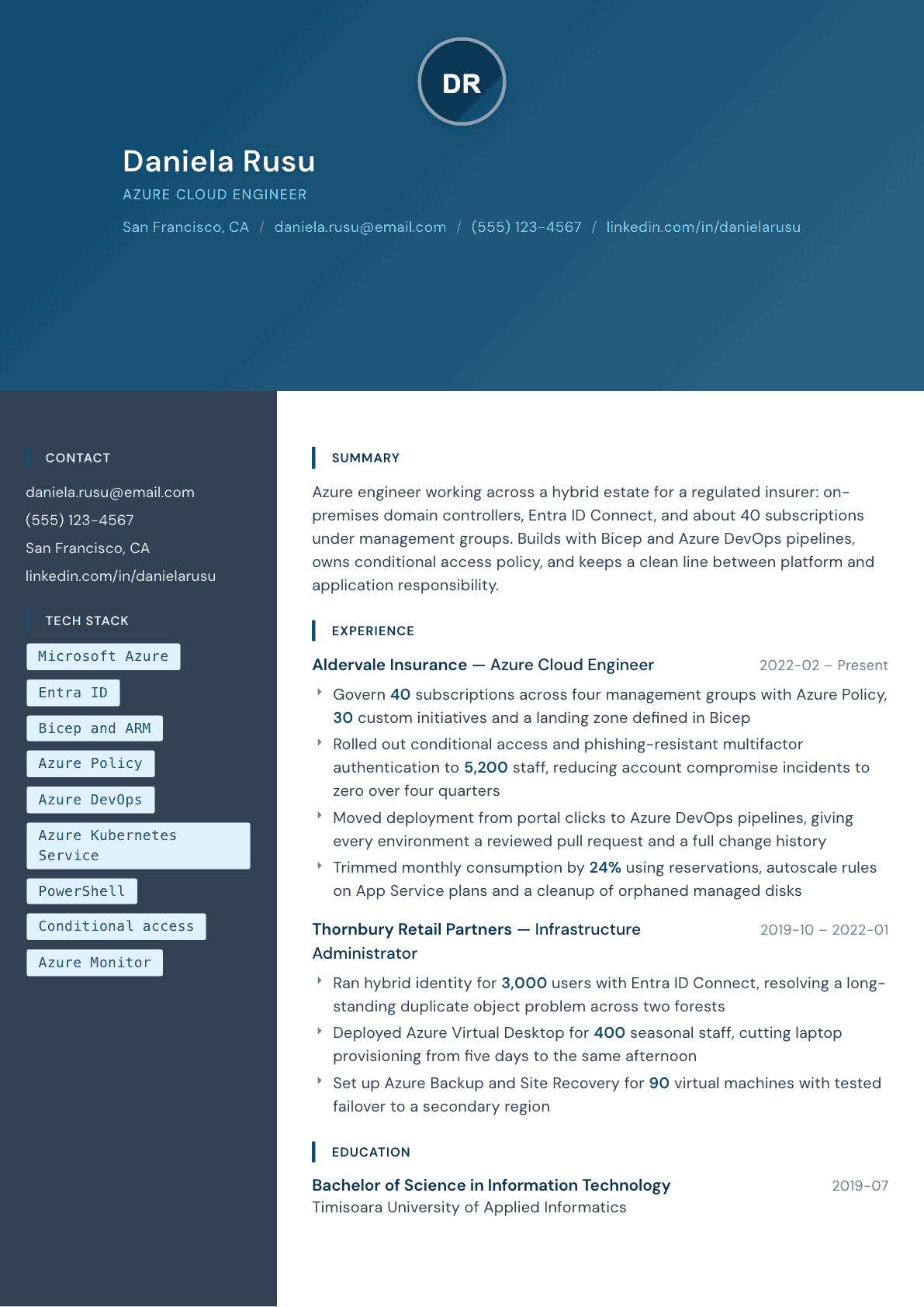
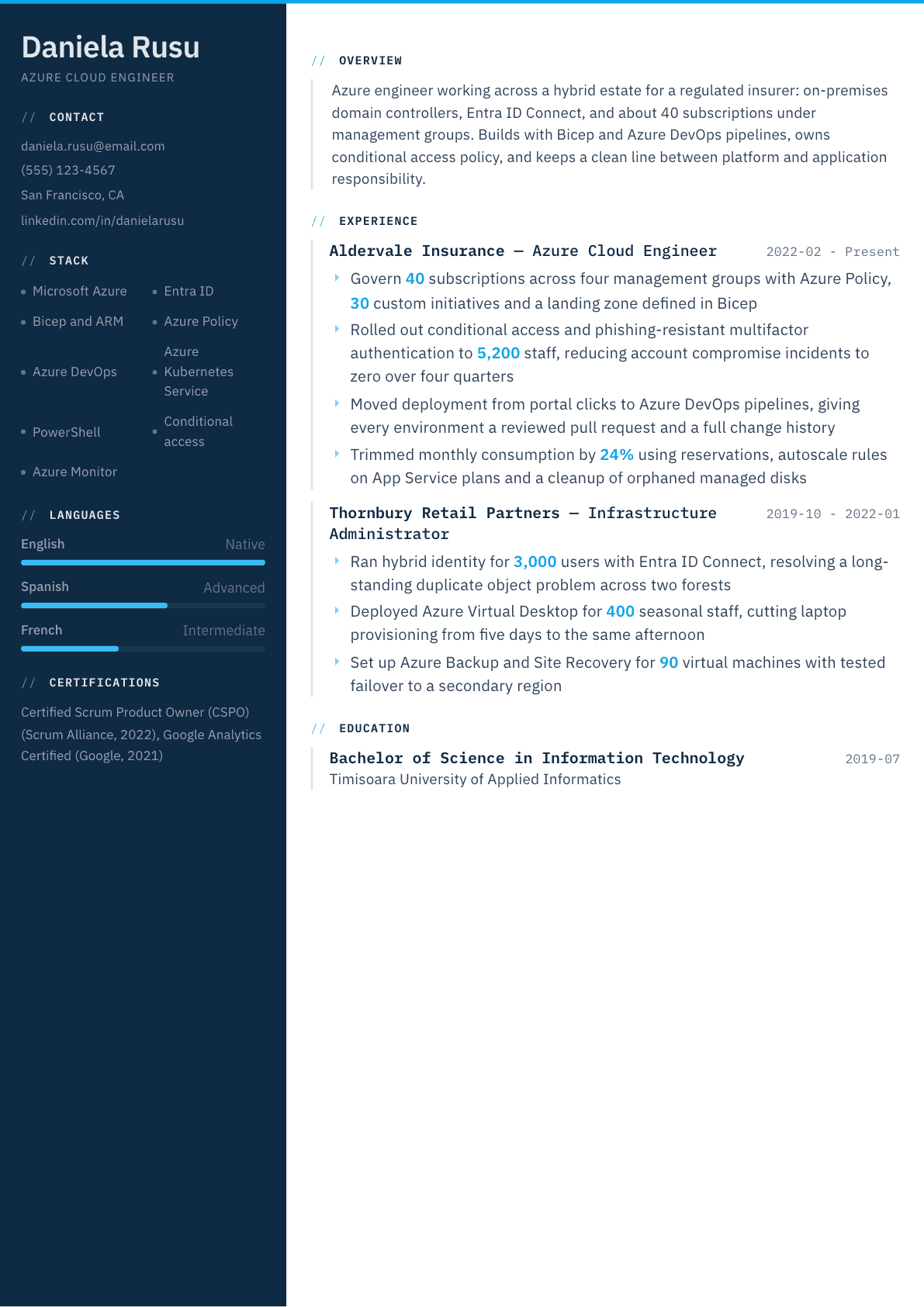
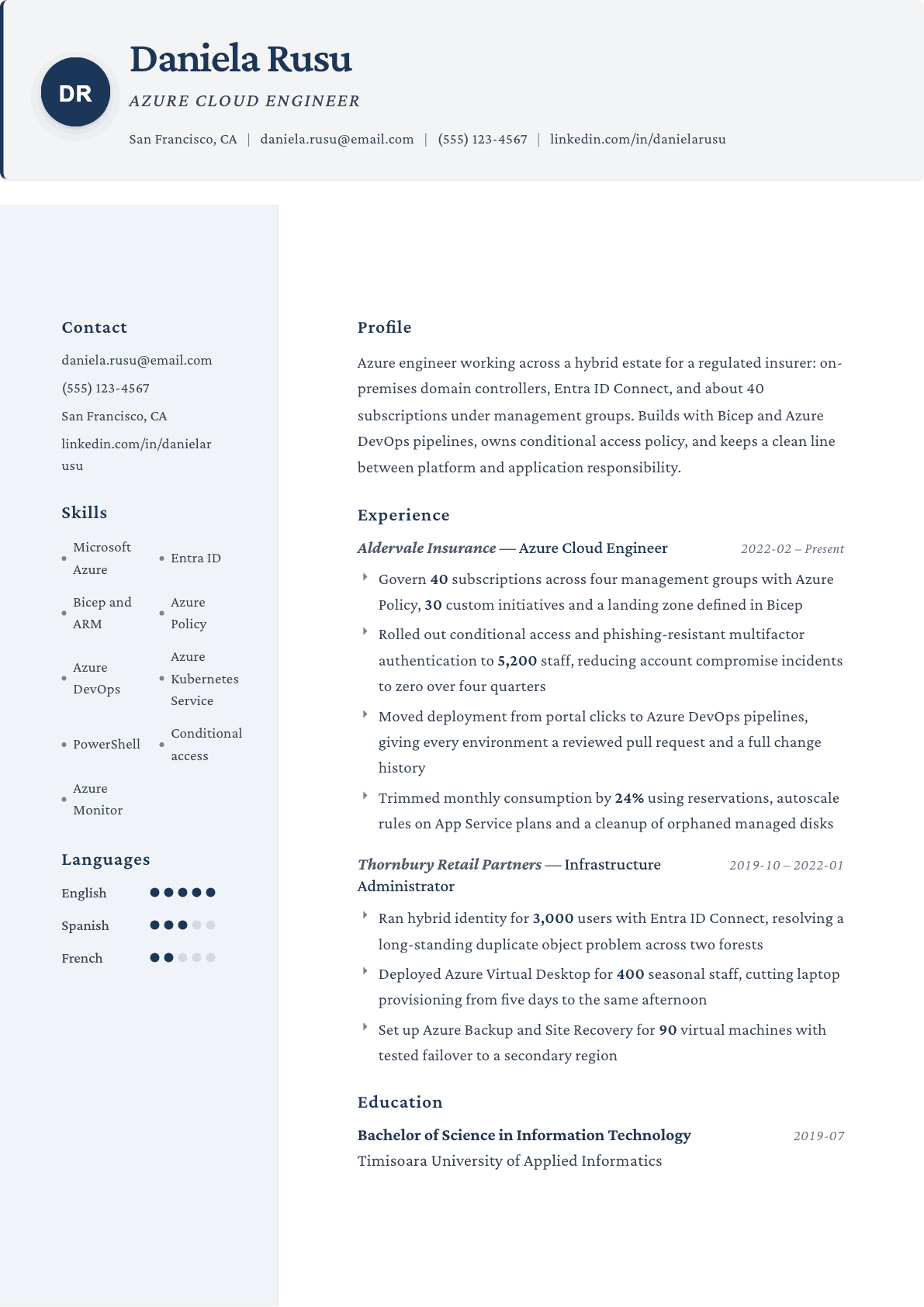
Example Azure Engineer summary
Azure engineer with six years running hybrid estates for regulated employers. Governs forty subscriptions through management groups, Azure Policy initiatives and a landing zone written in Bicep, and owns identity from Entra ID Connect through conditional access. Delivered phishing-resistant multifactor authentication to more than five thousand staff and reduced monthly consumption by 24% through reservations, autoscale and disk cleanup.
Skills to list on a Azure Engineer resume
- Microsoft Azure
- Entra ID and hybrid identity
- Conditional access
- Azure Policy and governance
- Bicep and ARM templates
- Terraform
- Azure DevOps pipelines
- Azure Kubernetes Service
- Azure Virtual Desktop
- Azure Monitor and Log Analytics
- Azure Backup and Site Recovery
- PowerShell scripting
- Virtual network design
- Cost management and reservations
What actually gets this resume read
- Say how many subscriptions and management groups you govern, since Azure hiring turns on scope of control more than service count.
- Give identity its own bullets: Entra ID, hybrid sync, conditional access and privileged identity management are the hardest part of the job.
- Name your deployment language, whether Bicep, ARM templates or Terraform, and say which pipeline runs it.
- Show policy and compliance work through initiative counts or remediation results rather than the phrase governance experience.
- Include hybrid and migration detail if you have it, because many Azure estates still sit half in a data center.
- Write certification names in full, for example Azure Administrator Associate, so the applicant tracking system matches the posting text.
How to write a azure engineer resume
Azure hiring has a distinct shape. Many of the estates are hybrid, many of the employers are regulated, and identity sits at the center of nearly everything. So an Azure engineer resume that reads like a generic cloud resume misses the point. The reader wants subscription and management group scope, an identity story, and evidence that policy is enforced rather than documented.
The second thing they check is how you deploy. An estate created through portal clicks leaves no history, no review and no repeatability, and it is still extremely common. Showing Bicep, ARM templates or Terraform running through a pipeline with reviewed pull requests instantly separates you from that pile.
This guide covers the section order for the role, three summaries across career stages, rewritten bullets that add the specificity Azure interviewers expect, and answers to the questions engineers ask when their estate is half in a data center and half in the cloud.
Format: plain layout with governance visible early
Reverse-chronological, one column, no graphics. Under the summary put a short block covering identity, governance, deployment tooling, compute and data services. That order matters, because Azure roles are usually built around identity and governance first and workload services second.
Keep credential names in full. Microsoft renames its certifications periodically and filters match the exact current title, so an abbreviation can cost you a screen you would otherwise pass.
- Header: name, title, location, email, and current Microsoft credentials on one line.
- Order: summary, platform block, experience, certifications, education.
- Say whether the estate is cloud only or hybrid, since hybrid identity is a separate skill set.
Summary: subscriptions, identity, and the regime you work under
Give the scope in units the platform uses: subscriptions, management groups, tenants and regions. Then name your identity responsibility, and if you work in a regulated sector, say so, because compliance-shaped Azure work is a specialty that employers hunt for directly.
Leave out generic statements about passion for cloud technology. The scope line does more persuading in half the words.
Experience: identity, policy, deployment, cost
Open each role with the estate line, then build bullets around the four pillars of the job. Identity, meaning directory design, hybrid sync, conditional access and privileged access. Policy, meaning initiatives, guardrails and remediation. Deployment, meaning the language and the pipeline. Cost, meaning reservations, autoscale rules and cleanup.
Identity bullets should carry numbers: users covered by a policy rollout, forests consolidated, privileged roles removed from standing assignment, or duplicate objects resolved during a sync repair. These are the problems Azure teams live with, and specificity here reads as lived experience.
For policy, give initiative and remediation counts rather than the word governance. Anyone can claim governance experience, and almost nobody can name what they enforced and what it broke on the first attempt.
- Estate line: subscriptions, management groups, tenants, regions, users supported.
- Deployment: the language, the pipeline, and how much of the estate it now covers.
- Migration: workload counts, cutover phases and what stayed on premises and why.
Hybrid and migration detail is a selling point
A large share of Azure estates still have a foot in a data center, so directory synchronization, site to site connectivity, virtual desktop deployments and workload migrations are valuable, not legacy. Write them with volumes and phases.
If you have handled a messy migration, say what made it messy. Duplicate directory objects, unsupported applications, licensing constraints or an immovable database are the details that show you have done this outside a lab.
Keywords Azure postings reuse
The vocabulary is consistent: management groups, landing zone, conditional access, privileged identity management, role-based access control, Azure Policy, Bicep, Azure DevOps pipelines, Log Analytics, Site Recovery, virtual network peering, private endpoints and reservations. Mirror the posting phrasing once in the platform block and once in a bullet backed by a number.
Azure Engineer resume summary examples
Moving from server administration
Windows administrator with three years supporting 900 users, now working across a hybrid Azure estate. Handles directory synchronization, multifactor rollout and virtual machine builds, and writes PowerShell for repeat tasks. Holds the Azure Administrator Associate credential and is seeking a dedicated cloud engineering role.
Five years in
Azure engineer governing 20 subscriptions across three management groups for a healthcare provider. Owns conditional access, Azure Policy initiatives and a landing zone defined in Bicep, and moved deployment out of the portal into reviewed pipelines. Cut monthly consumption by 24% through reservations and autoscale.
Senior or platform lead
Senior Azure engineer with nine years in regulated environments, currently responsible for 40 subscriptions, hybrid identity for 5,200 staff and the platform standards other teams build against. Delivered phishing-resistant authentication across the workforce and led two data center exits without unplanned downtime.
Work experience bullets: before and after
Before: Managed Azure resources and subscriptions.
After: Governed 40 subscriptions across four management groups using Azure Policy, 30 custom initiatives and a landing zone written in Bicep.
Scope plus enforcement mechanism shows platform ownership rather than resource maintenance.
Before: Rolled out multifactor authentication to users.
After: Deployed conditional access with phishing-resistant multifactor authentication to 5,200 staff in three waves, with a documented exception process for shared clinical devices.
Population, phasing and the exception handling show a rollout that respected how people actually work.
Before: Used Azure DevOps for deployments.
After: Moved every environment change from portal clicks to Azure DevOps pipelines running Bicep, giving each change a reviewed pull request and a full history.
The contrast between manual portal work and reviewed pipelines is exactly what the reader is checking for.
Before: Reduced Azure spending.
After: Trimmed monthly consumption 24% with one-year reservations, autoscale rules on App Service plans and the removal of orphaned managed disks.
Three named actions make the reduction reproducible instead of a claim without a method.
Before: Handled identity synchronization issues.
After: Repaired hybrid identity for 3,000 users by resolving duplicate directory objects across two forests and rebuilding synchronization rules with staged validation.
A specific failure mode and the repair method demonstrate genuine directory expertise.
Hard skills
- Microsoft Azure platform administration
- Entra ID and hybrid identity
- Conditional access and privileged identity management
- Role-based access control
- Azure Policy and initiatives
- Bicep and ARM templates
- Terraform
- Azure DevOps pipelines
- Azure Kubernetes Service
- Virtual network design and private endpoints
- Azure Monitor and Log Analytics
- Azure Backup and Site Recovery
- Azure Virtual Desktop
- PowerShell scripting
Soft skills
- Working inside audit constraints
- Change control discipline
- Coordinating cutover weekends
- Translating policy into technical controls
- Stakeholder updates during migrations
- Documentation for auditors
Certifications worth listing
- Microsoft Certified: Azure Administrator Associate (Microsoft)
- Microsoft Certified: Azure Solutions Architect Expert (Microsoft)
- Microsoft Certified: DevOps Engineer Expert (Microsoft)
- Microsoft Certified: Identity and Access Administrator Associate (Microsoft)
- HashiCorp Certified: Terraform Associate (HashiCorp)
Mistakes that cost azure engineer candidates the interview
- Describing resources you created without ever naming the subscription and management group scope you worked within.
- Leaving identity out, when directory and access work is the core of most Azure engineering roles.
- Claiming governance experience with no initiative count, no remediation result and no example of what it blocked.
- Hiding portal-only work behind vague deployment language instead of showing template and pipeline coverage.
- Abbreviating Microsoft credential names so filters matching the full title never register them.
- Treating hybrid and migration work as legacy, when many employers are hiring precisely for that experience.
Azure Engineer resume questions
How important is Entra ID experience for an Azure engineer?
It is usually decisive. Access, conditional policy and privileged role management touch every workload in the tenant, so hiring teams treat identity depth as the difference between an engineer who can own the platform and one who can only deploy resources into it.
Should I write Bicep or Terraform on my resume?
Write whichever you use daily, and both when that is honest. Microsoft-native shops often standardize on Bicep, while organizations with more than one cloud lean toward Terraform. What matters more is the share of the estate your templates actually cover.
Does hybrid data center experience hurt me for cloud roles?
No, it usually helps. Many Azure estates still run domain controllers, file services and line of business applications on premises, so directory synchronization, connectivity and migration experience makes you immediately useful rather than looking dated.
How do I present compliance work without breaching confidentiality?
Name the framework and the control area rather than findings or client identity. Saying you built policy initiatives and logging retention to satisfy an annual audit gives a hiring manager everything they need without disclosing anything sensitive.
What certification should I get first for Azure work?
The administrator associate credential is the usual starting point because it maps to the daily tasks in the role and clears most application filters. Move to an expert level credential only once you have real estate scope to talk about in the interview.
Related resume examples
- Cloud Architect Resume example
- Infrastructure Engineer Resume example
- Cloud Engineer Resume example
- System Administrator Resume example
- IT Manager Resume example
- IT Support Specialist Resume example