Employment Specialist Resume Examples: read this first
Build an Employment Specialist Resume Around Placements That Stuck
By Mustafa Tarabya, founder of CVBooster · Published · Updated
Employment specialist resume sample with placement and retention numbers, employer development examples and a complete writing guide.
Sample resumes for a employment specialist
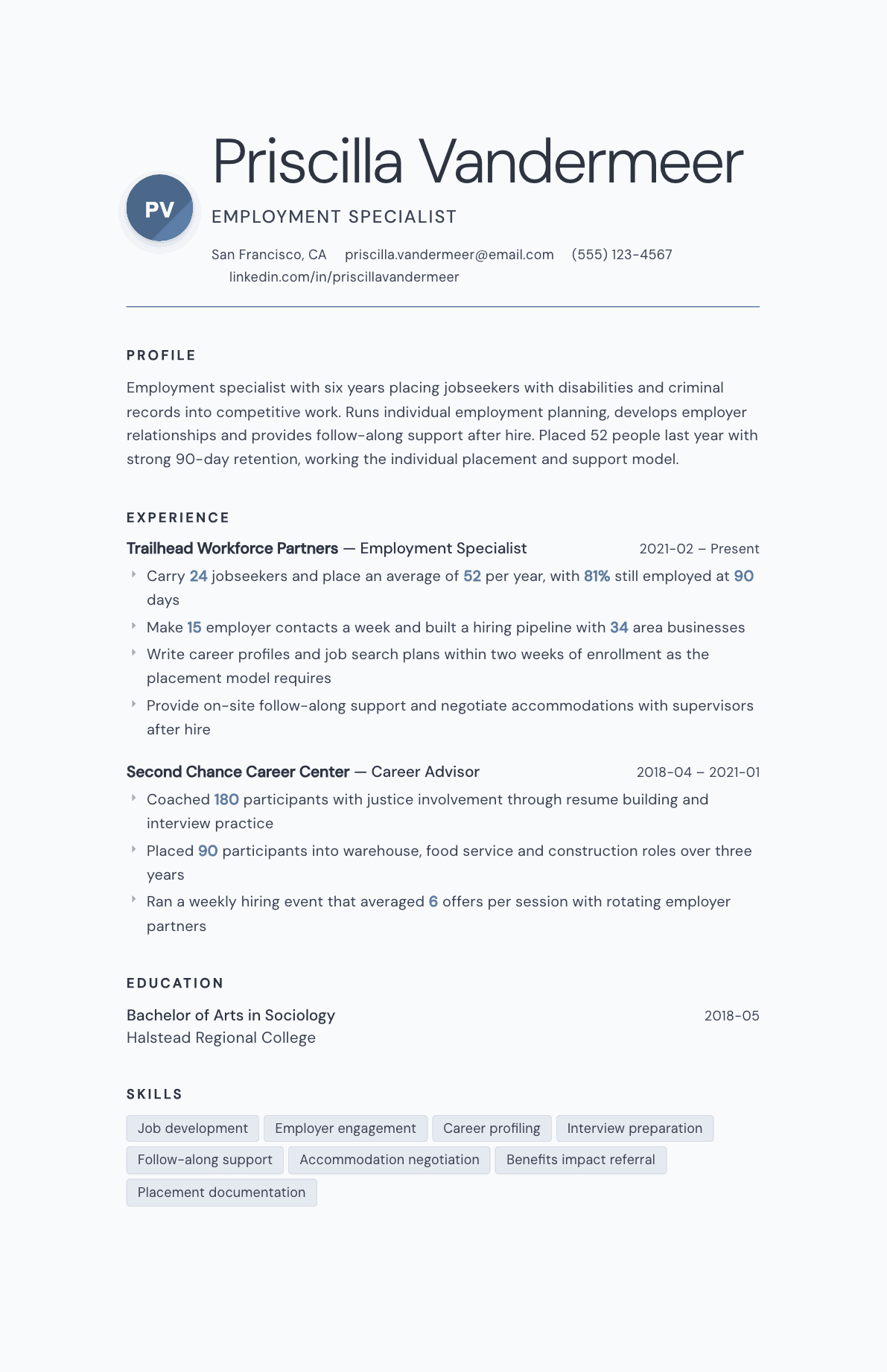
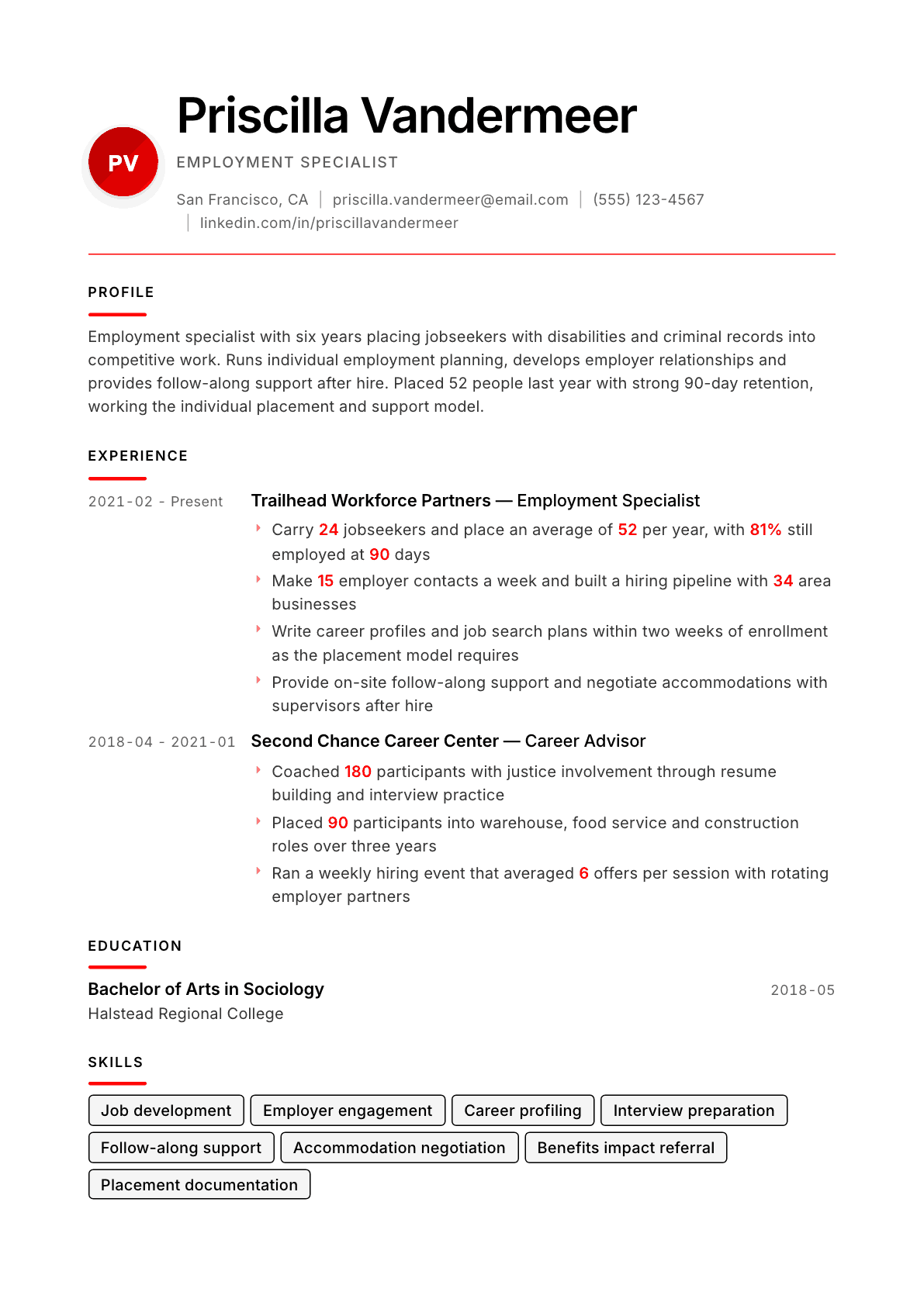
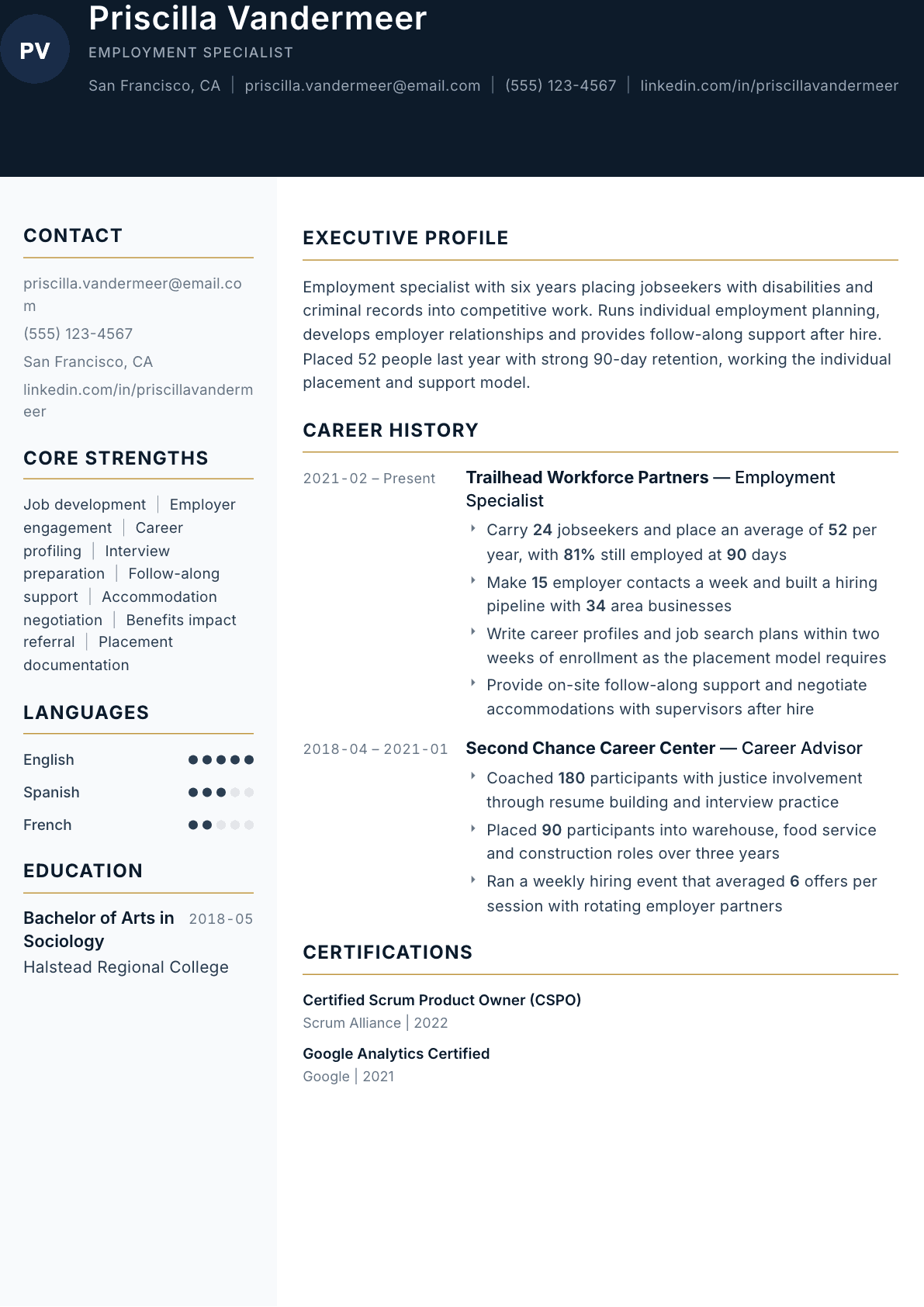
The same employment specialist content laid out in three CVBooster templates, so you can see what the finished document looks like before you write a word.
Example Employment Specialist summary
Employment specialist with six years placing jobseekers with disabilities and justice involvement into competitive work. Carries 24 active participants, makes 15 employer contacts a week and placed 52 people in one year with strong 90-day retention. Works the individual placement and support model, writes career profiles quickly after enrollment and negotiates accommodations with supervisors after hire.
Skills to list on a Employment Specialist resume
- Job development
- Employer engagement
- Individual placement and support
- Career profiling
- Resume and application coaching
- Interview preparation
- Job matching
- Follow-along support
- Workplace accommodation negotiation
- Benefits impact referral
- Labor market research
- Hiring event coordination
- Retention tracking
- Outcome reporting
What actually gets this resume read
- Put placements and 90-day retention in the first bullet, because funders pay this role on outcomes.
- Report employer contacts per week, since job development volume is the number program managers interview about.
- Name the model you work, such as individual placement and support, and the fidelity standards it holds you to.
- Show follow-along support after hire, not only the placement, because retention work is what separates the role.
- Mention the populations you serve, whether disability, justice involved, refugee or youth, since caseloads differ.
- Include the tracking system you use for placements and the reporting deadlines you met each month.
How to write a employment specialist resume
Employment specialist roles are paid for by contracts that count outcomes, so the manager reading your resume is doing arithmetic. How many people did this person put to work last year, how many were still there three months later, and how many employer conversations did it take. Everything warm and supportive on the page is read after those three answers, if at all.
The work itself is half relationship building with jobseekers and half sales to employers, which is why so many resumes for this role feel unbalanced. Applicants from human services describe the coaching and forget the cold calls. Applicants from staffing describe the placements and forget that a participant with a criminal record or a psychiatric disability needs a different conversation than a candidate on a recruiter's list.
This guide balances both halves, with example summaries for a first employment role, an experienced specialist and a team lead, before and after bullets that put numbers on work most people describe vaguely, and the questions people ask when they move between workforce, disability and reentry programs.
Open with placements, retention and the employer contact rate
The first three bullets of your most recent job should carry the outcomes. Participants placed in the last year, the share still employed at ninety days or whatever milestone your contract used, and your weekly employer contact volume. A program manager can size you up from those alone, and every additional bullet is read in their light.
If your placements were modest, give the context that explains them: a rural labor market, a population with heavy barriers, or a caseload of people who had never worked. Then show the pipeline work you did anyway. Managers forgive a small number attached to a real strategy far more readily than a large number attached to nothing.
- Job line: program, funding source or contract if relevant, active caseload, and the population served.
- State the placement milestone your contract measured, whether thirty, ninety or one hundred eighty days.
- Give average wage or hours range only if your program tracked it, and describe it as full or part time work.
Job development is sales, so write it like sales
Employer contacts per week, new employers added to the pipeline, informational meetings held, and repeat hiring partners are the units of job development. Describe how you open a conversation with a hiring manager, what you offer beyond a candidate, and how you follow up when the answer is not now. Program managers interview for this because it is the part most staff avoid.
Add the industry knowledge. A specialist who knows which warehouses hire on the spot, which restaurants have a second-chance policy and which manufacturers run their own training brings a map that a new hire would take a year to build. Name the sectors you placed into most often.
The jobseeker side: profile, plan and preparation
Show the front end of the caseload. Career profiles or vocational profiles completed, the timeline your model required for them, job search plans written, and the preparation work: resume building, application support, interview practice, disclosure decisions and transportation planning. Time to first interview and time to placement are useful numbers if you tracked them.
Then show the judgment. Matching is what separates this role from a job board. Describe how you weigh a person's schedule constraints, sensory tolerance, transportation, medication timing or supervision needs against a specific employer's shift structure, because a bad match costs the program its ninety-day outcome.
Retention support after the hire
Follow-along is the part of the job that separates a placement from an outcome. Say how often you contact a participant and their supervisor after the start date, how long support continues, and what you have actually fixed: a schedule conflict, a missing accommodation, an early performance concern, or a conflict with a coworker that would have ended the job in week three.
Accommodation negotiation belongs here. Describe requests you have made with an employer, what you disclosed and what you did not, and how the arrangement was documented. This is the work that makes a specialist trusted by both sides.
- Name the follow-along schedule and how long support continued after the start date.
- Include benefits questions you routed to a certified benefits planner rather than answering yourself.
- Say which tracking system you used for placements, milestones and monthly contract reporting.
Model fidelity, populations and posting keywords
If you worked a defined model such as individual placement and support, name it and the fidelity standards it holds you to: rapid job search after enrollment, zero exclusion, integration with the clinical team, attention to participant preference and time spent in the community rather than the office. Fidelity reviewed programs hire specialists who already know the scorecard.
Name the populations you have served, since caseloads differ sharply between disability, justice involved, refugee, veteran and youth programs. Then mirror the posting vocabulary: job development, job matching, career profile, follow-along, workplace accommodation, retention, employer engagement and outcome reporting.
Employment Specialist resume summary examples
First employment role
Employment specialist with one year at a reentry career center, coaching 180 participants through resume building and interview practice and placing 90 into warehouse, food service and construction roles. Runs a weekly hiring event with rotating employer partners and tracks every placement for contract reporting.
Five years placing
Employment specialist with five years in supported employment, carrying 24 jobseekers and placing an average of 52 a year with strong ninety-day retention. Makes 15 employer contacts weekly, writes career profiles within two weeks of enrollment, and negotiates accommodations with supervisors after hire.
Employment team lead
Employment team lead with nine years across workforce and disability employment programs, supervising six specialists and the employer engagement pipeline. Raised team retention at the ninety-day milestone, prepared the program for its fidelity review, and holds standing hiring agreements with regional logistics and healthcare employers.
Work experience bullets: before and after
Before: Helped clients find jobs.
After: Placed an average of 52 jobseekers a year into competitive positions from a caseload of 24, with 81% still employed at the ninety-day milestone the contract measured.
Placement volume, caseload size and the contract milestone are the three figures the funder reads first.
Before: Reached out to local employers.
After: Made 15 employer contacts a week, converted 34 area businesses into an active hiring pipeline, and returned to each hiring manager quarterly whether or not they had an opening.
Contact volume plus the follow-up rhythm shows a job development routine instead of occasional outreach.
Before: Prepared clients for interviews.
After: Ran mock interviews with recorded playback, coached disclosure decisions for participants with gaps or records, and rehearsed answers to the specific questions each employer partner asks.
Employer specific rehearsal and disclosure coaching describe preparation that actually changes an interview outcome.
Before: Provided support after clients started working.
After: Checked in with each new hire and their supervisor weekly for the first month, resolved schedule and transportation conflicts before they became attendance problems, and negotiated two written accommodations.
Naming the cadence and the problems solved shows retention work rather than a promise of continued support.
Before: Matched people to suitable jobs.
After: Matched participants to shifts by weighing transportation windows, medication timing and supervision style against each employer's schedule, which kept early separations rare across the caseload.
Spelling out the matching variables demonstrates the judgment that protects a program's retention numbers.
Hard skills
- Job development and employer outreach
- Individual placement and support practice
- Career and vocational profiling
- Job matching
- Resume and application coaching
- Interview preparation and mock interviewing
- Disclosure and accommodation negotiation
- Follow-along retention support
- Labor market research
- Hiring event coordination
- Placement and milestone tracking
- Contract outcome reporting
Soft skills
- Persuasion with hiring managers
- Resilience after rejection
- Encouragement without pressure
- Cross-team collaboration
- Discretion about participant history
- Organized follow-up
Certifications worth listing
- Certified Employment Support Professional (CESP) (APSE, the Association of People Supporting Employment First)
- Global Career Development Facilitator (GCDF) (Center for Credentialing and Education)
- ACRE Basic Employment Services Certificate (Association of Community Rehabilitation Educators)
Mistakes that cost employment specialist candidates the interview
- Writing only about the coaching relationship, which leaves a program manager unsure whether you can call an employer at all.
- Reporting placements without a retention milestone, when the contract almost always pays on the milestone rather than the start date.
- Leaving employer contact volume off the page, the single number that predicts placement performance in this role.
- Claiming a placement model by name without describing the fidelity practices it requires, which fails in the first interview.
- Ignoring benefits questions entirely, when participants routinely turn down hours out of fear and specialists must know where to route them.
- Listing populations served without saying what changed in your approach for each one, which reads as caseload trivia.
Employment Specialist resume questions
What numbers should an employment specialist resume include?
Placements per year, caseload size, retention at the milestone your contract measures, employer contacts per week and new employers added to the pipeline. Those five figures let a program manager compare you against the targets she is already carrying.
How do I write this resume with a staffing or recruiting background?
Keep the sales fluency and translate the rest. Show that you understand supported employment, accommodations, disclosure decisions and the barriers participants bring. Programs value recruiting instincts, but only from someone who will not push a person into the wrong shift.
Should I name the individual placement and support model on my resume?
Yes if you truly worked it, and back it up with fidelity practices: rapid job search after enrollment, integration with a clinical team, attention to participant preference and time spent in the community. Fidelity reviewed programs test that claim quickly.
How do I describe placements that did not last?
Do not list them individually. Report your retention rate honestly and describe what you changed as a result, such as tighter matching on transportation or earlier supervisor check-ins. Improvement described with a mechanism reads stronger than a perfect number.
Does an employment specialist need a degree?
Many programs hire on experience, a driver license and demonstrated employer relationships rather than a specific degree, while agency contracted positions may require one. Employment support certifications strengthen either application and are worth listing with the issuing body.
Related resume examples
- Case Manager Resume example
- Outreach Coordinator Resume example
- Job Coach Resume example
- Vocational Rehabilitation Counselor Resume example
- Career Coach Resume example
- Social Services Assistant Resume example