Congressional Staffer Resume Examples: read this first
Congressional Staffer Resume for the Hill Hiring Market
By Mustafa Tarabya, founder of CVBooster · Published · Updated
Congressional staffer resume example, keyword list and writing guide covering Hill titles, issue portfolios, vote recommendations and casework volume.
Sample resumes for a congressional staffer
The same congressional staffer content laid out in three CVBooster templates, so you can see what the finished document looks like before you write a word.
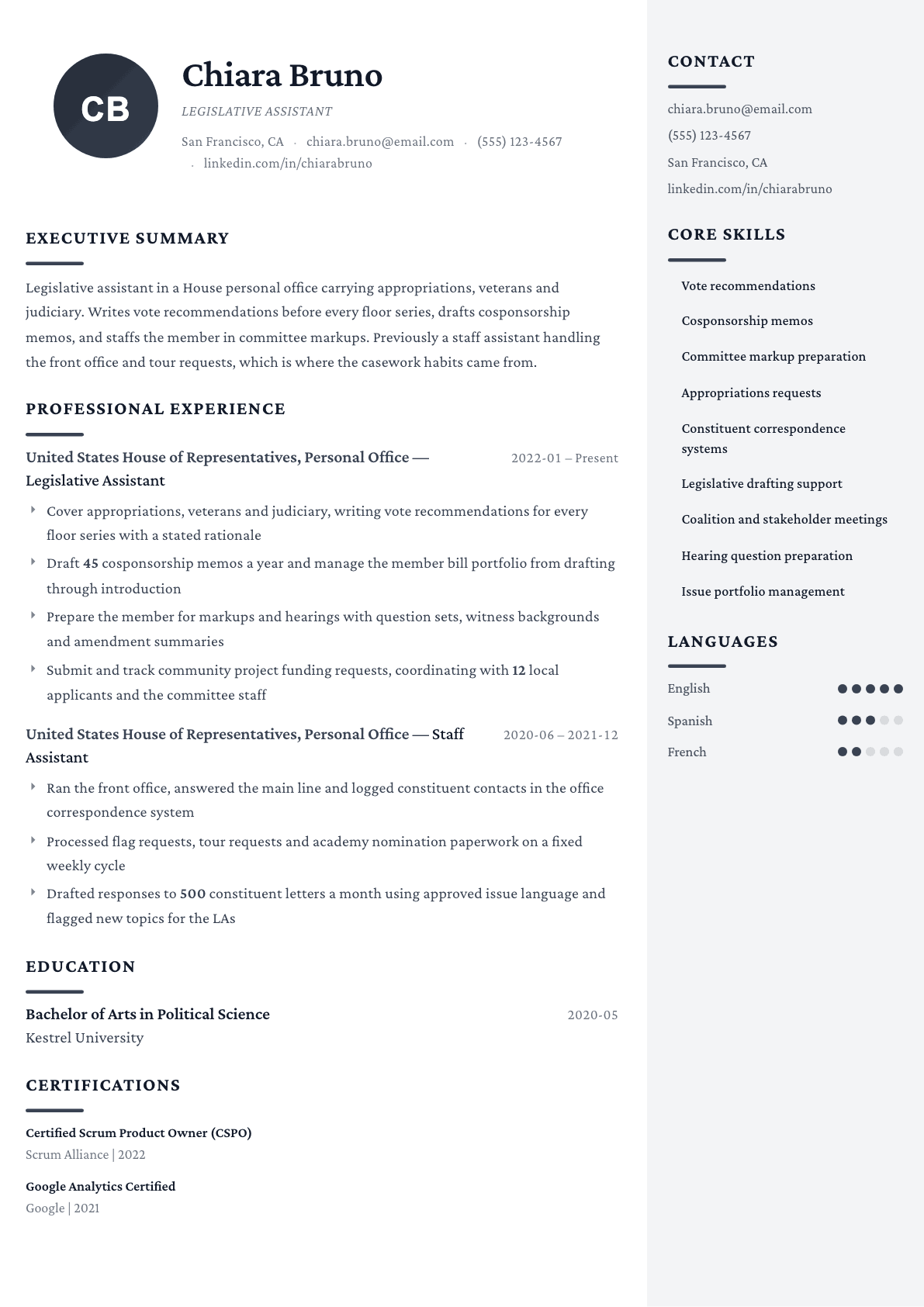
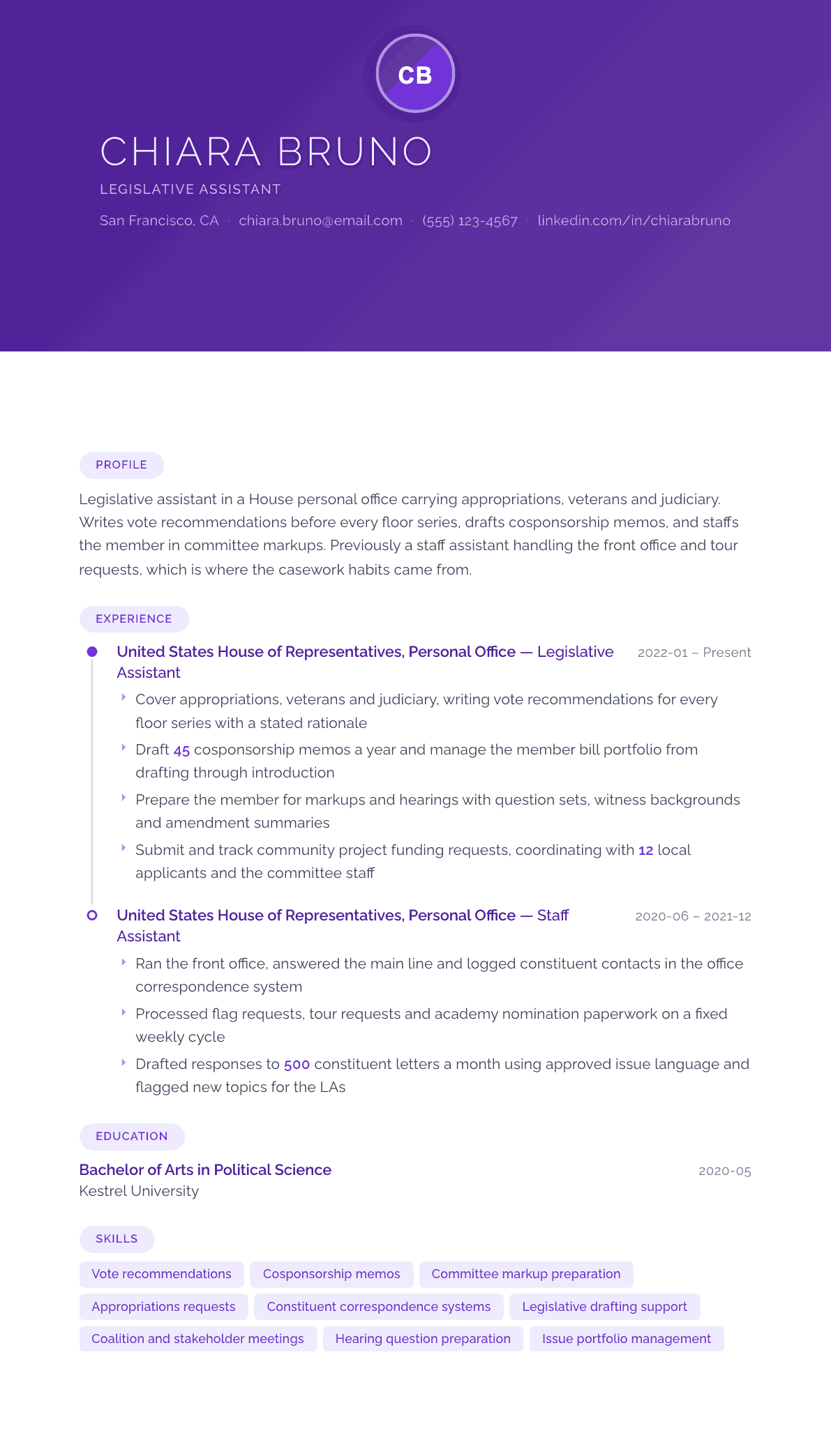
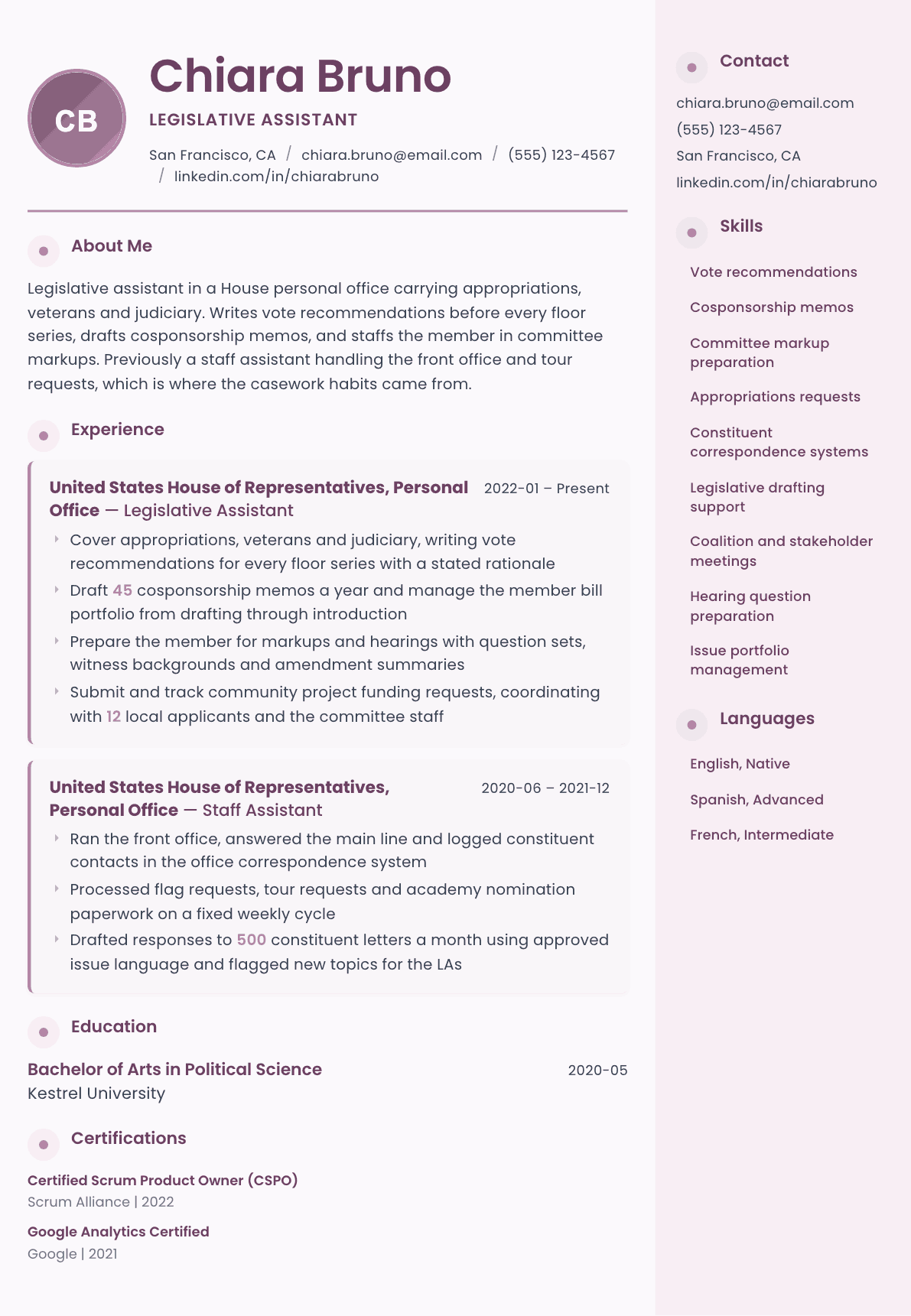
Example Congressional Staffer summary
Congressional staffer with five years in a House personal office, promoted from staff assistant to legislative assistant covering appropriations, veterans and judiciary. Writes vote recommendations with a clear rationale, manages the member bill portfolio, and prepares the member for markups. Seeking a legislative director position in a personal or committee office.
Skills to list on a Congressional Staffer resume
- Vote recommendation writing
- Cosponsorship and bill portfolio management
- Committee markup and hearing preparation
- Appropriations and project funding requests
- Legislative drafting support
- Constituent correspondence management
- Casework and federal agency liaison
- Coalition and stakeholder meetings
- Floor procedure tracking
- Memo and briefing writing
- District and state office coordination
- Intern supervision
What actually gets this resume read
- Use the Hill title exactly: staff assistant, legislative correspondent, legislative assistant, legislative director or chief of staff.
- State whether the office was a personal office, a committee or leadership, because those three hire on different signals.
- List your issue portfolio by name, since a hiring chief of staff is filling a specific gap in coverage.
- Quantify correspondence and casework volume, because that is the workload every Hill office understands instantly.
- Name the correspondence management system you used, since offices care about the retraining cost when they switch.
- Leave the member name in and keep the tone neutral, because Hill resumes are read by people who know the office.
How to write a congressional staffer resume
Capitol Hill runs its own resume market with its own vocabulary, and the people reading are almost always former staffers themselves. A chief of staff or a committee staff director recognizes every title, knows roughly what each office pays attention to, and can tell within seconds whether a candidate has actually worked the floor or has only been near it.
That makes precision more valuable than polish. Use the real titles, name the office type, list the issue portfolio, and give the volumes for correspondence and casework. A congressional staffer resume that reads like a corporate one, full of leveraged and spearheaded, marks the candidate as an outsider before the second bullet.
This guide covers the Hill title ladder and what each rung is expected to show, how to present a portfolio, how to write about appropriations and casework without breaching confidence, and how to move between personal offices, committees and the executive branch.
Format: Hill titles, office type, one page for a long time
One page is the norm well into a Hill career, and two pages only once you are at legislative director or chief of staff level with committee work behind you. Offices read a large volume of applications in a short window, and brevity is read as fluency.
Use the exact title you held: staff assistant, legislative correspondent, legislative aide, legislative assistant, senior legislative assistant, legislative director, communications director, district or state director, chief of staff. Then say what kind of office it was, because a personal office, a committee, leadership and a caucus staff each hire on different evidence.
- Header with name, city, phone, email, and a line naming your issue portfolio.
- Experience with the office identified by chamber, office type and the member or committee.
- Portfolio, correspondence volume and casework volume inside each entry.
- A short block for the systems you have used and any security clearance you hold.
The portfolio is the product
Hiring on the Hill is gap filling. An office loses the person covering health and needs health covered by the next floor series. So list your issues by name, in the order you owned them, and say which committees of jurisdiction they touched. Vague coverage of domestic policy tells a chief of staff nothing he can act on.
Say what you produced from that portfolio. Vote recommendations before every series, cosponsorship memos with a recommendation, meeting memos for stakeholder visits, and the bill portfolio you managed from drafting request through introduction. The Hill is a memo culture, and memo counts describe the job better than adjectives do.
Committee, markups and appropriations
If your member sat on a committee you staffed, name it and describe the preparation you produced: question sets, witness backgrounds, amendment summaries and the opening statement draft. Markup preparation in particular is where a legislative assistant proves value, because the material has to be right in a room that moves quickly.
Appropriations work is worth its own bullets. Community project funding requests, programmatic and language requests, coordination with local applicants and with committee staff, and tracking through subcommittee. Offices value staff who have run a request cycle without letting a deadline slip, because the consequences are visible back home.
Correspondence, casework and the front office
Nearly every Hill career starts with volume work, and it is a strength rather than something to minimize. Give the monthly letter counts you drafted, the correspondence management system you used, and how you built or maintained the approved issue language. A legislative correspondent who kept response times short under heavy mail flow is demonstrating exactly the discipline the next rung requires.
Casework should show the agencies. Veterans benefits, immigration status inquiries, social security, passport and federal agency delays are the recurring categories, and naming them tells a district or state director that you know which liaison to call.
- Correspondence volume per month and the system used to manage it.
- Casework categories, the agencies involved, and the outcomes you can describe generally.
- Front office duties such as flag requests, tours, academy nominations and intern supervision.
- Any clearance held, its level and status, stated plainly with no further detail.
Moving between offices, committees and downtown
Movement is normal and expected, so make the trajectory legible. If you moved from a personal office to a committee, say what changed: deeper jurisdiction, hearing production, legislative drafting at a different scale. If you are aiming at an executive branch legislative affairs role or a government relations job, translate the same work into the counterpart language, such as coalition management, member engagement and legislative strategy.
Keep the document neutral in tone. Hill resumes circulate widely, and a page that reads as advocacy rather than staff work narrows the set of offices willing to consider it.
Congressional Staffer resume summary examples
Staff assistant
Staff assistant in a House personal office with 18 months running the front office, logging constituent contacts and drafting responses to 500 letters a month using approved issue language. Processed flag, tour and academy nomination requests on a fixed weekly cycle and supervised 4 interns each term.
Legislative assistant
Legislative assistant in a House personal office covering appropriations, veterans and judiciary. Writes vote recommendations for every floor series, drafts 45 cosponsorship memos a year, prepares the member for markups, and manages community project funding requests with 12 local applicants.
Legislative director
Legislative director in a Senate personal office managing 4 legislative staff and the full bill portfolio, with 9 years on the Hill across a committee and two personal offices. Sets the legislative strategy, clears every memo reaching the senator, and negotiates cosponsorship and amendment agreements with counterpart offices.
Work experience bullets: before and after
Before: Advised the member on legislation.
After: Covered appropriations, veterans and judiciary, writing vote recommendations for every floor series with a stated rationale and the position of relevant outside groups.
Naming the portfolio and the recommendation format shows the reader exactly which coverage gap you can fill.
Before: Managed the member bill portfolio.
After: Drafted 45 cosponsorship memos a year and carried the member bills from legislative counsel drafting request through introduction, including counterpart outreach for original cosponsors.
The memo count and the drafting to introduction path prove ownership rather than administrative support.
Before: Prepared the member for hearings.
After: Prepared the member for markups and hearings with question sets, witness backgrounds, amendment summaries and a one-page opening statement draft for each.
Listing the actual materials shows what preparation means in a committee room that moves fast.
Before: Worked on funding requests for the district.
After: Submitted and tracked community project funding requests, coordinating with 12 local applicants on eligibility documentation and with subcommittee staff through the request deadline.
The applicant coordination and the deadline discipline are the parts that determine whether a request survives.
Before: Answered constituent mail.
After: Drafted responses to 500 constituent letters a month in the office correspondence system, maintained the approved issue language, and flagged emerging topics for the legislative team.
Volume, system and the feedback loop turn mail duty into evidence of judgment about what the office is hearing.
Hard skills
- Vote recommendation writing
- Cosponsorship and bill portfolio management
- Committee markup and hearing preparation
- Appropriations and project funding requests
- Legislative drafting requests
- Constituent correspondence management systems
- Casework and federal agency liaison
- Floor procedure and scheduling awareness
- Coalition and stakeholder meeting management
- Memo and briefing writing
- District and state office coordination
- Intern program supervision
Soft skills
- Working long floor days without dropping detail
- Discretion about member deliberations
- Fast relationship building across offices
- Written brevity
- Staying neutral in a partisan building
Mistakes that cost congressional staffer candidates the interview
- Inventing a title instead of using the Hill ladder, which every reader in this market recognizes instantly.
- Failing to name the office type, so a reader cannot tell a personal office from a committee or leadership role.
- Leaving the issue portfolio off, when offices hire specifically to fill a coverage gap before a floor series.
- Minimizing correspondence and front office work, which is the standard proving ground for the next rung.
- Writing in corporate verbs, which marks the candidate as unfamiliar with how the building talks.
- Stretching to two pages early, when brevity is read as fluency in this hiring market.
- Referring to internal deliberations in detail, which raises a discretion concern before an interview happens.
Congressional Staffer resume questions
How long should a congressional staffer resume be?
One page for most of a Hill career, including legislative assistant roles. Two pages become acceptable at legislative director, communications director or chief of staff level, particularly with committee experience worth describing in detail.
Do I need to have interned on the Hill to get hired?
It is the most common entry route and it builds the network that circulates openings, but it is not required. Campaign field work, state legislative staff experience and federal agency roles all lead into staff assistant and legislative correspondent positions.
Should I say which party the office belonged to?
You do not need to state it directly, since the member and committee names make it clear to anyone in the market. Keep the language neutral and factual so the resume can travel to committee, executive branch and government relations roles.
How do I move from a personal office to a committee?
Show depth in the committee jurisdiction. Lead with the bills you carried in that policy area, the markups you prepared for, the hearing materials you produced, and any drafting work you did with legislative counsel on that subject.
What should I do about a short stay in one office?
List it with honest dates and no explanation on the page. Turnover is high and readers know it, but be ready with a short neutral answer in the interview, since Hill reference checking happens through personal networks quickly.
Related resume examples
- Legislative Assistant Resume example
- Public Affairs Specialist Resume example
- Legislative Aide Resume example
- Policy Advisor Resume example
- Government Relations Manager Resume example
- Civil Servant Resume example