Legislative Aide Resume Examples: the lines they read
Legislative Aide Resume: Bills, Constituents and Committee Work
By Mustafa Tarabya, founder of CVBooster · Published · Updated
Legislative aide resume example, keywords and a writing guide covering bill tracking, constituent casework, committee prep and district office operations.
Sample resumes for a legislative aide
The same legislative aide content laid out in three CVBooster templates, so you can see what the finished document looks like before you write a word.
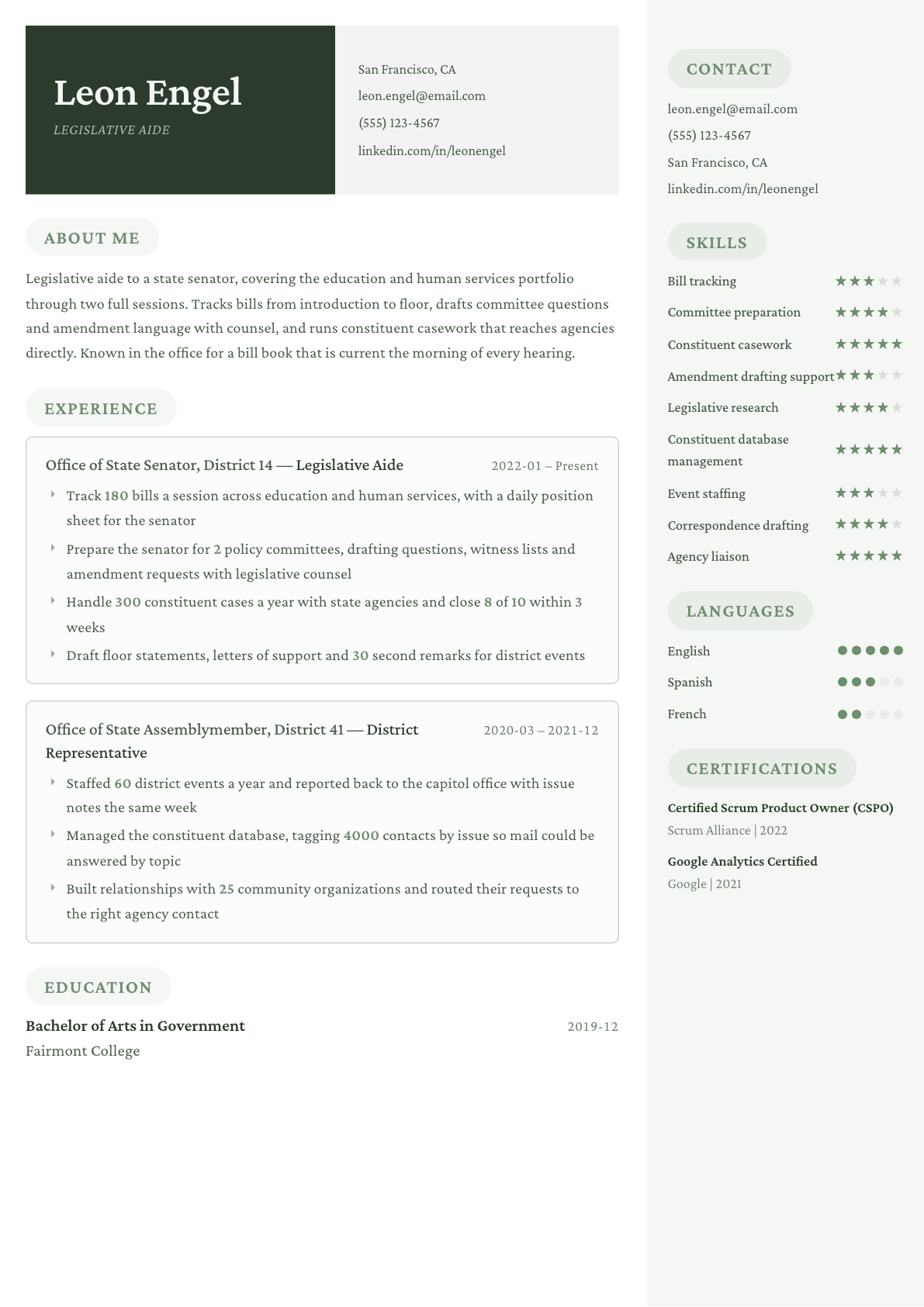
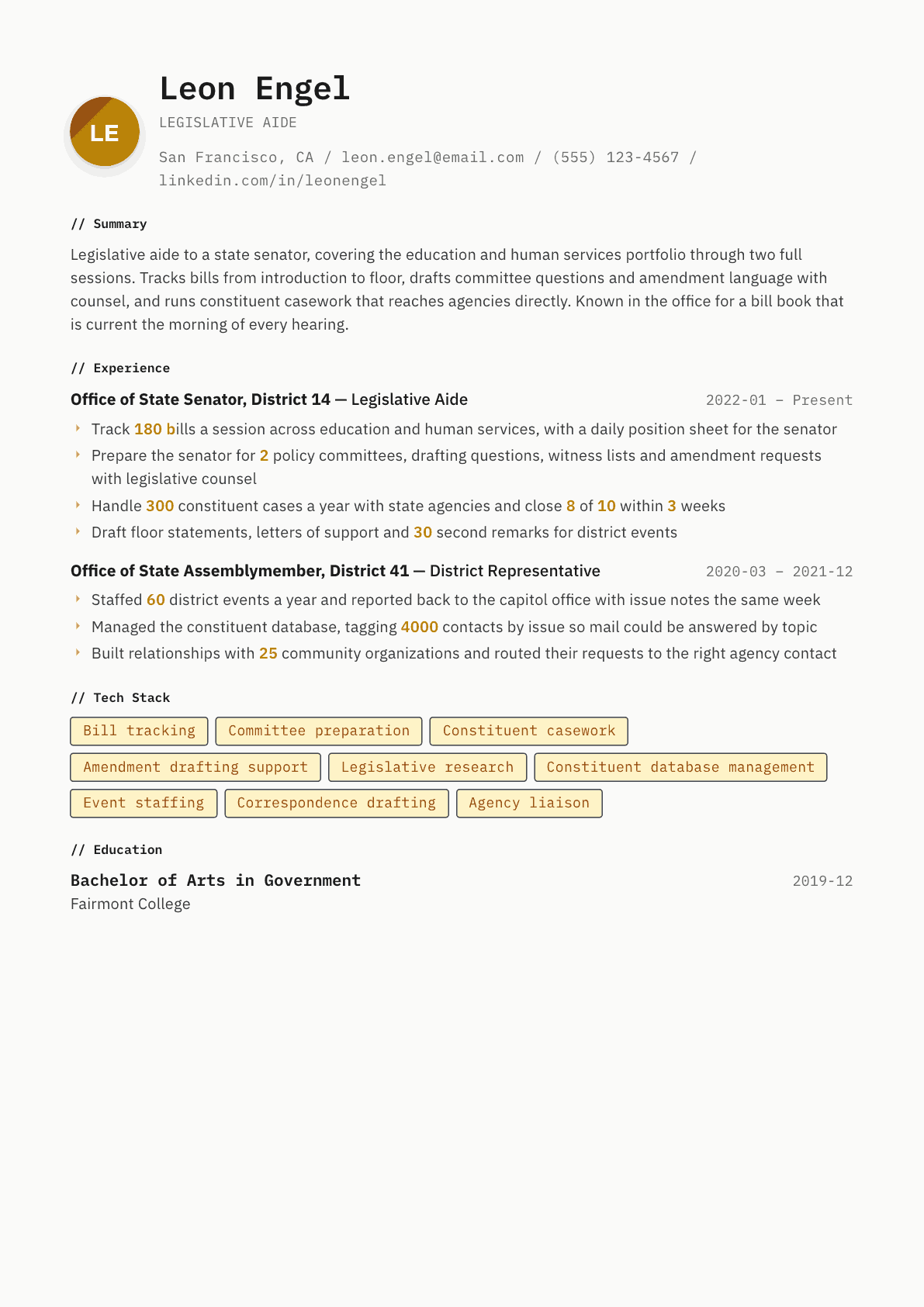
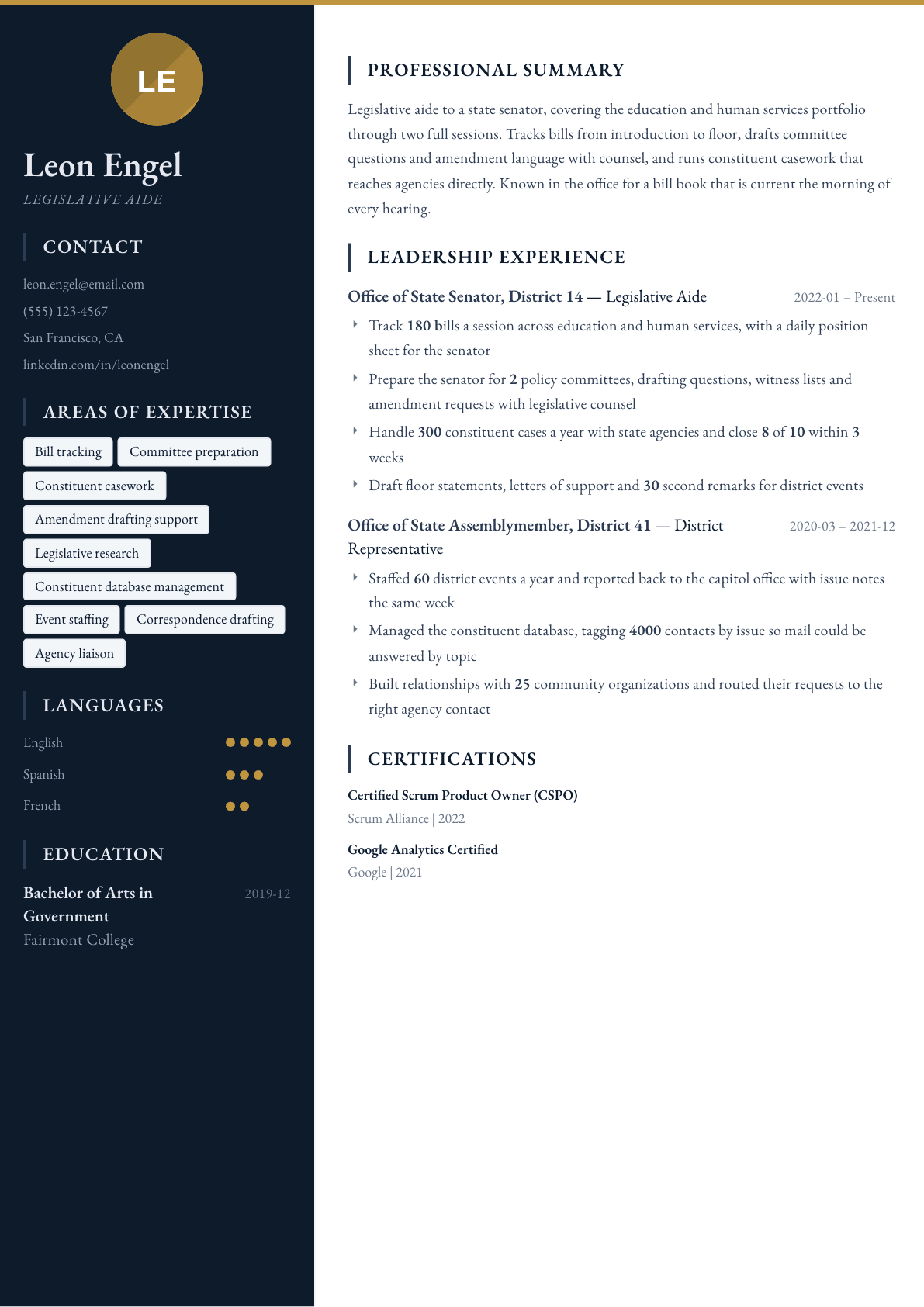
Example Legislative Aide summary
Legislative aide with four years in state capitol and district offices, covering education and human services through two full sessions. Tracks a large bill load, prepares members for committee with drafted questions and amendment requests, and closes constituent cases with agencies quickly. Looking for a legislative director role in a policy committee office.
Skills to list on a Legislative Aide resume
- Bill tracking and position sheets
- Committee hearing preparation
- Amendment and bill drafting support
- Legislative research
- Constituent casework and agency liaison
- Correspondence and letter drafting
- Floor statement preparation
- Stakeholder meeting scheduling
- District event staffing
- Constituent relationship databases
- Budget subcommittee follow up
- Coalition and advocacy tracking
What actually gets this resume read
- Name the chamber, the member office and the policy portfolio you carried, since a health aide and a budget aide are different hires.
- Give bill volume per session and say what you produced from it: position sheets, committee analyses or amendment requests.
- Report constituent casework volume and your close rate, because district offices are judged on responsiveness.
- Show that you have worked with legislative counsel on amendment language rather than only summarizing bills.
- Keep party and personality out of the resume, because member offices hire across a wider range than people expect.
- List session dates precisely, since capitol offices read a resume against the calendar of sessions and interim periods.
How to write a legislative aide resume
Legislative aide hiring runs on a short calendar and a narrow set of signals. A chief of staff filling a seat during session has weeks at most, and she is reading for three things: the portfolio you have carried, the bill volume you can absorb, and whether you can walk into a committee room with a member and hand him the right question at the right moment.
The job is also two jobs stitched together. Capitol side is bills, committees, amendments and the daily position sheet. District side is casework, community organizations and events. Most aides do both, and a resume that flattens them into general legislative support makes it impossible for the reader to tell which half you are strong in.
This guide covers how to write for a member office, how to size a bill load, how to describe casework in terms a district director recognizes, and how to keep a resume that can travel between offices with different politics.
Format: chamber, office, portfolio, session
One page early in your career, two once you have carried a portfolio through several sessions. Legislative offices read fast, so put the identifying facts in the first three lines: the chamber, the office, the policy portfolio and the sessions you covered.
Use month and year for every position and align the dates to sessions and interim periods. Capitol staff read a resume against the legislative calendar automatically, and an aide who left mid-session raises a question the resume should answer with dates rather than leave open.
- Header with name, city, phone and email, plus a line naming the chamber and portfolio you cover.
- Experience with the office identified by chamber and district number rather than by personality.
- Separate capitol and district responsibilities inside each job so the reader can see the split.
- A short block for legislative systems, bill tracking tools and the constituent database you used.
Bills: volume, portfolio and what you produced
Give the number of bills you tracked in a session and the policy areas they fell into. Bill volume is the workload unit of the job, and a chief of staff uses it to judge whether you can carry the office through a deadline week without dropping something.
Then say what you made from that tracking. A daily position sheet, committee analyses, floor notes, cosponsorship recommendations, an amendment request drafted with legislative counsel. Tracking bills is passive. Producing decisions from them is the job.
If you have worked directly with legislative counsel on bill language, put it high on the page. Aides who can turn a member idea into a drafting request that comes back close to usable are rare and offices know it.
Committee work and floor
Name the committees your member sat on and say what you prepared: question sets, witness lists, amendment summaries, background on the author and the sponsors. Committee preparation is where a member is most visible and most exposed, so this section carries real weight.
Add the floor rhythm if you handled it. Vote recommendations, floor statements, notification of amendments in print, and the coordination with the caucus or party desk. These duties change with the chamber, so describing them precisely tells a reader you have done the specific version they run.
Constituent casework and the district
Casework is measurable, so measure it. Cases opened a year, the agencies you work with most, the average time to close and the share resolved without escalation. District directors think in exactly those terms, because responsiveness is what the office is judged on between elections.
Describe the district side beyond casework: events staffed, community organizations you built relationships with, and how you fed district issues back to the capitol team. Then name the constituent relationship system you worked in, since offices weigh retraining cost when they hire mid-session.
- Case volume, the agencies involved and your close rate or average time to resolution.
- Constituent correspondence handled, including the issue tagging you maintained.
- District events staffed per year and how issue notes traveled back to the capitol office.
- Community organizations and local government contacts you kept warm.
Keep the resume portable
Member offices hire across a wider spread than outsiders expect, and staff move between chambers, parties and levels of government more often than people admit. Write the resume so it travels: describe duties and volumes, keep advocacy language out, and let campaign work sit in its own dated entry rather than coloring the whole document. Neutral does not mean bland. It means the reader judges you on the work.
Legislative Aide resume summary examples
District representative
District representative with 2 years in a state assembly office, staffing 60 district events a year and managing a constituent database of 4000 contacts tagged by issue. Built working relationships with 25 community organizations and routed their requests to the right agency contact.
Legislative aide, two sessions
Legislative aide to a state senator covering education and human services through 2 full sessions. Tracks 180 bills a session with a daily position sheet, prepares the member for 2 policy committees with drafted questions and amendment requests, and closes 8 of 10 constituent cases within 3 weeks.
Legislative director
Legislative director managing a 3-person policy team and the full bill portfolio for a senate office, with 7 years in the capitol. Sets the office legislative agenda, works bill language with legislative counsel, and coordinates author negotiations through committee and floor.
Work experience bullets: before and after
Before: Tracked legislation for the office.
After: Tracked 180 bills a session across education and human services and produced a daily position sheet the senator used before every committee and floor vote.
The volume and the daily product show the tracking turned into decisions rather than a spreadsheet nobody opened.
Before: Helped prepare for committee hearings.
After: Prepared the member for 2 policy committees each week, drafting question sets, assembling witness backgrounds and coordinating amendment requests with legislative counsel.
Naming the deliverables and the counsel relationship shows preparation at the level a member actually relies on.
Before: Handled constituent complaints.
After: Handled 300 constituent cases a year with state agencies covering benefits, licensing and unemployment, closing 8 of 10 within 3 weeks and escalating the rest to agency leadership.
Volume, agency mix and a close rate are the numbers a district director uses to judge a caseworker.
Before: Wrote letters and statements.
After: Drafted floor statements, letters of support and short district remarks, and maintained the approved issue language library the whole office writes from.
The library is a durable contribution, which distinguishes a writer from someone who fills templates.
Before: Attended events in the district.
After: Staffed 60 district events a year and filed same-week issue notes to the capitol team, which fed 3 bill ideas into the following session.
Event attendance becomes valuable only when the reader sees what came back from it and where it went.
Hard skills
- Bill tracking and position sheets
- Committee hearing preparation
- Amendment and drafting requests
- Legislative research and analysis
- Constituent casework and agency liaison
- Correspondence and issue language libraries
- Floor statement preparation
- Constituent relationship databases
- District event staffing and advance
- Stakeholder and lobbyist meeting management
- Budget subcommittee follow up
- Coalition and advocacy tracking
Soft skills
- Speed under deadline week pressure
- Discretion around member decisions
- Composure with angry constituents
- Relationship building across offices
- Reading a room before a hearing
Mistakes that cost legislative aide candidates the interview
- Blending capitol and district duties so a hiring chief cannot tell which half of the job you are strong in.
- Giving no bill volume, which leaves the reader guessing whether you have carried a real load.
- Writing casework as complaints handled rather than cases closed with agencies named.
- Letting partisan language into the resume, which shrinks the number of offices that will read it.
- Omitting session dates, when capitol staff read every resume against the legislative calendar.
- Naming the member personally throughout instead of identifying the office by chamber and district.
Legislative Aide resume questions
How do I get a legislative aide job with no capitol experience?
Come in through the district office or an internship during session. District representative and field roles hire on constituent service ability rather than policy depth, and moving to the capitol side after one session is a well worn path.
Should I list the member I worked for by name?
Identify the office by chamber and district, and you can name the member in the entry itself. Avoid building the whole resume around one person, because offices change and a portable document serves you longer.
How much does the policy portfolio matter?
A great deal. Offices hire to fill a coverage gap, so an aide with education and human services experience is a direct fit for one vacancy and a stretch for another. Name your areas precisely rather than claiming general policy.
Is campaign experience useful on a legislative aide resume?
Yes, as its own dated entry showing field, fundraising or communications work. Keep it factual and separate, since governing offices value the organizing skills while wanting to see that you can operate in a nonpartisan staff role.
What is the difference between a legislative aide and a legislative director?
Scope and authority. An aide carries a portfolio and produces the material, while a director owns the office agenda, assigns portfolios across staff and negotiates bill language and author agreements on the member behalf.
Related resume examples
- Legislative Assistant Resume example
- Policy Analyst Resume example
- Congressional Staffer Resume example
- Political Campaign Manager Resume example
- Government Relations Manager Resume example
- Policy Advisor Resume example