Maintenance Supervisor Resume Examples: read this first
Build a Maintenance Supervisor Resume That Shows Crew Control
By Mustafa Tarabya, founder of CVBooster · Published · Updated
Maintenance supervisor resume example with crew size, backlog, PM compliance and downtime keywords, plus a full writing guide.
Sample resumes for a maintenance supervisor
The same maintenance supervisor content laid out in three CVBooster templates, so you can see what the finished document looks like before you write a word.
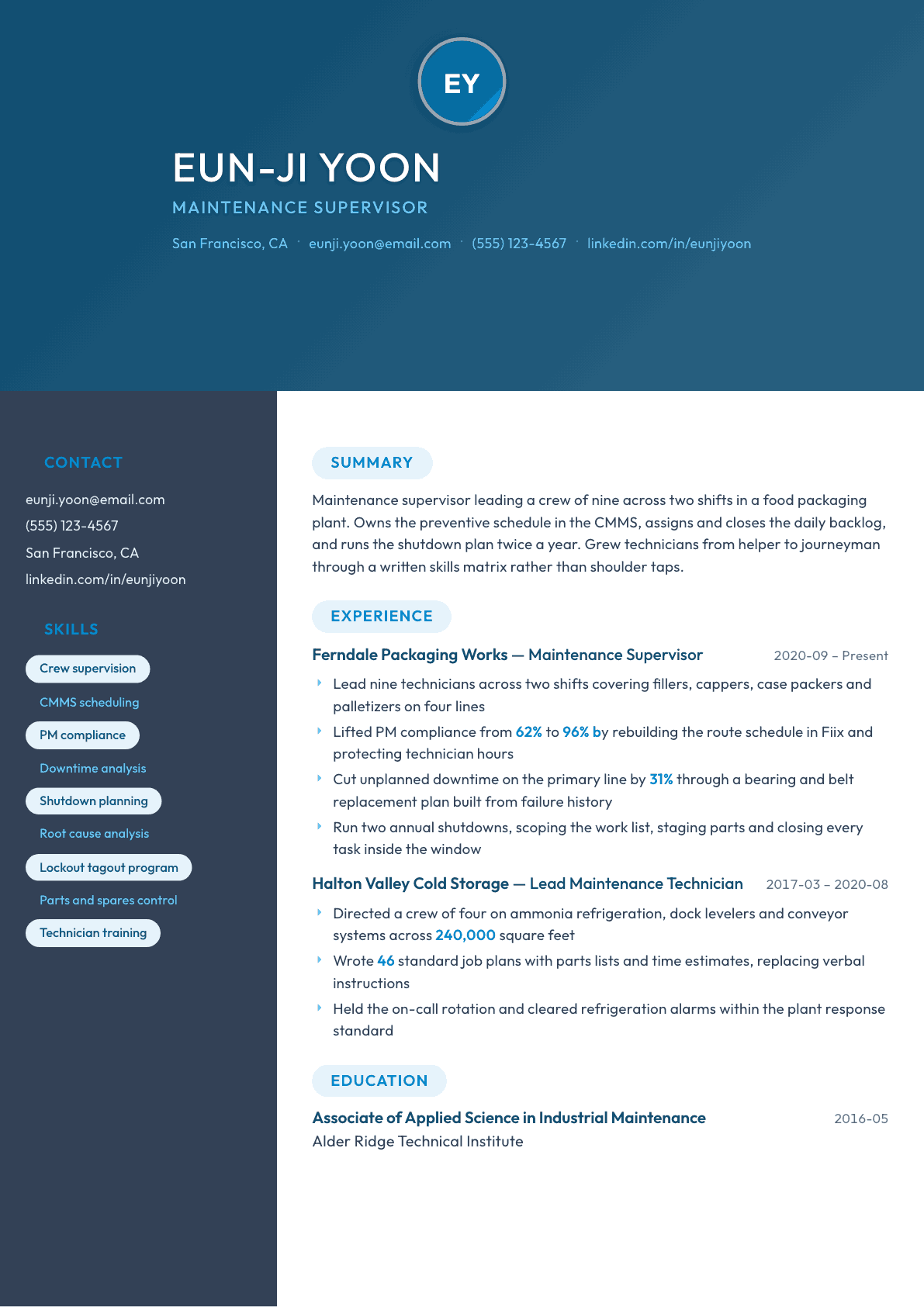
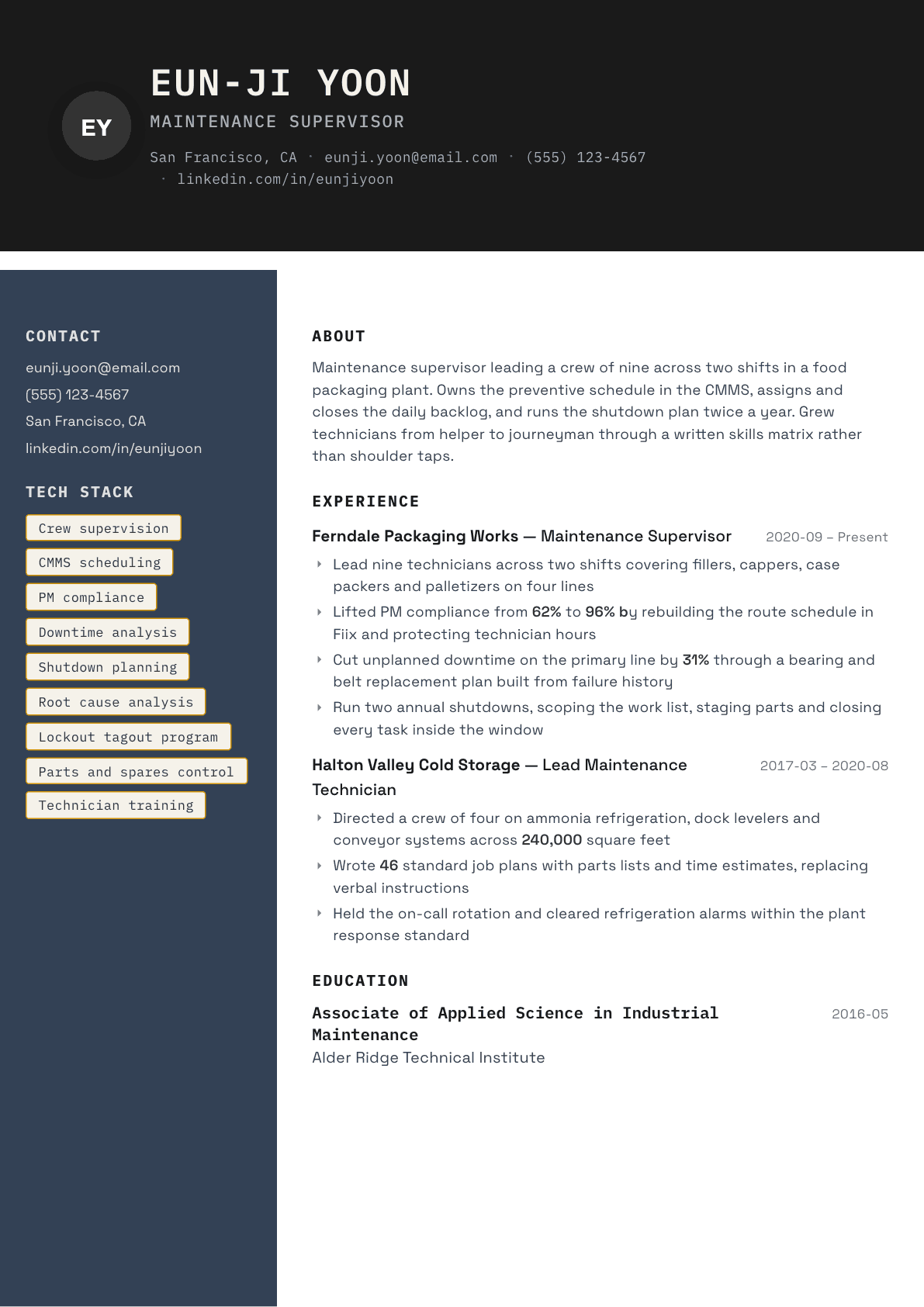
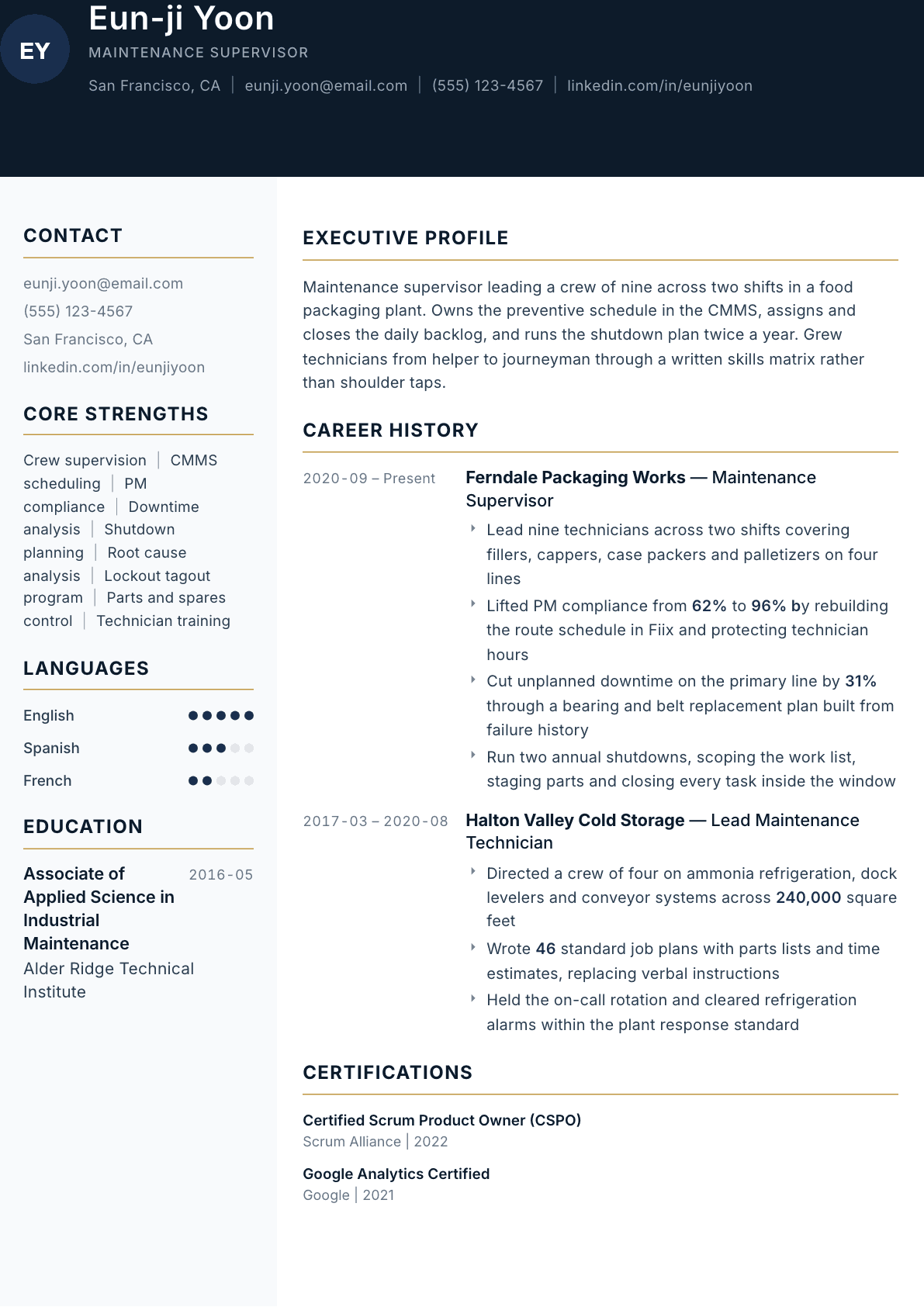
Example Maintenance Supervisor summary
Maintenance supervisor leading a crew of nine across two shifts in a packaging plant, owning the preventive schedule, the daily backlog and the annual shutdown plan. Rebuilt the route schedule in the CMMS and lifted compliance into the mid nineties while cutting unplanned downtime on the primary line. Develops technicians against a written skills matrix and runs lockout tagout audits every quarter.
Skills to list on a Maintenance Supervisor resume
- Crew scheduling across shifts
- Preventive maintenance program ownership
- CMMS administration
- Backlog and work order prioritization
- Downtime tracking and reduction
- Root cause failure analysis
- Shutdown and turnaround planning
- Maintenance budget input
- Spare parts min and max levels
- Contractor supervision
- Lockout tagout auditing
- Technician skills development
- Safety incident investigation
- Reliability reporting
What actually gets this resume read
- Open with crew size, shift coverage and the equipment you are responsible for, in that order.
- Give your preventive compliance figure and say what you changed to move it, not just the number.
- Quantify downtime in hours or as a rate on a named line, because that is the number a plant manager tracks.
- Name the CMMS you schedule in, since migrating a supervisor to a new system costs real weeks.
- Describe how you develop technicians: a skills matrix, a sign-off list, or a documented training route.
- Show shutdown or turnaround work with the scope, the window and whether you closed inside it.
- Put your safety program ownership on the page, including lockout tagout audits and confined space permits.
How to write a maintenance supervisor resume
A plant manager hiring a maintenance supervisor is buying control of a backlog. He has technicians who fix whatever screams loudest, a preventive schedule nobody protects, and production leads who take his people whenever a line stops. He wants a supervisor who can hold a weekly plan against that pressure and still answer the phone at two in the morning.
That is why the strongest maintenance supervisor resumes look nothing like a longer technician resume. Technical bullets still matter, but they sit under the numbers a supervisor owns: crew size, shift coverage, preventive compliance, backlog age, unplanned downtime on the lines that matter, and whether shutdown work closed inside its window.
What follows is the section order a hiring plant expects, how to write the compliance and downtime story without inflating it, three summaries at different levels of responsibility, before and after bullets, and the questions supervisors ask when they move between a plant, a warehouse and a property portfolio.
Format: scope header first, technical depth second
One page if you have under a decade, two if you have supervised at more than two sites. Reverse chronological, with a scope header under each employer rather than a company description. The header carries crew size, shifts covered, the equipment or building portfolio, and whether the operation ran continuously.
Keep a short technical block near the bottom rather than the top. A hiring manager wants to know you can still read a schematic and put hands on a gearbox, but the reason he is hiring is the crew, not the wrench. Leading with your own tool skills makes the page read like a technician applying up.
- Scope header per job: crew size, shift pattern, lines or buildings covered, continuous or day operation.
- The CMMS you schedule in, named, with what you administer inside it.
- A safety block: lockout tagout program ownership, permits you issue, audits you run.
- A short trade block last: your own hands-on strengths, in three or four words each.
Summary: crew, coverage, compliance, downtime
Four facts in three lines. How many technicians report to you and across how many shifts, what equipment or property they cover, where preventive compliance sits and what you did to move it, and what happened to unplanned downtime under your schedule. Everything else is detail.
Be careful with compliance numbers. A supervisor who claims high compliance without saying how the schedule was protected sounds like someone closing work orders on paper. Say what you changed: hours ring-fenced, routes rebuilt around production windows, a second technician trained so a route no longer depended on one person.
Experience: the plan, the backlog, the interruption
Write bullets around the weekly cycle a supervisor actually runs. Planning and scheduling the coming week, assigning the daily board, walking the floor to verify work rather than trusting a closed ticket, and managing the interruptions that arrive from production. That cycle is invisible in most resumes and it is exactly the job.
Backlog deserves its own bullet. Give the number of open orders you inherited and where you took it, or give backlog age in weeks, and describe how you cleared it: a Saturday crew, a contractor push, or ruthless closure of tickets that were never real work. Managers know backlog cannot be wished away and they respect a candidate who names the method.
Downtime bullets must be attached to a named line or system. A plant-wide downtime claim is unverifiable and reads as inherited credit. A claim about the filler drive, the number two extruder or the ammonia system reads as yours.
- Weekly planning and scheduling volume, with the planned work ratio you held.
- Backlog: starting count or age, ending count, and the specific method that moved it.
- Downtime on a named line or system, with the failure mode you attacked.
- Shutdown or turnaround: scope, window length, contractors coordinated, closure inside the window.
- People: technicians developed, skills matrix built, apprentices signed off, turnover held down.
Safety and compliance, written the way an auditor reads it
Supervisors carry the safety program in practice. Say what you own: lockout tagout procedure writing and periodic inspections, confined space entry permits, hot work permits, arc flash boundaries, crane and hoist inspection records. Name the audits your area passed and what you fixed after a finding.
If your site is regulated, say so plainly. Boiler and pressure vessel inspections, refrigeration compliance, fire system testing and environmental recordkeeping all sit under a maintenance supervisor in many operations, and a plant with those obligations will filter for a candidate who has held them before.
Skills and keywords a maintenance posting screens on
Adverts for this role repeat a short list: preventive maintenance program, work order backlog, CMMS, unplanned downtime, root cause analysis, mean time between failures, shutdown planning, spare parts, contractor supervision, lockout tagout. Mirror the exact terms the posting uses, once in a list and once inside a bullet where the work is shown.
Include the reporting you produce. Supervisors who send a weekly one-page report on compliance, backlog and downtime to operations are far easier to hire than ones who only speak in meetings, because a manager can picture what lands in his inbox on Monday.
Maintenance Supervisor resume summary examples
Newly promoted lead
Maintenance lead promoted from technician after six years, directing a crew of four on conveyors, dock equipment and refrigeration across a distribution site. Built 46 standard job plans with parts lists and time estimates, and holds the on-call rotation. Seeking a full supervisor role with schedule and budget input.
Supervisor, single site
Maintenance supervisor leading nine technicians across two shifts on four packaging lines. Rebuilt the preventive route schedule in the CMMS and lifted compliance from 62% to 96%, then cut unplanned downtime on the primary filler by 31% with a bearing and belt replacement plan drawn from failure history.
Senior supervisor, multi-shift
Senior maintenance supervisor covering a continuous operation with fourteen technicians across three shifts, plus contractor crews during outages. Runs two annual shutdowns to a scoped work list, owns the lockout tagout program and its periodic inspections, and has held technician turnover under 10% for four years.
Work experience bullets: before and after
Before: Supervised a team of maintenance technicians.
After: Led nine technicians across two shifts covering fillers, cappers, case packers and palletizers on four production lines running a continuous schedule.
Crew size, shift pattern and the actual equipment tell a plant manager whether the job matches his own.
Before: Improved preventive maintenance compliance.
After: Lifted preventive compliance from 62% to 96% by rebuilding routes around production windows and ring-fencing technician hours that production could no longer pull.
The method behind the number is what makes it believable, and it shows you defended the plan under pressure.
Before: Reduced equipment downtime.
After: Cut unplanned downtime on the primary filler by 31% over eight months through a scheduled bearing and belt replacement plan built from two years of failure history.
A named machine, a time frame and the failure mode attacked make the result attributable to you.
Before: Managed the annual plant shutdown.
After: Scoped and ran two annual shutdowns a year, staging parts four weeks ahead, coordinating three contractor crews, and closing every task inside a 72-hour window.
Preparation lead time, contractor count and closure inside the window are the three things an outage is judged on.
Before: Trained and developed maintenance staff.
After: Built a written skills matrix covering 22 competencies and signed off four technicians from helper to journeyman against it instead of by tenure.
A documented development route shows you can grow a crew rather than only inherit one.
Hard skills
- Crew scheduling across multiple shifts
- Preventive maintenance program ownership
- CMMS administration and data quality
- Work order backlog prioritization
- Downtime tracking and reduction
- Root cause failure analysis
- Shutdown and turnaround planning
- Spare parts min and max control
- Contractor supervision and sign-off
- Lockout tagout program and audits
- Confined space and hot work permits
- Maintenance cost tracking
- Reliability and KPI reporting
Soft skills
- Holding a schedule against production pressure
- Coaching technicians without taking the tools off them
- Escalating honestly when a repair will not hold
- Running a shift handover that leaves nothing lost
- Deciding fast during an outage with partial information
Certifications worth listing
- Certified Maintenance and Reliability Technician (CMRT) (Society for Maintenance and Reliability Professionals)
- Certified Maintenance and Reliability Professional (CMRP) (Society for Maintenance and Reliability Professionals)
- OSHA 30-Hour General Industry (Occupational Safety and Health Administration)
- Certified Reliability Leader (Association of Asset Management Professionals)
Mistakes that cost maintenance supervisor candidates the interview
- Writing a longer technician resume, where personal repair bullets crowd out crew size and schedule ownership.
- Giving a compliance figure with no explanation of what changed to produce it.
- Claiming plant-wide downtime reduction instead of naming the line or system you actually attacked.
- Omitting the CMMS, which tells a plant nothing about how you plan or what your data habits look like.
- Leaving safety program ownership off the page when a supervisor is the person auditors interview first.
- Listing shutdowns without the window length or whether the work closed inside it.
Maintenance Supervisor resume questions
How do I show supervisory experience if my title was still technician?
Describe the responsibility, not the title. If you assigned the daily board, held the on-call schedule, trained helpers or ran contractor crews during outages, write those as bullets with counts. Many plants promote lead technicians into supervision on exactly that evidence.
Should a maintenance supervisor resume include hands-on trade skills?
Yes, but keep them in a short block near the end. A plant wants a supervisor who can diagnose alongside the crew during a bad night, yet the hiring decision rests on scheduling, compliance and downtime, so those belong higher on the page.
What numbers matter most on this resume?
Crew size, shift coverage, preventive compliance, backlog count or age, and unplanned downtime on a named line. If you also hold spend against a budget or manage contractor cost, add that. Five real numbers beat fifteen vague accomplishments.
How do I move from a manufacturing plant to a property or facilities role?
Translate the vocabulary. Production lines become building systems, downtime becomes tenant impact, and shutdowns become planned outages. Keep the crew leadership, scheduling discipline and compliance recordkeeping, since those transfer directly and are what a property director is buying.
Is a reliability certification worth listing?
It is, particularly for plants running a formal reliability program. A recognized maintenance and reliability credential signals you speak the language of failure modes and criticality rather than just closing tickets, and it often clears an early screening filter.
Related resume examples
- Maintenance Technician Resume example
- Production Supervisor Resume example
- Maintenance Manager Resume example
- Industrial Maintenance Technician Resume example
- Medical Equipment Technician Resume example
- Biomedical Technician Resume example