Clean Room Technician Resume Examples: read this first
Build a Clean Room Technician Resume That Survives an Audit
By Mustafa Tarabya, founder of CVBooster · Published · Updated
Clean room technician resume example with ISO class, gowning, aseptic and documentation keywords, plus a guide to audit ready evidence.
Sample resumes for a clean room technician
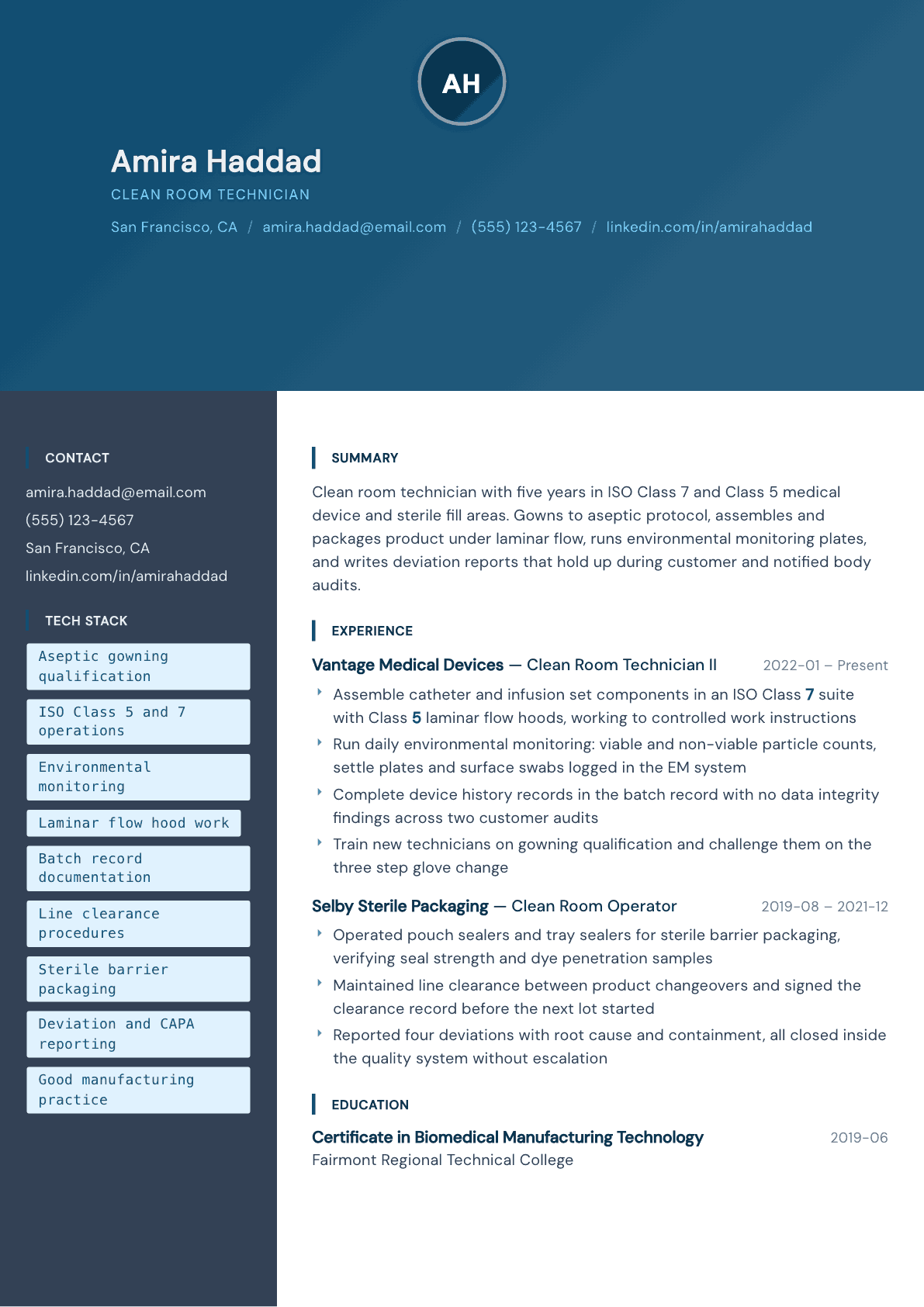
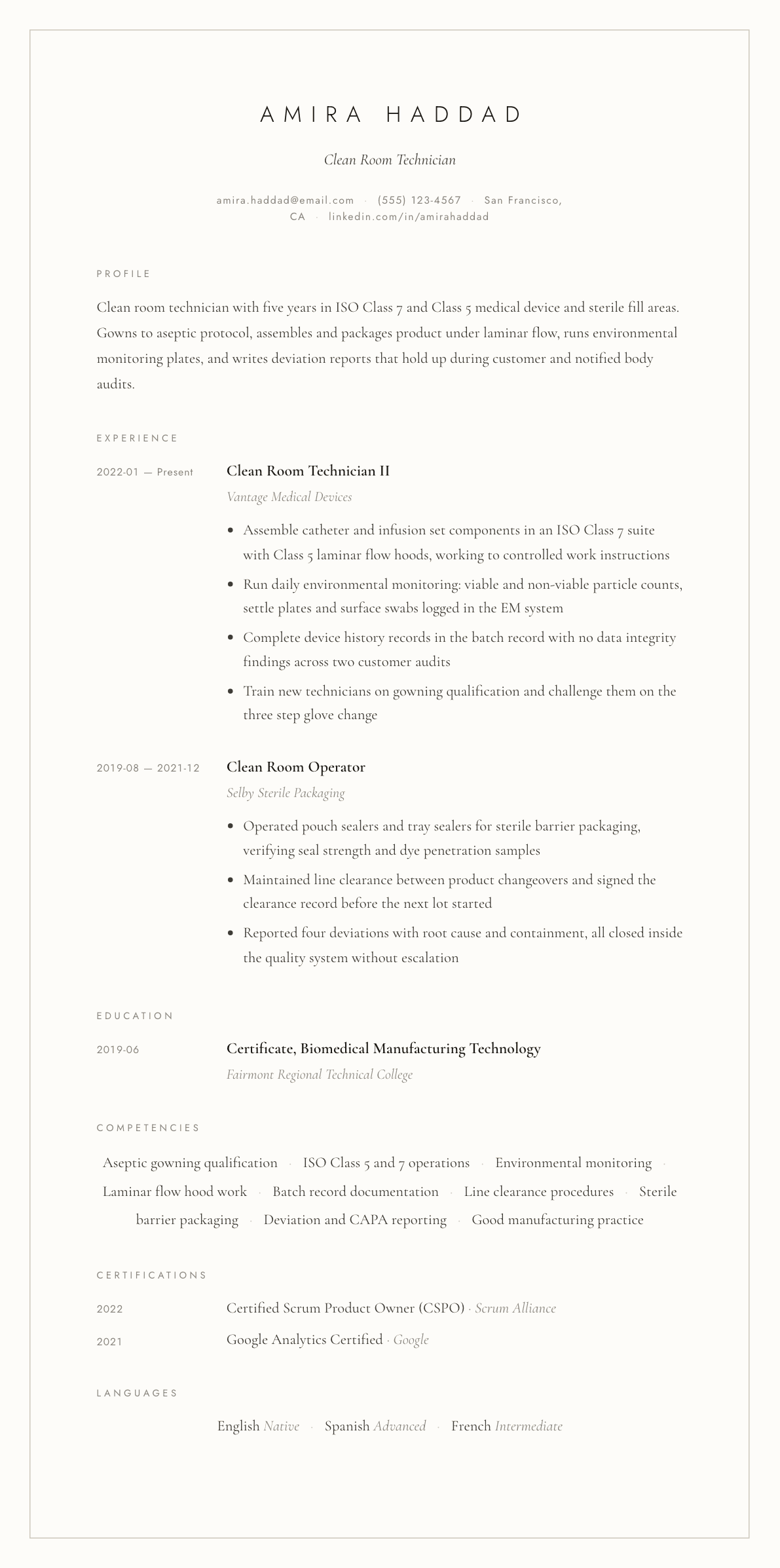
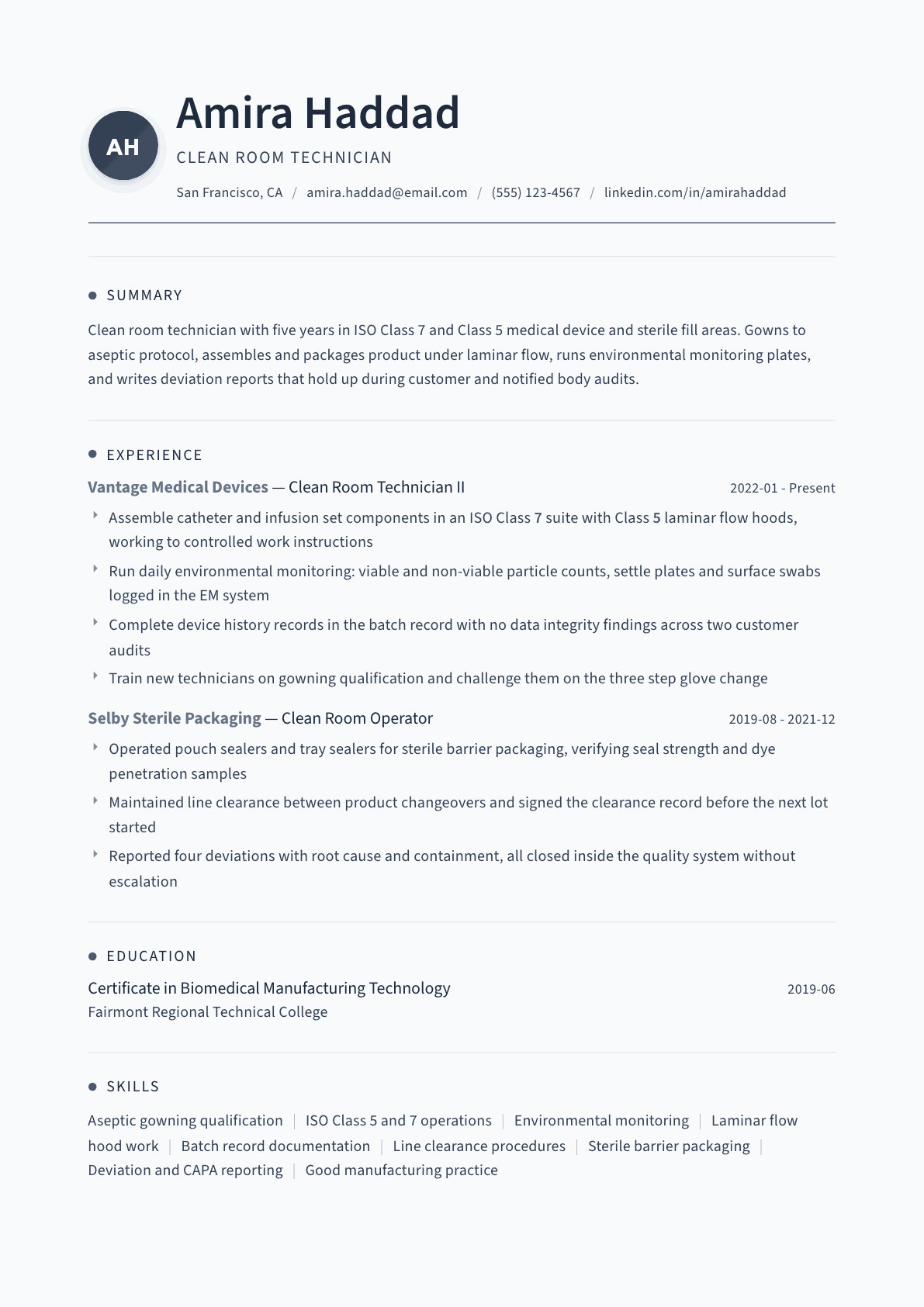
The same clean room technician content laid out in three CVBooster templates, so you can see what the finished document looks like before you write a word.
Example Clean Room Technician summary
Clean room technician with five years in ISO Class 7 suites and Class 5 laminar flow hoods across medical device assembly and sterile packaging. Gowns and requalifies to aseptic protocol, runs viable and non-viable environmental monitoring, and completes device history records that cleared two customer audits without a data integrity finding. Writes deviations with root cause and containment, and trains new technicians on gowning and glove change.
Skills to list on a Clean Room Technician resume
- ISO Class 5, 7 and 8 operations
- Aseptic technique
- Gowning and requalification
- Laminar flow and biosafety hoods
- Environmental monitoring sampling
- Viable and non-viable particle counts
- Batch and device history records
- Line clearance and changeover
- Sterile barrier packaging
- Seal integrity and dye penetration tests
- Deviation and nonconformance reporting
- CAPA support
- Good documentation practice
- Cleaning and disinfection cycles
- Component inspection under magnification
What actually gets this resume read
- State the ISO class of every room you have worked in, because that single number sets the whole job.
- Name the regulated setting: medical device, pharmaceutical sterile fill, or electronics, since the rules differ.
- Show your gowning qualification and how often you requalify, which is the first thing an auditor checks.
- Give the documentation you complete by name: batch records, device history records, line clearance forms.
- Include environmental monitoring work with the sample types you take and where the results are logged.
- Mention deviations you wrote and closed, because a technician who documents honestly is worth more than a silent one.
How to write a clean room technician resume
A clean room technician resume is read against an audit. Whoever hires you works in a plant where a customer, a notified body or a regulator can arrive and ask to see the records behind any lot ever released. So the hiring question is not only whether you can assemble the product. It is whether the paperwork you leave behind will survive being read by someone looking for a reason to write a finding.
That is why the classification matters so much. An ISO Class 8 electronics assembly room and an ISO Class 5 aseptic fill line are governed by different rules, different gowning, different monitoring and different consequences for a mistake. Say which rooms you have worked in, at what class, under which quality system, and the reader can immediately place you.
This guide covers the layout an employer in a regulated plant expects, how to write about gowning and aseptic technique, how to present documentation as a skill rather than an afterthought, and how to describe deviations honestly in a way that helps you rather than hurting you.
Format: classification, quality system and product first
One page, reverse chronological. What goes at the top is not a summary of your qualities but three facts: the ISO classes you have worked, the regulated setting, and the product. Medical device assembly, sterile pharmaceutical filling, compounding, semiconductor or optics assembly and food or cosmetic clean areas are all clean room work and all different jobs.
Under that, put the quality framework you have worked under in the plant's own language: good manufacturing practice, design controls, a quality management system for medical devices, or a customer specific standard. Name it plainly without claiming to be a quality professional. You are the person who executes inside it, and saying so accurately reads better than overreaching.
- Contact line: name, phone, email, city, plus shift availability, since clean rooms run around the clock.
- Classification line: each ISO class you have worked, with the type of area and the airflow arrangement.
- Product line: what you assembled, packaged, filled or inspected, and the volume per shift.
- Documentation block: batch records, device history records, line clearance forms, monitoring logs.
- Training block: gowning qualification date, aseptic technique, good documentation practice, safety.
Gowning and aseptic technique: the part an auditor checks first
Gowning is the visible test of whether a person belongs in a controlled area. Say what level you gown to, how often you requalify, and whether you have ever trained or observed others through their qualification. In aseptic areas add the specific behaviors: slow deliberate movement, keeping hands out of the first air, no reaching over open product, the sequence for a glove change without breaking the sterile field.
If you have worked under laminar flow hoods or in isolators or restricted access barrier systems, name the arrangement, because working through glove ports is a different physical skill from working in an open Class 5 hood. Employers running barrier systems specifically look for people who have already done it.
Documentation: what you fill in and what happens if you do not
Documentation is the half of the job that decides whether the product can be sold. List the records you complete by name: batch manufacturing records, device history records, equipment logbooks, line clearance forms, environmental monitoring sheets, calibration verification, cleaning records. Then say what standard you hold: contemporaneous entries, no back dating, single line corrections initialed and dated, no blanks left unexplained.
The strongest thing you can put here is an audit result. Records reviewed with no data integrity finding across a set number of customer or regulatory audits is a claim that a hiring manager values highly, because record errors are the most common reason lots are held.
Say whether you work on paper, on an electronic system, or both. A plant moving from paper to an electronic batch record wants people who have already lived through that, and someone who can operate in a validated electronic system without shortcuts is easier to hire than someone who has to learn why the shortcuts matter.
- Named records you complete and sign, not the word documentation.
- Good documentation practice specifics: contemporaneous entry, correction convention, no blanks.
- Audit outcomes with the number of audits and who conducted them.
- Electronic systems used, and whether they were validated environments.
- Line clearance and changeover verification, including who countersigns.
Environmental monitoring, cleaning and the work around the product
Many technician roles include monitoring even when the title does not mention it. If you take samples, list the types: viable air sampling, settle plates, surface swabs and contact plates, non viable particle counts, personnel monitoring on gloves and gowns. Say where results are logged and who reviews them, and mention any excursion you helped investigate.
Cleaning and disinfection is a similar case. Name the rotation of agents, the contact times you observe, the sporicidal cycle if you run one, and the records you sign. Employers know that a technician who understands why the disinfectant rotates is a technician who will not shorten a contact time when the schedule is tight.
Deviations, CAPA and the honesty that gets you hired
Writing deviations is not an admission of failure, it is the system working. Say how many you have raised, what a typical one covered, and that you documented containment and supported the investigation. A technician who never raised a deviation in five years either worked a perfect line or did not report, and hiring managers in regulated plants know which is more likely.
If you have supported corrective and preventive action work, describe the part you did: gathering the sequence of events, retraining on a revised work instruction, verifying that the change held over the next lots. Keep the language plain and within your actual role. Employers filter hard on candidates who claim quality authority they did not have.
Clean Room Technician resume summary examples
First controlled area role
Biomedical manufacturing graduate with a certificate covering aseptic technique, good manufacturing practice and documentation practice. Completed a placement assembling device components in an ISO Class 8 area, gowned to protocol daily, and recorded work in batch records under supervision without a documentation error.
Five years in the room
Clean room technician with five years in ISO Class 7 suites and Class 5 laminar flow hoods across medical device assembly and sterile packaging. Runs viable and non viable environmental monitoring, completes device history records that cleared two customer audits with no data integrity finding, and trains new technicians on gowning.
Senior technician
Senior clean room technician with eleven years in sterile fill and finish, qualified for aseptic intervention and media fill participation. Leads line clearance, mentors four technicians through gowning qualification, writes deviations with containment, and supports investigations through to verified corrective action.
Work experience bullets: before and after
Before: Assembled products in a clean room environment.
After: Assembled catheter and infusion set components in an ISO Class 7 suite using Class 5 laminar flow hoods, working to controlled work instructions with in process checks at each stage.
Naming the product, both classifications and the work instruction control tells an employer exactly what environment you can step into.
Before: Followed gowning procedures.
After: Gowned to full aseptic protocol every shift, requalified on schedule, and trained new technicians on the three step glove change without breaking the sterile field.
Requalification and a training role turn compliance into demonstrated competence an auditor could verify.
Before: Completed required paperwork.
After: Completed device history records and equipment logbooks contemporaneously with initialed single line corrections, closing two customer audits with no data integrity finding.
The documentation convention plus the audit result is the exact evidence a regulated plant is screening for.
Before: Did environmental monitoring.
After: Ran daily viable and non viable environmental monitoring including settle plates, surface swabs and particle counts, logging every result in the monitoring system and flagging two excursions for investigation.
Sample types, the logging path and the excursions raised show you understand monitoring as a control, not a chore.
Before: Reported problems on the line.
After: Raised four deviations with root cause description and immediate containment, all closed inside the quality system without escalation or product impact.
A count with containment and outcome demonstrates the reporting culture regulated employers most want to hire.
Hard skills
- ISO Class 5, 7 and 8 operations
- Aseptic technique and intervention
- Gowning and periodic requalification
- Laminar flow hood and barrier system work
- Environmental monitoring sampling
- Viable and non viable particle counting
- Batch and device history record completion
- Good documentation practice
- Line clearance and changeover verification
- Sterile barrier packaging and seal verification
- Cleaning and disinfectant rotation
- Deviation and nonconformance reporting
- Corrective and preventive action support
- Component inspection under magnification
Soft skills
- Moving slowly and deliberately when the schedule is pushing
- Writing down what actually happened rather than what should have
- Staying comfortable working gowned for a full shift
- Speaking up about a breach even when it was your own
- Explaining a record entry calmly during an audit
Certifications worth listing
- Certified Pharmaceutical GMP Professional (American Society for Quality)
- Certified Quality Inspector (American Society for Quality)
- Certified Production Technician (Manufacturing Skill Standards Council)
- OSHA 10-Hour General Industry (OSHA Training Institute)
Mistakes that cost clean room technician candidates the interview
- Saying clean room without the ISO class, which leaves an employer unable to judge the environment you actually worked in.
- Treating documentation as an afterthought when in a regulated plant it is half the job and all of the risk.
- Hiding deviations, which reads as either a perfect record nobody believes or a reporting culture nobody wants.
- Claiming quality authority you did not have, such as approving investigations, when your role was to support them.
- Leaving out gowning requalification dates and training, which is the first thing checked in a controlled area.
- Using generic assembly language that could describe an open factory floor, losing everything specific to controlled environments.
Clean Room Technician resume questions
How much does the ISO class of my previous room matter?
A great deal, because it sets gowning, behavior, monitoring frequency and the consequences of an error. Moving from a higher number to a lower one is a real step up in discipline, so an employer wants to see the class stated rather than inferred from the product you handled.
Can I move from electronics clean room work into medical device manufacturing?
Yes, and contamination control transfers directly. What you will need to show is comfort with documentation and traceability, since regulated device work records far more than most electronics assembly. Name any controlled records you have completed to bridge that gap.
Should I mention deviations I was involved in?
Yes, as long as you describe your part factually: what you observed, how you contained it, what you wrote. Hiring managers in regulated plants read that as maturity. What they avoid is a candidate who cannot describe a single thing that ever went wrong.
Is a quality certification worth having as a technician?
It helps you stand out and it signals you understand the system you work inside, which often opens a path toward inspection or quality roles later. It does not replace hands on time in a controlled area, so keep your room experience at the top of the page.
What if I cannot name the product because of confidentiality?
Describe the product category and the process instead: single use device components, sterile fill vials, implantable subassemblies. Employers understand confidentiality, and a clear description of the operations and classification carries almost all of the useful information anyway.
Related resume examples
- Semiconductor Technician Resume example
- Quality Control Inspector Resume example
- Manufacturing Technician Resume example
- Assembler Resume example
- Manufacturing Associate Resume example
- Quality Assurance Technician Resume example