Semiconductor Technician Resume Examples: free ATS score
Write a Semiconductor Technician Resume Fabs Take Seriously
By Mustafa Tarabya, founder of CVBooster · Published · Updated
Semiconductor technician resume example with process tool, etch, litho and metrology keywords, plus a guide to uptime and yield evidence.
Sample resumes for a semiconductor technician
The same semiconductor technician content laid out in three CVBooster templates, so you can see what the finished document looks like before you write a word.
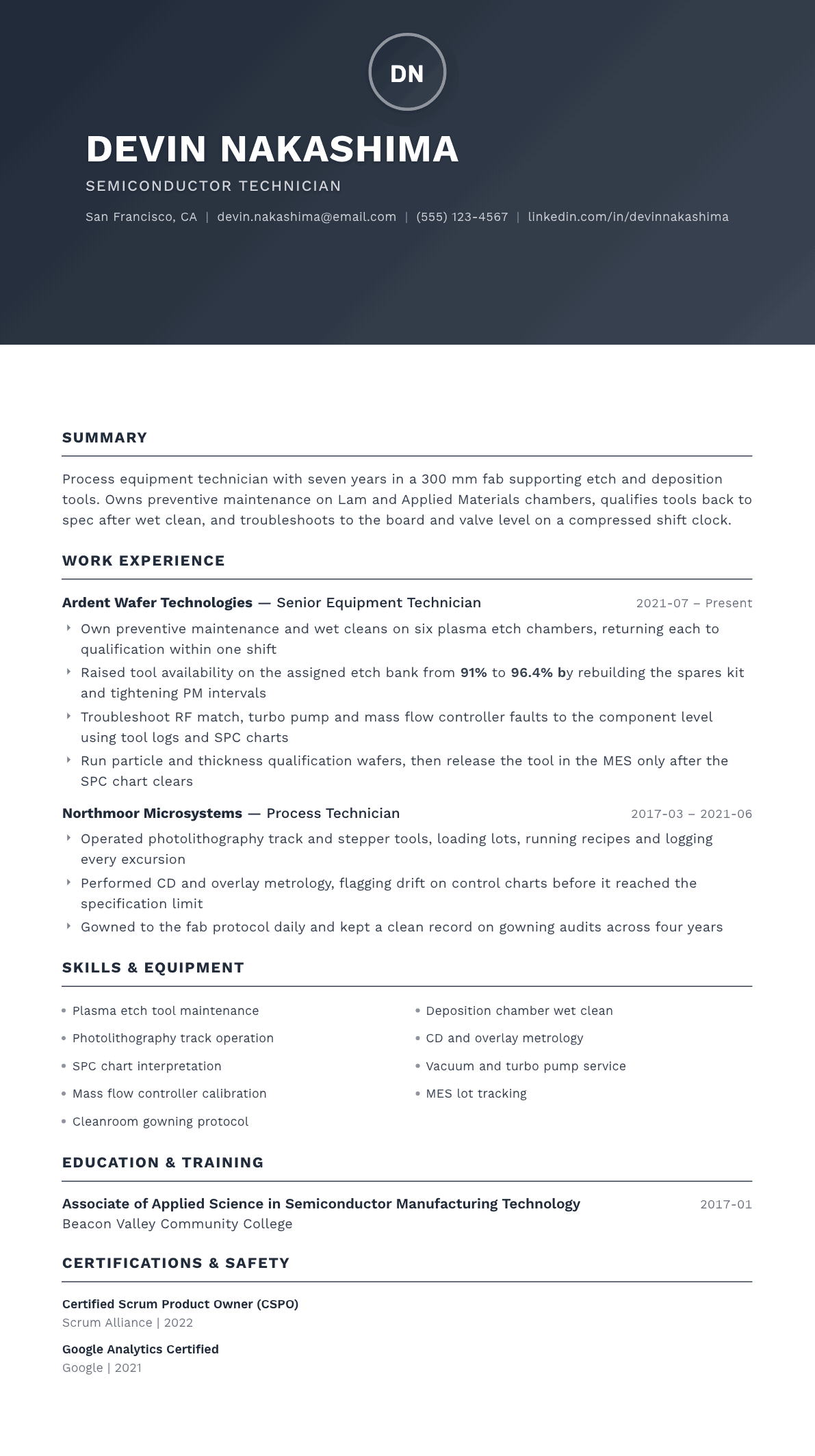
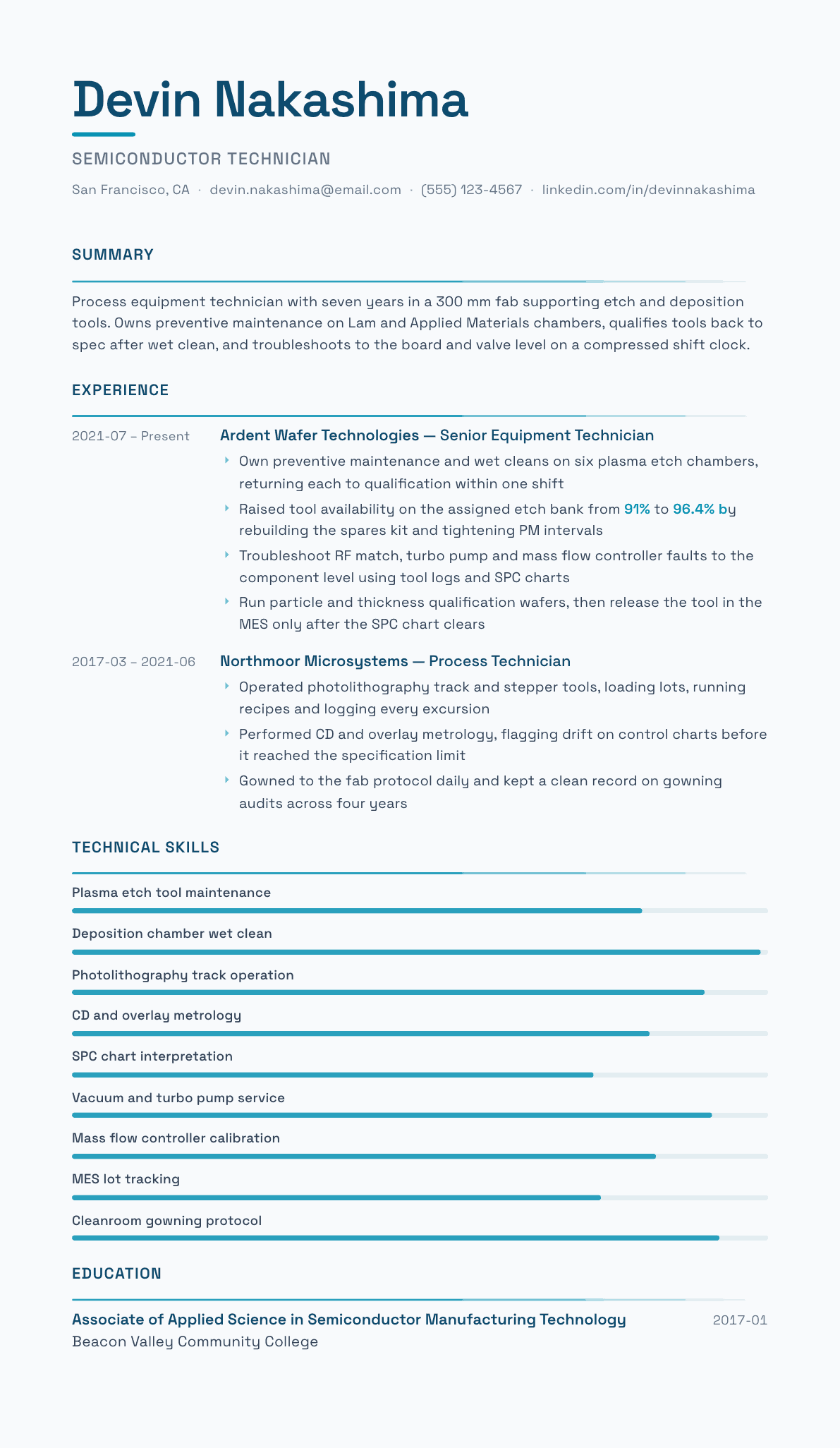
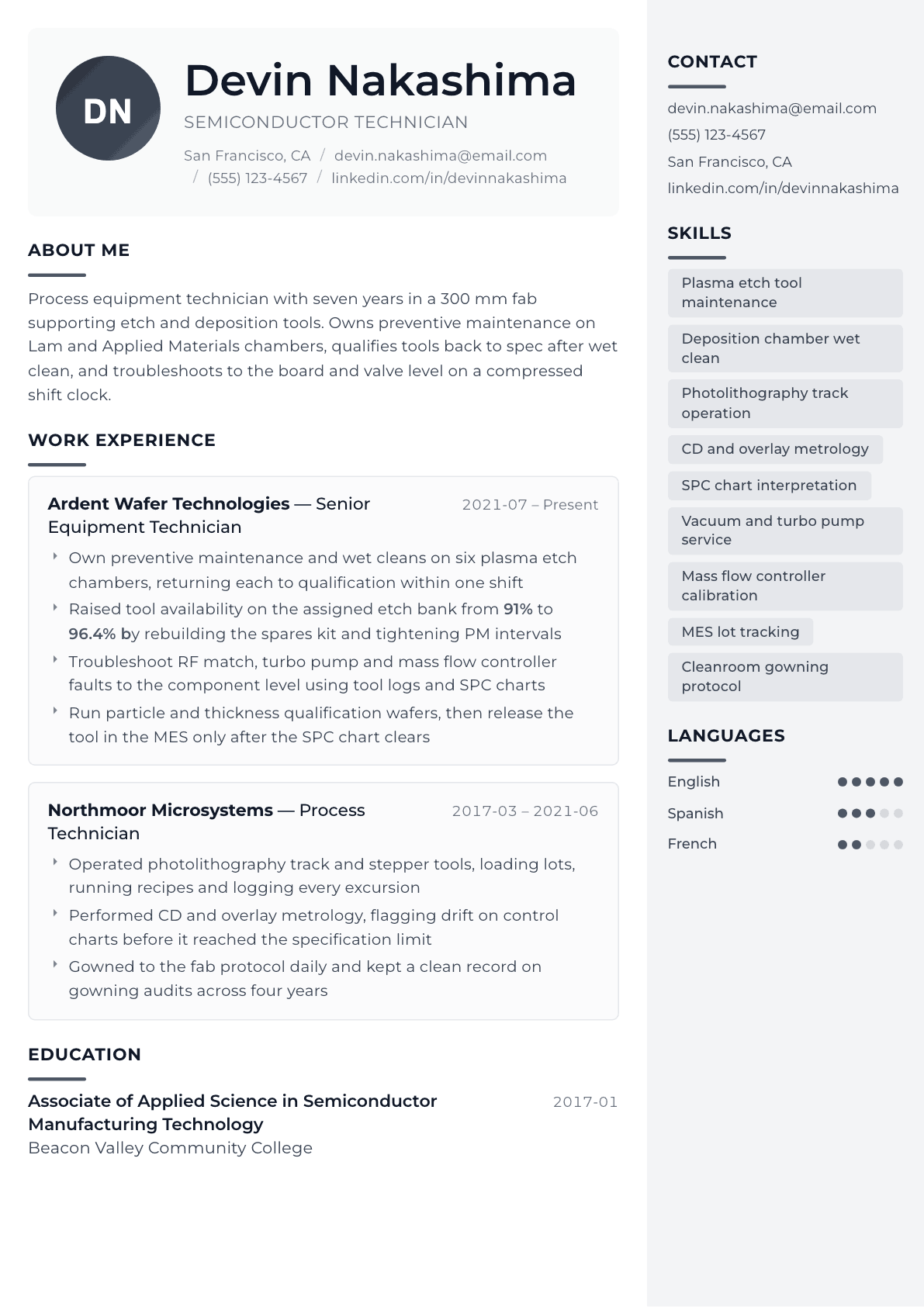
Example Semiconductor Technician summary
Semiconductor technician with seven years in a 300 mm fab covering plasma etch and deposition equipment plus lithography track operation. Owns preventive maintenance and wet cleans on six etch chambers and returns each to qualification within a shift, using particle and thickness wafers and SPC release in the MES. Troubleshoots RF match, turbo pump and mass flow controller faults to the component level, and lifted tool availability on the assigned bank.
Skills to list on a Semiconductor Technician resume
- Plasma etch equipment
- Chemical vapor deposition tools
- Physical vapor deposition tools
- Photolithography track and stepper
- Chemical mechanical planarization
- Wet bench and clean processes
- Preventive maintenance and wet clean
- Vacuum systems and turbo pumps
- RF generator and match tuning
- Mass flow controller calibration
- CD, film thickness and overlay metrology
- Statistical process control
- MES and lot dispositioning
- Cleanroom gowning and protocol
- Hazardous gas handling
- Root cause troubleshooting
What actually gets this resume read
- Name the tool platforms you have touched, because a fab hires for a specific chamber and a specific vendor.
- Split process operation from equipment maintenance, since fabs post those as two different jobs.
- Give tool availability or mean time between failures with the bank of tools it covers.
- Show your qualification routine after a wet clean: the particle counts, the thickness checks and who releases the tool.
- State your cleanroom class and gowning experience, plus the wafer size the fab ran.
- List the chemicals and gases you have handled and the safety training that goes with them.
How to write a semiconductor technician resume
Fabs hire technicians against tools, not against titles. The manager reading your resume owns a bank of etch chambers, or a litho module, or the wet benches, and he is trying to work out how many weeks of training you would need before you can be trusted to open a chamber and put it back in production. Everything on your page should shorten that estimate.
The word that ruins semiconductor technician resumes is "equipment". Nobody maintains equipment; they maintain a specific platform from a specific vendor, with its own consumable set, its own qualification recipe and its own failure modes. Say which. Then say what you do to it: preventive maintenance, wet clean, part replacement, alignment, requalification, or the whole cycle from taking the tool down to releasing it back to production.
This guide covers how to organize the page around tools and modules, how to separate process operation from equipment maintenance, what numbers a fab actually tracks, and how to present cleanroom discipline and safety training so a hiring manager can move you through onboarding quickly.
Format: a tool list is the first thing on the page
One page for most technicians, two once you have supported several module areas across multiple fabs. Under the contact line, put a tool block. Vendor and platform on the left, what you do to it on the right. That single block answers the manager's first question without him having to read a job history.
Then arrange the page by module area rather than by job title, because a fab is organized that way: etch, deposition, lithography, planarization, diffusion and furnaces, implant, wet processing, metrology. A technician who has worked etch and deposition should make both visible even if they happened at one employer under one title.
- Contact line: name, phone, email, city, plus the shift pattern you can work, since fabs run continuously.
- Tool block: vendor and platform with the maintenance level you perform on each.
- Module areas you have supported, each with the wafer size and the fab node if you can state it.
- Metrics block: tool availability, mean time between failures, mean time to repair, qualification turnaround.
- Training block: cleanroom gowning, hazardous gas, chemical handling, lockout tagout, electrical safety.
Process operation and equipment maintenance are two jobs
Fabs post process technician and equipment technician separately, and they pay them differently. A process technician runs lots, loads recipes, watches control charts and dispositions material. An equipment technician takes the tool apart. Many people do both at some point in a career, but your resume must say which one you are applying as and which experience is secondary.
If your background is process, lead with lots run, recipe management, excursion response, SPC chart reading and material disposition through the MES. If it is equipment, lead with preventive maintenance ownership, the parts you replace, the diagnostics you run and the qualification you take the tool through. Mixing them into one undifferentiated paragraph is the most common reason a strong candidate gets screened out.
Maintenance work: say what level you actually perform
Be concrete about depth. Changing a consumable kit is different from a full chamber wet clean, which is different from rebuilding a turbo pump or replacing an RF generator and retuning the match. Vendor support handles some of this in some fabs and none of it in others, so specify what you did with your own hands and what you escorted a vendor engineer through.
Then describe the return path, because that is the part that separates a parts changer from a technician. After the clean, you pump down, leak check, season the chamber, run particle wafers, run thickness or uniformity wafers, review the results against the control limits, and release the tool in the manufacturing system. Writing that sequence out shows you understand that the job ends with a qualified tool, not with a closed lid.
Diagnostics deserve their own bullet. Reading tool logs and alarm histories, tracing a pressure control fault to a throttle valve, catching a drifting mass flow controller against a leak up rate, isolating an RF reflected power problem between the generator, the match and the chamber. Those examples cannot be invented and a manager knows it.
- The maintenance level you perform, from consumable changes to full chamber rebuilds.
- Named subsystems you service: vacuum, RF, gas delivery, thermal, robotics and wafer handling.
- Your qualification routine after a PM, including which wafers you run and who signs the release.
- Diagnostic examples with the fault, the method and the resolution.
- Spare parts and kit management, since PM speed usually depends on the crib being right.
Numbers a fab tracks and how to quote them
Fabs measure tools on availability, mean time between failures, mean time to repair and PM cycle time. Quote yours with the scope: the number of chambers or tools you covered and the period the figure describes. An availability figure on a named bank of tools carries weight because a manager can picture it.
Yield and defect language belongs on the page too if you have touched it. Particle excursions found and closed, a chamber matched back to its peers, a recipe drift caught on an SPC chart before it reached the specification limit. Keep the language plain, because process claims made loosely tend to invite questions a technician cannot answer.
Cleanroom discipline, safety training and how fabs search
Cleanroom protocol is not a soft skill in a fab, it is a hiring requirement. State the cleanroom class you have worked, the gowning standard, and your record on gowning audits. Add the wafer size, because a technician who has only worked smaller wafers will be learning new handling and automation on day one.
Safety training is the block that speeds up onboarding. Hazardous gas response, chemical handling and spill response, lockout tagout, electrical safety for the voltage levels involved, ergonomic and lifting training for chamber parts. List each with the issue date. Fabs also search on the vocabulary of the work: PM, wet clean, tool qual, SPC, MES, excursion, chamber match, uptime, first time right. Use those words where they belong rather than in a keyword block.
Semiconductor Technician resume summary examples
First fab role
Semiconductor manufacturing graduate with an associate degree and a fab internship on lithography track tools. Loads lots, runs recipes, logs excursions and performs basic preventive maintenance under supervision. Gowned to Class 10 protocol daily with a clean audit record, and trained in chemical handling and lockout tagout.
Seven years on the tools
Equipment technician with seven years in a 300 mm fab supporting plasma etch and deposition. Owns preventive maintenance and wet cleans on six chambers, returns each to qualification within a shift using particle and thickness wafers, and troubleshoots RF match, turbo pump and mass flow controller faults to component level.
Senior technician and shift lead
Senior semiconductor technician with thirteen years across etch, deposition and planarization, leading a shift crew of five. Writes and revises PM procedures, runs chamber matching after major rebuilds, manages the spares kit, and escorts vendor engineers through installations and upgrades.
Work experience bullets: before and after
Before: Performed maintenance on semiconductor equipment.
After: Owned preventive maintenance and wet cleans on six plasma etch chambers, replacing consumable kits, leak checking, seasoning and returning each chamber to qualification within one shift.
The tool count, the tasks and the return to qualification show the full maintenance cycle rather than a job description.
Before: Improved equipment uptime.
After: Raised availability on the assigned etch bank from 91% to 96.4% over two quarters by rebuilding the spares kit and shortening PM intervals on the parts that were failing early.
A named tool bank, a measured change and the two actions behind it make the improvement checkable.
Before: Troubleshot equipment problems.
After: Traced an intermittent pressure control fault to a sticking throttle valve by comparing alarm history against leak up rate data, then replaced the valve and verified control across the recipe range.
A specific fault with the diagnostic reasoning proves troubleshooting ability in a way a general claim never can.
Before: Ran wafers through process tools.
After: Operated photolithography track and stepper tools, loading lots, running recipes and taking CD and overlay measurements, flagging drift on the control chart before it reached the specification limit.
Naming the metrology and the early catch shows process judgment rather than button pressing.
Before: Followed cleanroom procedures.
After: Gowned to Class 10 protocol every shift, passed four years of gowning audits without a finding, and coached new technicians through the glove and hood sequence during their qualification.
An audit record and a coaching role turn protocol compliance into evidence a manager can rely on.
Hard skills
- Plasma etch equipment maintenance
- Chemical and physical vapor deposition tools
- Photolithography track and stepper operation
- Chemical mechanical planarization
- Wet bench and clean processes
- Preventive maintenance and chamber wet clean
- Vacuum systems, turbo and dry pumps
- RF generator and match network tuning
- Gas delivery and mass flow controller calibration
- Robotics and wafer handling alignment
- CD, film thickness and overlay metrology
- Statistical process control interpretation
- MES lot tracking and tool dispositioning
- Hazardous gas and chemical handling
- Cleanroom gowning and contamination control
Soft skills
- Working methodically inside a compressed tool down window
- Handing a partly disassembled tool to the next shift with usable notes
- Escalating a fault instead of guessing at an expensive part
- Staying precise during a night shift excursion
- Explaining a tool problem clearly to a process engineer
Certifications worth listing
- Certified Electronics Technician (CET) Associate (ETA International)
- IPC-A-610 Certified IPC Specialist (IPC)
- Certified Production Technician (Manufacturing Skill Standards Council)
- OSHA 10-Hour General Industry (OSHA Training Institute)
Mistakes that cost semiconductor technician candidates the interview
- Writing about semiconductor equipment generically instead of naming vendors and platforms a fab can match to its own floor.
- Blurring process operation and equipment maintenance, when fabs post and pay for them as separate jobs.
- Describing a PM without the qualification that follows it, which leaves out the half that decides whether the tool runs.
- Quoting an availability figure with no tool count or time period attached to it.
- Omitting cleanroom class, wafer size and gowning record, which are the basics of fab readiness.
- Leaving safety training undated, which slows onboarding at a site where every certificate has to be current before badging.
Semiconductor Technician resume questions
How do I move from a process technician role into an equipment role?
Emphasize every hands on task you already do: consumable changes, minor alignments, first line troubleshooting and anything you have escorted a vendor through. Then say plainly that you are targeting equipment work. Fabs promote across that line often when the interest is stated clearly.
Should I name the process node I worked at?
Name it if you are permitted to, because it tells a manager about tolerance and contamination expectations. If your employer treats it as confidential, describe the wafer size and the cleanroom class instead, which conveys most of the same information without a disclosure problem.
Do certifications matter in semiconductor technician hiring?
Less than tool experience, but they help with the first screen, particularly for candidates coming from military electronics or another industry. An electronics technician credential shows a fab that you can troubleshoot to component level before it has seen you work.
How do I write about experience gained in the military?
Translate every system into civilian terms: vacuum, RF, cryogenics, robotics, hydraulics, calibration and documentation discipline. Fabs recruit heavily from military maintenance backgrounds, and the deciding factor is usually whether the resume speaks fab language or only service language.
What if I have never worked in a cleanroom at all?
Say so, and lead with maintenance depth on comparable systems plus any controlled environment experience you do have. Gowning and contamination discipline are trainable in weeks, while component level troubleshooting on vacuum and RF systems takes years, so put the harder skill first.
Related resume examples
- Semiconductor Engineer Resume example
- Clean Room Technician Resume example
- Electronics Technician Resume example
- Manufacturing Technician Resume example
- Production Technician Resume example
- Quality Control Technician Resume example