SEO Specialist Resume Examples: the lines they read
SEO Resume Examples for Technical and Content SEO Specialists
By Mustafa Tarabya, founder of CVBooster · Published · Updated
Build a data-driven SEO specialist resume with ATS-optimized keywords, traffic growth metrics, and technical SEO skills that hiring managers search for.
Sample resumes for a seo specialist
The same seo specialist content laid out in three CVBooster templates, so you can see what the finished document looks like before you write a word.
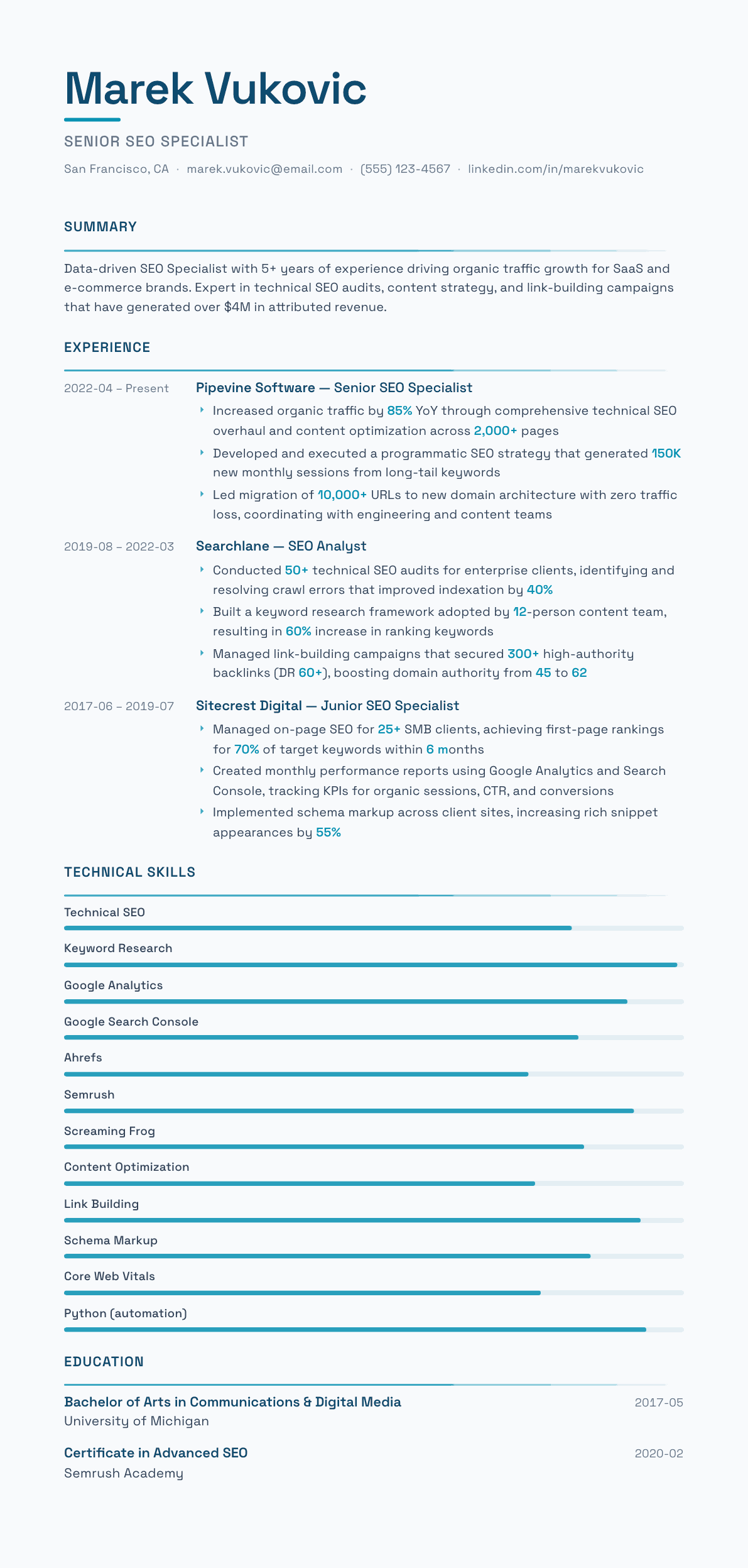
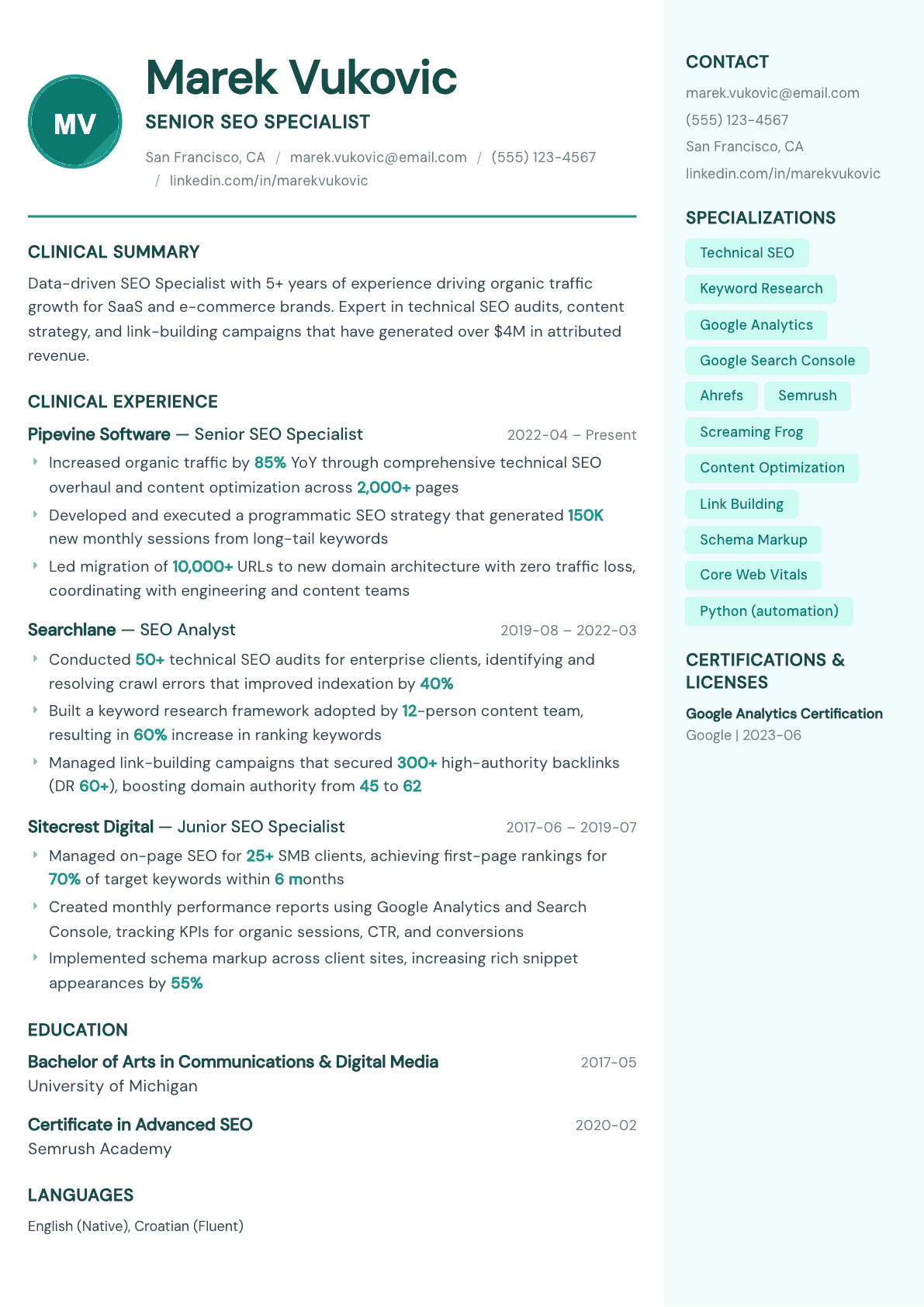
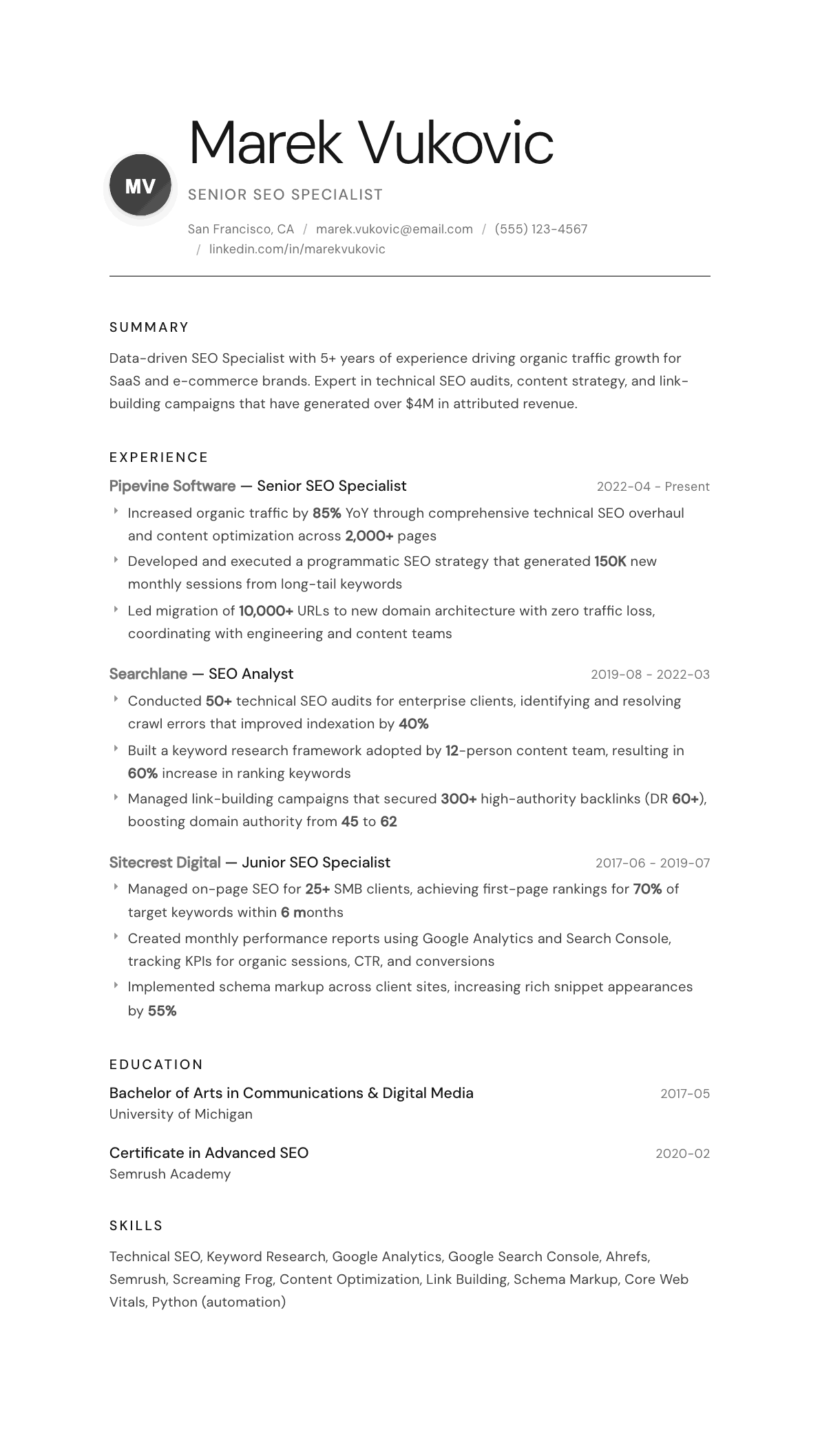
Example SEO Specialist summary
SEO Specialist with 5 years scaling organic traffic for B2B SaaS. Runs technical audits, programmatic SEO and content optimization that delivered 85% YoY traffic growth and $4M in attributed pipeline, plus a 10,000-URL migration with no ranking loss. Targeting a senior role owning organic growth strategy.
Skills to list on a SEO Specialist resume
- Technical SEO
- On-Page SEO
- Off-Page SEO
- Keyword Research
- Content Strategy
- Link Building
- Google Analytics
- Google Search Console
- Ahrefs
- Semrush
- Screaming Frog
- Schema Markup
- Core Web Vitals
- A/B Testing
- Python for SEO
What actually gets this resume read
- Quantify traffic growth, ranking improvements, and revenue impact from organic search in every role.
- List specific SEO tools you are proficient in: Ahrefs, Semrush, Screaming Frog, Surfer SEO, Moz.
- Showcase both technical SEO (site speed, crawlability, schema) and content SEO (keyword research, on-page optimization) skills.
- Include Google Analytics and Search Console certifications to validate your data analysis capabilities.
- Highlight cross-functional collaboration with content, engineering, and product teams.
- Mention specific algorithm updates you have navigated and how you adapted strategies.
How to write a seo specialist resume
An SEO specialist resume is read by someone who has been burned. Almost every hiring manager in this field has hired a candidate whose traffic chart turned out to be a seasonal curve, a brand term, or a site migration somebody else executed. So they read your bullets looking for the mechanism: what did you change, on which pages, and how do you know the change is what moved the number.
The role also splits into two crafts that share a title. Technical SEO is crawl budget, rendering, log files, canonical logic, status codes, structured data and site migrations. Content SEO is search intent, topic architecture, internal linking, page quality and editorial process. Most postings want one of them badly and the other passably, and your resume should say which one you are.
This guide covers an SEO resume example written out line by line, how to structure the resume for both readers, how to report organic growth in a way that survives scrutiny, three summaries by career stage, before and after bullets, and the questions specialists ask when their best work was invisible.
Format: one page, tools visible, site type stated per job
Reverse chronological, one page under eight years. Under each employer, state the site type and scale in a single line: a business software site of a few hundred pages, an ecommerce catalog with tens of thousands of product URLs, a publisher pushing daily articles, or a marketplace with user generated pages. Nearly every SEO decision depends on which of those you were working on.
Keep a compact tools line high on the page. Recruiters for this role search literally for Ahrefs, Semrush, Screaming Frog, Search Console and the analytics platform, and burying them under the fold is a needless filter failure.
- Order: summary, tools and skills, experience, selected projects, education and certifications.
- Per job: site type, page scale, the content management system, and whether the site renders client side.
- Say who executed your recommendations: you, an engineering team, or an editorial team.
Summary: which SEO you are, on what kind of site
Three lines. Lead with technical or content, name the site types you know, and give one result with a mechanism attached. A specialist who has taken a large ecommerce catalog through faceted navigation cleanup and a specialist who has built topic clusters for a publisher both call themselves SEO specialists and solve opposite problems.
If you have led a migration without losing traffic, put it in the summary. Migrations are the highest risk work in this field and the shortest path to being taken seriously.
Experience: the change, the scope, the measurement
Write each bullet as a change and its consequence. Fixed the pagination and canonical logic on category pages so indexable URLs fell from a large number to a controlled set, then measured the recovery in impressions on those templates in Search Console. That is a bullet a technical lead can interrogate and believe.
Name the diagnostics you use. Log file analysis for crawl behavior, Screaming Frog or Sitebulb crawls with custom extraction, the Search Console coverage and query reports, rendering checks for client side frameworks, Core Web Vitals field data as opposed to lab scores, and structured data validation. Diagnostics are the difference between an SEO who has opinions and one who has evidence.
For content SEO, describe the architecture and the process, not the word count. How you clustered topics against intent, how you decided what to consolidate and what to prune, the internal linking model you imposed, the brief format you gave writers, and the refresh cadence you set for pages that decay.
Attribute honestly. If engineering shipped your fix a quarter late and traffic moved for other reasons, say what you can prove and no more. Attribute results at template level rather than site level where possible, because a template level result is much harder to explain away and much more convincing.
Reporting growth without hand waving
Prefer non brand organic clicks and impressions over total sessions, and say the window. Year over year on a comparable period neutralizes seasonality, which is the first objection an experienced reader raises. Where you can, separate the pages you touched from the rest of the site and report on those.
Rankings alone are a weak claim now that results vary by user and device, so pair any ranking movement with the traffic or revenue that followed. If your work fed an ecommerce or lead generation funnel, give the conversion outcome as well, since organic traffic that converts at nothing persuades nobody in a budget meeting.
Projects: the section most SEO resumes are missing
Add two or three short project entries: a migration, a technical audit that turned into a roadmap, a content consolidation, an international rollout with hreflang, or a programmatic template built at scale. Give the problem, your intervention and the outcome in three lines each.
This section is where career changers and consultants win. A well documented project on your own site, with the before state, the diagnosis and the measured result, is more persuasive than a year of vague agency bullets.
SEO resume example, with the keywords the screen expects in place
Postings for this role reuse a narrow set: technical SEO, on page optimization, keyword research, search intent, internal linking, crawl budget, indexation, canonical tags, schema markup, Core Web Vitals, site migration, link building, and the tool names. Use the posting's exact phrasing once in the skills block and once in a bullet where you did the work. Anything you list here is fair game for a whiteboard question, so list only what you can explain end to end.
Here is how that reads on an SEO resume written out for an invented technical specialist, Priya Castellanos, so you can see the posting vocabulary sitting on real work.
- Header: Priya Castellanos, Technical SEO Specialist, Denver, CO, phone, email, portfolio link.
- Summary: Technical SEO specialist on ecommerce catalogs of tens of thousands of URLs. Owns crawl budget, indexation and site migrations, and writes the tickets engineering ships.
- Tools and skills: Search Console, Screaming Frog, Ahrefs, GA4, BigQuery, log file analysis, schema markup, Core Web Vitals, hreflang.
- Experience bullet: Rewrote canonical and pagination rules on category templates, cutting crawled parameter URLs to a controlled set and recovering impressions on those templates within two months.
- Project: Led the replatforming migration of a forty thousand URL store, mapping every redirect in advance and holding non brand clicks steady through launch.
SEO Specialist resume summary examples
First SEO role
SEO specialist with one year at an agency covering six small business clients. Run monthly Screaming Frog crawls, fix title, heading and internal linking issues, build keyword research and briefs for writers, and report from Search Console. Google Analytics certified and learning log file analysis.
Five years in
Technical SEO specialist with five years on ecommerce catalogs of tens of thousands of URLs. Cleaned up faceted navigation and pagination, took two sites through replatforming migrations with no lasting drop in non brand clicks, and lifted category template impressions 40% year over year.
Lead or head of SEO
Head of organic search with nine years across publisher and business software sites. Own the technical roadmap with engineering, the topic architecture with editorial, and an international rollout across seven markets. Grew non brand organic clicks 90% in two years while consolidating a third of the page count.
Work experience bullets: before and after
Before: Improved website SEO and increased organic traffic.
After: Rewrote title and meta patterns across 4,000 product templates and fixed duplicate canonical tags, lifting non brand organic clicks to those pages 38% year over year on a comparable period.
Naming the template, the change and a seasonality adjusted window makes the traffic claim checkable.
Before: Performed technical SEO audits.
After: Audited a catalog of 60 thousand URLs with Screaming Frog and server log analysis, found that faceted parameters absorbed most of the crawl, and cut crawlable parameter URLs by 80% with robots rules and canonical consolidation.
The log evidence and the specific crawl waste show diagnosis rather than a checklist audit.
Before: Did keyword research and content planning.
After: Built a topic architecture of 40 clusters mapped to search intent, wrote the brief template the editorial team still uses, and set a refresh cadence that recovered 25% of decaying pages within two quarters.
Architecture, a reusable brief and a refresh process describe a system instead of a spreadsheet.
Before: Helped with a website migration.
After: Led SEO for a replatforming migration: mapped 12 thousand redirects, held the URL structure where it had equity, ran parallel crawls of staging and production, and returned to prior non brand click levels within five weeks.
The redirect map, the staging crawl and a recovery window turn helped into owned and measurable.
Before: Built backlinks for clients.
After: Earned links from 30 relevant publications by turning proprietary product data into two original research pieces and pitching them to writers already covering the topic.
The method matters more than the count, and original data pitching is a defensible tactic rather than a vague campaign.
Hard skills
- Technical SEO audits
- Crawl budget and indexation management
- Server log file analysis
- Screaming Frog
- Ahrefs
- Semrush
- Google Search Console
- Google Analytics 4
- Schema and structured data
- Core Web Vitals
- Site migrations and redirect mapping
- International SEO and hreflang
- Keyword and intent research
- Internal linking architecture
- SQL or Python for SEO data
Soft skills
- Persuading engineers to prioritize fixes
- Writing briefs writers will follow
- Explaining risk to executives
- Patience with slow feedback loops
- Documenting decisions for handover
Certifications worth listing
- Google Analytics Certification (Google Skillshop)
- Semrush SEO Toolkit Exam (Semrush Academy)
- HubSpot SEO Certification (HubSpot Academy)
Mistakes that cost seo specialist candidates the interview
- Claiming a site wide traffic rise with no page or template attribution, which reads as taking credit for seasonality.
- Listing every tool in the industry when the interview will test the two you actually use daily.
- Reporting rankings with no traffic or revenue attached, which no longer persuades a hiring manager.
- Omitting the site type and scale, so a reader cannot tell whether your experience transfers to their catalog.
- Describing audits as deliverables with no mention of what was implemented or by whom.
- Saying nothing about working with engineering, which is where most SEO recommendations quietly die.
SEO Specialist resume questions
Should I specialize in technical or content SEO?
Pick the one you are stronger in and say so in the summary, then show competence in the other. Postings almost always weight one heavily, and a resume that claims equal mastery of both usually reads as shallow in each to an experienced reader.
How do I prove SEO results when I cannot share client data?
Report relative change rather than absolute numbers, restrict the claim to the templates or sections you touched, and describe the intervention in enough detail that the mechanism is credible. A precise method with a percentage beats an impressive figure with no explanation.
Do I need Python or SQL for an SEO specialist role?
Not for entry level, but they become a real differentiator on large sites where you need to join crawl data, log files and Search Console exports. Even basic scripting for data cleanup is worth listing, described by what you actually used it for.
How do I show SEO experience with no professional job yet?
Build and document one site of your own. Show the crawl issues you found, the architecture you chose, the changes you made and the Search Console data over time. A single honest case study with real screenshots and a stated method opens doors that a course certificate does not.
What does a hiring manager check first on an SEO resume?
Whether your site type matches theirs, and whether any traffic claim comes with a mechanism. If your bullets name the change, the template and the measurement window, you clear the credibility bar most applicants fail before the interview even starts.