CMO Resume Examples: what a hiring manager reads first
Craft a Chief Marketing Officer Resume That Commands the C-Suite
By Mustafa Tarabya, founder of CVBooster · Published · Updated
Build an executive-level CMO resume with revenue growth, brand transformation, and organizational leadership that board members and executive recruiters expect.
Sample resumes for a cmo
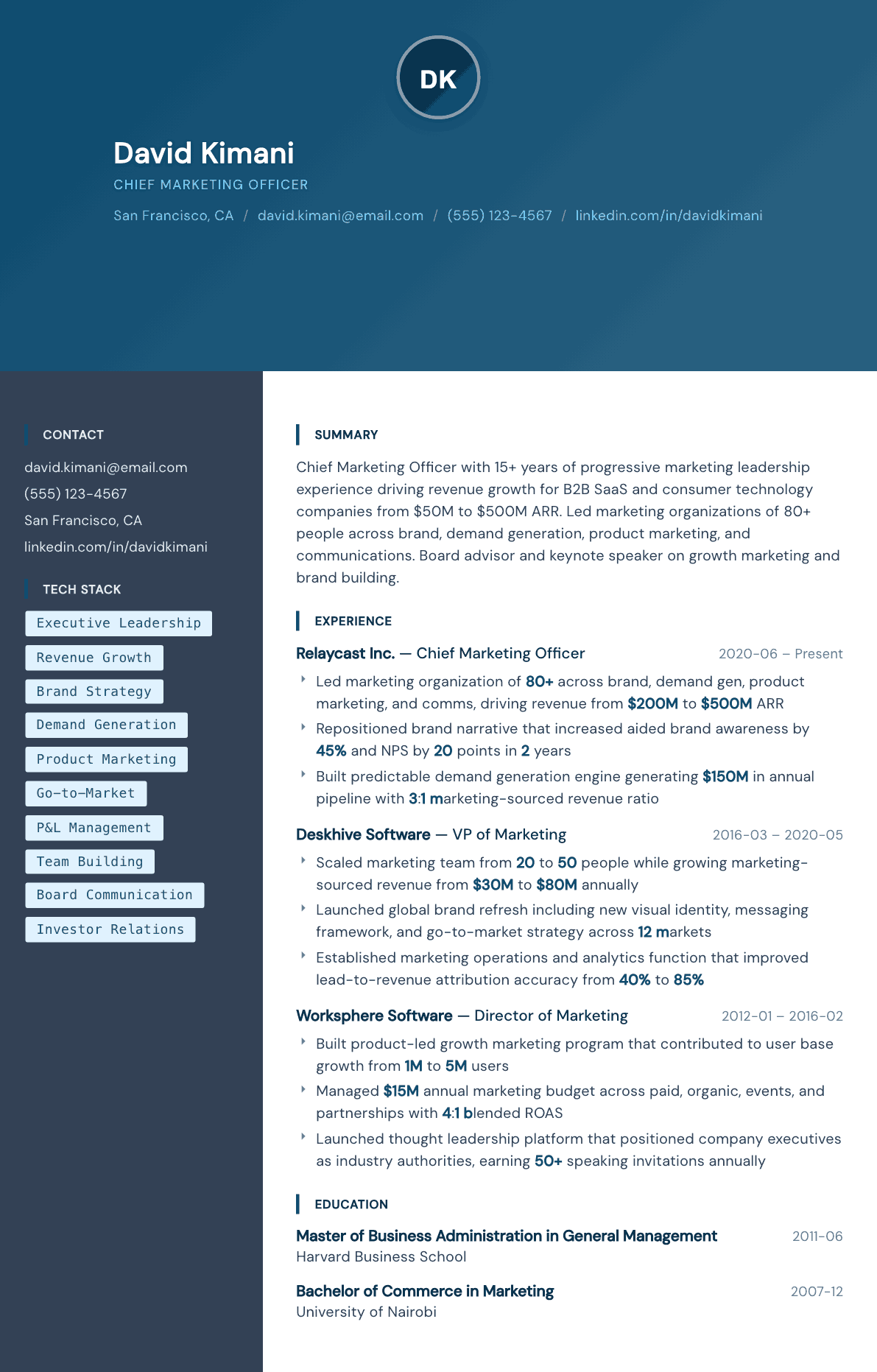
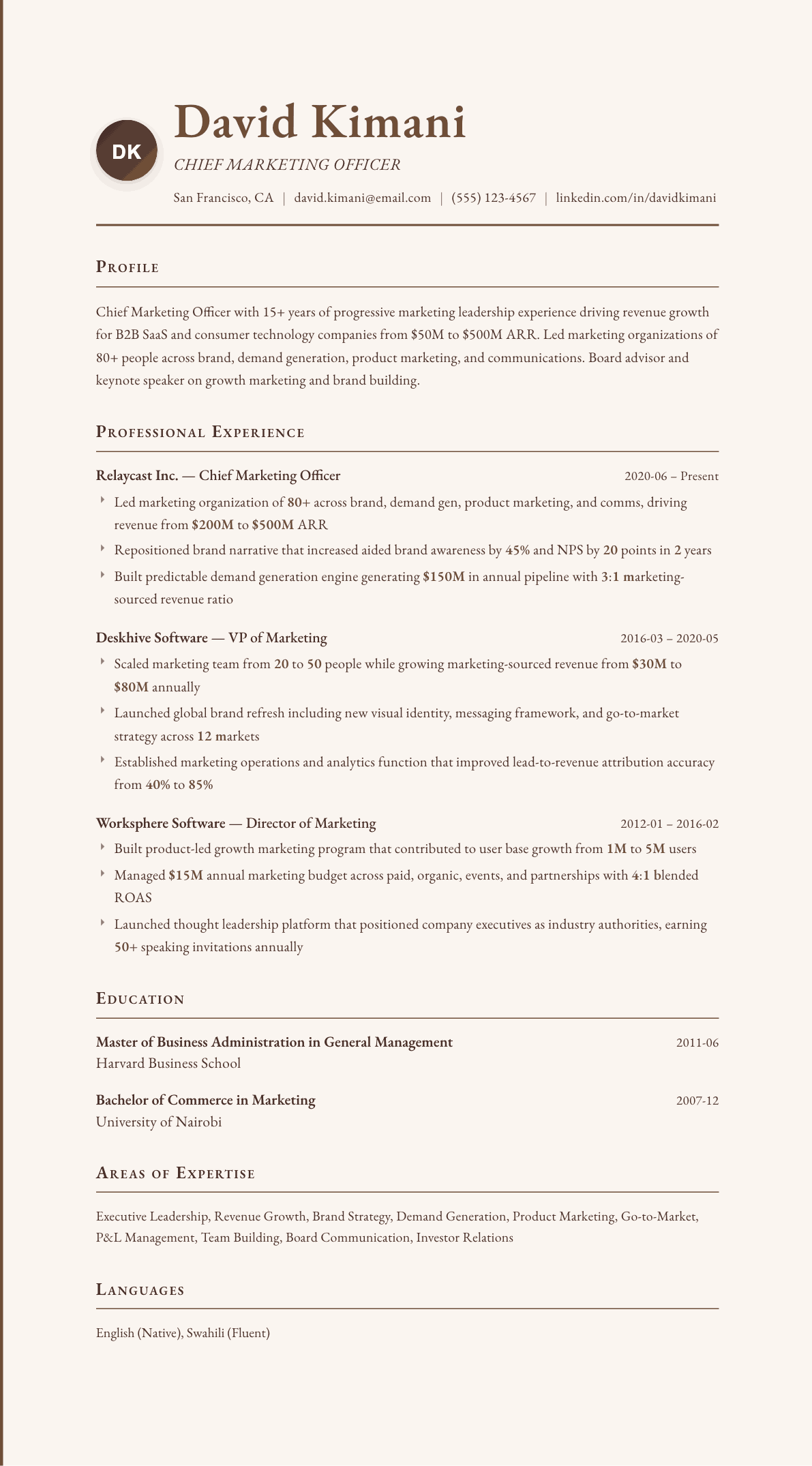
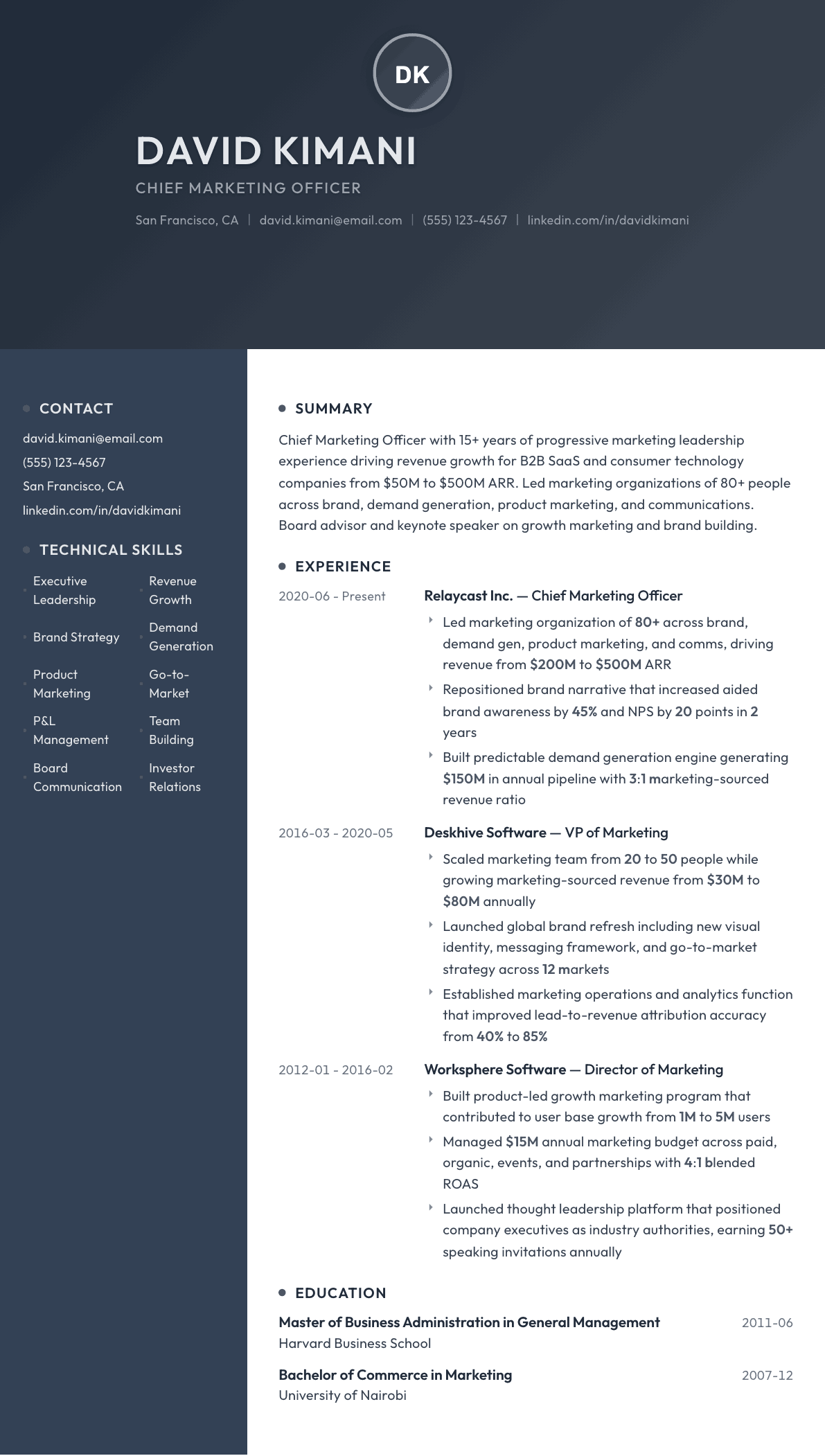
The same cmo content laid out in three CVBooster templates, so you can see what the finished document looks like before you write a word.
Example CMO summary
Transformational CMO with 15 years of progressive marketing leadership scaling B2B SaaS companies from $50M to $500M ARR. Built and led 80-person marketing organizations, generated $150M in annual pipeline, and repositioned brands that increased awareness by 45%. MBA from Harvard Business School with board advisory experience.
Skills to list on a CMO resume
- Executive Leadership
- Revenue Growth Strategy
- Brand Strategy
- Demand Generation
- Product Marketing
- Go-to-Market Strategy
- P&L Management
- Team Building & Development
- Board Communication
- Investor Relations
- Marketing Operations
- Digital Transformation
- Customer Acquisition
- Thought Leadership
What actually gets this resume read
- Lead with revenue impact: ARR growth, pipeline generated, market share gained, and brand metrics moved.
- Showcase organizational leadership: team sizes built, org design decisions, and talent development outcomes.
- Demonstrate board-level communication skills and investor relations experience.
- Highlight brand transformation stories that combine creative vision with measurable business outcomes.
- Include speaking engagements, board positions, and industry recognition to establish thought leadership.
- Keep to two pages maximum -- even at the C-level, brevity signals executive communication skills.
How to write a cmo resume
A CMO resume rarely reaches a recruiter first. It reaches an executive search partner, a board member, or a founder who has already decided what kind of marketing leader the company needs: a category creator, a demand engine builder, a brand rebuilder, or an operator who can cut a bloated budget without losing pipeline. Your document has to declare which one you are inside the first eight lines, because the search partner is sorting a shortlist against a mandate, not reading for potential.
The screen at this level is unusual. Nobody checks whether you can run a campaign. They check the revenue band you have owned, the company stage you have operated in, the size and shape of the organization you built, whether you have sat in front of a board, and whether your category matches theirs. A CMO who scaled a self-serve consumer product is not interchangeable with one who built an enterprise field marketing motion, and a resume that blurs the difference gets passed over by both.
This guide covers the section order search firms expect, three summaries for a first CMO seat, a repeat CMO and a public company operator, before-and-after bullets, and the questions marketing executives ask most when they update a document they have not touched in years.
Format: two pages, with the mandate answered in the top third
Two pages is the ceiling, and the top third of page one carries the decision. That block is your name and title line, a four-line summary, and a short scope line: company stage, revenue band, team size, functions owned. Search partners read that block, decide whether to keep reading, and only then look at the roles.
Reverse chronological, no columns, no logos, no skill rating graphics. Executive files get forwarded as attachments and pasted into search firm databases, and decorative layouts survive neither. Keep the file name professional because it appears in the board packet.
- Header: name, the words Chief Marketing Officer or the seat you are targeting, city, phone, email, LinkedIn.
- Scope line under the summary: stage, revenue range, org size, functions owned, geography.
- Sections in this order: summary, scope, experience, board and advisory work, education, recognition.
- Do not include a photo, and do not include a page of logos of every brand you touched.
Summary: category, stage, revenue arc, org shape
Four lines. Name the category you know (B2B software, consumer subscription, marketplace, regulated financial services), the stage arc you have run through (Series B to Series D, private to public, turnaround), the revenue movement you were accountable for, and the shape of the organization you led. Adjectives such as visionary and transformational are noise at this level; every candidate on the shortlist claims both.
If you are stepping into a first CMO seat from a VP role, say so plainly and anchor it in scope: full funnel ownership, a direct reporting line to the CEO, or a quarterly board presentation cadence. Search partners will find out anyway, and a candid line reads stronger than an inflated title.
Experience: own the number, then own the organization
Every role needs a context line before the bullets: what the company did, the revenue when you arrived, the revenue when you left, who you reported to, and the functions in your org. Without it the reader cannot tell whether you inherited a machine or built one from a two-person team.
Then four to six bullets per recent role, and fewer as you go back. Lead with the commercial result, then the mechanism that produced it. A CMO bullet without a mechanism sounds like a claim on someone else's work: the pipeline number matters, but the reader wants to know whether it came from a repositioning, a partner channel, a pricing change, or a rebuilt lead scoring model.
Reserve at least one bullet per role for organizational work: the functions you added, the leaders you hired, the operating cadence you installed, the agency roster you consolidated. A board hires a CMO to build a team as much as to build a brand.
Board, category and investor evidence
Give board work its own short section: advisory seats, non-executive directorships, and the investor or diligence work you have supported. If you have presented a marketing plan to a board or supported a fundraise or a sale process, name it in one line. This is the difference between a senior marketer and an executive, and most resumes leave it buried inside a bullet.
Category leadership is evidence too, but only the kind with a name attached: a keynote at a named industry conference, an analyst evaluation your team was placed in, a book, a widely referenced framework. Skip the generic claim of thought leadership.
Skills and keywords a search screen filters on
Executive search databases are tagged on function, stage and category, so the vocabulary matters more than the layout. Use the terms your target companies use: pipeline coverage, net revenue retention, marketing sourced pipeline, product marketing, category design, partner marketing, marketing operations, brand architecture, go to market. Put them where they belong, inside real accomplishments, and repeat the two or three that define your candidacy in the summary.
Name the operating stack you have governed at the executive level rather than the tools you personally used a decade ago: the CRM, the marketing automation platform, the attribution approach, the customer data platform. A CMO is judged on the system, not on button knowledge.
CMO resume summary examples
Stepping into a first CMO seat
Marketing leader moving from VP into a first CMO seat, currently owning brand, demand and product marketing for a Series C vertical software company that grew from 18M to 46M ARR in three years. Built a 26-person org, reports to the CEO, and presents the marketing plan to the board each quarter.
Second-time CMO
Two-time CMO in B2B software, most recently taking a founder-led company from a single product to three lines and from Series B through Series D. Owns brand, demand generation, product marketing and marketing operations across a 40-person org, with marketing sourced pipeline holding above 3x coverage.
Public company and turnaround CMO
CMO with public company and turnaround experience across consumer subscription and marketplace businesses. Led an 80-person global organization through a repositioning and a brand consolidation, cut agency spend by 30% while holding acquisition volume flat, and served on two private company boards as a marketing director.
Work experience bullets: before and after
Before: Responsible for all marketing at a fast growing SaaS company.
After: Owned brand, demand generation, product marketing and marketing operations for a Series C data platform, taking annual recurring revenue from 18M to 46M across three fiscal years.
The functions owned and the revenue arc tell a board what seat you actually held, which the phrase all marketing never does.
Before: Grew the marketing team significantly.
After: Grew marketing from six generalists to a 26-person org with named leaders for demand, product marketing and content, and reduced first-year attrition on the team to one departure.
Org design and retention are what a CEO is buying; a headcount adjective proves nothing about how the team was built.
Before: Repositioned the brand and improved awareness.
After: Repositioned the company from a reporting tool to a decision platform, rewrote the pricing and packaging narrative with the CRO, and lifted win rate against the two named incumbents by 9 points.
A repositioning is only credible when the reader can see what changed, who it was aimed at, and what commercial number moved.
Before: Managed a large marketing budget efficiently.
After: Rebuilt the annual marketing plan around pipeline coverage rather than channel spend, consolidated seven agencies to two, and held pipeline flat while cutting program spend by 22%.
Efficiency claims land only when the reader sees the mechanism and the trade-off you protected.
Before: Worked closely with the board and investors.
After: Presented the go to market plan at eight consecutive board meetings, built the marketing section of the Series D diligence pack, and supported four investor reference calls with named customers.
Naming the cadence and the artifacts turns a soft claim into verifiable executive exposure.
Hard skills
- Go to market strategy
- Demand generation
- Product marketing
- Brand architecture
- Pricing and packaging input
- Marketing operations
- Budget and headcount planning
- Pipeline and revenue forecasting
- Partner and channel marketing
- Analyst and press relations
- Customer data platform governance
- Attribution and reporting design
- Agency roster management
- Post-merger brand integration
Soft skills
- Board communication
- Executive team alignment
- Hiring and succession planning
- Narrative building
- Cross-functional negotiation
- Decision making with incomplete data
Certifications worth listing
- Professional Certified Marketer (PCM) (American Marketing Association)
- NACD Directorship Certification (National Association of Corporate Directors)
Mistakes that cost cmo candidates the interview
- Writing a summary of adjectives instead of a scope line, so the reader cannot place your stage, category or org size.
- Listing campaign-level work that a director owned, which shrinks a CMO file down to a manager file.
- Leaving out the revenue when you joined, so growth numbers have no starting point and read as inherited.
- Hiding board and investor exposure inside a bullet instead of giving it a labeled section a search partner can find.
- Using a designed two-column template that breaks when the file is pasted into a search firm database or a board packet.
- Claiming credit in the first person plural, since a board wants to know what you decided, not what the company did around you.
- Running to three pages by keeping full bullets on roles held more than a decade ago.
CMO resume questions
How long should a CMO resume be?
Two pages. Give the last two roles most of the space, compress everything older into one line each with title, company and dates, and drop early-career detail entirely. A third page signals that you cannot prioritize, which is the exact skill the seat requires.
Should a CMO resume include specific revenue numbers?
Yes, in ranges and only where you were accountable. Give the revenue when you joined and when you left, plus pipeline or retention figures if marketing owned them. If a number is confidential, use a growth multiple or a percentage instead of an exact figure.
How do I show board experience if I have never held a board seat?
Show board exposure rather than a seat. Name how often you presented, what you owned in the board deck, whether you led a diligence workstream, and any investor or advisory work. That exposure is what a search partner is testing for at the first CMO hire.
Does a CMO need a portfolio or case studies?
Not attached to the resume. Prepare two or three narrative cases for the interview covering a repositioning, a demand build and an organizational fix, each with the starting condition, the decision you made, and the result. The resume only needs to make those cases visible in outline.
How do I position a CMO resume when moving between categories?
Lead with the motion rather than the industry. A leader who built a product-led motion should say so in the summary and translate the customer, the buying cycle and the channel mix into the target category, then use one bullet per role that maps directly to the new category buyer.