Marketing Operations Manager Resume Examples: free score
Craft a Marketing Operations Manager Resume Built on Systems
By Mustafa Tarabya, founder of CVBooster · Published · Updated
A marketing operations manager resume centered on Marketo, lead routing and attribution, with a sample resume, keyword list and a practical writing guide.
Sample resumes for a marketing operations manager
The same marketing operations manager content laid out in three CVBooster templates, so you can see what the finished document looks like before you write a word.
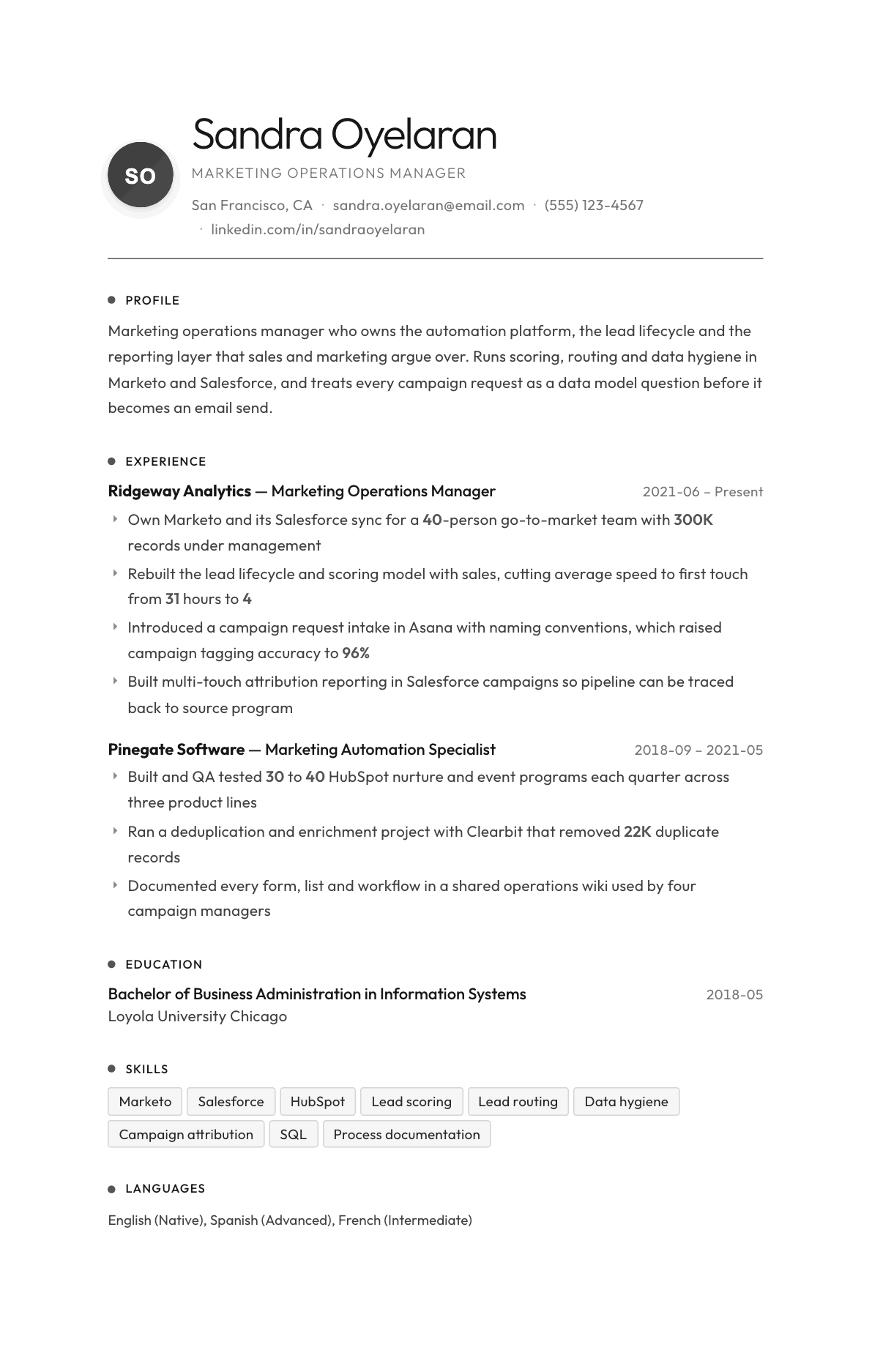
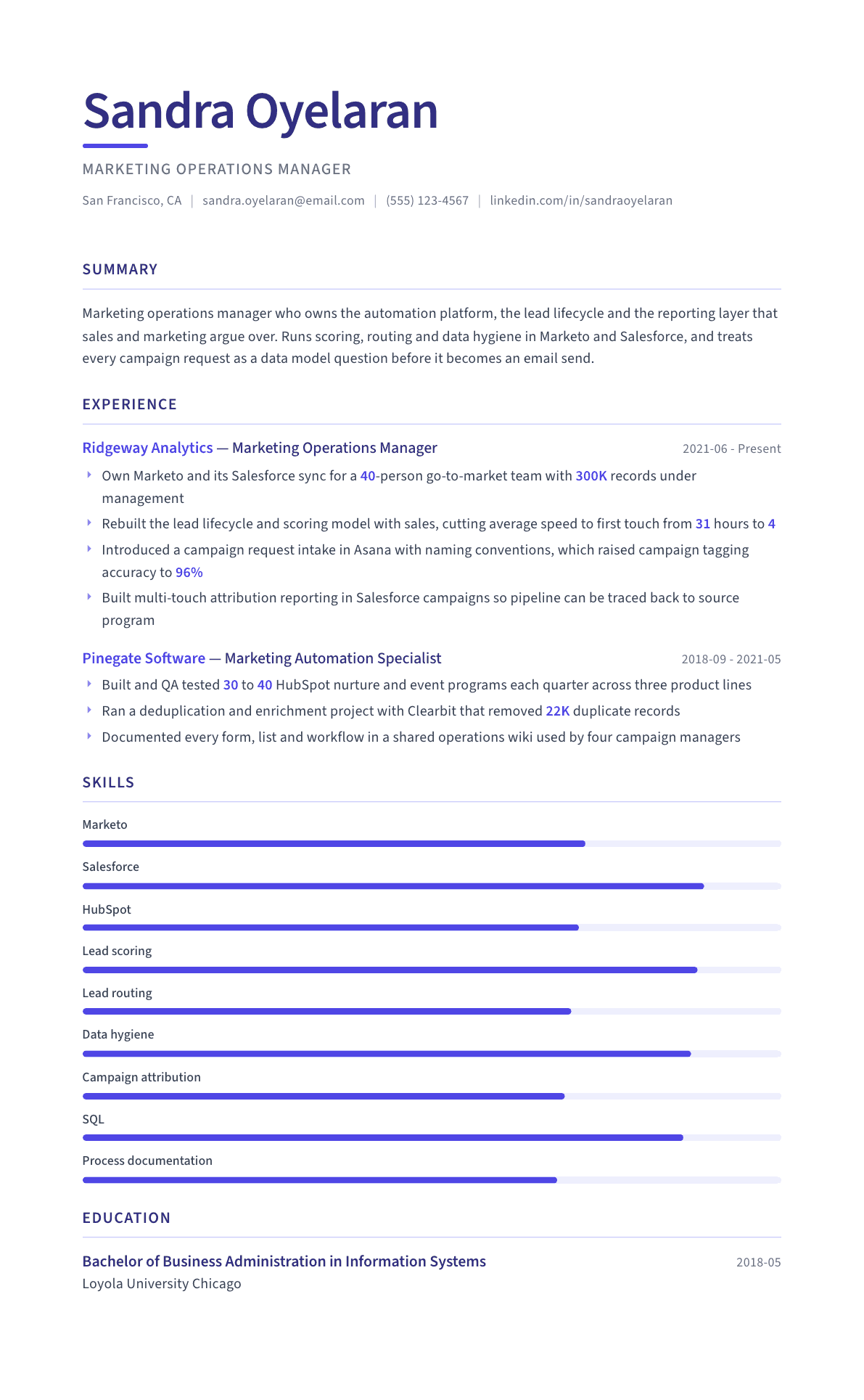
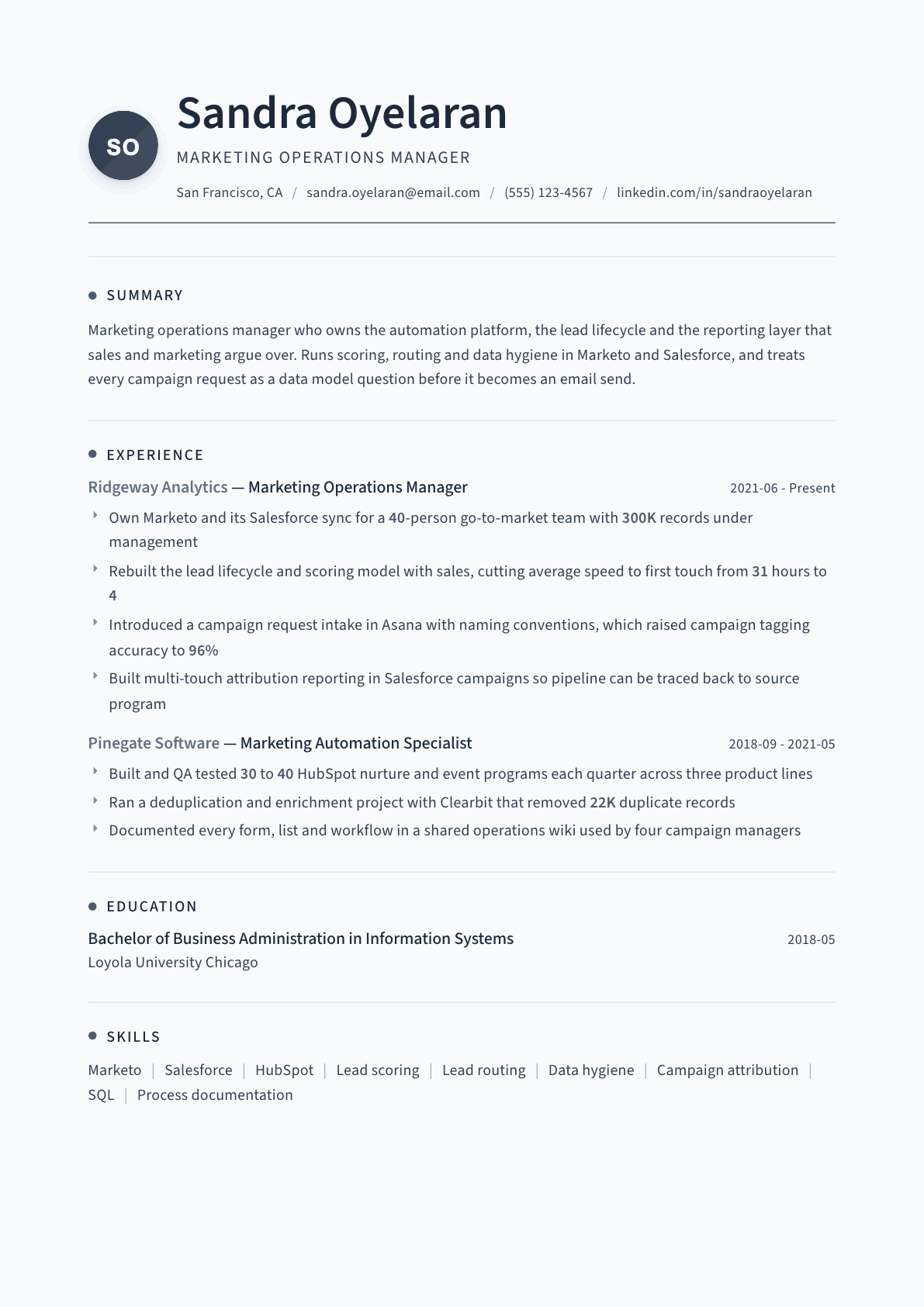
Example Marketing Operations Manager summary
Marketing operations manager with six years owning Marketo, Salesforce and the reporting layer behind them. Supports a 40-person go-to-market team and 300K records, and rebuilt a lead lifecycle that took average speed to first touch from 31 hours to 4. Strong on scoring, routing, data hygiene and multi-touch attribution, and used to writing the governance documents that keep campaign data trustworthy.
Skills to list on a Marketing Operations Manager resume
- Marketo
- HubSpot
- Salesforce
- Pardot
- Lead scoring
- Lead routing
- Lifecycle stage design
- Campaign attribution
- Data governance
- SQL
- Snowflake
- Looker
- Consent and preference management
- Integration management
- Process documentation
What actually gets this resume read
- Name the automation platform and the CRM as a pair, because Marketo with Salesforce is a different job from HubSpot alone.
- Give the size of the database and the go-to-market team you supported, since that sets the complexity of everything else.
- Describe the lifecycle stages you defined and who signed off on them, as governance is the core of the role.
- Show one migration or platform consolidation, because operations hiring managers screen hard for that experience.
- Quantify data quality work with duplicate rates, field completeness or routing time, not with a vague cleanup claim.
- List the reporting layer you built and who reads it, whether Salesforce reports, Looker or a warehouse model.
How to write a marketing operations manager resume
Marketing operations is the only marketing job where the interview usually starts with a systems question. The hiring manager wants to know which automation platform you administer, which customer relationship management system it syncs to, how many records you keep clean, and who signed off on the lifecycle stages. Answer those four and you are already ahead of most of the pile.
The trap is writing this resume as if it were a campaign role. Producing emails is the smallest part of the work. The real job is governance: the naming conventions, the scoring model, the routing rules, the consent records, the attribution logic and the intake process that stops a sales director from requesting a blast on a Friday afternoon. Those are the things that break at scale, and the resume should show you have fixed them.
This guide sets out how to structure the page, how to describe platform ownership without overstating it, three summaries at different levels, before and after bullets built from real operations work, and the questions that come up in every marketing operations interview.
Format: put the stack in the header
Reverse chronological, one page for under six years. Directly beneath your name, add a one-line stack summary: the automation platform, the customer relationship management system, the analytics layer and the database size. "Marketo and Salesforce administrator, 300K records, Snowflake and Looker reporting" answers the screening call before it happens.
Marketing operations resumes benefit from a plain single-column layout more than most, because the reader is often an operations person themselves and will be irritated by anything that hides information behind design.
- Header: name, title, city, contact details, and the platform pair you administer.
- Section order: summary, technical stack, experience, projects or migrations, certifications, education.
- Keep a short projects block if you have led a migration, since that is what the role is often hired to do.
Say exactly what level of ownership you had
Platform claims are checked in interviews, so be precise. There is a real difference between being a platform administrator with full instance rights, a power user who builds programs, and a requester who briefs somebody else. Use the word administrator only if you held the admin seat, managed users and permissions, and were the person the vendor contacted.
Do the same for the customer relationship management side. Say whether you configured campaign objects, built reports and dashboards, edited page layouts, or worked alongside a Salesforce administrator who owned those changes. Operations hiring managers respect a clean boundary far more than an inflated claim.
Experience: lifecycle, routing, data and reporting
The strongest marketing operations bullets sit in four areas. Lifecycle and scoring: the stage definitions you wrote, the scoring model you agreed with sales, and the service level for follow-up. Routing: the assignment rules, territory logic and the time from form fill to first touch. Data: deduplication, enrichment, field standardization, consent capture and the completeness rate you got a key field to. Reporting: campaign attribution, the influence model, and the dashboard leadership actually opens.
Give each of those a measurable edge. Speed to first touch in hours, duplicate records removed, tagging accuracy, form completion rates, the share of pipeline traceable to a source program. Operations impact is nearly always a cycle time or a data quality figure, and those numbers are easy to state and easy to defend.
Add the intake and documentation work, because it is what makes an operations team scale. A campaign request process with naming conventions, a quality assurance checklist and a documented workflow library is real, visible impact and it is almost always missing from resumes at this level.
Migrations and integrations deserve their own lines
Platform migrations are the hardest thing this role does, and hiring managers screen for them directly. If you have moved from one automation platform to another, or merged two instances after an acquisition, describe the record volume, the timeline, the parallel run and what you cut over last. If you have not run one, say what you did inherit and rebuild instead, which counts for a great deal.
List integrations by name and purpose, not as a logo wall. A webinar platform pushing attendance back as a scored activity, an enrichment vendor filling firmographic fields on form submission, a chat tool creating records: each of those is an integration a future employer will ask you to rebuild.
- Name the source and target platforms and the record count that moved.
- State what you preserved: program history, scoring, unsubscribe status, consent evidence.
- Say who else was involved, whether a vendor, a systems integrator or an internal engineering team.
- Give the cutover approach, since a parallel run and a hard cutover are different risk profiles.
Keywords and compliance language
Postings repeat a narrow vocabulary: marketing automation, lead scoring, lead routing, lifecycle stages, campaign attribution, data hygiene, database management, service level agreement, marketing qualified lead, sales qualified lead and the platform names. Use the posting's wording once in the summary and once in a bullet.
Include the privacy side if you have it. Consent capture, preference management, double opt-in handling, suppression lists and record retention rules are increasingly a requirement rather than a bonus, and very few candidates mention them at all.
Marketing Operations Manager resume summary examples
Automation specialist, two years
Marketing automation specialist with two years building and testing HubSpot nurture and event programs across three product lines, around 35 a quarter. Ran a deduplication and enrichment project that removed 22K duplicate records, and documented every form, list and workflow in a shared operations wiki.
Owning the platform
Marketing operations manager administering Marketo and its Salesforce sync for a 40-person go-to-market team and 300K records. Rebuilt the lead lifecycle and scoring model with sales, cutting average speed to first touch from 31 hours to 4, and introduced a campaign intake process with enforced naming conventions.
Leading the operations function
Marketing operations lead with nine years running the automation, data and reporting layer for business software companies. Managed two platform migrations, built the multi-touch attribution model reported to the board, and now leads a team of four covering systems, analytics and campaign quality assurance.
Work experience bullets: before and after
Before: Managed the marketing automation platform for the company.
After: Administered Marketo and its bidirectional Salesforce sync for a 40-person go-to-market team, with 300K records and 14 integrated systems under management.
The named platform pair, the team size and the record volume let a reader size the instance you actually ran.
Before: Improved lead handoff between marketing and sales.
After: Rebuilt lifecycle stages and the scoring model with sales leadership, reducing average speed to first touch from 31 hours to 4 against a documented service level.
A cycle time with a before and after, plus a written service level, turns an interdepartmental claim into an operational result.
Before: Cleaned up the marketing database.
After: Ran a deduplication and enrichment project across 300K records, removing 22K duplicates and raising completeness on the industry field from 41% to 93%.
Two different data quality measures show the work was scoped and verified rather than a one-off merge.
Before: Created reports for marketing leadership.
After: Built multi-touch campaign attribution in Salesforce campaign objects so pipeline could be traced to the source program, adopted in the monthly revenue review.
Naming the object model and the meeting it feeds shows the reporting was trusted, not merely produced.
Before: Set up a process for handling campaign requests.
After: Introduced a campaign intake in Asana with required fields, naming conventions and a quality assurance checklist, lifting campaign tagging accuracy to 96%.
The tool, the enforcement mechanism and the accuracy figure make a governance change measurable.
Hard skills
- Marketo administration
- HubSpot and Pardot
- Salesforce configuration and reporting
- Lead scoring model design
- Lead routing and assignment rules
- Lifecycle stage definition
- Campaign attribution modeling
- Data deduplication and enrichment
- SQL and warehouse reporting
- Looker and Tableau
- Consent and preference management
- API and integration management
- Process documentation
Soft skills
- Negotiating definitions with sales
- Requirements gathering
- Explaining systems to non-technical teams
- Change management
- Vendor evaluation
- Precision under deadline pressure
Certifications worth listing
- Adobe Certified Expert, Marketo Engage Business Practitioner (Adobe)
- Salesforce Certified Administrator (Salesforce)
- Salesforce Certified Marketing Cloud Account Engagement Specialist (Salesforce)
- HubSpot Marketing Hub Implementation Certification (HubSpot Academy)
- Certified Information Privacy Professional, Europe (International Association of Privacy Professionals)
Mistakes that cost marketing operations manager candidates the interview
- Calling yourself a platform administrator when you were a power user without admin rights.
- Describing campaign production while leaving out scoring, routing, data quality and attribution.
- Omitting the database size and the team you supported, which are the two numbers that set the scope.
- Listing integrations as a logo wall with no indication of what each one moved or why it existed.
- Skipping migration experience, or burying it in a bullet when it deserves its own project entry.
- Ignoring consent, suppression and retention work when many employers now screen for it first.
- Writing a design-heavy layout that an operations reader will find harder to scan than a plain one.
Marketing Operations Manager resume questions
Do I need to be a certified Salesforce administrator for this role?
Not always, but it removes a common objection. Many marketing operations roles sit next to a Salesforce administrator rather than replacing one. If you hold the certification, list it. If not, be specific about which parts of the instance you configured yourself.
How technical should a marketing operations manager resume be?
Technical enough to be checkable. Name platforms, objects, integrations and data models, and include SQL if you write it. Avoid engineering language you cannot support, because operations interviews almost always include a live scenario about routing or scoring logic.
What if I have only ever used HubSpot and the job asks for Marketo?
Apply anyway and frame the transferable layer: lifecycle design, scoring, routing, data hygiene and attribution work the same way conceptually. Name the concepts explicitly so the reader sees platform-independent skill rather than a single tool habit.
How do I show impact when my work is invisible when it goes right?
Use cycle times and quality rates. Speed to first touch, duplicate rate, field completeness, campaign tagging accuracy and the share of pipeline traceable to a program are all defensible numbers that describe the health of the system you ran.
Should I list every campaign I have built?
No. Give a volume figure such as the number of programs built per quarter, then spend the space on the systems work. A hiring manager assumes you can build a nurture track and is looking for evidence you can govern the whole database.