Marketing Automation Specialist Resume Examples: free
Automate Your Career With a Marketing Automation Specialist Resume
By Mustafa Tarabya, founder of CVBooster · Published · Updated
Build a technical marketing automation specialist resume with platform expertise, workflow design, and lead nurturing metrics that demand generation teams seek.
Sample resumes for a marketing automation specialist
The same marketing automation specialist content laid out in three CVBooster templates, so you can see what the finished document looks like before you write a word.
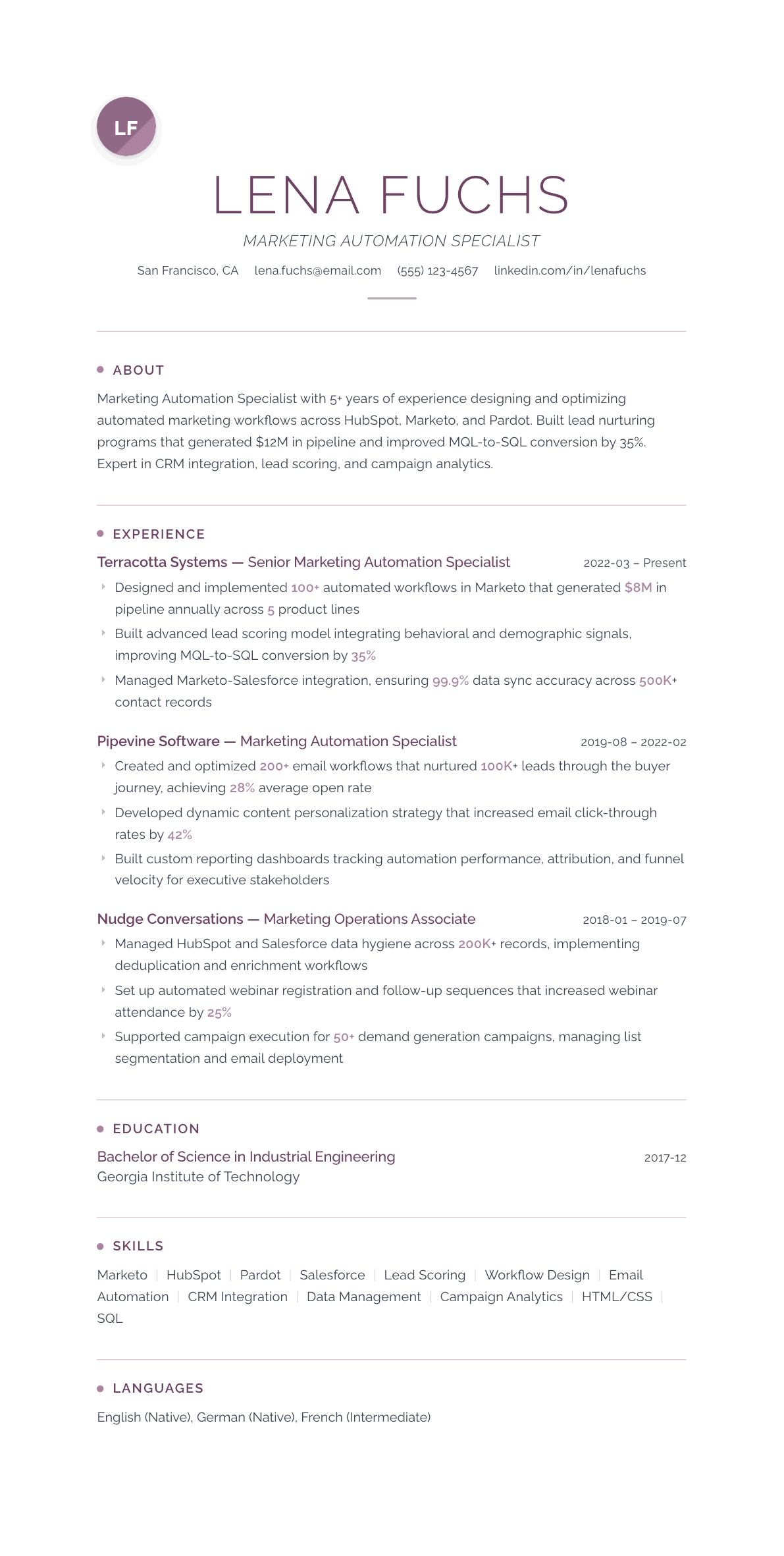
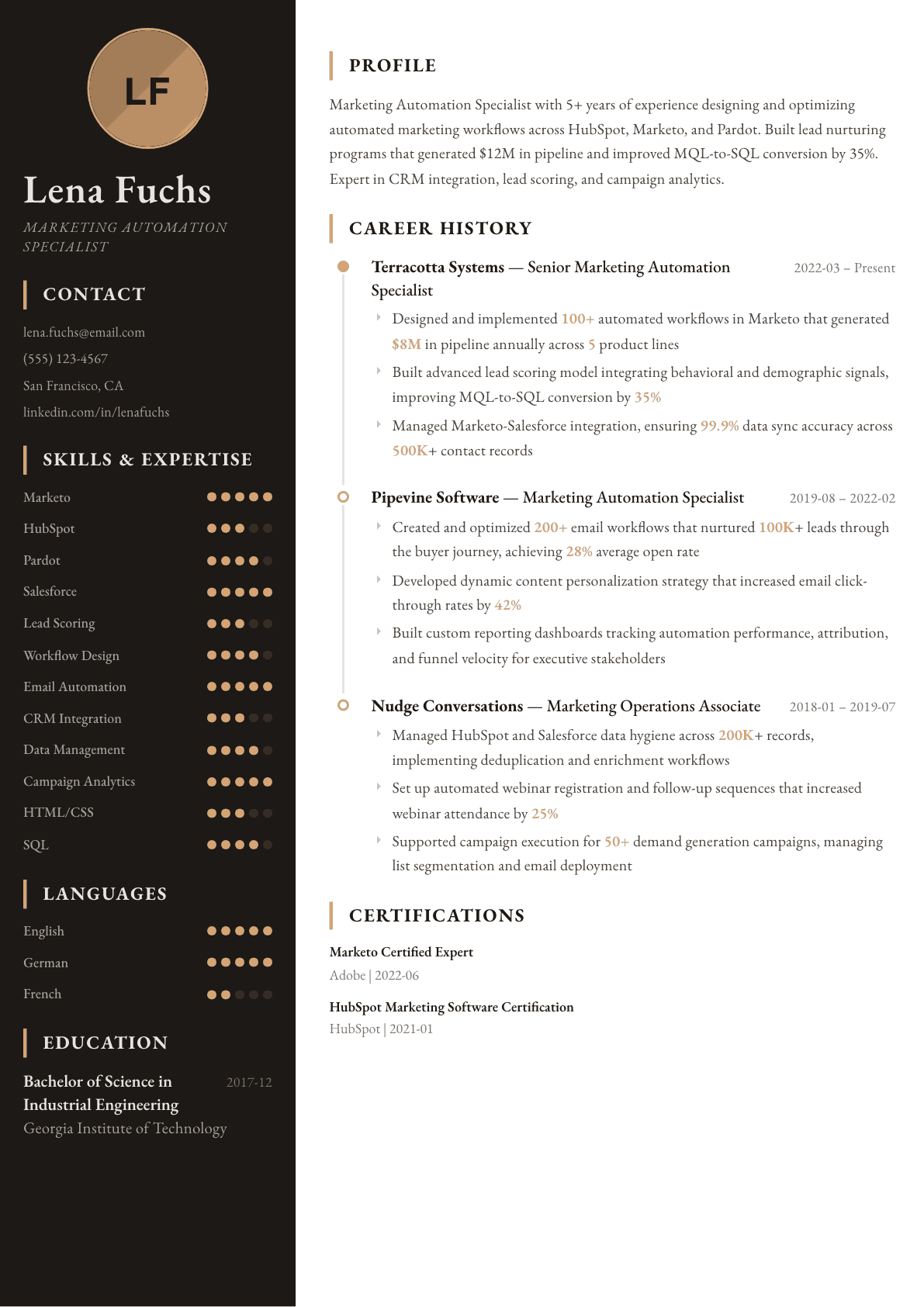
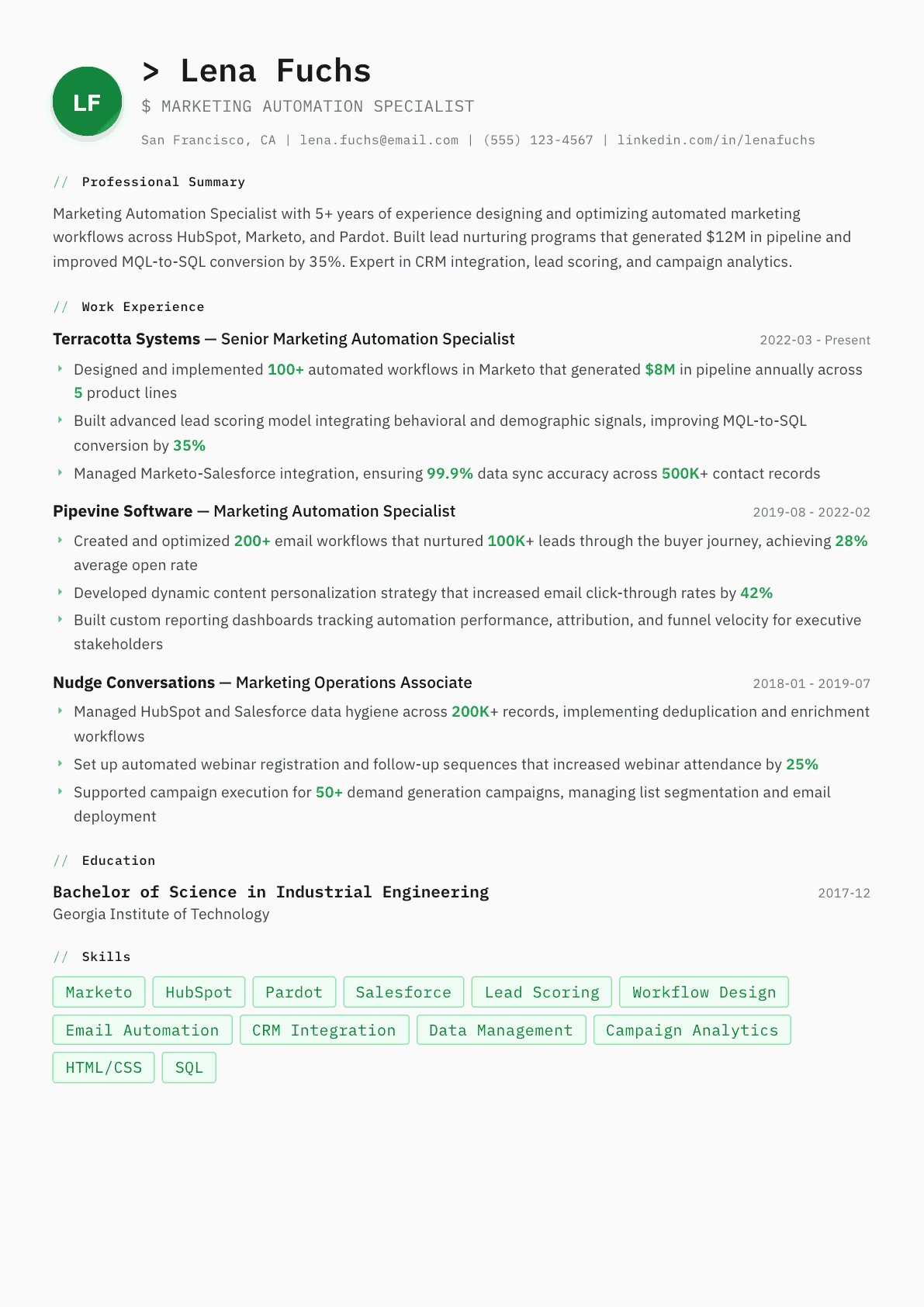
Example Marketing Automation Specialist summary
Technical Marketing Automation Specialist with 5 years of experience building automated workflows that generated $12M in pipeline. Marketo Certified Expert with deep expertise in lead scoring, CRM integration, and campaign optimization across HubSpot, Marketo, and Pardot. Seeking a senior role to drive demand generation at scale.
Skills to list on a Marketing Automation Specialist resume
- Marketing Automation
- Marketo
- HubSpot
- Pardot
- Eloqua
- Salesforce CRM
- Lead Scoring
- Lead Nurturing
- Workflow Design
- Email Automation
- CRM Integration
- Data Management
- Campaign Analytics
- HTML/CSS
- SQL
What actually gets this resume read
- Highlight platform certifications: Marketo Certified Expert, HubSpot certifications, Pardot Specialist.
- Quantify pipeline generated, MQL volume, conversion rate improvements, and revenue influenced by your automations.
- Showcase CRM integration experience and data management skills -- these are critical for this role.
- Demonstrate lead scoring expertise: how you built models, what signals you used, and the business impact.
- Include technical skills: HTML/CSS for email, SQL for data queries, API integrations.
- Mention your approach to testing and optimization of automated workflows.
How to write a marketing automation specialist resume
A marketing automation specialist resume is really a marketing operations resume, and the person hiring you already knows which platform they are stuck with. They have a Marketo instance nobody has audited in two years, a lead scoring model that fires on nothing useful, and a sales team that says the leads are bad. Your resume needs to prove you can open that instance and find the broken thing.
Two audiences read it. The recruiter matches platform names: Marketo, HubSpot, Pardot, Eloqua, Braze, Salesforce, and the certification that goes with them. The demand generation or marketing operations lead reads for architecture: how you designed programs, how you handled data hygiene, whether you understand what happens when a record syncs badly between the platform and the CRM.
This guide covers the section order that works for an operations role, how to describe programs without listing every email you sent, three summaries by career stage, before and after bullets, and the questions specialists ask when the work is technical but the title is marketing.
Format: platform block near the top, one clean column
Reverse chronological, one page for under six years. Put a platforms and certifications block directly under the summary rather than at the bottom, because it is the first filter and the reason many operations resumes are screened out before the experience is read at all.
List platform versions of the truth carefully: name the automation platform, the CRM it syncs to, and the direction of that sync. Marketo with a bidirectional Salesforce sync is a different job from HubSpot as the single system of record, and hiring managers screen on exactly that difference.
- Order: summary, platforms and certifications, experience, technical skills, education.
- Say which instance you administered versus which you were a user in. Admin access is the credential.
- Include database scale in plain words when it is large, for example a database of several million records.
Summary: the stack, the scale, and the system you fixed
Three lines. Name the platform you are strongest in, the CRM, the go to market motion you supported, and one system level thing you built or repaired. Operations leaders hire for repair as often as for build, so a summary that mentions a migration, an instance audit or a scoring rebuild lands harder than one that lists campaign counts.
If you are certified, put the credential in the summary line rather than saving it for the bottom. Marketo Certified Expert is a term recruiters search literally, and it carries more weight in this field than in most marketing roles.
Experience: programs, data, and the handoff to sales
Structure each job around three areas rather than a list of campaigns. First, program architecture: the nurture tracks, the trigger logic, the templates and tokens, the way you kept a program library maintainable instead of cloning it forever. Second, data: deduplication rules, normalization of country and job title fields, form handling, list imports, consent and preference management. Third, the handoff: scoring, lifecycle stages, routing rules, and what sales saw when a record arrived.
Lead scoring deserves its own bullet because it is the topic every interview covers. Say what behavioral and demographic signals you used, how you decayed scores, how you validated the threshold against closed won records, and what changed after. A scoring model with no validation story reads as a model somebody handed you.
Quantify in the units operations is measured in: qualified lead volume, conversion rate between lifecycle stages, sync error rate, email deliverability, time to launch a campaign, number of programs consolidated. Pipeline influenced is fine to mention if you can explain how it was calculated, and dangerous if you cannot.
Name the integrations you have wired: webinar platforms, chat, enrichment providers, the data warehouse, the customer data platform. Integration work is where operations specialists prove they can reason about systems rather than screens.
Technical skills: enough code to be dangerous, listed honestly
This role sits at the edge of engineering, so the technical block matters. HTML and CSS for responsive email templates, an understanding of REST APIs and how the platform exposes them, SQL for pulling the truth out of the warehouse when the platform reporting disagrees with itself, and any scripting you use to move data.
Say what you use each one for. HTML and CSS for modular email templates tested across clients tells the reader you have fought a rendering bug in Outlook. Listing HTML alone tells them nothing they can probe.
Governance: the part that separates senior from mid
Senior operations people are hired to impose order. Describe naming conventions you set, program templates you standardized, documentation you wrote, quality assurance checklists you enforced before a send, and the request intake process you built so the team stopped taking campaign briefs over chat.
Consent and data handling belong here too. Global suppression lists, double opt in for regions that require it, preference centers, and how unsubscribes propagated between the platform and the CRM. An operations hire who cannot discuss consent handling is a risk, and saying nothing about it reads as never having handled it.
Keywords the screen looks for
Postings for this role reuse a tight vocabulary: marketing automation, lead scoring, lead nurturing, lifecycle stages, campaign operations, CRM integration, data hygiene, email deliverability, segmentation, program templates, demand generation and the platform names. Use the posting's own phrasing once in the platform block and once in a bullet that proves it. Where a posting names a specific platform you have not used, do not claim it; name the closest one and say you administered it, since operations hiring managers assume platform transfer is learnable and dishonesty is not.
Marketing Automation Specialist resume summary examples
Coordinator moving into operations
Marketing operations coordinator with two years building and launching email programs in HubSpot for a business software company. Own template maintenance, list hygiene and form handling, and rebuilt the lifecycle stage definitions with sales. HubSpot Marketing Software certified and learning SQL.
Five years in
Marketing automation specialist and Marketo Certified Expert with five years administering an instance of roughly 3 million records synced bidirectionally with Salesforce. Rebuilt lead scoring against closed won data, raising qualified lead acceptance by sales from 41% to 68%, and consolidated 200 legacy programs into 12 templates.
Operations lead
Marketing operations lead with nine years across Marketo, Pardot and Braze. Ran two platform migrations without a gap in campaign delivery, built the scoring and routing model used by three sales regions, and set the naming, quality assurance and intake standards a team of six now works inside.
Work experience bullets: before and after
Before: Created email campaigns in Marketo.
After: Built and maintained 12 modular Marketo program templates with tokenized content, cutting the time to launch a regional campaign from six days to under one.
Templates and launch time show architecture and leverage, where created campaigns shows only volume.
Before: Managed lead scoring.
After: Rebuilt the lead scoring model using behavioral signals weighted against 18 months of closed won records, added a 30 day decay rule, and raised sales acceptance of scored leads from 41% to 68%.
Validating against closed won data and adding decay proves you designed the model rather than inherited it.
Before: Integrated Marketo with Salesforce.
After: Owned the bidirectional Marketo and Salesforce sync, resolved a duplicate record problem affecting 9% of the database with normalization and merge rules, and cut daily sync errors to near zero.
The failure mode and the fix are the interesting part; integrated could mean anything from a checkbox to a rebuild.
Before: Improved email performance.
After: Raised inbox placement by authenticating sending domains, moving to a warmed dedicated IP and suppressing records with no engagement for 12 months, lifting click through rate on the nurture track by 31%.
Deliverability work is technical and specific, so naming authentication and suppression proves you did it.
Before: Helped with a platform migration.
After: Migrated 340 active programs and a database of 2 million records from Eloqua to Marketo over four months, mapping fields and preference data first and running both systems in parallel through the final campaign cycle.
Scale, sequence and the parallel run show a managed migration instead of an export and import.
Hard skills
- Marketo
- HubSpot
- Salesforce Pardot
- Oracle Eloqua
- Salesforce CRM administration
- Lead scoring model design
- Lifecycle stage architecture
- Nurture program design
- Email deliverability and authentication
- Data hygiene and deduplication
- HTML and CSS for email
- REST API integrations
- SQL
- Consent and preference management
Soft skills
- Translating sales complaints into system changes
- Documentation discipline
- Request intake and prioritization
- Quality assurance before launch
- Cross functional troubleshooting
Certifications worth listing
- Marketo Certified Expert (Adobe)
- HubSpot Marketing Software Certification (HubSpot Academy)
- Salesforce Certified Marketing Cloud Account Engagement Specialist (Salesforce)
- Salesforce Certified Administrator (Salesforce)
- Oracle Eloqua Marketing Certified Implementation Specialist (Oracle)
Mistakes that cost marketing automation specialist candidates the interview
- Listing campaign counts instead of program architecture, which reads as an executor rather than an operations owner.
- Claiming a platform you have only seen demonstrated, when the first technical screen is a walkthrough of the instance.
- Saying nothing about data hygiene, so the reader assumes you never touched the database underneath the campaigns.
- Burying the certification at the bottom when it is one of the literal search terms recruiters use for this role.
- Describing a scoring model with no validation, no decay and no sales feedback loop.
- Ignoring consent, suppression and preference handling, which is a compliance risk the hiring manager is screening for.
Marketing Automation Specialist resume questions
Is a Marketo or HubSpot certification worth it for this role?
Yes, more than in most marketing jobs. Recruiters filter on the exact credential name, and the exams cover the program and data model you will be asked about in the technical screen. Take the one matching the platform in the postings you want.
How do I move from email marketing into marketing automation?
Reframe your bullets around systems rather than sends: template architecture, list segmentation logic, form and field handling, suppression rules and the CRM sync. Add SQL or API work if you have any, and get the certification for the platform your current employer uses.
Should I list pipeline influenced on my resume?
Only if you can explain the attribution rule behind the number in an interview. Operations hiring managers know the figure is model dependent, so an unexplained pipeline claim invites a question you may not want. A conversion rate between lifecycle stages is safer and just as persuasive.
How technical does this resume need to be?
Technical enough that an engineer would not wince. Show email HTML, API familiarity and SQL if you have them, and describe at least one integration you wired yourself. The role sits between marketing and systems, and resumes that read as purely creative get filtered out.
What if I have only worked in one automation platform?
That is normal and fine. Go deep instead of wide: describe the instance size, the sync, the program library and the governance you set. Then name the other platforms you have evaluated or trained in, clearly separated, so nobody assumes admin experience you do not have.