Email Marketing Manager Resume Examples: free ATS score
Create an Email Marketing Manager Resume That Delivers Results
By Mustafa Tarabya, founder of CVBooster · Published · Updated
Build a high-converting email marketing manager resume with campaign metrics, automation expertise, and deliverability skills that land interviews.
Sample resumes for a email marketing manager
The same email marketing manager content laid out in three CVBooster templates, so you can see what the finished document looks like before you write a word.
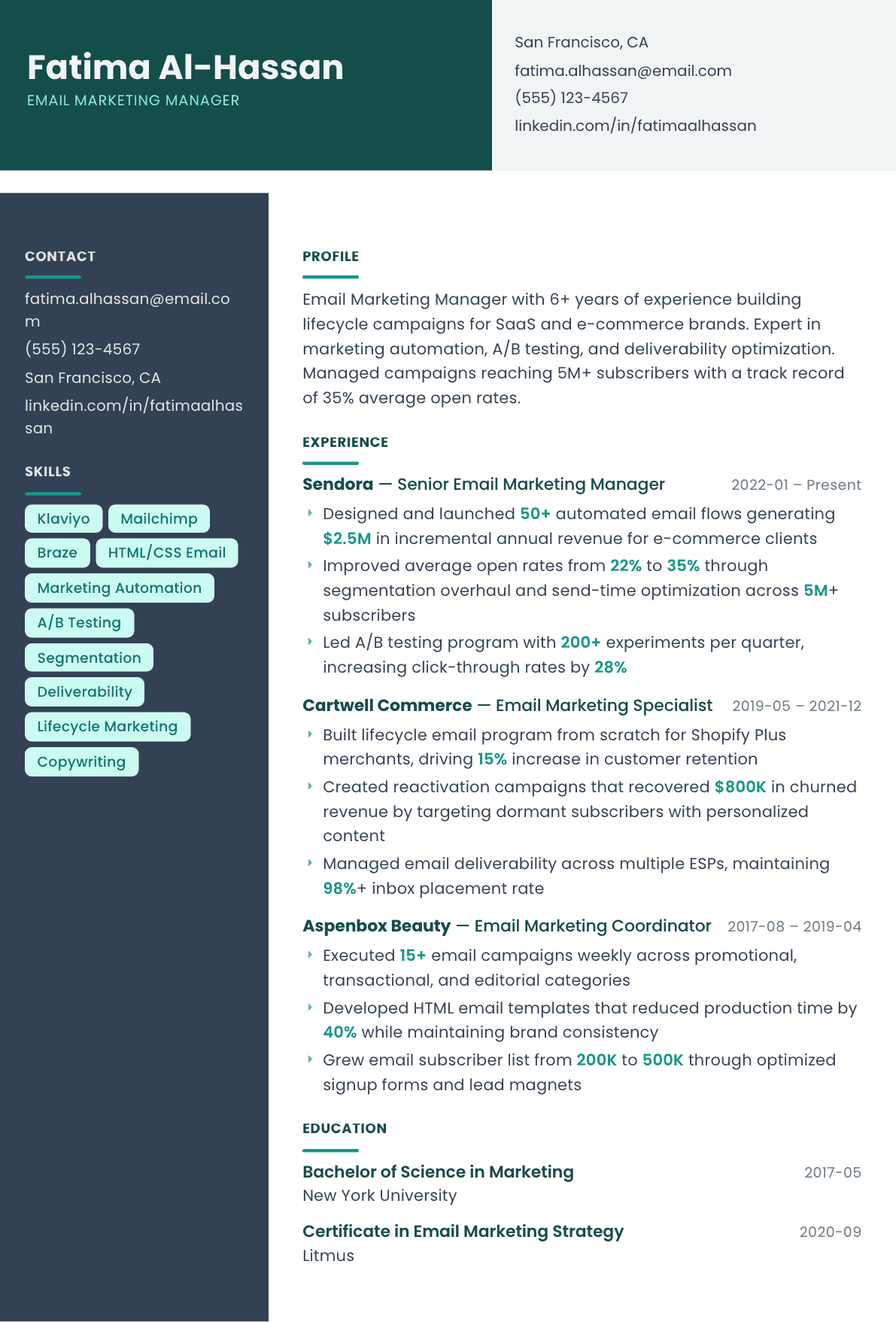
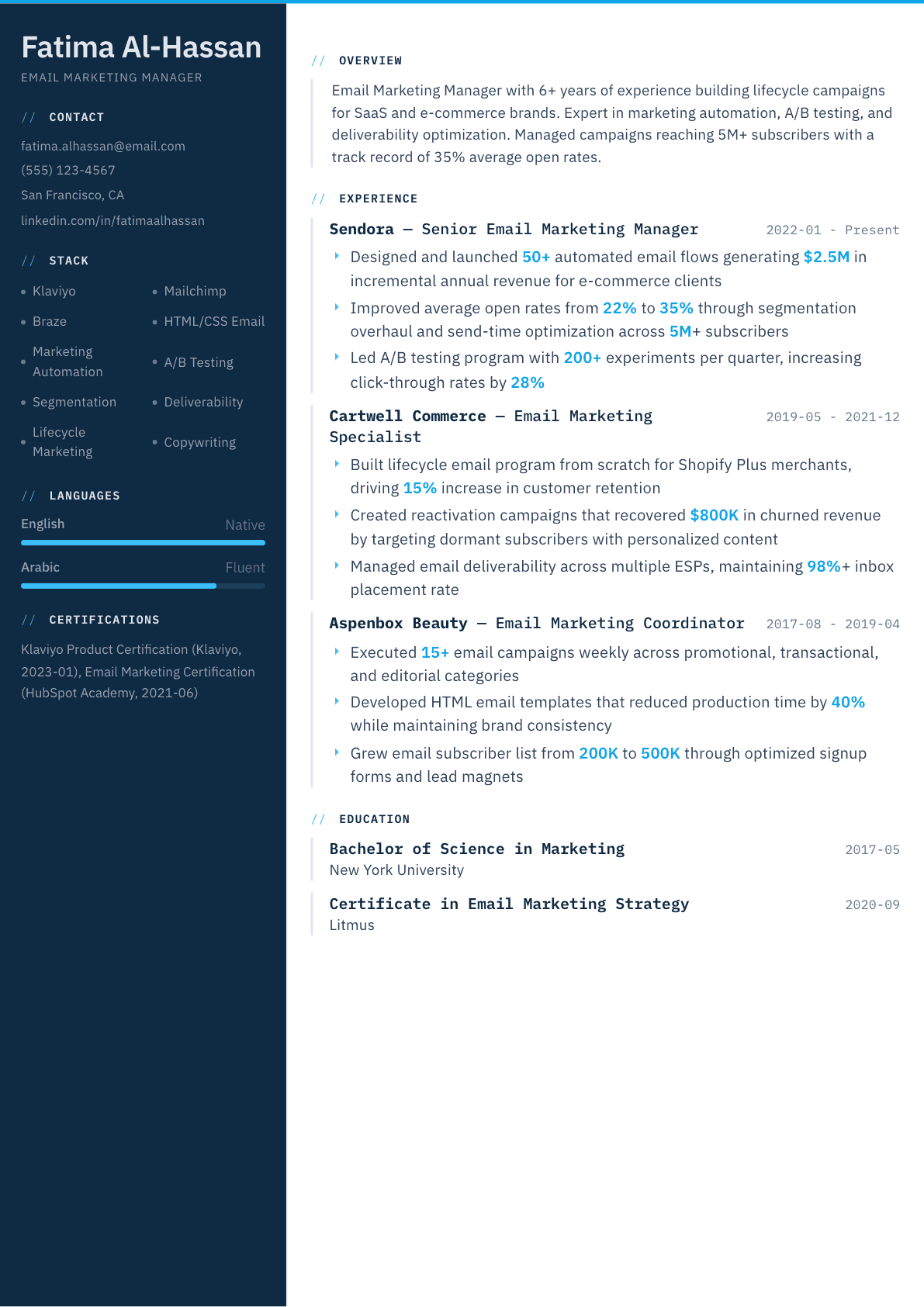
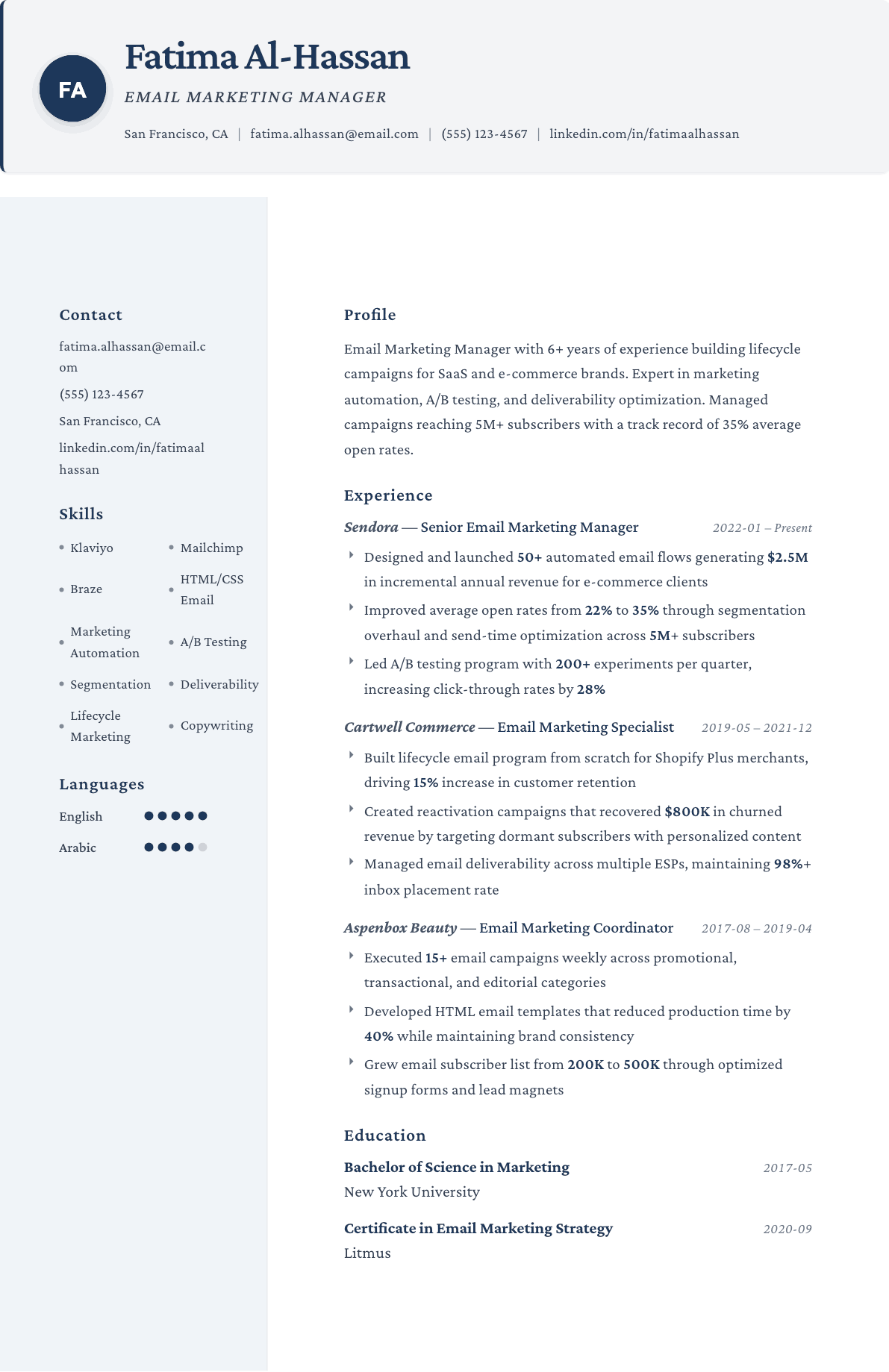
Example Email Marketing Manager summary
Data-driven Email Marketing Manager with 6 years of experience building high-performing lifecycle campaigns for SaaS and e-commerce brands. Increased open rates by 60% and generated $2.5M in incremental revenue through automated flows and advanced segmentation. Seeking a leadership role to scale email programs at a growth-stage company.
Skills to list on a Email Marketing Manager resume
- Email Marketing
- Marketing Automation
- Klaviyo
- Mailchimp
- Braze
- Iterable
- A/B Testing
- Segmentation
- Deliverability
- HTML Email
- Lifecycle Marketing
- Campaign Analytics
- Copywriting
- CRM Integration
What actually gets this resume read
- Quantify every campaign: open rates, click-through rates, conversion rates, and revenue generated.
- Highlight your experience with specific ESPs and marketing automation platforms (Klaviyo, Braze, Mailchimp, Iterable).
- Showcase A/B testing methodology and results to demonstrate a data-driven approach.
- Include deliverability expertise: inbox placement rates, authentication protocols (SPF, DKIM, DMARC).
- Demonstrate lifecycle marketing knowledge: onboarding, nurture, re-engagement, and win-back flows.
- Mention HTML/CSS email coding skills if applicable, as many roles require template creation.
How to write a email marketing manager resume
Email is the one marketing channel where the hiring manager can check your work in the interview. They will ask what your list size was, what your unsubscribe rate looked like, how you handled a sudden drop in inbox placement, and what you did with the segment that had not opened anything in six months. Vague answers end the conversation, because email is an operational job with a visible scoreboard and a spam complaint rate that follows you.
The resume screen splits along two lines. First, the platform: an operator who lives in Klaviyo for e-commerce flows is doing different daily work from one running Braze cross-channel journeys or Marketo nurture programs tied to a CRM. Second, the depth: some email managers write and schedule campaigns, others own deliverability, authentication, list health, consent records and the data model behind segmentation. Postings ask for both, but the second group gets hired faster.
This guide covers how to lay out an email resume, which metrics to use and which ones now mislead, three summaries from a first email role to a lifecycle lead, before-and-after bullets, and the questions email marketers ask when a strong result came from a promotion rather than from the message.
Format: one page, with the program profile up front
One page for most email managers, two once you lead a team or run several brands. Under the summary, put a program profile: list size band, send volume, the platform, the type of program (promotional calendar, automated flows, transactional, or all three), and whether you own the template code.
That block matters because scale changes the job. Running a weekly send to a list of eight thousand is a craft problem. Running daily sends to millions is an infrastructure problem involving warmup, throttling, suppression logic and reputation monitoring, and a manager hiring for one will not accept experience from the other without seeing the numbers.
- Header: name, title, city, email, LinkedIn.
- Program profile: list size band, monthly send volume, platform, program types, template ownership.
- Sections in this order: summary, program profile, experience, skills and platforms, certifications, education.
Summary: platform, program, and the number you moved
Three lines naming the platform, the program you ran, the audience, and one result that is genuinely attributable to email, such as revenue from automated flows, activation among new subscribers, or reactivation of a lapsed segment.
Open rates are no longer a clean metric because privacy features inflate them, and any hiring manager who has worked in email since that change knows it. Leading with an open rate improvement signals that you stopped paying attention. Lead with clicks, conversions, revenue per recipient or retention instead, and use open rates only as supporting context.
Experience: flows, segmentation and the decisions behind them
Structure bullets around programs rather than campaigns. Welcome and onboarding, abandoned browse and cart, post-purchase and replenishment, winback, renewal and expiry, re-engagement and sunset. For each, say how many messages, what triggered them, what the branching logic keyed on, and what the program produced. A flow described with its trigger and branching tells a manager you built it rather than inherited it.
Segmentation is where the craft shows. Explain what you segment on: purchase history, engagement recency, product usage, plan type, lifecycle stage, predicted value. Then show a decision, such as suppressing a low-engagement segment from promotional sends and watching complaints fall, or splitting a single newsletter into two audiences with different offers.
Include the unglamorous operational work, because it is the part that breaks. Suppression lists and their maintenance, preference centers, consent capture and record keeping, seed testing and rendering checks across clients, throttling on large sends, and the checklist you run before a send goes out. One error here can affect a whole list, and managers hire people who visibly respect that.
Deliverability: the section that separates candidates
Name the authentication you have set up or maintained: SPF, DKIM and DMARC, plus alignment and reporting. Say whether you have warmed a new sending domain or dedicated address, moved a program between providers, or recovered a reputation problem. Describe the monitoring you use: complaint rate, bounce rate by type, seed placement, and the postmaster tools for the major mailbox providers.
If you have handled an incident, describe it in one bullet with the diagnosis and the fix. A candidate who can explain that complaints rose after a purchased list was imported, that they suppressed it, tightened consent capture and rebuilt sending volume gradually, is worth more than one who has only ever had clean numbers.
Building, testing and the tools worth naming
Say whether you build templates yourself. Hand-coded responsive email in HTML with table layouts and inline styles, dark mode handling, and rendering testing across clients is a genuine skill and worth a line. If you work in a drag and drop builder and hand code to a developer, say that instead; both are fine, and the wrong claim is exposed in the first task.
Describe your testing method: what you test, how you split, when you call a result, and what you do with the loser. Subject lines, sender name, send time, offer, layout and message length all qualify. Then name the platforms honestly, distinguishing the ones you administered from the ones you used.
Email Marketing Manager resume summary examples
First email role
Email marketing coordinator running the weekly promotional calendar and three automated flows for a retail brand with a list of ninety thousand subscribers. Built the current welcome series, cleaned a two-year backlog of unengaged addresses, and raised click to conversion on the flagship send from 3.1% to 5.4%.
Six years in
Email marketing manager with six years in e-commerce, owning the full flow library in Klaviyo across welcome, browse, cart, post-purchase and winback for two brands. Automated messages now produce 31% of email revenue, and a re-engagement and sunset policy cut the complaint rate by half over three quarters.
Lifecycle lead
Lifecycle marketing lead running email, push and in-app messaging in Braze for a subscription business sending to millions of recipients a month. Migrated the program to a dedicated sending domain with staged warmup, rebuilt segmentation on product usage rather than list tenure, and improved trial to paid conversion by 12%.
Work experience bullets: before and after
Before: Sent weekly email campaigns to the subscriber list.
After: Owned a weekly promotional calendar to a list of ninety thousand subscribers, segmenting each send on purchase recency and category interest, and coordinated the offer with merchandising two weeks ahead.
Segmentation logic and the planning cadence show a managed program rather than a scheduling task.
Before: Improved open rates through better subject lines.
After: Tested subject line and sender name on every promotional send with a fixed split and holdout, and lifted click to conversion from 3.1% to 5.4% over two quarters.
Moving the claim from opens to conversion shows awareness that open data is no longer a reliable measure.
Before: Built automated email flows.
After: Built a nine-message flow library covering welcome, browse abandonment, cart, post-purchase and winback, branching on first order value and category, which grew automated messages to 31% of email revenue.
Message count, triggers, branching and revenue share turn a generic build claim into a described system.
Before: Managed email deliverability.
After: Configured SPF, DKIM and DMARC alignment, warmed a dedicated sending domain over six weeks, and monitored complaint and bounce rates weekly against seed placement tests.
Naming the authentication records, the warmup and the monitoring proves the technical depth this role is screened on.
Before: Cleaned up the email list.
After: Introduced a re-engagement and sunset policy that suppressed addresses with no interaction in 180 days, removing a fifth of the list and halving the complaint rate without reducing revenue per send.
A defined rule with a deliberate trade-off shows list health judgment instead of a tidying exercise.
Hard skills
- Marketing automation platforms
- Klaviyo
- Braze
- Mailchimp
- Iterable
- Lifecycle flow design
- Segmentation and audience logic
- Deliverability and authentication
- SPF, DKIM and DMARC
- HTML email development
- A/B and holdout testing
- Consent capture and preference centers
- Suppression and list hygiene
- Revenue and cohort reporting
Soft skills
- Attention to detail before a send
- Calm incident handling
- Working to a merchandising calendar
- Explaining deliverability to executives
- Restraint about send frequency
- Documentation habits
Certifications worth listing
- Klaviyo Product Certification (Klaviyo Academy)
- HubSpot Email Marketing Certification (HubSpot Academy)
- Salesforce Certified Marketing Cloud Email Specialist (Salesforce)
Mistakes that cost email marketing manager candidates the interview
- Leading with open rate improvements, which tells an experienced manager you have not followed how that metric changed.
- Leaving out list size and send volume, so the reader cannot tell whether you have faced infrastructure problems at all.
- Never mentioning deliverability, which is the first area a manager probes and the fastest way to fail a technical screen.
- Describing campaigns instead of flows, since automated programs are where most of the revenue and most of the skill sit.
- Claiming to code templates when you use a drag and drop builder, a claim that collapses in the first practical task.
- Reporting revenue from email without saying whether a promotion or a product launch was running at the same time.
- Listing every platform in the category rather than the two you have genuinely administered.
Email Marketing Manager resume questions
Which email metrics should I put on my resume now?
Prioritize click rate, click to conversion, revenue per recipient, automated revenue share, unsubscribe and complaint rates, and retention or reactivation figures. Use open rates only as supporting context, since privacy protections inflate them and experienced managers discount them.
How much deliverability knowledge does an email manager need?
Enough to own it. You should be able to explain authentication records, why alignment matters, how to warm a new sending domain, what a rising complaint rate suggests, and how you would investigate a placement drop at one mailbox provider but not another.
Do I need to code HTML email?
It is not required everywhere but it is a strong differentiator, especially in small teams. If you do code, mention table-based layouts, inline styles, dark mode handling and rendering tests. If you do not, say you work in a builder and hand off custom modules.
How do I show results when I inherited an existing program?
State what you inherited and what you changed. A baseline of the list size, send cadence and revenue share when you arrived makes every later number credible, and describing an inherited program honestly reads better than implying you built it.
Should I list list size if it was small?
Yes, because relevance matters more than scale. A small list with strong engagement, disciplined consent capture and well-built flows is real experience, and hiding the number makes a hiring manager assume it was hidden for a worse reason.