Metallurgical Engineer Resume Examples: read this first
Write a Metallurgical Engineer Resume That Reads Like a Failure Analysis Report
By Mustafa Tarabya, founder of CVBooster · Published · Updated
Metallurgical engineer resume example with heat treatment, failure analysis and alloy work, plus the keywords and a detailed writing guide.
Sample resumes for a metallurgical engineer
The same metallurgical engineer content laid out in three CVBooster templates, so you can see what the finished document looks like before you write a word.
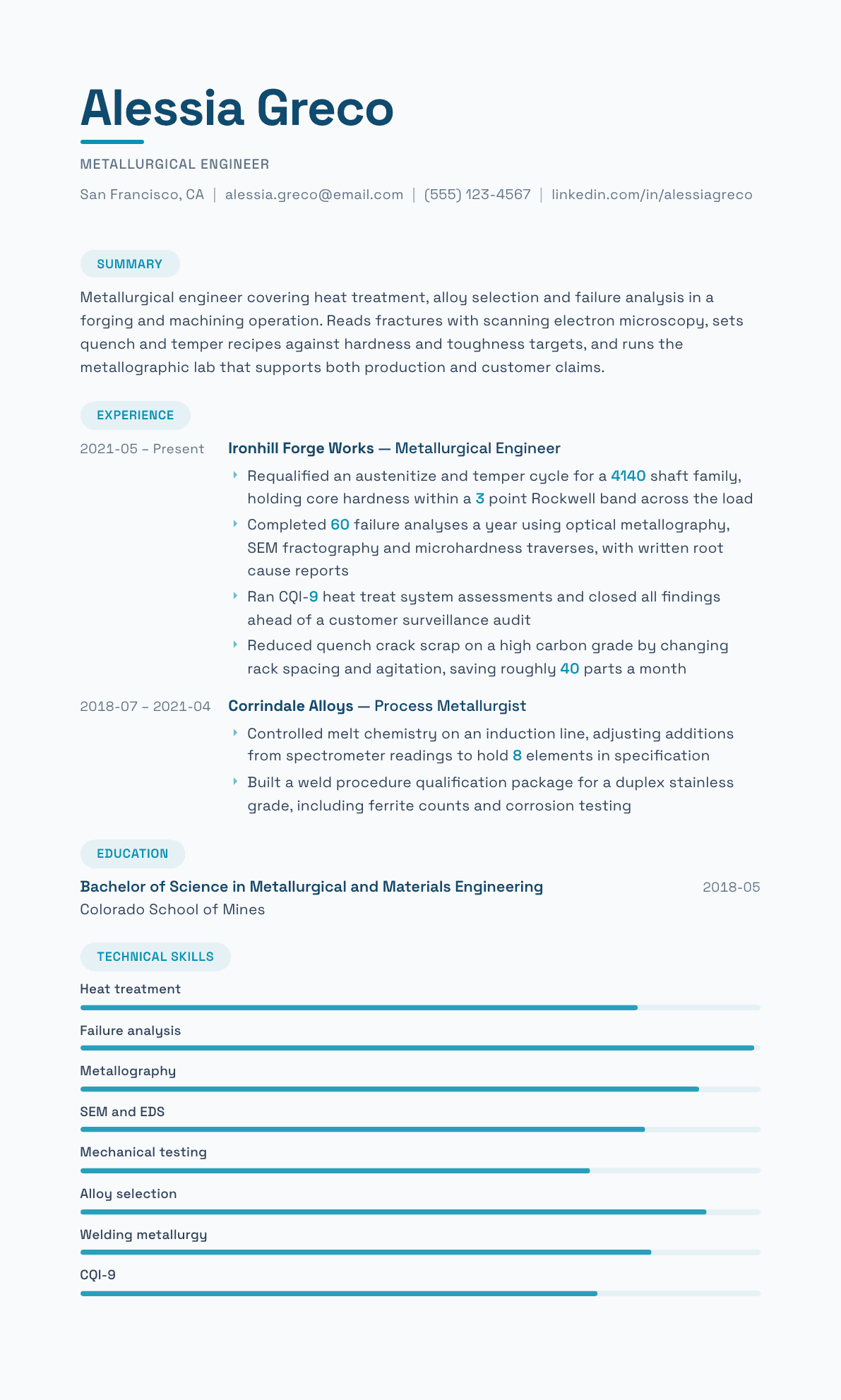
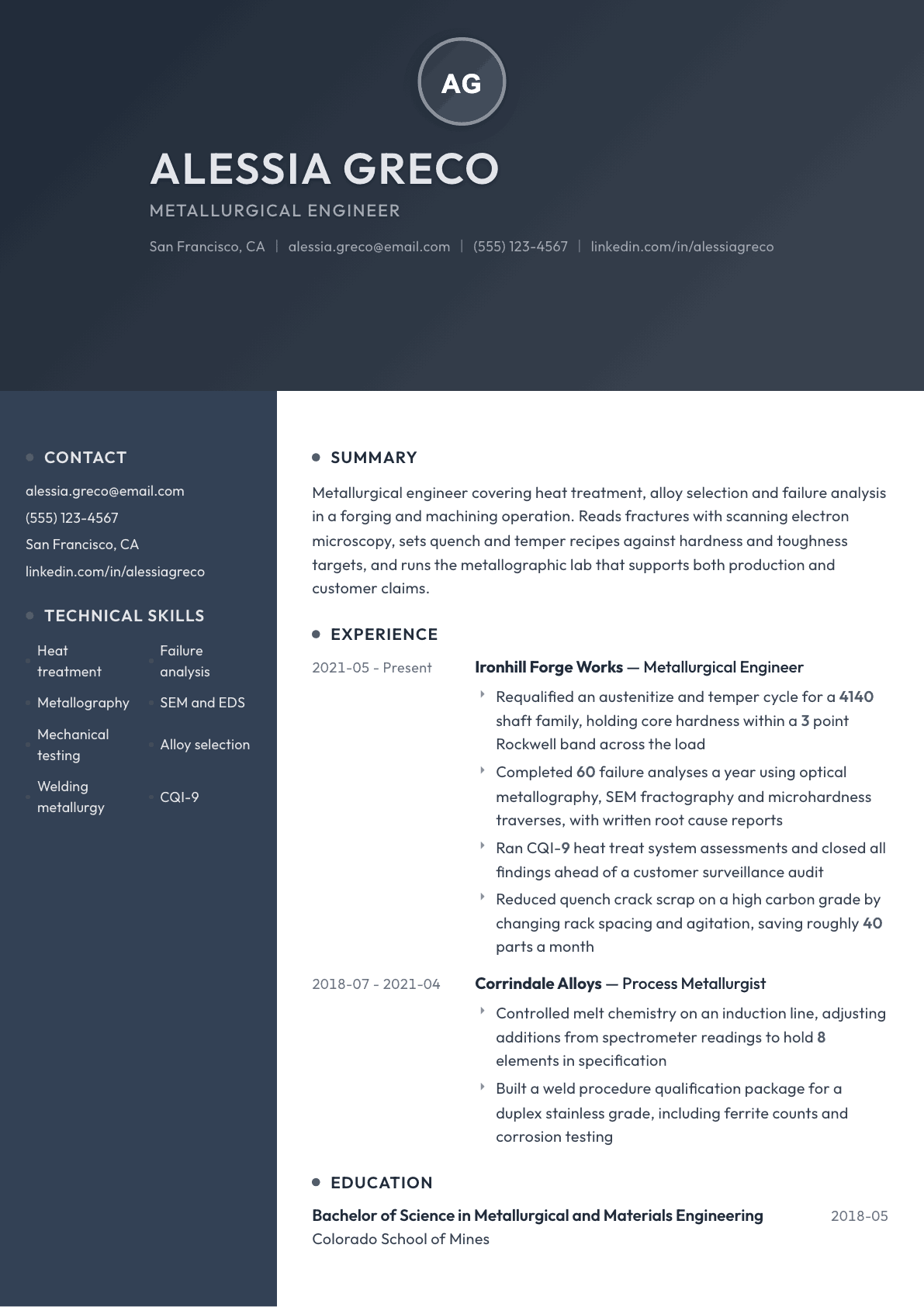
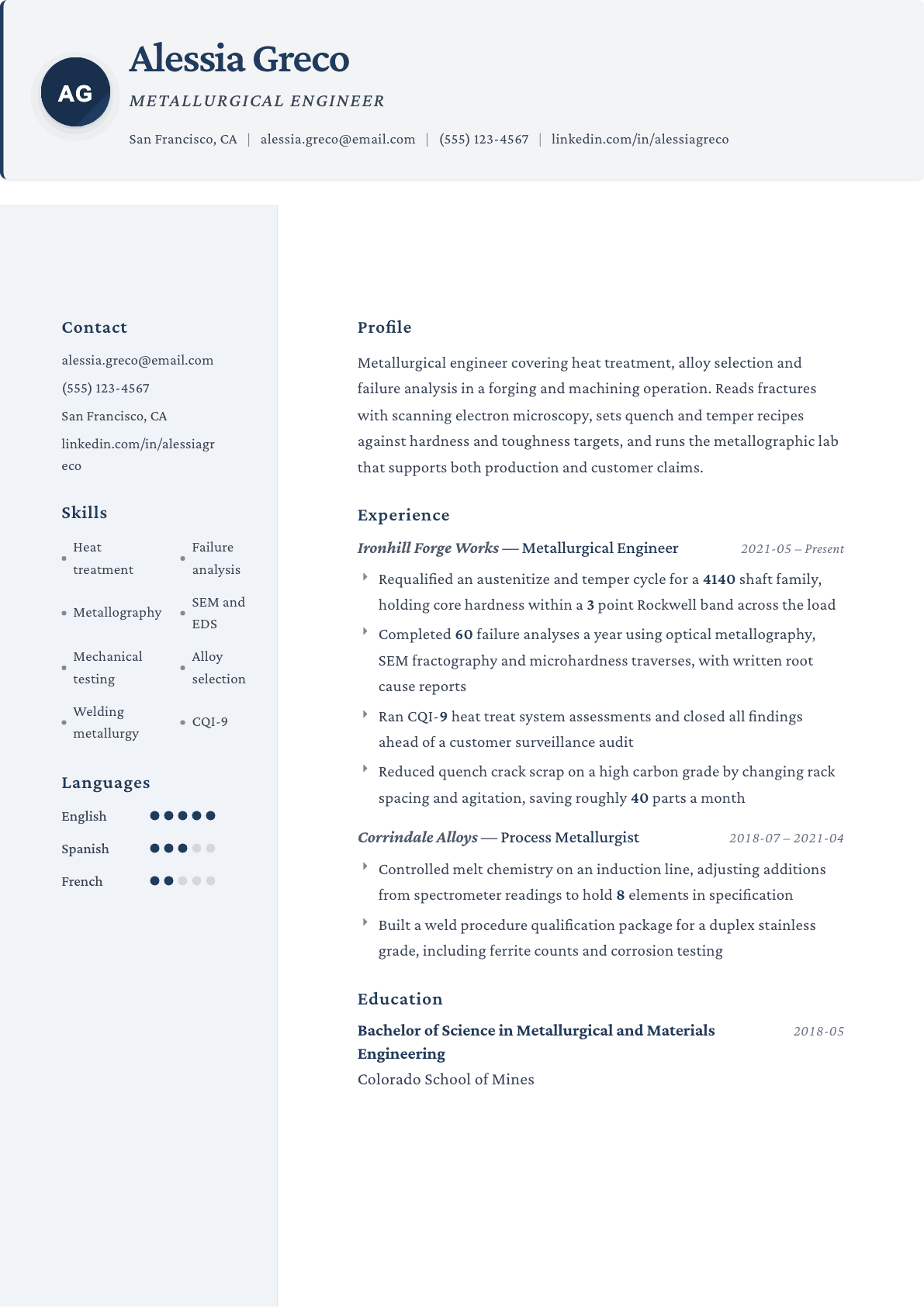
Example Metallurgical Engineer summary
Metallurgical engineer with six years in forging, melt and heat treat operations, covering alloy selection, quench and temper development, and root cause failure analysis. Works with optical metallography, SEM fractography and full mechanical testing, and holds heat treat systems to CQI-9. Reduced quench crack scrap on a high carbon grade through rack and agitation changes. Seeking a senior metallurgy role with lab and process ownership.
Skills to list on a Metallurgical Engineer resume
- Heat treatment and quench design
- Failure and root cause analysis
- Optical metallography
- SEM fractography and EDS
- Hardness and tensile testing
- Charpy impact testing
- Phase diagrams and microstructure
- Alloy and material selection
- Welding metallurgy
- Corrosion evaluation
- ASTM test methods
- CQI-9 heat treat assessment
- Statistical process control
- Nondestructive testing methods
What actually gets this resume read
- Lead each job with the material families you handled, since carbon steel, superalloy and aluminum work hire separately.
- Name your characterization equipment, because access to a scanning electron microscope changes what a lab can offer.
- Describe failure analyses by the mechanism you identified, such as hydrogen embrittlement, fatigue or intergranular attack.
- Reference the specifications you worked to, such as ASTM test methods, AMS material specs, or NADCAP and CQI-9 audits.
- Give heat treatment work real parameters: the grade, the cycle, the quench medium and the property target you held.
- Keep a publications or technical report line if you have written for a professional society, and cite the venue accurately.
How to write a metallurgical engineer resume
A metallurgical engineer is hired for a material family and a problem type, and the resume has to declare both in the opening lines. Carbon and alloy steel heat treatment, superalloy casting, aluminum extrusion, welding metallurgy and corrosion each draw a different pool of candidates, and a resume that says only metals gives the reader nothing to grip.
The strongest resumes in this discipline read a little like the reports the job produces. State the material, the process condition, the observation, the mechanism and the corrective action. A hiring manager who reads that structure in your bullets already knows how you write a failure analysis.
This guide covers the section order metallurgy groups expect, summaries for three career stages, before and after bullets from heat treat and failure work, and the questions engineers ask when their best analyses belong to a customer file.
Format: material families first, equipment second
Open each job with a scope line naming the material families, the processes on site and the lab equipment you had access to. A metallurgical engineer with a scanning electron microscope in the building does different work from one who sends samples out, and that single fact reshapes what a hiring manager expects you to be able to do.
Keep it to one page early and two pages once you have process ownership, audits and published work. Put certifications and any nondestructive testing levels in a credentials block, since those are searched for directly.
- Header: name, degree abbreviation, city and state, phone, email.
- Sections: summary, material and process scope, lab and characterization skills, experience, education, certifications.
- Add a standards line for the test methods and audit schemes you have worked to.
Summary: alloys, processes, and the analysis you run
Three lines. The alloy families, the processes you own, and the characterization you personally perform. Naming quench and temper development on alloy steel shafts alongside scanning electron microscope fractography tells a manager exactly which openings you fit.
Say whether you sit in production support, quality, or research. Those functions share a title and differ completely in daily work: one is on the floor when a load comes out of the furnace, one is writing the report that answers a customer complaint, and one is developing an alloy that will not ship for years.
Heat treatment and process work with real parameters
Heat treat bullets need parameters or they mean nothing. The grade, the austenitizing condition, the quench medium and agitation, the temper, and the property window you had to hold. Holding core hardness within a three point Rockwell band across a full load is a claim another metallurgist can evaluate; improving heat treatment quality is not.
Process improvements should carry the mechanism. Reducing quench crack scrap by changing rack spacing and agitation explains why the change worked, which is what separates an engineer from someone who adjusted a setting until the problem stopped.
If you have run furnace surveys, pyrometry checks or system assessments, list them explicitly. Temperature uniformity surveys and instrument calibration work are audit critical and are frequently the reason a metallurgist is hired into a plant.
Failure analysis: mechanism, not just conclusion
Name the failure mechanisms you have identified. Fatigue with beach marks and a ratchet origin, hydrogen embrittlement, intergranular stress corrosion cracking, creep, decarburization, overload ductile rupture: each name proves you can read a fracture surface rather than describe one.
Give the volume and the format. Sixty analyses a year, each closed with a written root cause report going to a customer, tells a manager you can carry a caseload and defend a conclusion in front of someone who does not want to hear it.
Include the corrective actions that followed. A failure analysis that changed a supplier specification or a process parameter is a complete story, and it is what distinguishes a metallurgical engineer from a laboratory technician.
Standards, audits and the lab you run
List the test methods you work to by their designation, because they function as keywords: tensile, hardness, impact, grain size, inclusion rating and case depth methods all have published standards, and naming them shows disciplined lab practice.
Audit experience is a strong differentiator. Heat treat system assessments, aerospace special process accreditation and customer surveillance audits all require someone who can produce records under pressure, and that person is usually the metallurgist. Say which schemes you have been assessed under and what the outcome was.
Metallurgical Engineer resume summary examples
New graduate
Metallurgical engineering graduate with senior research on carbide precipitation in a stainless grade, including 40 metallographic samples and microhardness mapping. Trained in optical metallography, sample preparation and hardness testing. Seeking an entry metallurgical engineer role in a heat treat or forging operation.
Six years in
Metallurgical engineer covering heat treatment, alloy selection and failure analysis in a forging operation. Requalified a quench and temper cycle holding core hardness within a 3 point Rockwell band, completes roughly 60 failure analyses a year using metallography and scanning electron microscope fractography, and runs heat treat system assessments.
Chief metallurgist
Chief metallurgist with seventeen years across melt, forging and heat treatment, owning material specifications for four product lines and the laboratory that supports them. Leads customer failure investigations, holds special process accreditation for the site, and has developed two alloy substitutions that removed a constrained raw material.
Work experience bullets: before and after
Before: Improved the heat treatment process.
After: Requalified an austenitize and temper cycle for a 4140 shaft family, holding core hardness within a 3 point Rockwell band across a full furnace load after a rack and load density change.
Grade, cycle, property window and the change made are all checkable, so the improvement becomes engineering rather than a claim.
Before: Conducted failure analysis on parts.
After: Completed about 60 failure analyses a year using optical metallography, scanning electron microscope fractography and microhardness traverses, issuing written root cause reports to customers on each.
Caseload, technique and the reporting standard show a metallurgist who can carry customer facing investigations.
Before: Reduced scrap in the plant.
After: Reduced quench crack scrap on a high carbon grade by roughly 40 parts a month by increasing rack spacing and quench agitation after thermal gradient measurements identified the cause.
The measurement that led to the change explains the mechanism, which makes the result repeatable.
Before: Handled melt chemistry.
After: Controlled melt chemistry on an induction line, adjusting additions from optical emission spectrometer readings to hold 8 elements inside specification across every heat.
Naming the instrument and the element count turns a supervision claim into a description of process control.
Before: Worked on welding procedures.
After: Built a weld procedure qualification package for a duplex stainless grade, including ferrite counts, bend and impact testing, and corrosion evaluation to the customer specification.
Listing the qualification elements proves the package would survive review, which is the whole point of the work.
Hard skills
- Heat treatment and quench design
- Failure and root cause analysis
- Optical metallography and sample preparation
- Scanning electron microscopy and energy dispersive spectroscopy
- Hardness and microhardness testing
- Tensile and Charpy impact testing
- Case depth and grain size evaluation
- Phase diagrams and microstructure interpretation
- Alloy and material selection
- Welding metallurgy and procedure qualification
- Corrosion testing and evaluation
- ASTM test methods
- Furnace surveys and pyrometry
- Statistical process control
- Nondestructive testing methods
Soft skills
- Defending a root cause conclusion
- Writing for a customer quality engineer
- Working with furnace operators
- Audit composure
- Prioritizing a lab caseload
- Training technicians on sample preparation
Certifications worth listing
- Certified Quality Engineer (American Society for Quality)
- Certified Welding Inspector (American Welding Society)
- NDT Level II, Liquid Penetrant and Magnetic Particle (American Society for Nondestructive Testing)
- Fundamentals of Engineering (FE) (NCEES)
- Professional Engineer (PE), Metallurgical and Materials (NCEES and state licensing boards)
Mistakes that cost metallurgical engineer candidates the interview
- Writing metals rather than naming the alloy families, which leaves the reader guessing at your actual specialty.
- Describing heat treat work without a grade, a cycle or a property target, so no metallurgist can evaluate it.
- Reporting failure analyses by count only, never naming a mechanism you identified.
- Leaving out lab equipment access, which changes what a hiring manager can expect you to do in the first month.
- Skipping the corrective action that followed an investigation, which reduces the work to an interesting observation.
- Omitting audit and system assessment experience, one of the strongest reasons plants hire a metallurgist at all.
Metallurgical Engineer resume questions
How do I write about failure analyses that belong to a customer?
Keep the metallurgy and drop the identity. Name the alloy class, the component type generically, the mechanism you found and the corrective action taken. That preserves everything a hiring metallurgist wants to evaluate while leaving out the customer, the part number and the commercial context.
Is a metallurgical engineering degree required for these roles?
Most postings ask for metallurgical or materials engineering, though mechanical and chemical graduates do enter through quality and process routes. If your degree is adjacent, put your metallurgy coursework, lab technique and any professional society training high enough that a screener sees it early.
How much should I emphasize scanning electron microscope work?
A great deal, if you operate one yourself. Fractography capability is the difference between a plant that can answer a customer complaint in a week and one that waits on an outside lab, and it is often the single reason a candidate is preferred.
Should I list publications and conference papers?
Yes, cited plainly with the venue and year, in a short section after experience. Technical society presentations carry real weight in this field because the community is small, and a paper shows you can defend a conclusion in front of peers who will argue with it.
What separates a process metallurgist from a quality metallurgist on paper?
A process metallurgist owns the parameters, the furnaces, the melt and the yield. A quality metallurgist owns the specification, the records, the customer response and the audit. Say which chair you sat in, because managers post those roles separately even when the titles look identical.
Related resume examples
- Materials Engineer Resume example
- Quality Engineer Resume example
- Welding Engineer Resume example
- Process Engineer Resume example
- Thermal Engineer Resume example
- R&D Engineer Resume example