Thermal Engineer Resume Examples: the lines they read
Create a Thermal Engineer Resume That Proves Heat Path Skill
By Mustafa Tarabya, founder of CVBooster · Published · Updated
Thermal engineer resume examples with cooling design, thermal testing and simulation bullets, plus recruiter keywords and a full writing guide.
Sample resumes for a thermal engineer
The same thermal engineer content laid out in three CVBooster templates, so you can see what the finished document looks like before you write a word.
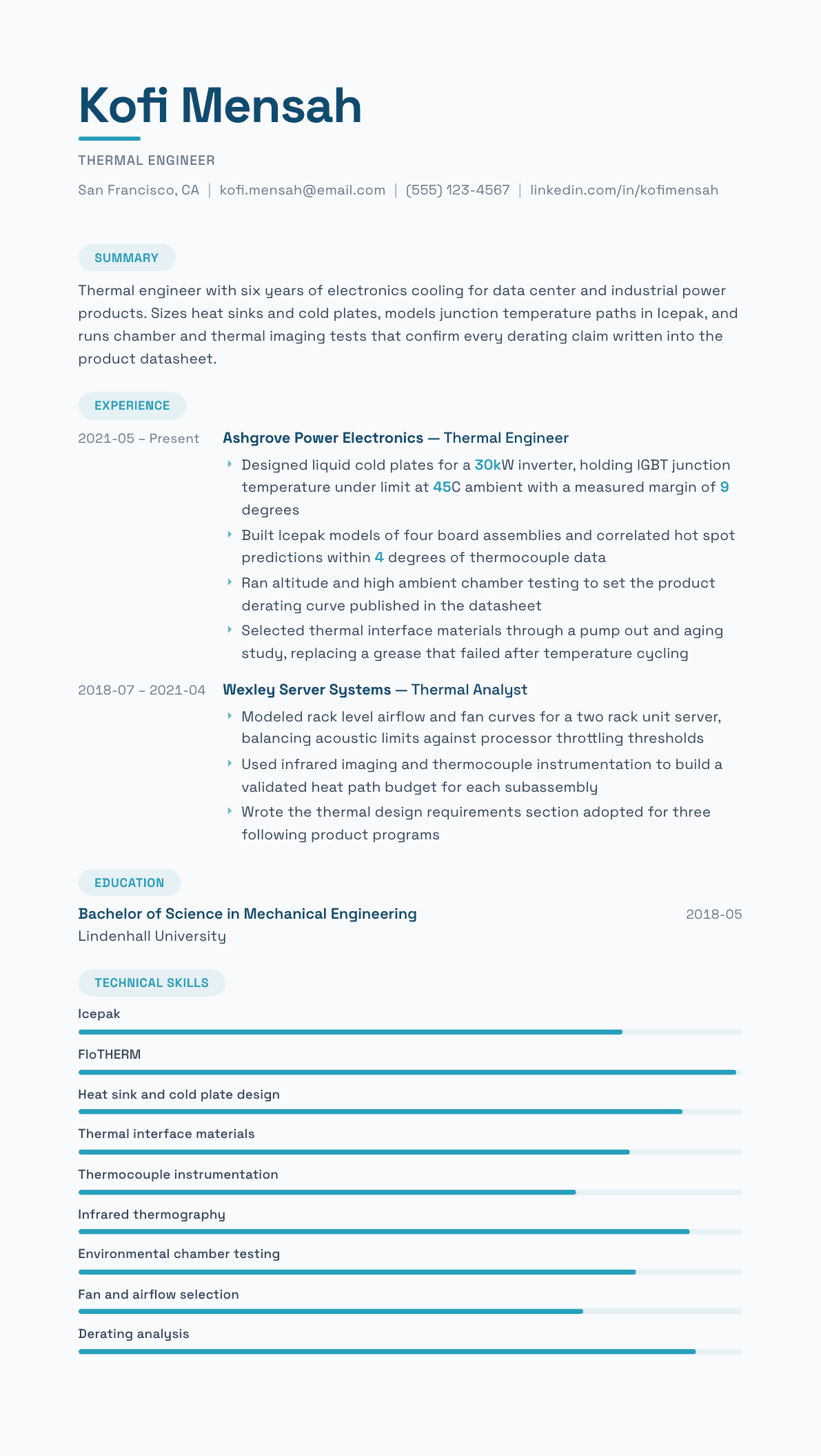
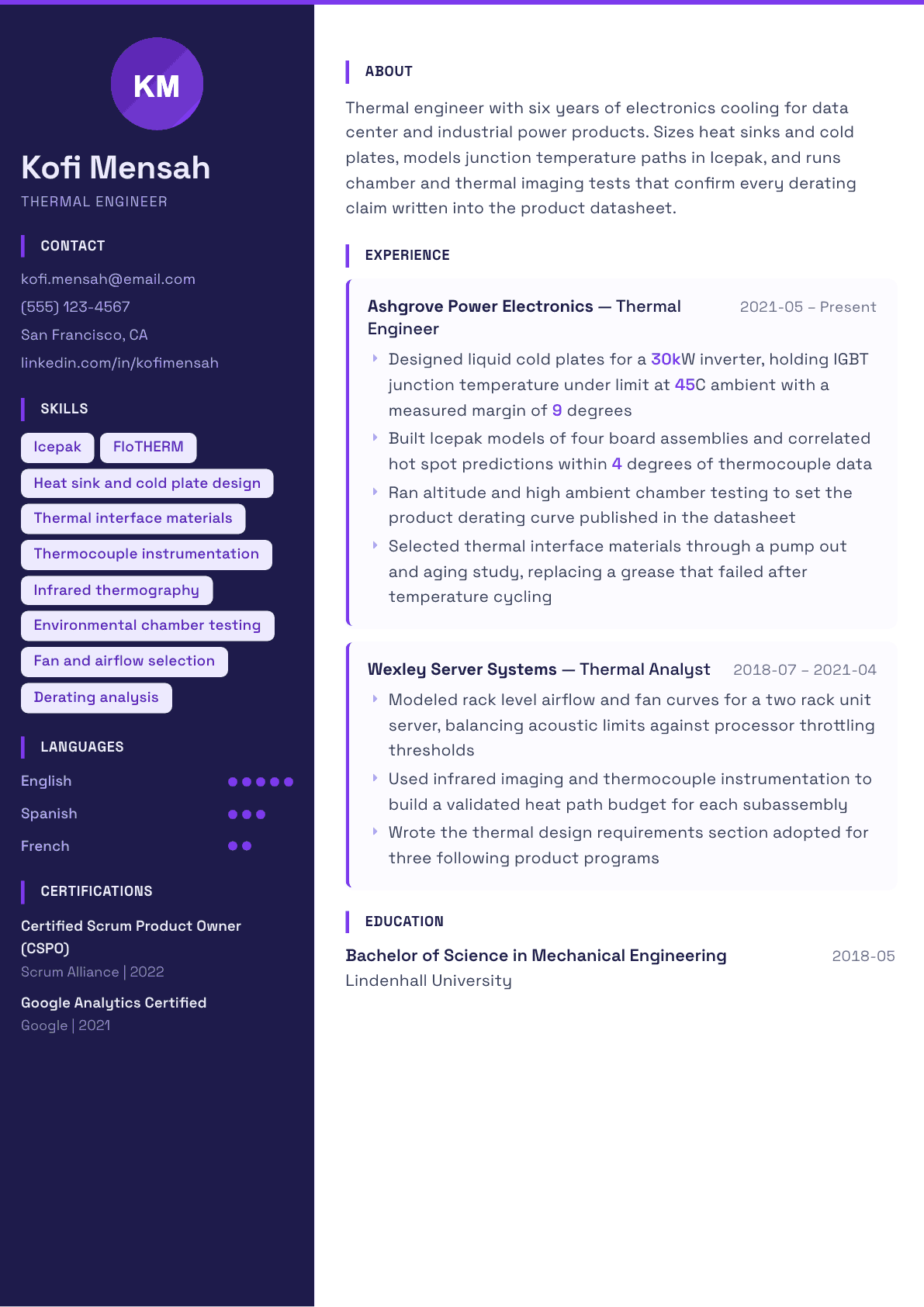

Example Thermal Engineer summary
Thermal engineer with six years cooling power electronics and server hardware. Sizes heat sinks, cold plates and liquid loops, builds Icepak models that land within a few degrees of thermocouple data, and proves the result in a chamber before the datasheet claims it. Designed cold plates for a thirty kilowatt inverter that held junction temperature under limit at high ambient. Bachelor of Science in mechanical engineering with strong instrumentation habits.
Skills to list on a Thermal Engineer resume
- Thermal simulation
- Icepak
- FloTHERM
- Computational fluid dynamics
- Heat sink design
- Cold plate and liquid loop design
- Thermal interface materials
- Junction temperature analysis
- Thermocouple instrumentation
- Infrared thermography
- Environmental chamber testing
- Fan selection and airflow balancing
- Derating analysis
- Heat pipe and vapor chamber solutions
- Design of experiments
What actually gets this resume read
- State the products you cooled, because power electronics, servers, batteries and aerospace avionics are different jobs.
- Give temperatures and margins in your bullets: junction temperature, ambient rating, delta to limit and measured correlation.
- Name both the simulation tool and the test rig, since a thermal claim without measurement is not credible to a reviewer.
- Include the interface material work, from grease and pads to pump out and aging behavior, which many resumes skip.
- Show whether you handled air cooling, liquid cooling or two phase systems, and say which loop you sized yourself.
- Reference the standard or specification you designed to, such as a derating curve or an altitude requirement.
How to write a thermal engineer resume
Thermal work is judged on margin. The engineer reading your resume wants to know whether the parts you cooled stayed under their limits, at what ambient, with how much room to spare, and whether anybody measured it afterward. A thermal engineer resume without temperatures on it is asking a reader to take the whole page on faith, and in a discipline where a datasheet claim can trigger a field failure, nobody does that.
The second question is which physical regime you have worked in. Air cooled electronics, liquid cold plates, two phase systems, heat pipes and vapor chambers, and vehicle or aerospace environments demand different intuition and different suppliers. Naming the products you cooled places you immediately, and it stops a hiring manager from assuming you are a building services engineer who learned some analysis.
This guide covers how to write thermal bullets with temperatures and margins, why simulation without instrumentation is a weakness rather than a strength, where interface material work belongs, and the questions engineers ask when moving between server, power electronics and vehicle thermal roles.
Format: single column, products cooled named early
Reverse chronological, plain layout, no side panels. Add a short line under the summary naming the product classes you have cooled and the cooling regimes you have designed, since those two facts do more sorting than anything else on the page.
One page under about four years and two pages after that. The second page is well spent on a tools and instrumentation block, because a hiring manager reads a thermal engineer's equipment list to work out whether the analysis was ever checked against a thermocouple.
- Header: name, city and state, phone, email, and the cooling regime you specialize in.
- Sections in this order: summary, tools and instrumentation, experience, education, certifications.
- Graduates lead with education and describe a heat transfer project by its measured temperatures.
Summary: product, regime, and a margin you proved
Four lines. Name the product, the power level, the cooling regime and one margin you held with measurement behind it. Holding a junction temperature under limit at a stated ambient with a measured margin says more about your capability than any list of software.
If you are moving between product classes, say which physics transfers. Heat path budgeting, interface material behavior, instrumentation practice and correlation discipline all carry across. Airflow intuition from a server rack does not automatically carry into a sealed enclosure, and a reader respects the distinction.
Experience: the heat path, the model, the chamber, the datasheet
Write bullets that follow the heat from the die to the ambient. Name the source and its dissipation, the spreader or cold plate, the interface material, and the final rejection path, whether that is a fan, a liquid loop or a chassis. A reader who can trace that path through your sentence knows you own the whole budget rather than one component.
Every simulation bullet needs a measurement beside it. Say what you modeled, how you correlated it, and what the difference was against thermocouple or infrared data. Predictions inside a few degrees of measurement is a claim a thermal engineer can respect; accurate thermal modeling is not.
Testing deserves its own bullets. Chamber work at high ambient and altitude, instrumented builds with thermocouple counts, infrared imaging, and the derating curve that came out of it are the parts of the job that end up published in a datasheet. That is the sentence that shows your work carried consequences.
Add interface material work if you have done it. Grease pump out, pad compression set, aging behavior after temperature cycling and the selection study that replaced a failing material are details most resumes skip entirely, which makes them a strong differentiator when present.
Tools and instrumentation, kept separate
Give simulation tools one line and instrumentation another. On the simulation side, name the electronics cooling package you use, any general purpose fluid solver, and whether you build compact component models or resolve geometry. On the instrumentation side, name thermocouple types and attachment practice, infrared imaging, power measurement, flow measurement and the chamber capability you had access to.
A reader is looking for the pairing. Analysis with no instrumentation reads as a simulation engineer applying for a thermal job, and testing with no analysis reads as a technician. The two lines together are the profile the posting was written for.
- Simulation: electronics cooling solver, general fluid solver, compact modeling practice.
- Instrumentation: thermocouples, infrared imaging, flow and power measurement.
- Environment: chambers, altitude capability, acoustic bench if airflow noise was a constraint.
- Hardware you specified: heat sinks, cold plates, fans, pumps, heat pipes, interface materials.
Numbers a thermal reviewer looks for
Four figures do the work on this page. Dissipated power, ambient condition, temperature at the critical component, and the margin to its limit. Add correlation accuracy where you have it, and the acoustic or airflow constraint that bounded the design if there was one.
Present them as a condition rather than a boast. A cold plate that held a device under limit at high ambient with a measured margin, at a stated flow rate and pressure drop, gives a reviewer every number he would have asked for in the interview.
Thermal Engineer resume summary examples
New graduate
Mechanical engineering graduate with heat transfer coursework and a project instrumenting a finned heat sink across three airflow rates, comparing measured temperatures against a simple resistance network. Comfortable with thermocouple attachment, a data logger and a commercial thermal solver. Seeking an electronics cooling position.
Six years in
Thermal engineer with six years cooling power electronics and server hardware. Designed liquid cold plates for a 30kW inverter that held device junction temperature under limit at 45C ambient with 9 degrees of measured margin, and correlated board level models within 4 degrees of thermocouple data.
Thermal architect
Thermal architect with twelve years owning cooling strategy across a product family, from heat path budgets and supplier selection through chamber validation and the derating curves published to customers. Sets correlation standards for the analysis team and arbitrates thermal against acoustic and mechanical requirements at program reviews.
Work experience bullets: before and after
Before: Designed cooling for a power converter.
After: Designed liquid cold plates for a 30kW inverter, holding switching device junction temperature under limit at 45C ambient with 9 degrees of measured margin at the specified coolant flow rate.
Power, ambient, margin and flow condition give a reviewer the complete thermal statement rather than a design claim.
Before: Built thermal models of the product.
After: Built thermal models of four board assemblies with component level power maps and correlated predicted hot spots within 4 degrees of thermocouple measurements on the built hardware.
The correlation band turns modeling from an activity into a validated prediction the program can rely on.
Before: Ran environmental testing on the units.
After: Ran altitude and high ambient chamber testing on instrumented units, and used the results to set the derating curve published in the product datasheet.
Naming the published outcome shows the testing carried commercial consequence rather than ending in a folder.
Before: Selected thermal interface materials.
After: Selected thermal interface materials through a pump out and aging study after temperature cycling, replacing a grease that degraded in the field with a pad that held resistance across the cycle count.
The failure mode and the test method make a component choice look like engineering rather than a catalog pick.
Before: Worked on airflow and fan noise for a server.
After: Modeled rack level airflow and fan curves for a two rack unit server, balancing acoustic limits against processor throttling thresholds and verifying the chosen curve on the acoustic bench.
Naming the competing constraints and the verification bench shows a real tradeoff was managed and measured.
Hard skills
- Electronics cooling simulation
- Computational fluid dynamics
- Heat sink design and selection
- Cold plate and liquid loop design
- Heat pipe and vapor chamber solutions
- Thermal interface material selection
- Junction temperature and heat path budgeting
- Thermal resistance network modeling
- Thermocouple instrumentation
- Infrared thermography
- Environmental chamber and altitude testing
- Fan selection and airflow balancing
- Derating analysis
- Design of experiments
Soft skills
- Insistence on measurement before a claim
- Negotiating thermal against acoustic limits
- Working with electrical and mechanical designers
- Supplier evaluation
- Clear reporting of margin and risk
Certifications worth listing
- Fundamentals of Engineering (FE) (NCEES)
- Professional Engineer (PE), Mechanical (NCEES)
- Certified Six Sigma Green Belt (CSSGB) (American Society for Quality)
Mistakes that cost thermal engineer candidates the interview
- Writing about cooling with no temperatures, which asks a reviewer to trust a discipline that runs entirely on numbers.
- Showing simulation with no instrumentation, the fastest way to be read as an analyst rather than a thermal engineer.
- Omitting the ambient condition, so a junction temperature claim cannot be judged at all.
- Skipping interface materials, one of the most common causes of field failure and one of the rarest topics on these resumes.
- Failing to name the cooling regime, leaving a liquid cooling team unsure whether you have ever sized a loop.
- Describing airflow work without the acoustic or power constraint that made it difficult.
- Listing every solver rather than the one you use daily and can defend under technical questioning.
Thermal Engineer resume questions
How much of a thermal engineer resume should be testing versus simulation?
Roughly balanced, with the correlation between them made explicit. Employers hiring for this title have usually been let down by analysis that was never validated, so a resume that shows both a model and the thermocouple data behind it stands out immediately.
Can I include temperatures from a former employer's product?
Yes, when you describe conditions rather than identifying the product. Power level, ambient, margin and correlation band are engineering facts that carry your capability, and stated without a product name or a customer they rarely raise a confidentiality concern.
Should I mention liquid cooling if I have only sized one loop?
Mention it and say what you owned. Sizing a loop, selecting a pump, or specifying a cold plate are each distinct pieces, and naming yours precisely is far safer than a broad claim that unravels when an interviewer asks about pressure drop.
How do I move from building services into electronics thermal work?
Lead with the transferable core: heat transfer fundamentals, fluid network sizing, instrumentation and measurement discipline. Then be explicit about the gap in component level work, and highlight any board, enclosure or device cooling project you have done, even a small one.
Is a professional engineer license expected for thermal roles?
Not in electronics or product thermal work, where it is rare and seldom requested. It carries more weight in facilities, building systems and consulting. For product roles, correlated models and chamber results will influence a hiring manager far more.
Related resume examples
- Mechanical Engineer Resume example
- Aerospace Engineer Resume example
- HVAC Engineer Resume example
- Simulation Engineer Resume example
- Materials Engineer Resume example
- Metallurgical Engineer Resume example