Simulation Engineer Resume Examples: what gets the call
Write a Simulation Engineer Resume That Shows Real Correlation
By Mustafa Tarabya, founder of CVBooster · Published · Updated
Simulation engineer resume examples covering FEA and CFD work, test correlation, solver experience, ATS keywords and a section by section guide.
Sample resumes for a simulation engineer
The same simulation engineer content laid out in three CVBooster templates, so you can see what the finished document looks like before you write a word.
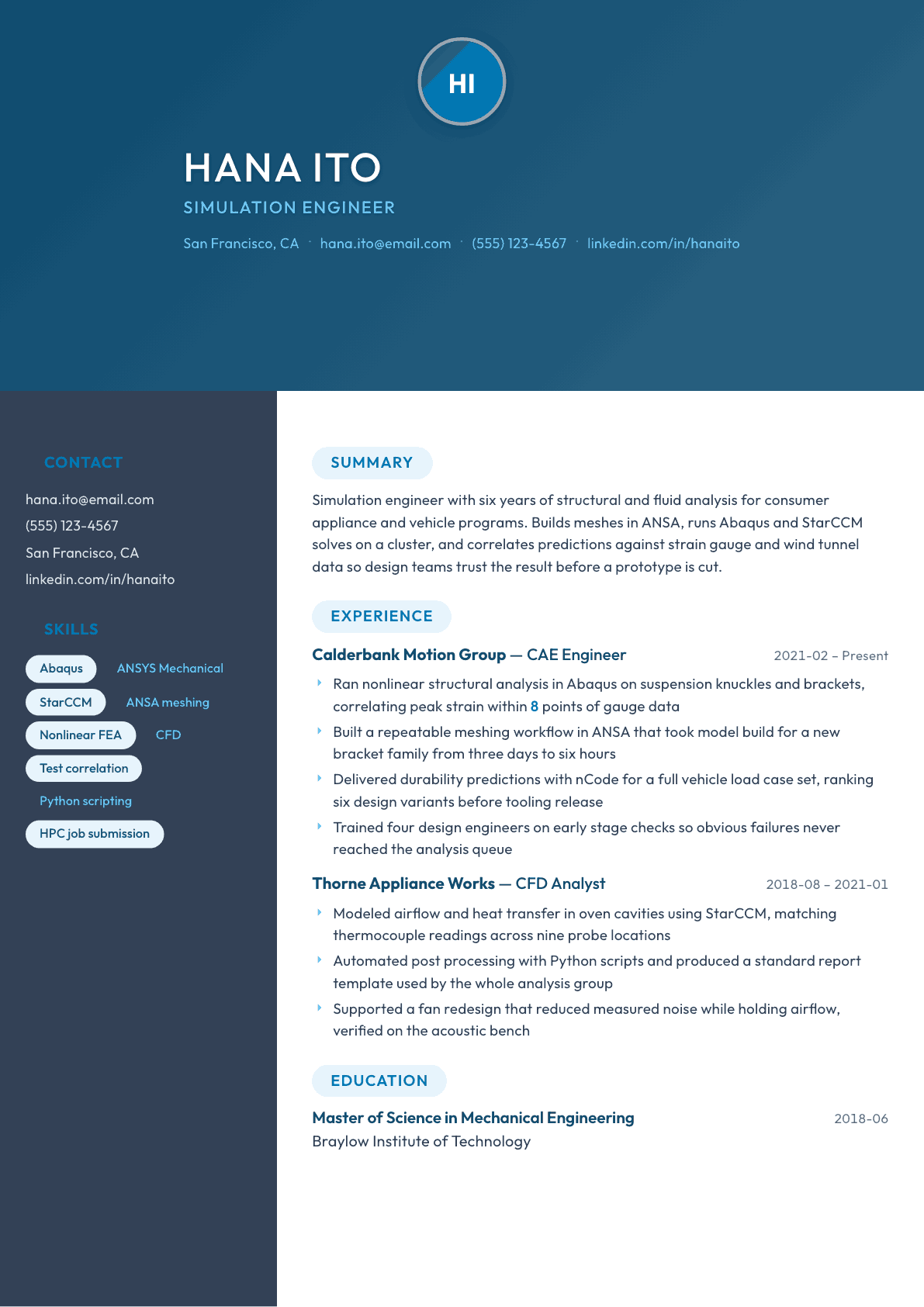
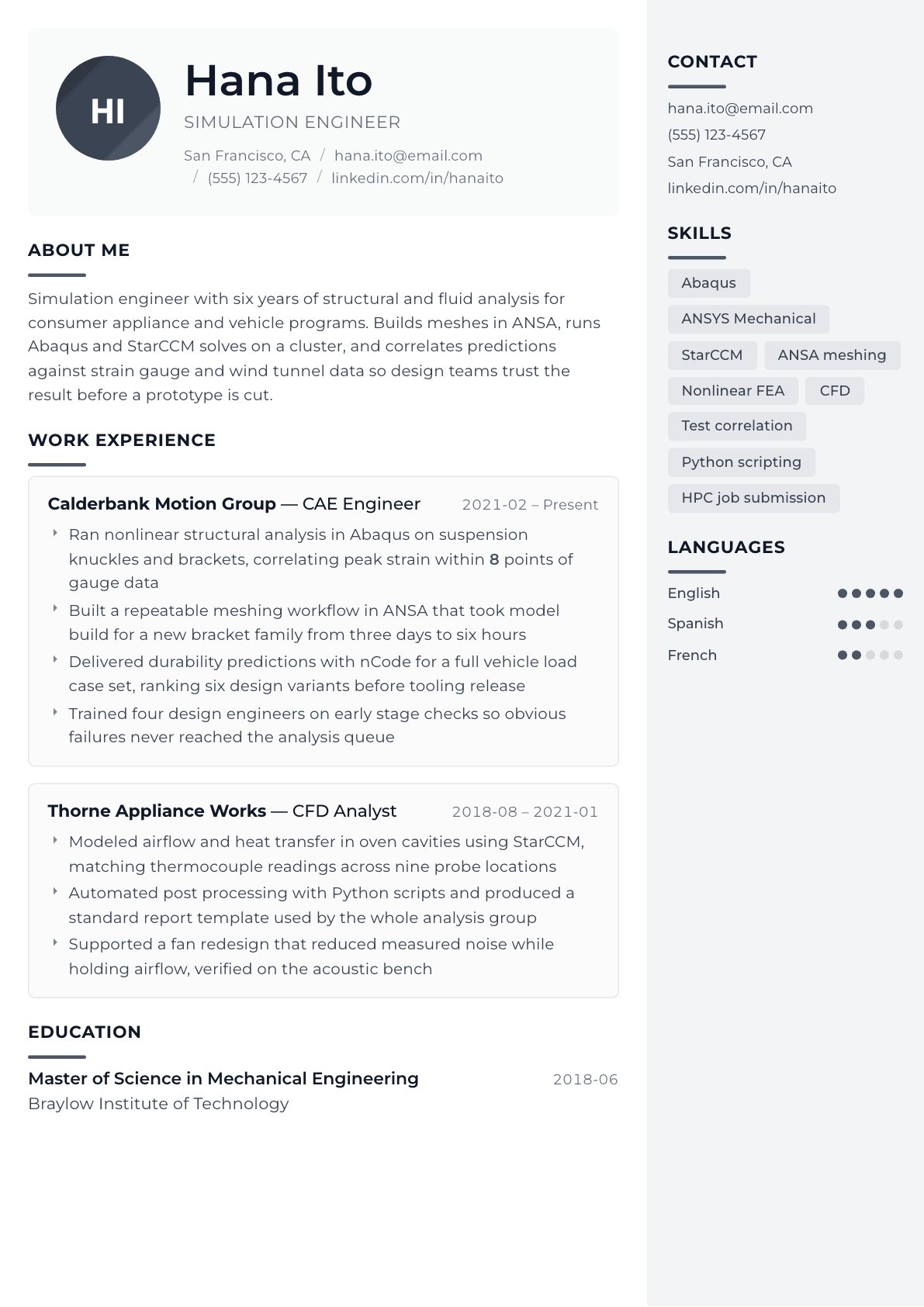
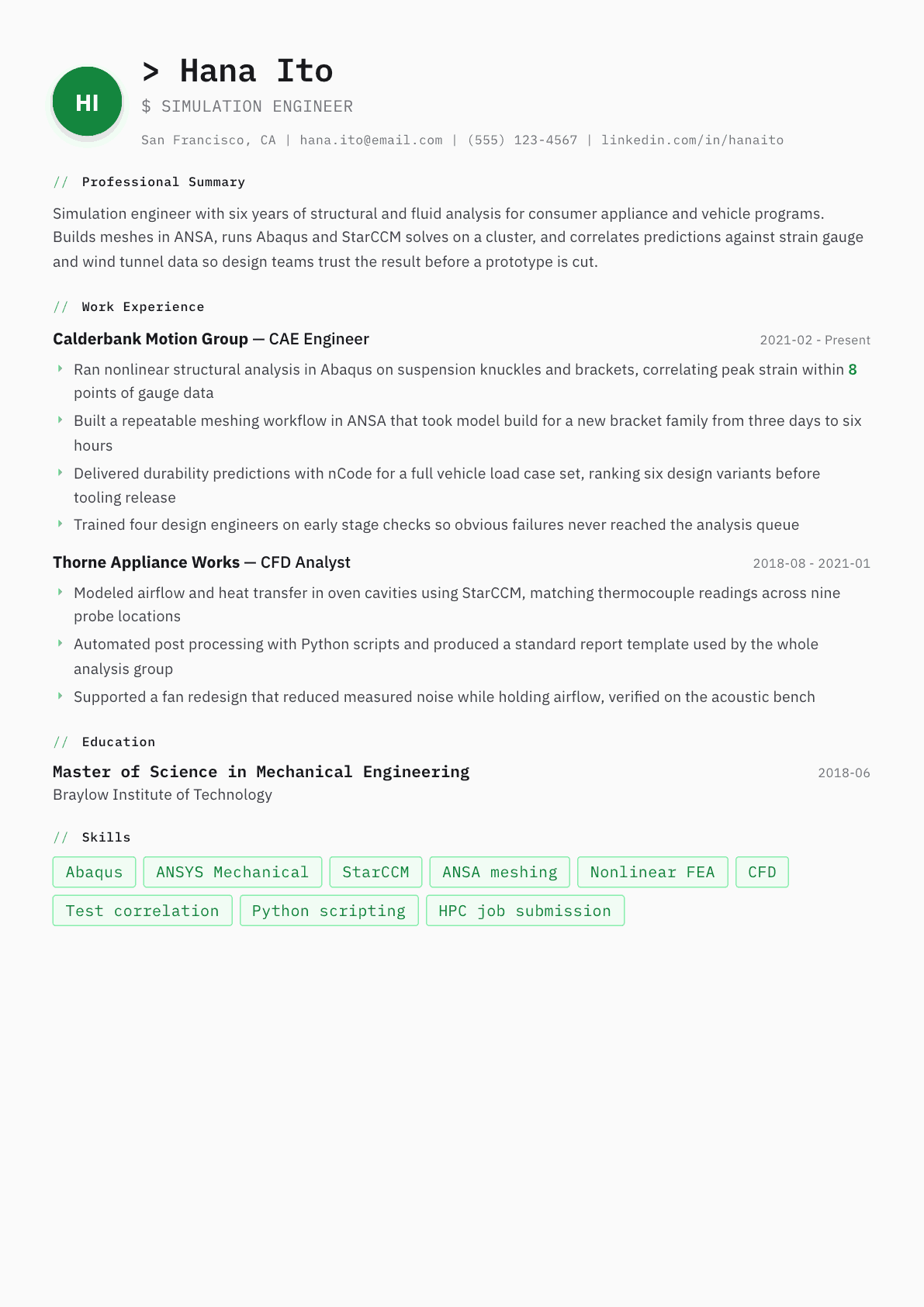
Example Simulation Engineer summary
Simulation engineer with six years of structural and fluid analysis across vehicle and appliance programs. Meshes in ANSA, solves in Abaqus and StarCCM on a cluster, and closes every study by correlating against strain gauge or thermocouple data. Built a meshing workflow that cut model build for a bracket family from three days to six hours. Master of Science in mechanical engineering, fluent in Python for automated post processing.
Skills to list on a Simulation Engineer resume
- Nonlinear FEA
- Abaqus
- ANSYS Mechanical
- LS-DYNA
- CFD
- StarCCM
- OpenFOAM
- ANSA meshing
- HyperMesh
- Modal and vibration analysis
- Durability and fatigue analysis
- Test correlation
- Python scripting
- HPC cluster workflows
- Design of experiments
- Report and review presentation
What actually gets this resume read
- Name the solvers, not just the physics, because a hiring manager screens on Abaqus, ANSYS, LS-DYNA, StarCCM or OpenFOAM.
- Say how your results were checked against physical test, since correlation is the only proof a simulation was useful.
- Give mesh and model scale, such as element counts, contact pairs or cell counts, to show the size of problem you handle.
- Separate preprocessing tools from solvers, because meshing skill in ANSA or HyperMesh is hired for on its own.
- Mention the decision your analysis changed, from a rib layout to a cooling path, rather than only the study you ran.
- Add automation work in Python or scripting, as analysis groups value engineers who remove manual report building.
How to write a simulation engineer resume
Every analysis group has been burned by a simulation engineer who could build a beautiful model and never checked it against anything physical. That memory is what your resume is read against. The manager scanning it is looking for one thing above all others: proof that your predictions were compared to test data and that you know how close they landed.
The second filter is solver specific. Simulation is not a general skill, it is a stack. Preprocessing, solver, physics and post processing each carry their own names, and a posting is written around a particular combination. A resume that says finite element analysis and computational fluid dynamics without naming the tools will be passed over by a screener who was told to look for a solver by name.
This guide covers how to structure a simulation engineer resume around correlation, how to describe model scale so a reader can judge the class of problem you handle, where automation and cluster work belong, and the questions analysts ask when moving between industries or between structures and fluids.
Format: single column, tool stack visible above the fold
Reverse chronological and plain. The one addition worth making is a compact tool stack near the top, arranged in the order the work happens: preprocessing, solver, physics, post processing and cluster environment. That layout mirrors how an analysis lead thinks about a candidate and lets him place you before he reads a single job entry.
One page under about four years, two pages afterward. If you have a research background, keep publications to a short block with titles and venues; the analysis work you did for products should still occupy more space than the papers.
- Header: name, city and state, phone, email, and the physics you specialize in.
- Sections in this order: summary, tool stack, experience, education, publications if relevant.
- Graduates lead with education and describe a thesis model by its mesh, its solver and its validation.
Summary: physics, solvers, industry, and one correlation result
Four lines. Name the physics, the solvers, the industry, and one number that shows a prediction was checked. Structural and fluid work are different hiring pools even inside one company, so say which you own and which you support.
Correlation belongs in the summary, not buried on page two. An engineer whose first three lines say strain predictions landed inside a stated band of gauge measurements has answered the reader's main question before he asked it.
Experience: the model, the scale, the correlation, the decision
Structure every analysis bullet around four parts. What you modeled, at what scale, how it was validated, and what design decision changed as a result. The fourth part is the one candidates skip and the one that separates an analyst from a report generator. A study that ranked six design variants before tooling release is worth more than a study that simply ran.
Give scale in the language of the field. Element counts, contact pair counts, cell counts, load case counts and solve times all communicate the size of problem you handle. Nonlinear contact and material nonlinearity should be named explicitly, because a reader assumes linear static work unless told otherwise.
Preprocessing deserves its own bullet. Meshing capability in a dedicated preprocessor is hired for on its own, and a workflow that took a model build from three days to six hours is an operational result an analysis manager will remember longer than any contour plot.
Add automation if you have it. Scripted post processing, templated report generation and job submission on a cluster are what let a small group serve a large program, and analysis leads value engineers who remove manual assembly of results.
Correlation: the section that decides the interview
Say what you correlated against and how close you got. Strain gauges, accelerometers, thermocouples, load cells, wind tunnel results, drop test high speed footage and durability rig data are all valid, and naming the instrument makes the claim checkable. Then state the band, whether that is a difference in peak strain, a temperature delta, or a frequency shift on the first few modes.
When a correlation was poor, that story is still usable and often more impressive. Describing how you found a boundary condition error, a missing joint stiffness or a wrong material card shows the reader you audit your own models, which is the trait every analysis group actually needs.
- The physical measurement you compared against, named by instrument.
- The agreement band you achieved, stated plainly.
- The model change that closed a gap when the first comparison failed.
- Whether the correlated model was then used to explore variants without further testing.
Keywords a simulation posting repeats
These postings reuse a predictable set: nonlinear analysis, contact, modal and vibration, durability and fatigue, thermal, computational fluid dynamics, meshing, test correlation, design of experiments and high performance computing. Mirror each once in the tool stack and once in a bullet.
Put the solver names in their own line rather than mixed with physics. A recruiter is often matching literal strings from the requisition, and a solver buried inside a sentence is easy for a scan to miss.
Simulation Engineer resume summary examples
New graduate
Mechanical engineering graduate with thesis work in nonlinear structural analysis, meshing a bolted joint assembly and validating predicted stiffness against a laboratory pull test. Comfortable with a commercial solver, a dedicated preprocessor and Python for post processing. Seeking a junior analysis position on a product team.
Six years in
Simulation engineer with six years of structural and fluid analysis across vehicle and appliance programs. Meshes in a dedicated preprocessor, solves nonlinear cases on a cluster, and correlated peak strain on suspension brackets within 8 points of gauge data before tooling release.
Analysis lead
Analysis lead with thirteen years owning the structural simulation strategy for a vehicle program, including method development, correlation standards and the review gate that sign off depends on. Mentors four analysts, sets meshing and material card practice, and defends predictions in front of test and design teams.
Work experience bullets: before and after
Before: Performed FEA on suspension components.
After: Ran nonlinear structural analysis on suspension knuckles and brackets with contact and plasticity, correlating peak strain within 8 points of gauge measurements from the durability rig.
The nonlinearity, the components and the correlation band together show a validated analysis rather than a rendering.
Before: Improved the meshing process for the team.
After: Built a repeatable meshing workflow in a dedicated preprocessor with reusable criteria files, taking model build for a new bracket family from three days to six hours.
The mechanism and the time saved make it an operational improvement a manager can budget against.
Before: Did CFD analysis on product airflow.
After: Modeled airflow and heat transfer inside oven cavities, matching predicted temperatures against thermocouple readings at nine probe locations before the design was released.
Naming the probe count and the physics turns a vague fluids claim into a validated thermal study.
Before: Ran durability studies on design options.
After: Delivered durability predictions across a full vehicle load case set and ranked six design variants on predicted life, which let the team choose a rib layout before tooling was cut.
The decision the analysis enabled is what makes the work valuable, and it belongs in the sentence.
Before: Automated reporting with scripts.
After: Automated post processing in Python and produced a standard report template that the whole analysis group now uses, removing a day of manual plot assembly from every study.
Naming the adoption and the time removed shows the automation outlived the project it was written for.
Hard skills
- Nonlinear finite element analysis
- Contact and material nonlinearity
- Explicit dynamics and impact analysis
- Computational fluid dynamics
- Conjugate heat transfer
- Modal and vibration analysis
- Durability and fatigue prediction
- Mesh generation in a dedicated preprocessor
- Material card preparation and calibration
- Test correlation methods
- Python scripting for pre and post processing
- High performance cluster job submission
- Design of experiments and variant studies
- Technical review presentation
Soft skills
- Skepticism toward your own results
- Explaining assumptions to design engineers
- Working with test engineers on instrumentation
- Scoping a study to the decision it serves
- Clear written reporting
Certifications worth listing
- Professional Simulation Engineer (PSE) (NAFEMS)
- Certified SOLIDWORKS Professional in Simulation (Dassault Systemes)
- Fundamentals of Engineering (FE) (NCEES)
- Professional Engineer (PE) (NCEES)
Mistakes that cost simulation engineer candidates the interview
- Writing finite element analysis without naming a solver, which fails the literal keyword match a recruiter was handed.
- Presenting results with no correlation, in a field where an uncorrelated model is treated as an opinion.
- Leaving out model scale, so a reader cannot tell a single part study from a full assembly with hundreds of contact pairs.
- Describing studies rather than decisions, which makes the analysis group look like a service desk rather than an input to design.
- Hiding meshing skill inside a solver line, when preprocessing capability is hired for on its own.
- Listing every solver ever opened instead of the two or three you can defend under questioning.
- Letting a publication list outweigh the product analysis work when applying to an industrial team.
Simulation Engineer resume questions
How do I write about correlation if my company never ran physical tests?
Say so honestly and describe the verification you did instead: mesh convergence studies, comparison against hand calculations or closed form solutions, benchmark cases, and cross checks between solvers. Demonstrating verification discipline is the next best thing to correlation and a reader will recognize it.
Should I list both structural and fluids work?
List both, but declare a primary. Groups hire against one physics and treat the second as useful breadth, so leading with a mixed identity can cost you both queues. Name your main physics in the summary and let the second appear in the experience bullets.
How much detail about mesh size and element counts is useful?
Enough to establish the class of problem, usually one figure per major project. Element or cell counts, contact pair counts and solve time give a reader the scale without turning the resume into a modeling report, and they invite the technical question you want to be asked.
Does scripting experience matter for a simulation engineer?
It matters more each year. Groups run large variant studies and cannot assemble every report by hand, so an engineer who automates model setup, extraction and plotting expands the team capacity. One concrete automation bullet is enough to make the point.
Is a professional engineer license valuable in analysis work?
It is uncommon outside civil and structural consulting but never a disadvantage. For product analysis roles, a recognized simulation credential and a track record of correlated models will influence a hiring manager more than a license he does not require for the position.
Related resume examples
- Mechanical Engineer Resume example
- Aerospace Engineer Resume example
- Design Engineer Resume example
- Thermal Engineer Resume example
- Engineering Intern Resume example
- Semiconductor Engineer Resume example