Military Officer Resume Examples: the lines they read
Write a Military Officer Resume Civilian Executives Understand
By Mustafa Tarabya, founder of CVBooster · Published · Updated
Military officer resume example with command scope, budget figures and a keyword list for program manager and operations director roles.
Sample resumes for a military officer
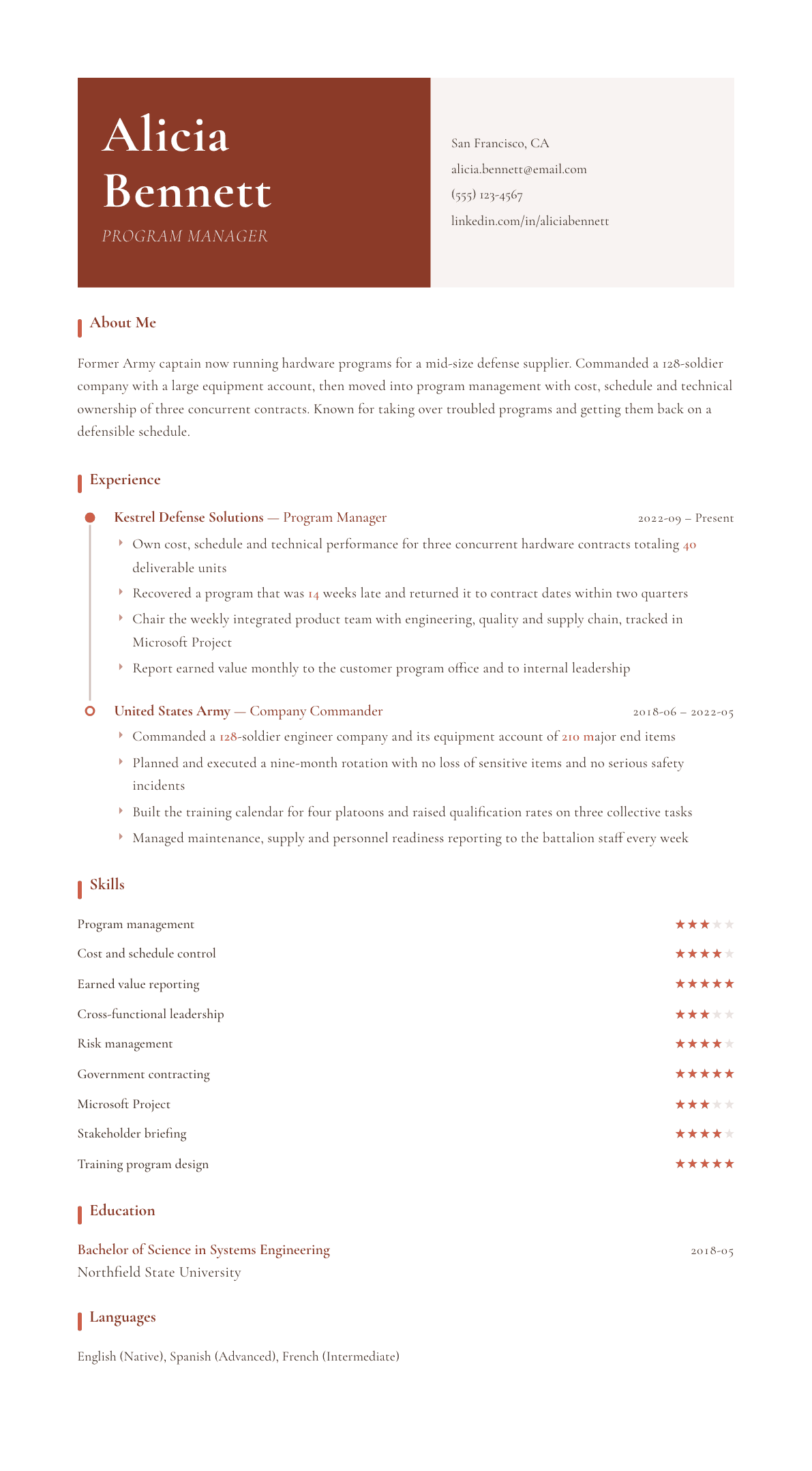
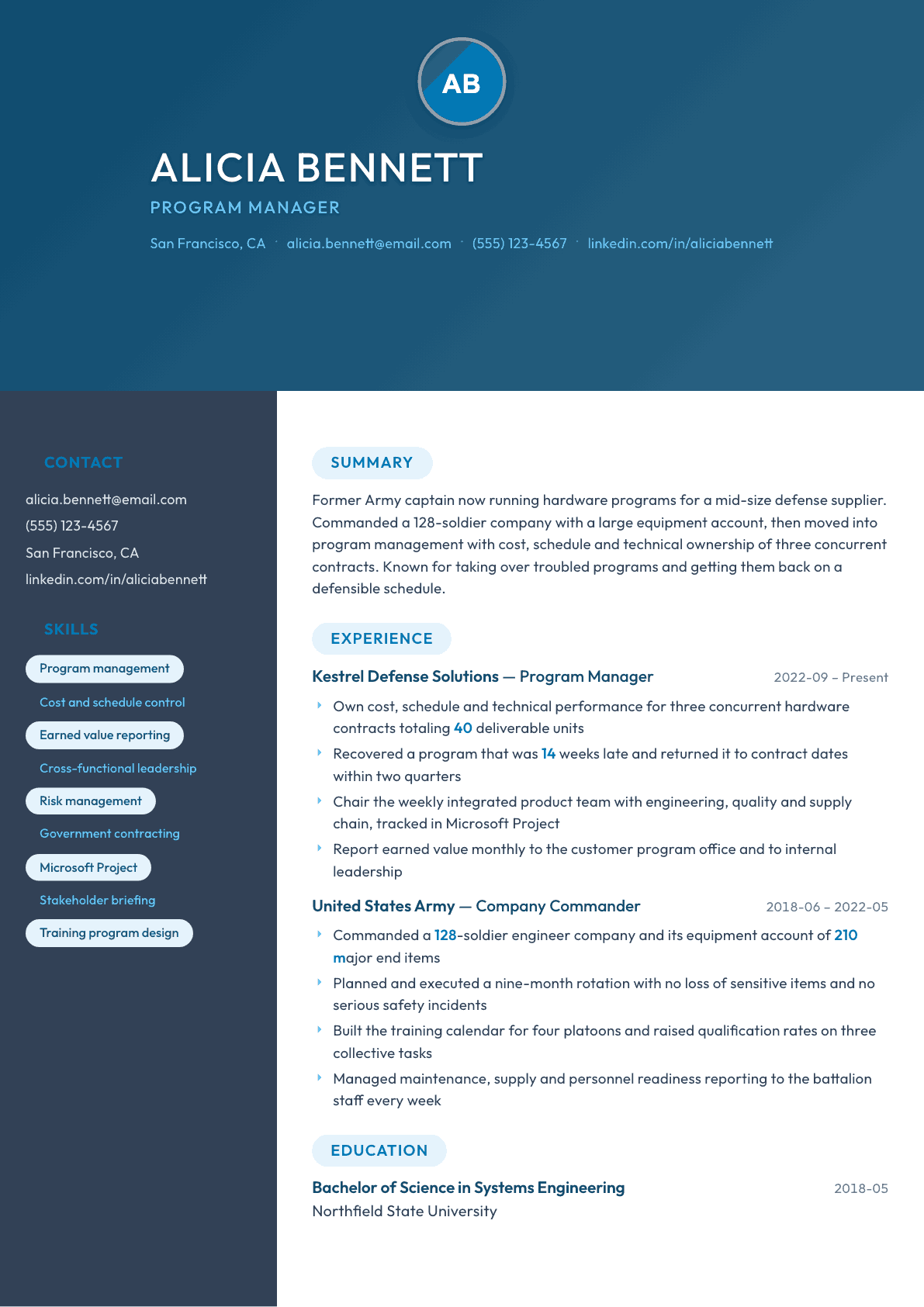
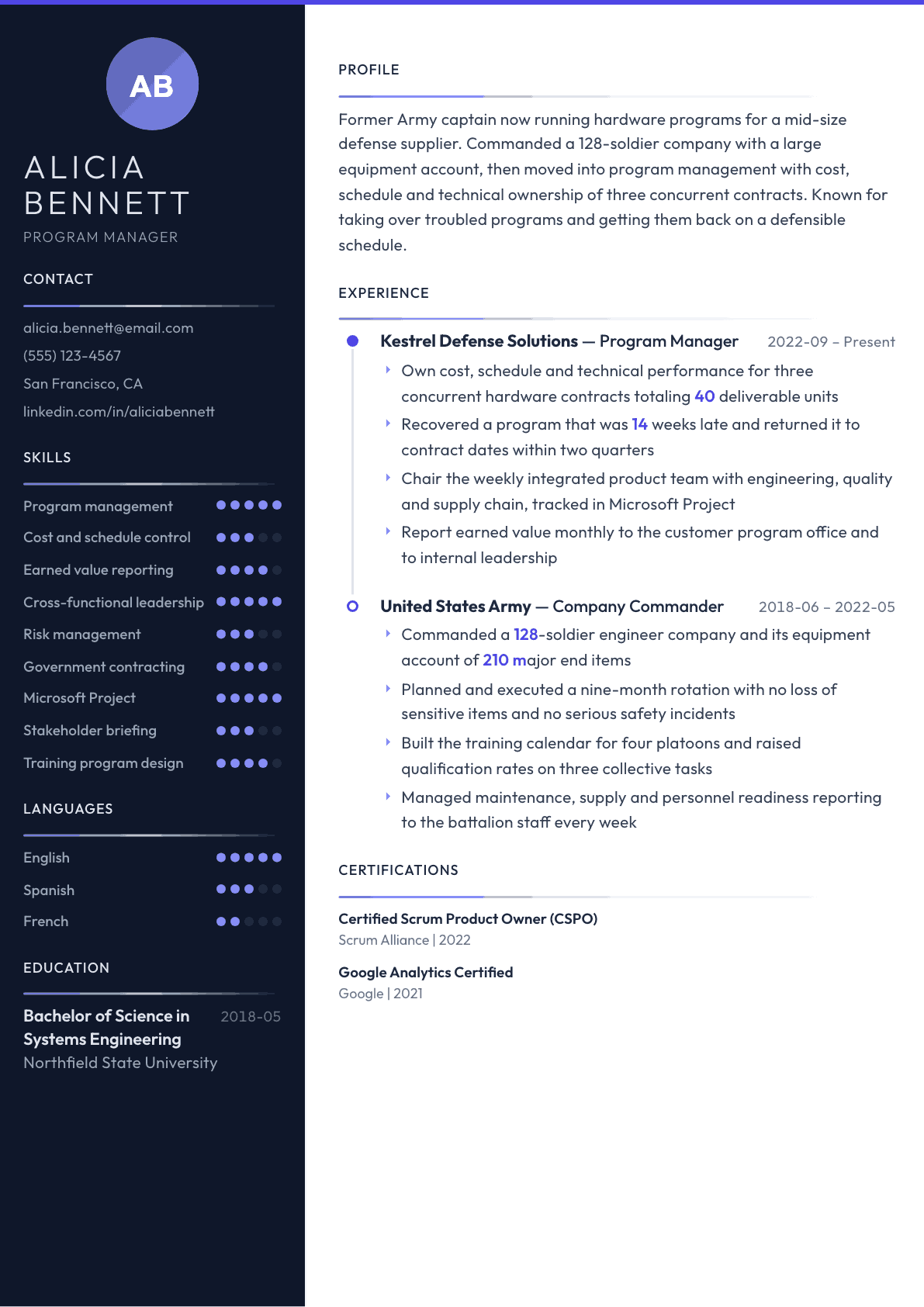
The same military officer content laid out in three CVBooster templates, so you can see what the finished document looks like before you write a word.
Example Military Officer summary
Former Army captain and program manager with four years of command and three years in defense program delivery. Led a 128-soldier company with 210 major end items, then took cost, schedule and technical ownership of three hardware contracts and recovered one that was 14 weeks behind. Reports earned value to a government program office monthly. Seeking a senior program manager role in aerospace or defense manufacturing.
Skills to list on a Military Officer resume
- Program and project management
- Operational planning
- Budget ownership
- Personnel leadership
- Risk assessment and mitigation
- Executive briefing
- Government contracting
- Earned value management
- Logistics and sustainment
- Training and development
- Process improvement
- Cross-functional team leadership
- Policy and compliance
- Crisis decision making
What actually gets this resume read
- Open with the civilian title you are targeting, not your rank, so a recruiter knows which pile the resume belongs in.
- Give command scope in three numbers: people led, equipment value or unit count, and the geography you covered.
- Convert operations orders and training plans into the civilian words for them: program plans, schedules and resource allocation.
- Show one recovery story where you took over something failing and name what changed under your leadership.
- Keep decorations off the page unless the award citation maps directly to the job, and never list more than two.
- Name the reporting cadence you owned, because executives hire officers for governance discipline as much as for leadership.
How to write a military officer resume
An officer resume fails for the opposite reason an enlisted resume fails. Enlisted pages are often too technical for a civilian reader. Officer pages are usually too abstract: led, directed, oversaw, was responsible for. A hiring executive reading that has no way to tell whether you ran a platoon in a training cycle or a battalion staff through a deployment, and abstraction always gets read down rather than up.
The fix is scope, expressed the way a company expresses it. People led. Budget or equipment value under your signature. Geography and operating tempo. Decisions you made without asking. Then one story where something was broken when you arrived and measurably better when you left. That is the shape of a private sector leadership resume, and officer careers fill it easily once you stop writing evaluation report language.
This guide covers the format executives expect, how to size command and staff assignments in civilian terms, what to do with joint and staff tours that produced no obvious deliverable, and the questions officers ask when they are choosing between program management, operations and consulting.
Format: two pages, target title first, scope visible in every heading
Two pages is normal for an officer with a decade or more of service and nobody penalizes it, but the first half of page one has to carry the case. Name the civilian role you are targeting under your name, then a summary of four lines, then a short competencies row, then experience.
Every assignment heading carries its own scope line before the bullets: the equivalent civilian title, the organization size, the asset or budget responsibility, and the location type. A reader should be able to skim only the headings and come away with a correct picture of how big your jobs were.
- Name line: full name, target title such as Program Manager or Director of Operations, city, phone, email, clearance status.
- Assignment heading pattern: civilian equivalent title, official position, organization, dates, then a one-line scope statement.
- Keep a short leadership philosophy or achievements block only if it holds real outcomes, otherwise cut it.
- Put graduate degrees and professional military education together near the bottom, with the resident or distance format noted.
Sizing command and staff in civilian terms
Command translates well because it has headcount, property and authority attached. Say how many people reported to you through how many layers, what equipment or facility you signed for by count and type, and what you were accountable for when it went wrong. A company command with a large equipment account is a general manager job and should read like one.
Staff tours are harder and get undersold constantly. A staff officer plans, coordinates across organizations that do not report to them, allocates constrained resources, and produces documents other people act on. Those are the same words a program management office uses. Name the plans you owned, the number of subordinate organizations they governed, and the review cycle they went through.
Where you had budget authority, say so plainly with the category of spending rather than an invented figure. Where you did not, say what you did control: schedule, manning, equipment, training throughput. Executives care more about accurate scope than large scope.
Achievements: pick the recovery, not the routine
Officers usually list responsibilities because evaluation reports are written that way. Civilian resumes reward the exception. Pick three or four moments where the unit was measurably different because you were in the chair: a readiness rate you moved, an inspection you turned around, a retention or qualification number you raised, a program you built that outlived your tour.
Write each one as situation and result inside a single line. The situation can be three words. The result needs a number and a period of time. If the only honest measure is qualitative, name the authority who judged it and what changed as a consequence, such as a program adopted by the higher headquarters after your unit ran it.
Two things to cut: anything phrased as selected for or hand-picked, which tells a civilian nothing, and any claim about being the best in the brigade without the criteria attached.
Rank, decorations and professional military education
Give rank once, with dates of service, and let the assignments carry the rest. A civilian reader parses captain, major and lieutenant colonel poorly, and a resume that leans on rank progression instead of results reads like a service record.
Decorations are worth one line at most, and only when the citation matches the job. A meritorious service award for standing up a maintenance program supports an operations application; a campaign ribbon list supports nothing on a resume.
Professional military education is valuable and underused. Command and staff college, intermediate level education and any resident program are graduate level leadership training, and saying so in one clause helps a reader who has never heard of them place the credential.
Keywords, clearance and the industry you are aiming at
Pick a lane before you write. Program management, supply chain, manufacturing operations, facilities, cleared analysis and consulting all reward different halves of an officer career, and one page cannot serve them all. Choose the target, then repeat its vocabulary: cost and schedule, cross-functional, stakeholder, risk register, resource allocation, governance cadence.
For defense industry roles, clearance level and investigation date belong high on page one, because those postings are filtered on that field before a human sees the file. For commercial roles, drop the clearance line to the credentials block where it reads as a background check that already passed.
Certifications close the credibility gap fastest. A project management credential or a quality methodology belt tells a commercial hiring manager that you have learned their language voluntarily, which is exactly the doubt they have about officers.
Military Officer resume summary examples
Junior officer, first separation
Former Army lieutenant with four years leading a 38-soldier platoon and a maintenance section, including a nine-month deployment. Managed 24 vehicles and a training calendar for four squads, raising collective task qualification from 60% to 95%. Seeking an operations supervisor role in manufacturing or distribution.
Company command, moving to industry
Former Army captain and program manager with four years of command and three years in defense program delivery. Led a 128-soldier company with 210 major end items, then owned cost, schedule and technical performance on three hardware contracts and recovered one running 14 weeks behind contract dates.
Field grade officer, director track
Retired lieutenant colonel with twenty-two years across command and joint staff assignments, including a battalion of 480 personnel and a headquarters plans directorate coordinating eight subordinate organizations. Built the sustainment plan adopted across the command. Targeting a director of operations seat in aerospace manufacturing.
Work experience bullets: before and after
Before: Commanded a company and was responsible for all training, readiness and equipment.
After: Commanded a 128-soldier engineer company with an equipment account of 210 major end items, delivering a nine-month rotation with no lost sensitive items and no serious safety incidents.
Three concrete measures of scope replace a responsibility list that could describe any command at any level.
Before: Served on the battalion staff and coordinated operations for subordinate units.
After: Wrote and governed the quarterly training plan for four subordinate units, running a monthly synchronization board that reconciled range time, transportation and instructor availability.
Staff work becomes a named deliverable with a governance cadence, which is what a program office is buying.
Before: Improved unit readiness through better management practices.
After: Raised equipment readiness from 74% to 93% in two quarters by rebuilding the services schedule and moving parts ordering to a weekly review with the maintenance warrant officer.
A before number, an after number, a timeframe and the mechanism make the claim testable in an interview.
Before: Briefed senior leaders on unit status regularly.
After: Briefed the commanding general monthly on operational readiness for a formation of 900 personnel, condensing four staff inputs into a two-slide decision brief.
Audience seniority, frequency and the product itself say more about executive communication than the word briefed.
Before: Managed the unit budget and resources effectively.
After: Controlled the annual training and supply account for a company, reallocating funds across four quarters to close a projected ammunition shortfall without a request to higher headquarters.
It shows the reallocation decision and its consequence rather than asserting that resources were managed well.
Hard skills
- Operational planning
- Program and project management
- Budget and resource allocation
- Risk assessment and mitigation
- Personnel management and evaluation
- Logistics and sustainment planning
- Governance and review cadence design
- Earned value reporting
- Policy and compliance oversight
- Training program design
- Contract and vendor coordination
- Executive briefing and decision support
Soft skills
- Delegating to people more technical than you are
- Absorbing pressure instead of passing it down
- Making the call when the staff is split
- Building trust with a team you inherited
- Saying no upward with a defensible reason
Certifications worth listing
- Project Management Professional (PMP) (Project Management Institute)
- Certified Six Sigma Green Belt (CSSGB) (American Society for Quality)
- Certified Supply Chain Professional (CSCP) (Association for Supply Chain Management)
Mistakes that cost military officer candidates the interview
- Writing in evaluation report voice, where every line is a responsibility and none is an outcome.
- Leading with rank progression instead of the size and difficulty of the jobs held.
- Sending the same resume to a program office, a plant manager and a consulting firm.
- Claiming strategic leadership with no plan, cadence or decision named anywhere on the page.
- Burying command scope in a bullet halfway down instead of putting it in the assignment heading.
- Listing professional military education without a clause explaining what level of schooling it is.
Military Officer resume questions
Is a two-page resume acceptable for a military officer?
Yes, and after ten years of service it is expected. Keep the strongest scope and results on page one, because a screener may never turn the page. Three pages only makes sense for federal applications, which follow their own format rules.
How do I write a staff tour that produced no visible product?
Find the documents, decisions or forums you owned and name them. A synchronization board you ran, a plan you wrote, a resource conflict you resolved between organizations that did not report to you. Coordination is the job, so describe the coordination as a deliverable.
Should I aim for director level roles straight out of service?
It depends on the industry and the scope you actually held. Officers with battalion level command and staff experience compete for senior manager and director roles in operations, while a first separation after company command usually lands as a manager or program manager.
Do I list my professional military education?
List the resident courses and any intermediate or senior level school, each with a short clause saying what it is. Skip the long list of short correspondence courses, which fills space without changing how a civilian reader judges your preparation.
How much of my deployment history belongs on the page?
One line per assignment noting the deployment length and what it changed about the scope of your job. Recruiters read deployments as evidence of operating under constraint, not as a travel record, so the detail that matters is what you were responsible for while there.
Related resume examples
- Federal Resume example
- Security Guard Resume example
- Military to Civilian Resume example
- Military Intelligence Analyst Resume example
- Veteran Resume example
- Military Resume example