Veteran Resume Examples: free score, then the gap list
Write a Veteran Resume That Wins Civilian Interviews
By Mustafa Tarabya, founder of CVBooster · Published · Updated
Veteran resume example with plain-language duty translation, a tips list and the keywords civilian recruiters search after separation.
Sample resumes for a veteran
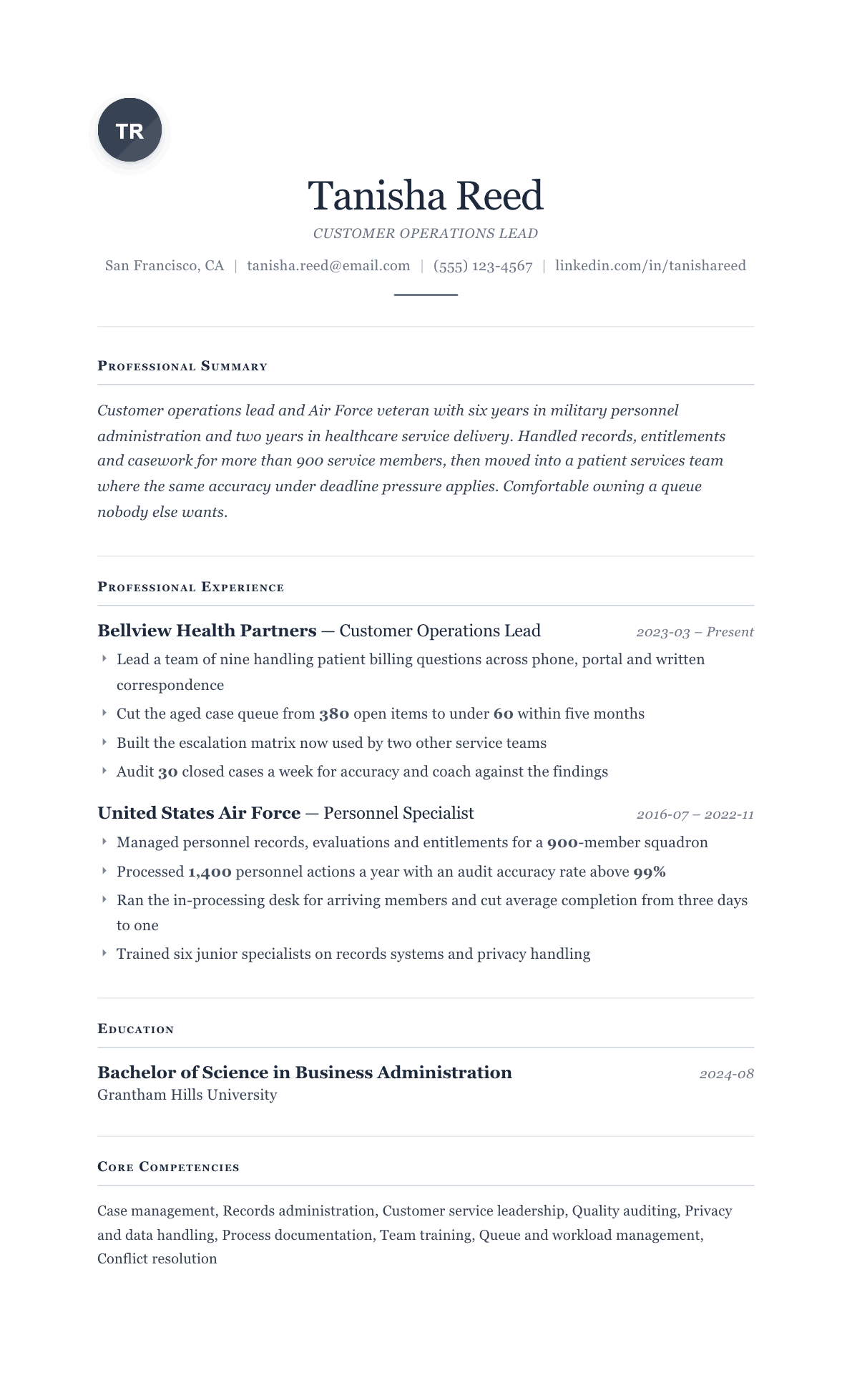
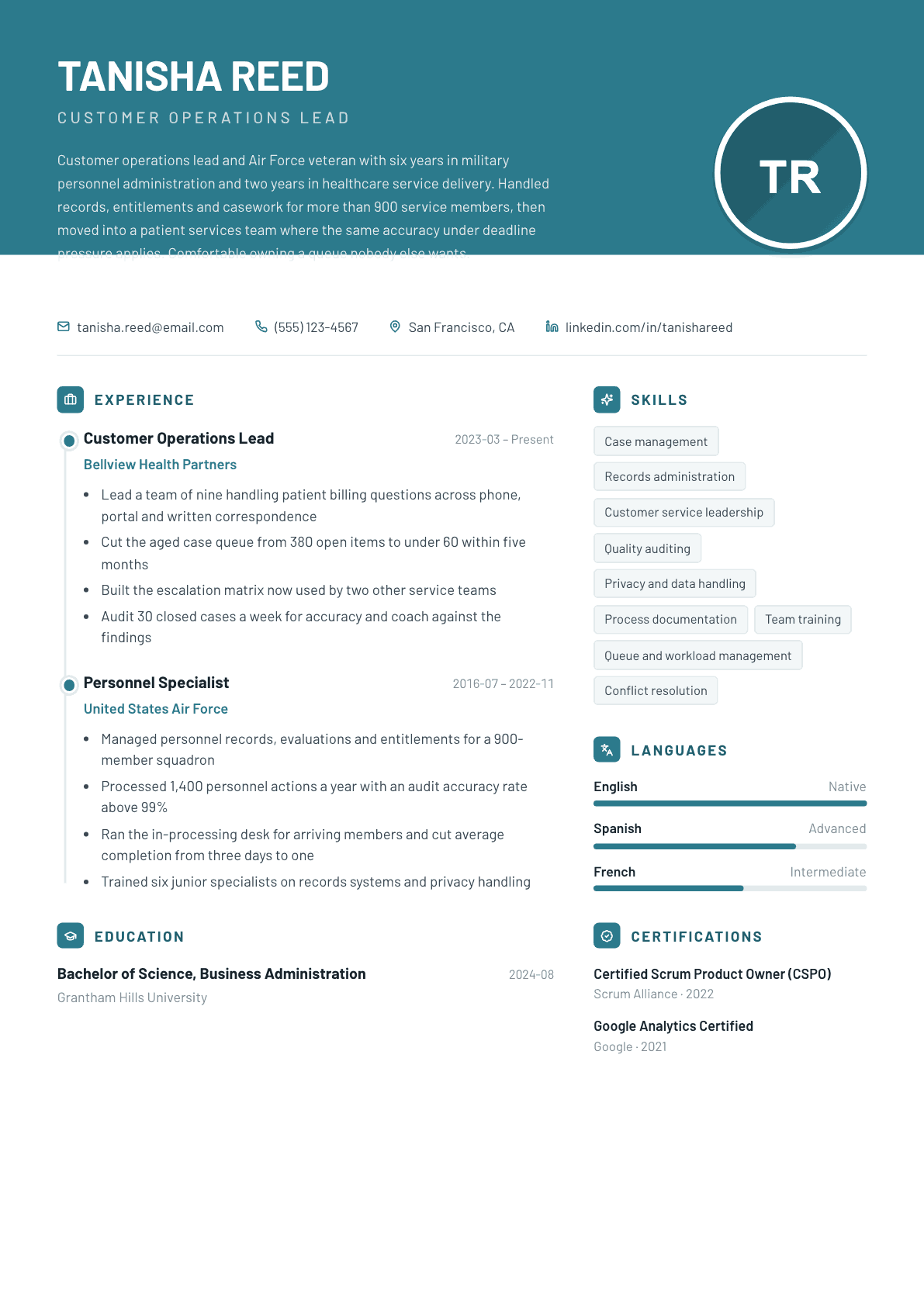
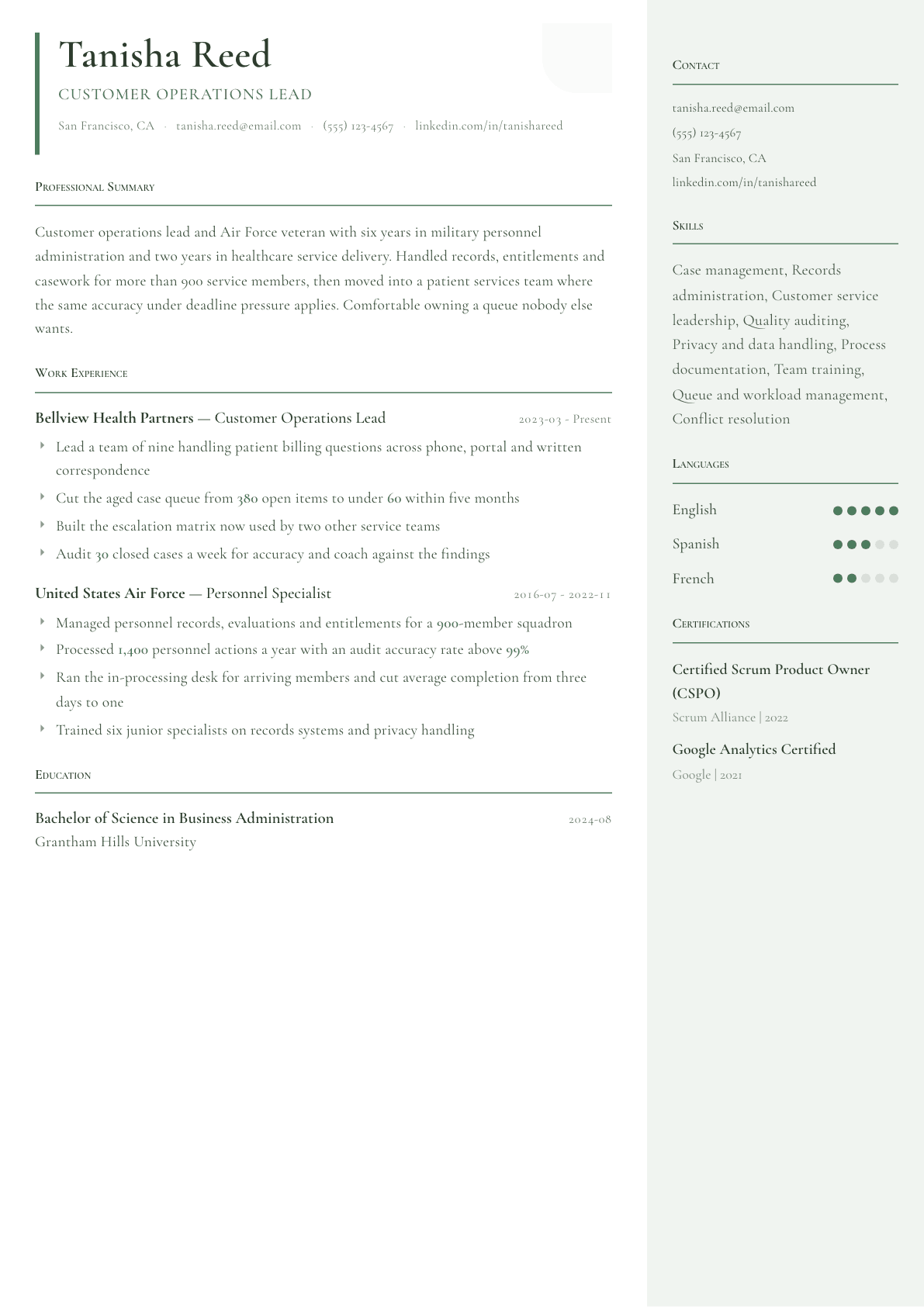
The same veteran content laid out in three CVBooster templates, so you can see what the finished document looks like before you write a word.
Example Veteran summary
Air Force veteran and customer operations lead with six years in military personnel administration and two years in healthcare services. Managed records and entitlements for a 900-member squadron at above 99% audit accuracy, then led a nine-person billing team and cleared an aged queue from 380 cases to under 60. Finished a business degree while working full time. Seeking a service operations manager role.
Skills to list on a Veteran resume
- Team leadership
- Case and records management
- Customer service operations
- Quality assurance auditing
- Standard operating procedures
- Training and mentoring
- Data privacy handling
- Scheduling and workload planning
- Conflict resolution
- Process improvement
- Reporting and metrics
- Cross-team coordination
- Security clearance handling
- Budget and resource tracking
What actually gets this resume read
- Lead with the civilian job title you want, then let the service history support it rather than the other way around.
- Give one line for each branch and dates of service, and keep rank abbreviations out of the job titles entirely.
- Quantify the population you supported, because headcount is the fastest way to show scope to a civilian reader.
- List the education and certifications you finished on tuition assistance right under the summary while they are recent.
- Explain any employment gap after separation in one neutral line, such as a degree program or a caregiving period.
- Skip service jargon and write the outcome instead, so the reader never has to look up an acronym to keep reading.
How to write a veteran resume
A veteran resume is judged by two very different readers. One is a veteran recruiter inside a hiring program who reads service history fluently and wants the branch, the occupational code and the clearance stated plainly. The other is a line manager who has never met anyone who served and needs the same page to read like any other application. Writing for only one of them costs you half your opportunities.
The page that works for both is unglamorous: a target job title at the top, a summary that puts service and civilian experience in one sentence, jobs written with scope lines and outcomes, and a credentials block a screener can check against the posting. Service specific detail lives in a few controlled places rather than spread through every bullet.
This guide covers how to structure the page, how to describe service without turning it into a service record, how to use veteran hiring programs without leaning on them, and the questions veterans ask when the first thirty applications produce silence.
Format: a page built for two readers at once
Reverse chronological, one page under about eight years of total working history and two pages after that. Under the name goes the civilian job title you are applying for, then a summary of three or four lines, then a competencies row that mirrors the posting, then experience.
Give the service its own employer block with the branch written out in full and each assignment listed underneath as a position, exactly the way you would show promotions at one company. This keeps a long career readable and stops the page from looking like eight short jobs.
- Top block: name, target civilian title, city and state, phone, email, and dates of service as a single line.
- Give the branch in full plus the occupational code once in parentheses, so both a veteran recruiter and a keyword search find it.
- Credentials block covering licenses, certifications, clearance status and any degree finished during or after service.
- A single availability line stating the month you can start, which prevents an application from stalling on a guess.
Summary: one sentence that carries both halves of your history
The strongest opening line for a veteran names the civilian role, the service years and the civilian years in the same breath. It signals immediately that you are not asking anyone to imagine your transition, because part of it has already happened, even if that part is only a degree or a certification.
If you are separating with no civilian work yet, name the population or asset scope you handled instead, then the target role. Managed records and entitlements for a nine hundred member squadron is a scope statement any office manager understands without translation.
Keep every adjective out of it. Disciplined, dedicated and mission focused are true of most applicants who served, so they distinguish nobody, and they consume the lines where scope belongs.
Experience: population, volume, accuracy, and what you fixed
Service work almost always has three measurable dimensions: how many people or assets you supported, how much throughput you handled, and how accurate or timely you were. Those three map onto civilian operations, administration, logistics and service roles with almost no distortion.
Write the scope line under each position, then three to five bullets. At least one should be a change you made: a process you shortened, a backlog you cleared, a training gap you closed. Duty descriptions alone read as a job posting rather than a record of performance.
Where you were the person others came to, say so with the mechanism rather than the sentiment. Ran the in-processing desk for arriving members tells a reader more than trusted by leadership ever will.
Education, credentials and everything you finished on the side
Many veterans finish a degree part time during service and then bury it at the bottom. If it is recent, or if the posting asks for it, move it above experience for the first year after graduation and put the completion date beside it.
List the training courses that carry a recognized civilian standard and skip the internal ones. A screener can judge an emergency medical registration, a safety course or a project credential. They cannot judge a service school by name alone unless you add a clause explaining what it teaches.
Include benefits-funded programs you are currently enrolled in with an expected completion date. It shows direction, and it explains any period after separation that would otherwise look empty.
Using veteran hiring programs without depending on them
Many employers run dedicated veteran pipelines, and applying through them puts your file in front of someone who reads service history well. Keep a second version of the resume for those pipelines with fuller service detail: unit type, occupational code, clearance and deployment history.
Do not rely on those pipelines alone. Most hires still come through the ordinary posting, read by the ordinary manager, and that page has to stand on its own with no allowance made for the background. Treat the veteran program version as the exception and the plain version as the default.
When a company has a veteran employee network, mention in the cover note that you found the role through it. That is context, not a claim on the job, and it usually gets the file read sooner.
Veteran resume summary examples
Separating this year
Air Force veteran with six years in personnel administration, managing records and entitlements for a squadron of 900 members and processing 1,400 actions a year at above 99% audit accuracy. Trained six junior specialists on records systems. Available in June for an operations or administrative coordinator role.
Two years into civilian work
Customer operations lead with six years of military personnel administration and two years in healthcare services. Leads a nine-person billing team, cleared an aged case queue from 380 items to under 60 in five months, and audits 30 closed cases weekly. Completed a business degree while working full time.
Long service, management track
Retired senior noncommissioned officer with twenty-one years across administration and operations leadership, including a section of 45 personnel and the command records program. Now managing a shared services team of 30 covering benefits and payroll cases for four thousand employees across three states.
Work experience bullets: before and after
Before: Performed administrative duties for the squadron including records and personnel actions.
After: Managed personnel records, evaluations and entitlements for a 900-member squadron, processing about 1,400 actions a year at above 99% audit accuracy.
Population size, annual volume and an accuracy figure convert an administrative duty into a workload a manager can size.
Before: Helped new members complete their arrival paperwork.
After: Ran the in-processing desk for arriving members and cut average completion from three days to one by pre-staging records before the arrival date.
It shows a process change with a before and after, which is the difference between doing the job and improving it.
Before: Trained new personnel and answered questions from across the unit.
After: Trained six junior specialists on records systems and privacy handling, then wrote the quick reference guide the section still uses for release requests.
A count, a subject and a lasting artifact make training verifiable instead of incidental.
Before: Maintained confidentiality of sensitive personnel information.
After: Handled protected personnel information under a privacy standard with annual inspection, closing three inspection cycles with no findings.
Discretion becomes a compliance record, which is what a civilian employer in a regulated field actually needs to see.
Before: Received awards for outstanding performance during my service.
After: Recognized for rebuilding the evaluation tracking process after a backlog of 90 overdue reports was cleared within one quarter.
Naming what the award was for beats naming the award, because the reason is the part a civilian reader can judge.
Hard skills
- Records and case management
- Customer service operations
- Quality auditing and review
- Standard operating procedures
- Workload and queue management
- Training and onboarding delivery
- Data privacy handling
- Reporting and metrics tracking
- Scheduling and shift coverage
- Inventory and property accountability
- Process improvement
- Cross-team coordination
Soft skills
- Holding a standard without a rank to back it up
- Translating your own experience for people who have not lived it
- Working in a culture with less structure than you are used to
- Coaching peers who outrank you on paper only
- Staying steady through a slow hiring process
Certifications worth listing
- Certified Associate in Project Management (CAPM) (Project Management Institute)
- CompTIA Security+ (CompTIA)
- Professional in Human Resources (PHR) (HR Certification Institute)
Mistakes that cost veteran candidates the interview
- Turning the resume into a service record with ranks, units and awards where results should be.
- Writing the same page for a veteran hiring pipeline and an ordinary posting read by a line manager.
- Hiding a degree finished during service at the bottom of the page while it is still the newest thing you have.
- Filling the summary with character adjectives that every applicant who served could claim.
- Leaving the availability date off and letting a recruiter assume you cannot start for months.
- Applying only to companies with veteran programs and ignoring the larger pool of ordinary postings.
Veteran resume questions
Should I say I am a veteran on the resume?
Yes, once, in a place that reads naturally: the summary line or the service employer block. Self-identification for hiring programs happens in the application form, not the resume, so there is no need to repeat it in a header banner.
How do I show a long career without a four-page resume?
List the branch once as an employer, then show only the last three assignments in detail and compress the rest into a single early career line with dates and titles. Depth matters for recent work, and almost never for a first tour.
Do employers really value military experience?
Many do, particularly for reliability, safety discipline and supervising under pressure. What they cannot do is infer it from titles they do not recognize, so the value depends entirely on whether your page states scope and outcomes in words they already use.
What if my occupational specialty has no civilian equivalent?
Then lead with what surrounded the specialty: the team you led, the equipment you controlled, the documentation you kept, the training you delivered. Very few roles are truly unique once you separate the technical core from the management work around it.
Should I attach my service record documents?
Not with the initial application. Keep your discharge paperwork ready for the verification stage, and use the resume for the argument. Sending records early buries a reader in material they are not trained to interpret.
Related resume examples
- Security Guard Resume example
- Federal Resume example
- Military to Civilian Resume example
- Marine Corps Veteran Resume example
- Military Officer Resume example
- Military Resume example