Military Police Resume Examples: the lines they read
Write a Military Police Resume for Civilian Law Enforcement
By Mustafa Tarabya, founder of CVBooster · Published · Updated
Military police resume example with patrol volume, investigation detail and a keyword list for police and corporate security hiring.
Sample resumes for a military police
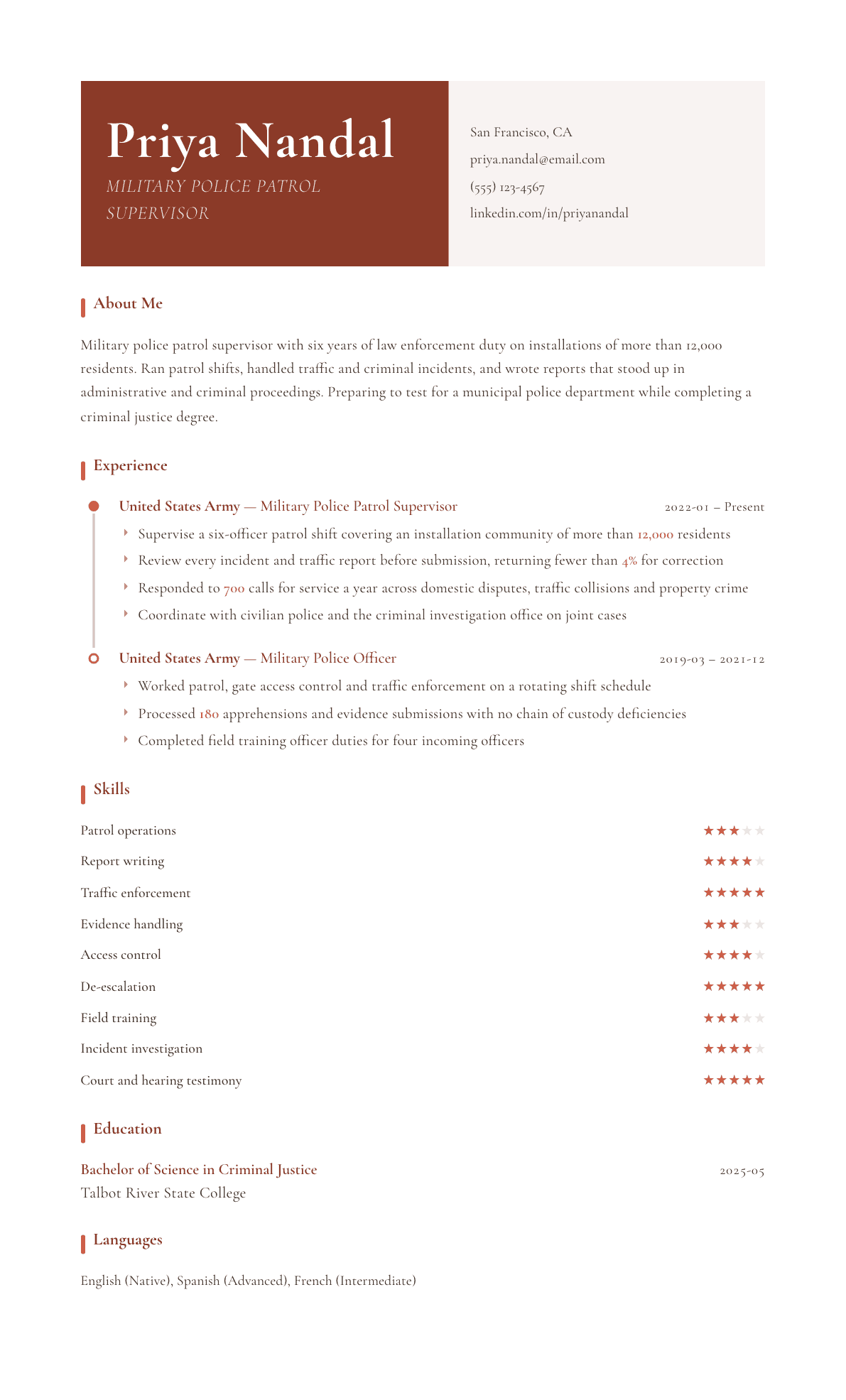
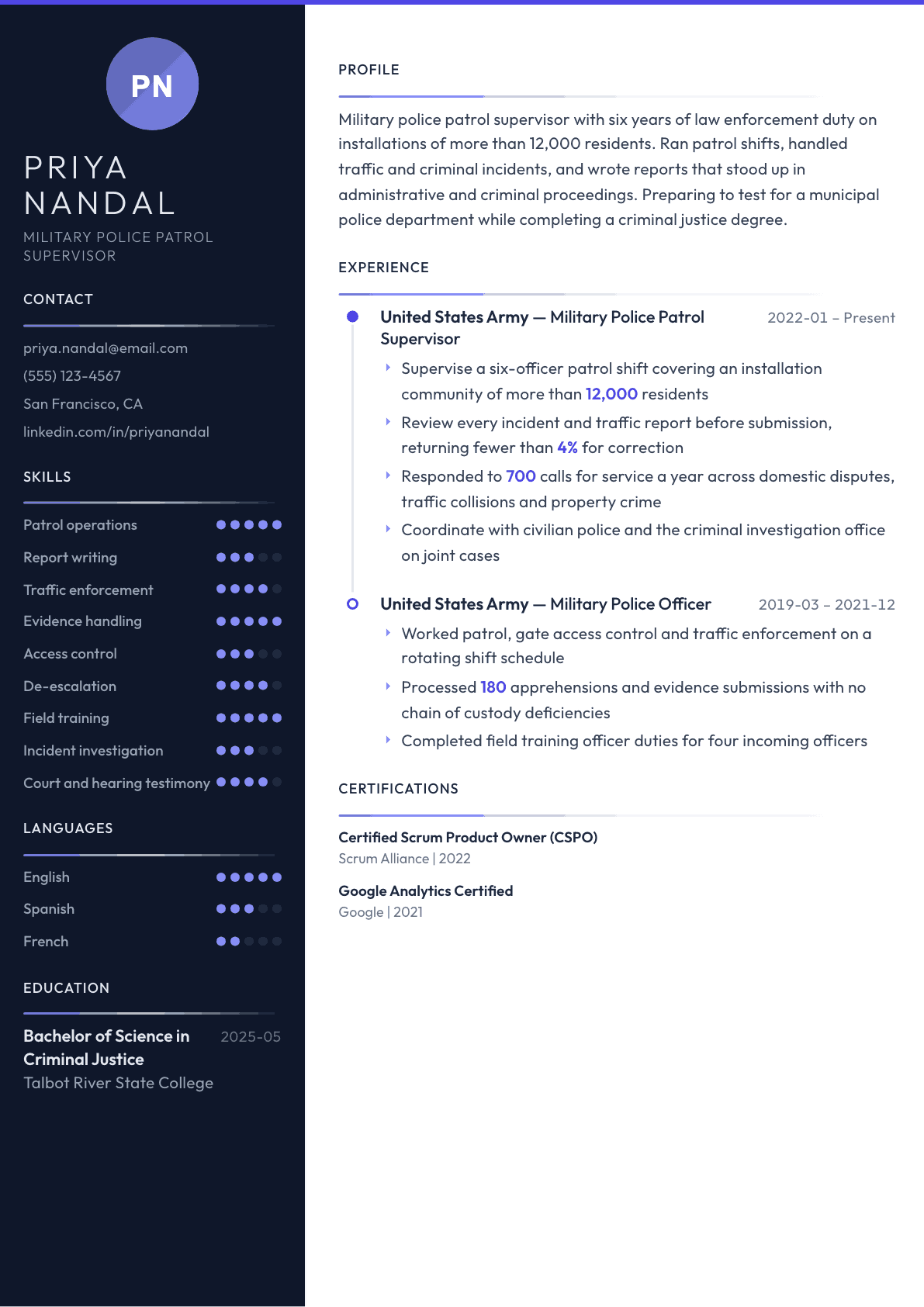
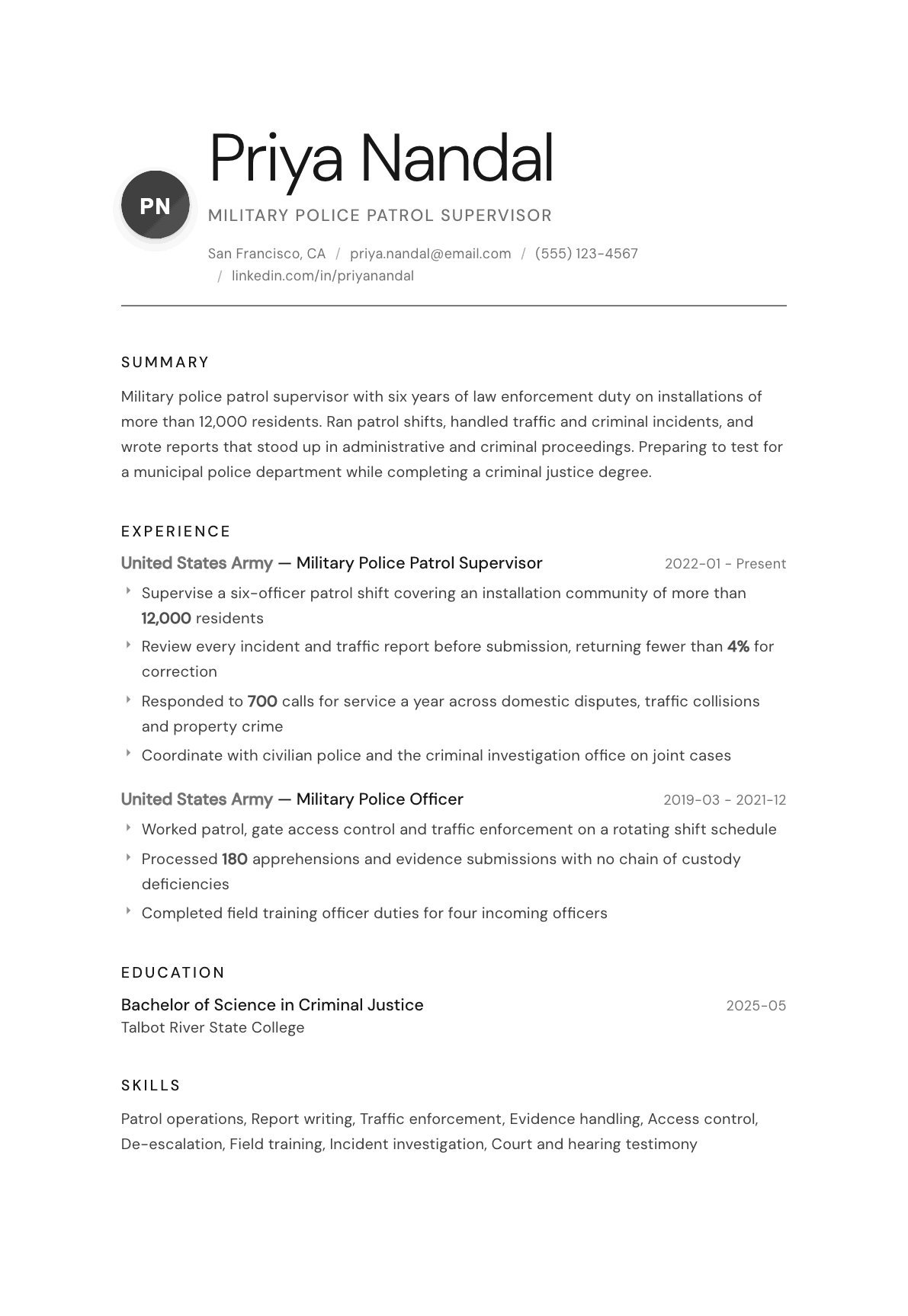
The same military police content laid out in three CVBooster templates, so you can see what the finished document looks like before you write a word.
Example Military Police summary
Military police patrol supervisor with six years of installation law enforcement, supervising a six-officer shift for a community of more than twelve thousand residents. Handles about 700 calls for service a year across domestic, traffic and property incidents, reviews every report before submission, and works joint cases with civilian departments. Finishing a criminal justice degree and testing for municipal police hiring this cycle.
Skills to list on a Military Police resume
- Patrol operations
- Criminal incident response
- Traffic enforcement and collision investigation
- Report writing and case documentation
- Evidence collection and chain of custody
- Access control and installation security
- De-escalation and crisis intervention
- Field training of new officers
- Interview and statement taking
- Radio dispatch procedures
- Detainee processing
- Shift supervision
- Court testimony
- Physical security assessment
What actually gets this resume read
- Give calls for service, patrol area population and shift size, since those three numbers frame every police application.
- Show report quality with a return rate or a supervisor review figure rather than saying you wrote accurate reports.
- Name evidence and chain of custody work explicitly, because departments treat it as a screening question.
- Include de-escalation and use of force training with the course names and the year you completed them.
- List any joint work with civilian departments, which proves you can operate outside the installation gate.
- Add your driving record, physical fitness results and academy eligibility if the posting asks for them.
How to write a military police resume
Military police resumes get read by two kinds of hiring authority, and they want opposite emphases. A municipal police background investigator wants patrol volume, report quality, use of force training and anything that predicts how you will behave on a traffic stop. A corporate security director wants access control, incident response, investigations and how you handle people who do not have to obey you.
The common ground is documentation. Law enforcement hiring is built on written records, and a military police candidate arrives with more of them than almost anyone else: incident reports, blotter entries, evidence logs, field training records. A resume that shows report quality, chain of custody discipline and call volume signals that you already work the way the department works.
This guide covers the format a hiring board expects, how to describe patrol and investigative work in civilian terms, what to do with the parts of the job that only exist on an installation, and the questions military police ask while they are preparing for a civilian academy.
Format: patrol scope first, credentials in a block a board can check
One page for a single enlistment, two if you have supervisory time and civilian security work as well. Under the name goes the target title, whether that is police officer, security supervisor or investigator, then a short summary, then a credentials block, then experience.
Police hiring processes are checklist driven. Put age, citizenship where relevant, driving record status, academy eligibility and physical test results where a background investigator can find them without a phone call. Every question you answer on the page is one that will not delay your file.
- Give each patrol position a scope line: shift size supervised, population of the area covered, and annual calls for service.
- Credential block: law enforcement courses, use of force and de-escalation training, first aid, and any state certification you hold.
- Name the branch in full and give the police occupational code once so veteran recruiters can search it.
- Add a line for any civilian academy you have already passed or are scheduled to attend.
Patrol work: volume, incident types, and report quality
Calls for service is the number that frames everything else. Give it annually and say what the mix was: domestic disputes, traffic collisions, property crime, alarm response, welfare checks. A department reading that can immediately tell whether you have handled the calls their officers handle.
Report quality deserves its own bullet because it is what a field training officer will judge you on for the first year. If you supervised, give the return rate on reports you reviewed. If you wrote them, say how many and what proportion supported administrative or criminal proceedings.
Traffic work is worth naming separately. Enforcement stops, collision investigation, impaired driving processing and the tests you are certified to administer all map directly onto civilian patrol and are easy for a board to verify.
Investigations, evidence and detainee processing
Chain of custody is a screening question in almost every law enforcement interview, so put it on the page with a record attached. Processing evidence submissions with no custody deficiencies over a period of years is exactly the sentence a background investigator is hoping to read.
Describe investigative work by the stage you owned. Initial response and scene control is different from statement taking, which is different from case preparation for a legal office. Say which you did and how many cases, rather than claiming investigations generally.
Detainee handling, custody procedures and use of force reporting belong here too. Write them factually and without drama, because the tone of these bullets tells a reader as much about your judgment as the content does.
Installation duties that need translating
Gate and access control is the duty most often written badly. On a resume it should read as credential verification, vehicle inspection, visitor management and denial of entry decisions at a fixed post with a defined threat posture. Corporate security directors buy exactly that.
Force protection conditions, exercises and installation security plans translate into physical security assessment and emergency planning. Give the size of the site and the number of access points, so the scale is visible without the doctrine.
Anything genuinely installation specific and untranslatable should be cut. Space on the page is better spent on the joint work you did with civilian agencies, which proves you can operate under civilian legal and procedural constraints.
De-escalation, community contact and the tone of the page
Departments and corporate clients both screen hard for temperament. Name your de-escalation and crisis intervention training by course, and pair it with one bullet showing a situation resolved without force. That single bullet does more for a modern police application than any tactical line.
Community contact work counts: school programs, neighborhood watch equivalents, safety briefings, working with family advocacy or victim support. It shows the part of policing that is not enforcement, which is exactly where many candidates have nothing to say.
Keep the writing calm and factual throughout. A resume that sounds eager for confrontation will not survive a psychological screening process, and the people reading are trained to notice it.
Military Police resume summary examples
First enlistment, applying to a department
Military police officer with three years of installation patrol, gate operations and traffic enforcement on a rotating shift schedule. Processed 180 apprehensions and evidence submissions with no chain of custody deficiencies and completed field training duties for four incoming officers. Applying to municipal police academies this hiring cycle.
Patrol supervisor
Military police patrol supervisor with six years of installation law enforcement, supervising a six-officer shift for a community of more than twelve thousand residents. Handles about 700 calls for service a year and reviews every report before submission, returning fewer than 4% for correction. Finishing a criminal justice degree.
Senior noncommissioned officer
Senior military police noncommissioned officer with fourteen years across patrol, investigations and physical security. Ran a station with 34 officers, rebuilt the field training program, and managed the evidence room through two inspection cycles with no findings. Targeting a corporate security manager or municipal sergeant position.
Work experience bullets: before and after
Before: Conducted law enforcement patrols on the installation and responded to incidents.
After: Supervised a six-officer patrol shift covering a community of more than twelve thousand residents, responding to about 700 calls for service a year.
Shift size, population and annual call volume are the three numbers every police hiring board uses to compare candidates.
Before: Wrote accurate and detailed incident reports.
After: Reviewed every incident and traffic report on the shift before submission, returning fewer than 4% for correction and coaching officers against the recurring errors.
A review rate plus the coaching that followed proves report quality instead of claiming it.
Before: Handled evidence and processed detainees according to regulations.
After: Processed 180 apprehensions and evidence submissions with no chain of custody deficiencies across three years, including packaging, sealing and transfer documentation.
Chain of custody is a screening question, and a clean record with a volume behind it answers it before it is asked.
Before: Used verbal skills to calm down subjects during disputes.
After: Resolved a domestic dispute involving an armed resident through sustained verbal contact and a coordinated approach with the responding unit, with no force used and no injuries.
One concrete de-escalation outcome carries more weight in a modern hiring process than any list of tactical qualifications.
Before: Worked with local police departments when needed.
After: Coordinated with the county sheriff and the criminal investigation office on 12 joint cases, including scene handover, statement sharing and joint traffic enforcement.
Joint work with civilian agencies shows you can operate under civilian procedure, which is the doubt an installation background raises.
Hard skills
- Patrol operations and response
- Incident and traffic report writing
- Evidence collection and chain of custody
- Traffic enforcement and collision investigation
- Detainee processing and custody procedures
- Access control and credential verification
- Physical security assessment
- Interview and statement taking
- Radio and dispatch procedures
- Field training of new officers
- Use of force reporting
- Court and administrative hearing testimony
Soft skills
- De-escalation with people who do not want to comply
- Keeping a neutral tone in a written record
- Sound judgment when nobody senior is on scene
- Handling a complaint against your own shift fairly
- Working nights and rotating shifts without losing consistency
Certifications worth listing
- Certified Protection Professional (CPP) (ASIS International)
- Physical Security Professional (PSP) (ASIS International)
- Emergency Medical Responder (National Registry of Emergency Medical Technicians)
Mistakes that cost military police candidates the interview
- Leaving out calls for service, which is the first comparison a police hiring board makes.
- Writing gate duty as standing a post instead of as credential verification and entry denial decisions.
- Describing investigations in general terms without saying which stage of the case you owned.
- Using a tone that reads as eager for confrontation, which will not survive psychological screening.
- Omitting de-escalation and crisis intervention training when departments now screen for it directly.
- Failing to state driving record, physical test results and academy eligibility that a background file will need anyway.
Military Police resume questions
Does military police experience count toward civilian police hiring?
Departments vary. Some credit it as prior law enforcement experience and shorten the academy, others treat every candidate as new. Check the specific department before applying, and write the resume as though the reader knows nothing about installation policing.
How do I present gate and access control duty?
As controlled entry work: credential verification, vehicle inspection, visitor processing and the authority to deny entry. Add the number of access points and the daily traffic volume. Corporate security hiring treats that as directly relevant experience.
Should I target corporate security or municipal policing?
Write for one at a time. Municipal applications need patrol volume, report quality and academy readiness. Corporate security applications need access control, investigations, incident management and evidence of working with people you have no authority over.
What if I have never testified in a criminal court?
Say what you have done instead: administrative hearings, statements provided to a legal office, case files prepared for prosecution. Be specific about the forum, because overstating courtroom experience is the kind of claim a background investigator checks first.
How much of the physical security side should I include?
Enough to show breadth, usually two bullets covering site assessment and access point management. Give it more space only when the target job is physical security or facility protection, where it becomes the core of the application rather than a supporting detail.
Related resume examples
- Security Guard Resume example
- Private Investigator Resume example
- Infantry Resume example
- Veteran Resume example
- Military to Civilian Resume example
- Police Sergeant Resume example