Police Sergeant Resume Examples: the lines they read
Build a Police Sergeant Resume That Shows Command Presence
By Mustafa Tarabya, founder of CVBooster · Published · Updated
Police sergeant resume examples covering squad supervision, use-of-force review, scheduling and the leadership keywords promotion boards look for.
Sample resumes for a police sergeant
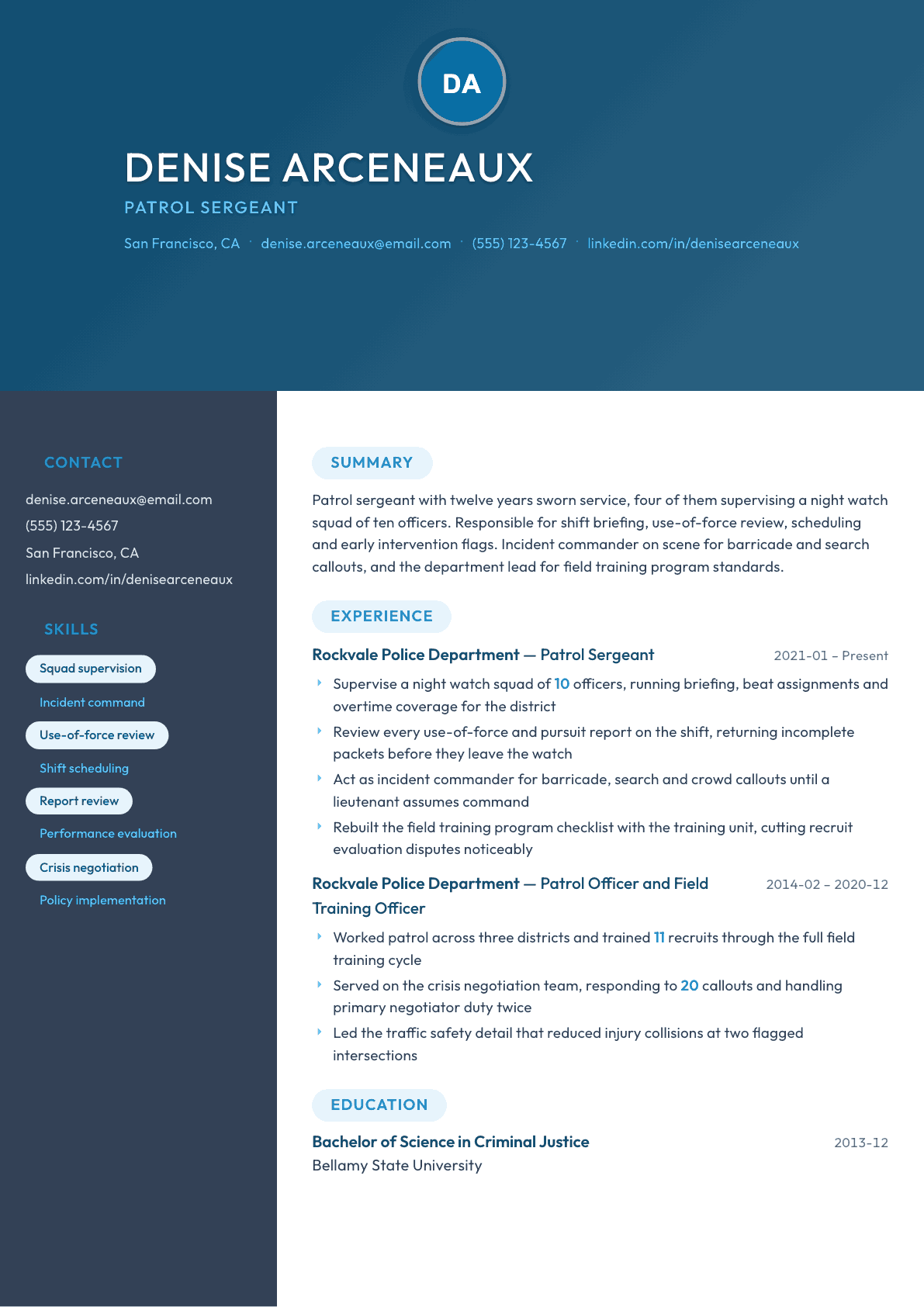
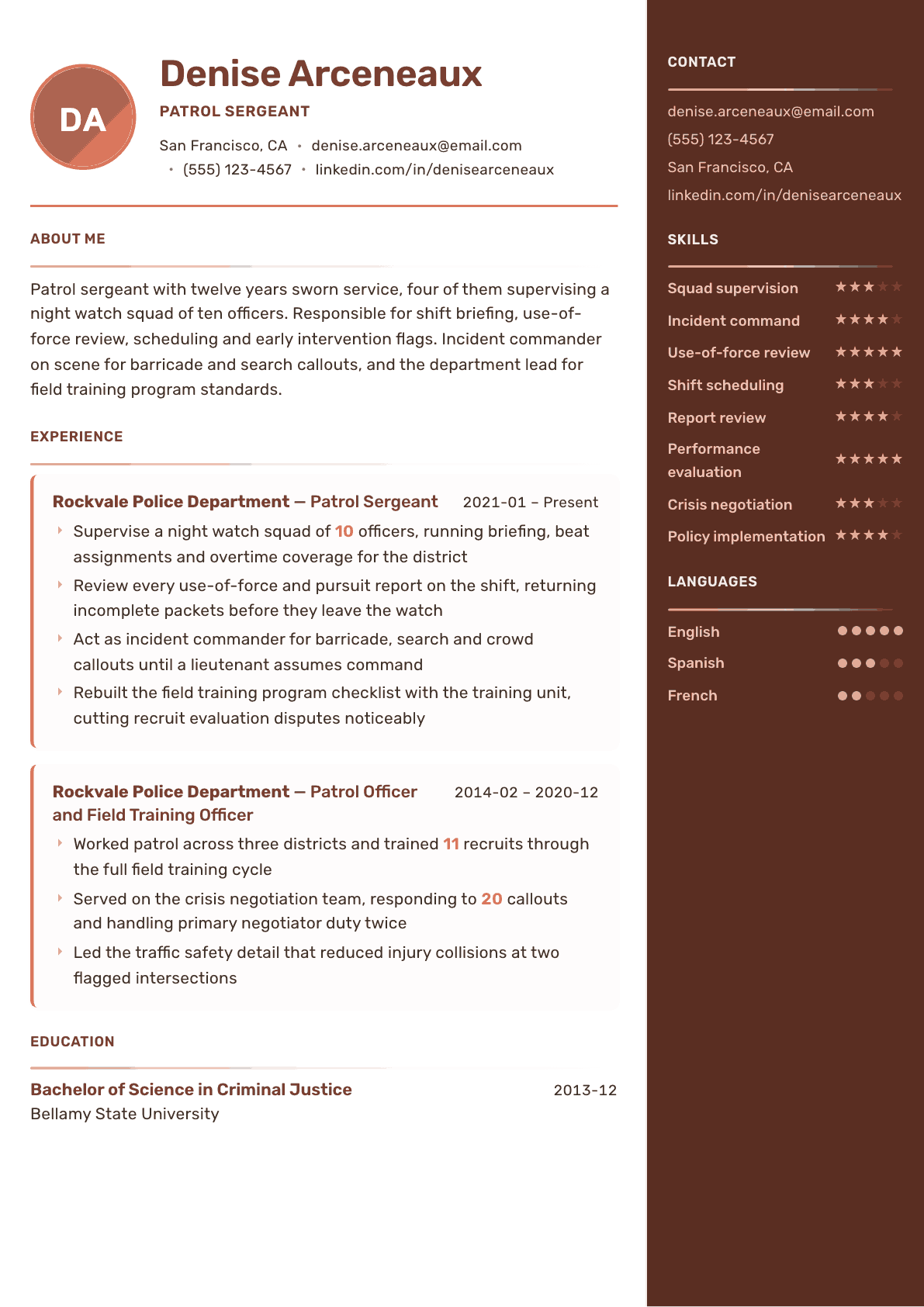
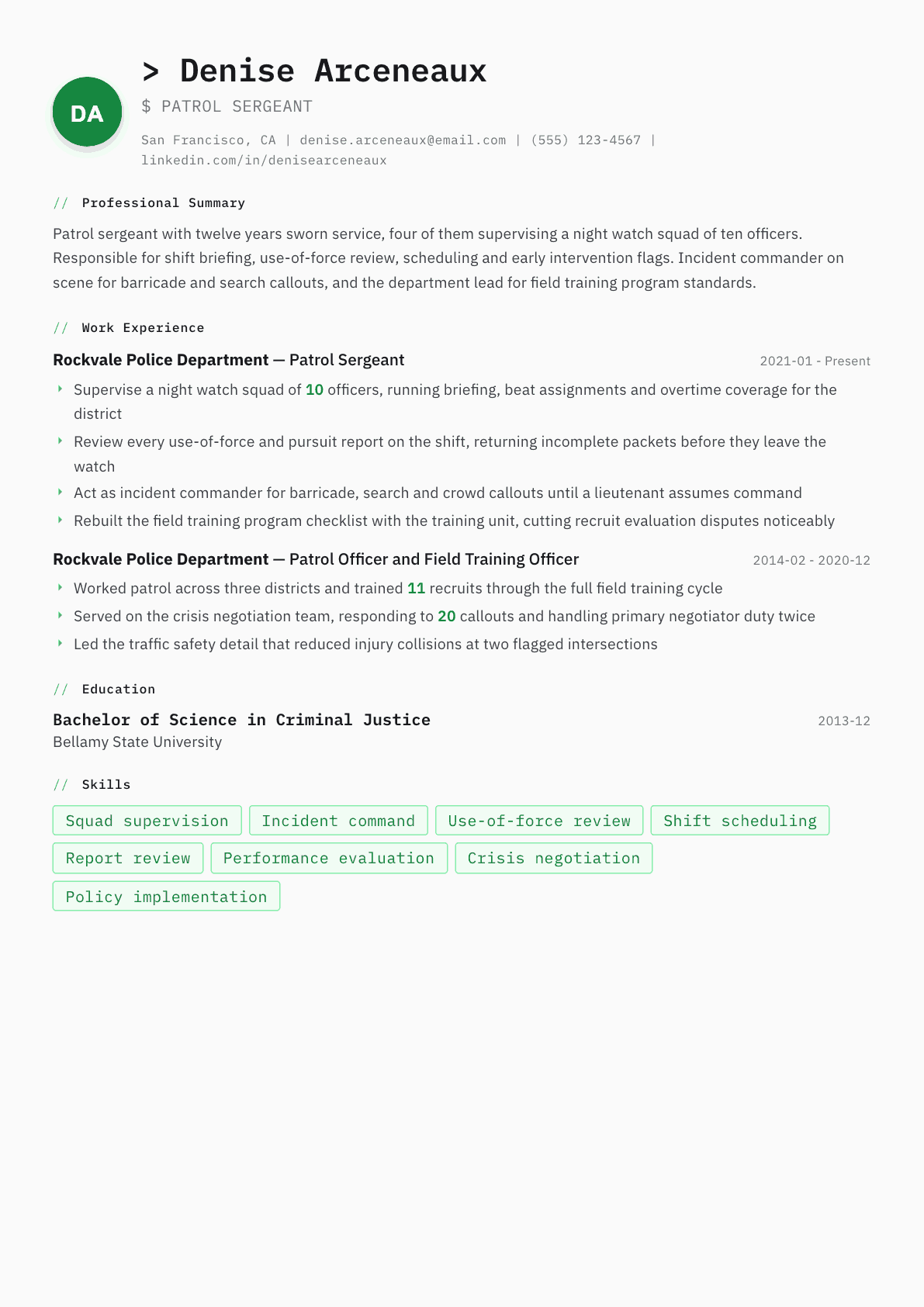
The same police sergeant content laid out in three CVBooster templates, so you can see what the finished document looks like before you write a word.
Example Police Sergeant summary
Patrol sergeant with twelve years sworn and four supervising a ten-officer night watch squad, owning briefing, beat assignments, overtime and evaluations. Reviews every use-of-force and pursuit packet on the shift, holds incident command until a lieutenant arrives, and rebuilt the field training checklist with the training unit. Preparing for a lieutenant assignment.
Skills to list on a Police Sergeant resume
- Squad supervision
- Shift briefing
- Incident command
- Use-of-force review
- Pursuit policy compliance
- Report and case review
- Scheduling and overtime control
- Performance evaluation
- Internal complaint intake
- Field training program oversight
- Crisis negotiation
- Policy and general order implementation
- Mutual aid coordination
- Mentoring and counseling
What actually gets this resume read
- Lead with span of control: how many officers on your squad, which watch, and how many districts you covered.
- Show supervisory review work, including use-of-force packets, pursuit reports and complaint intake, because that is the job.
- Name the incidents where you held command, since a promotion board wants proof you can run a scene.
- Include the personnel side: scheduling, overtime control, evaluations, counseling and early intervention conversations.
- List command and leadership schools you completed, with the hours and the institution that delivered them.
- Quantify what improved under your supervision, whether report rejection rates, response times or training completion.
How to write a police sergeant resume
The audience for a police sergeant resume is rarely a recruiter. It is a promotion board, a chief filling a lateral supervisory vacancy, or a smaller agency hiring an experienced supervisor outright. All three read the page for one thing: span of control. How many officers reported to you, on which watch, across how many districts, and what did you personally review before it left the shift.
That focus catches many sergeants off guard, because the instinct is to keep writing about calls. Calls were the previous job. A sergeant is judged on briefing, assignment, review, correction, documentation, scheduling and the incidents where command fell to them before a lieutenant arrived on scene.
What follows is the structure a board expects, the supervisory numbers worth putting on paper, three example summaries covering a newly promoted sergeant, an established patrol supervisor and a sergeant preparing for lieutenant, before and after bullets rewritten from supervisory work, and the questions that come up when sergeants apply outside their own agency.
Format: supervisory profile above the sworn history
Give the top third of page one to a supervisory profile: rank, years supervising, squad size, watch, districts covered, and the review duties you own. Below that, the sworn history can run in reverse chronological order, including the officer years that got you here.
Two pages is normal at this rank. Command schools, instructor certifications, collateral assignments and committee work take real space, and a board that is scoring candidates against a rubric would rather read them than guess at them.
- Supervisory profile: squad size, watch, districts, and the reports you review before they leave the shift.
- Command and leadership schools with the delivering institution and hours completed.
- Collateral roles: negotiation team, honor guard, accreditation, scheduling, training program oversight.
- Incident command experience, naming the call types you held command on until relieved.
Summary: rank, span of control, review duties, command moments
Three lines that name the rank, the years supervising, the squad you run, and the review responsibilities that come with it. A board reads use-of-force review, pursuit review and complaint intake as the core of the position, so those belong in the summary rather than buried in a bullet at the bottom.
Close with the command line: which callouts you have run and what relieved you. Barricades, searches, crowd events, multi-unit collisions and mutual aid responses are the scenes where a sergeant either holds the structure or loses it.
Experience: supervision, review, personnel and scene command
Write in four bands. Supervision covers briefing, beat assignment, minimum staffing, overtime control and coverage decisions. Review covers use-of-force packets, pursuit reports, arrest reports returned for correction and body-worn camera audits.
Personnel is the band sergeants most often skip and boards most want: evaluations written, counseling sessions held, early intervention conversations, remedial training arranged, and recruits carried through field training under your oversight. Say how many, and say what happened as a result.
Scene command is the fourth band. Describe the callout types, your role, how you organized units, and how you handed off. Avoid the narrative of any single incident and give the pattern instead, because a board is scoring capability rather than reading a story.
Programs owned, policy work and measurable improvement
Sergeants who get promoted usually own something beyond the shift. Field training program standards, accreditation files, scheduling systems, a training curriculum, a traffic safety detail or an equipment rollout are all programs, and each has a before and an after worth stating.
Attach a measure wherever you honestly can: report rejection rates, backlog cleared, training completion, response time on priority calls, or officer turnover on your squad. Boards read a measured improvement as the single strongest evidence that supervision changed something.
- Programs owned and the standard you set, from field training checklists to body-worn camera audits.
- General orders or procedures you drafted, revised or implemented across a watch.
- Measured improvement under your supervision, with the measure named rather than implied.
- Budget or resource decisions you controlled, including overtime and equipment allocation.
Keywords promotion boards and lateral postings use
The language of supervisory postings is consistent: span of control, shift briefing, beat assignment, use-of-force review, pursuit policy, internal complaint intake, performance evaluation, progressive discipline, incident command system, mutual aid, general orders, accreditation standards, and field training program oversight.
Use those phrases where they are true, once in a skills line and once inside a bullet that proves them. A board scoring against a written rubric is literally looking for the presence of these duties, and absence is read as absence rather than modesty.
Police Sergeant resume summary examples
Newly promoted sergeant
Newly promoted patrol sergeant supervising a squad of 7 on day watch after nine years sworn and four as a field training officer. Runs briefing and beat assignments, reviews arrest and use-of-force reports before end of shift, and completed a first-line supervision course.
Four years supervising
Patrol sergeant with twelve years sworn and four supervising a night watch squad of 10 across two districts. Reviews every use-of-force and pursuit packet on the shift, holds incident command on barricade and search callouts, and rebuilt the field training evaluation checklist.
Sergeant preparing for lieutenant
Senior sergeant with sixteen years sworn, supervising across patrol and investigations and serving as acting watch commander for two districts. Owns accreditation files, the scheduling system and the crisis negotiation team roster, and has trained four sergeants through their first year supervising.
Work experience bullets: before and after
Before: Supervised patrol officers on my shift.
After: Supervised a night watch squad of 10 officers across two districts, running briefing, beat assignments, minimum staffing and overtime coverage each shift.
Squad size, districts and the specific supervisory tasks establish span of control, which is what a board scores first.
Before: Reviewed reports for accuracy.
After: Reviewed every use-of-force and pursuit packet on the shift and returned incomplete reports before end of watch, cutting corrections requested by the prosecutor.
Naming the packet types and the correction loop shows a review standard rather than a glance at paperwork.
Before: Took charge at major incidents.
After: Held incident command on barricade, search and crowd callouts until a lieutenant assumed command, assigning perimeter, contact and traffic control roles on arrival.
The callout types and the assignments made show a working command structure, not a claim of leadership.
Before: Completed performance evaluations for my officers.
After: Wrote annual evaluations for 10 officers, held documented counseling sessions on performance concerns and arranged remedial training that returned two officers to full duty standards.
Evaluations plus counseling plus a result turn personnel work into evidence of a supervisor who develops people.
Before: Helped improve the training program.
After: Rebuilt the field training evaluation checklist with the training unit, standardizing daily observation criteria and reducing disputes over recruit ratings.
A named program, a specific change and its effect give a board something to score.
Hard skills
- Squad supervision and span of control
- Shift briefing and beat assignment
- Use-of-force and pursuit review
- Internal complaint intake
- Performance evaluation and progressive discipline
- Incident command system
- Scheduling and overtime control
- Field training program oversight
- General orders and policy implementation
- Accreditation standards
- Mutual aid coordination
- Body-worn camera auditing
Soft skills
- Decisive direction on scene
- Difficult conversations with officers
- Impartiality in review
- Mentoring newer supervisors
- Communication upward to command
- Consistency in applying policy
Certifications worth listing
- FBI National Academy (Federal Bureau of Investigation)
- Leadership in Police Organizations (International Association of Chiefs of Police)
- ICS-300 Intermediate Incident Command System (Federal Emergency Management Agency)
- ICS-400 Advanced Incident Command System (Federal Emergency Management Agency)
- Crisis Intervention Team (CIT) Training (CIT International)
Mistakes that cost police sergeant candidates the interview
- Writing the resume as a patrol officer with a new title, so nothing on the page reflects supervision.
- Omitting squad size and watch, which leaves a board unable to compare your span of control with other candidates.
- Leaving out personnel work such as evaluations, counseling and remedial training because it feels routine.
- Telling the story of one dramatic callout instead of showing the pattern of command roles you have held.
- Failing to list command schools and incident command coursework that a promotional rubric awards points for.
- Claiming improvement without naming the measure, when a board only credits results it can picture.
Police Sergeant resume questions
What does a promotion board look for that a patrol resume does not show?
Span of control, review responsibility and personnel work. Boards score whether you supervised a defined squad, reviewed force and pursuit reports, wrote evaluations and held command on scenes, so those four areas need explicit space on the page.
Should I still include my years as a patrol officer?
Yes, but compress them. Keep assignments, specialties and instructor certifications, and cut the routine call handling. The officer years establish credibility and the supervisory years carry the application, so the space should reflect that balance.
How do I present acting supervisor time before promotion?
List it as a distinct entry with the dates, the squad size and the duties you actually held. Acting watch commander or acting sergeant coverage is real supervisory evidence, and boards accept it when the scope is described honestly.
How much detail should I give about internal complaints?
Describe the process you own, such as intake, initial documentation and referral to internal affairs, and never describe individual cases or outcomes. The board wants to see you handle the function professionally, not to read the files.
Is a two-page sergeant resume too long?
No. At supervisory rank the training record, collateral assignments, command schools and program ownership will not fit on one page without deleting the material a board scores. Keep it two pages and cut narrative rather than substance.
Related resume examples
- Security Guard Resume example
- Private Investigator Resume example
- Police Officer Resume example
- Police Detective Resume example
- Security Supervisor Resume example
- Military Police Resume example