Infantry Resume Examples: free score, then the gap list
Turn Infantry Experience Into a Civilian Resume That Lands
By Mustafa Tarabya, founder of CVBooster · Published · Updated
Infantry resume example with squad leadership scope, plain-language duty translation and keywords for security and operations jobs.
Sample resumes for a infantry
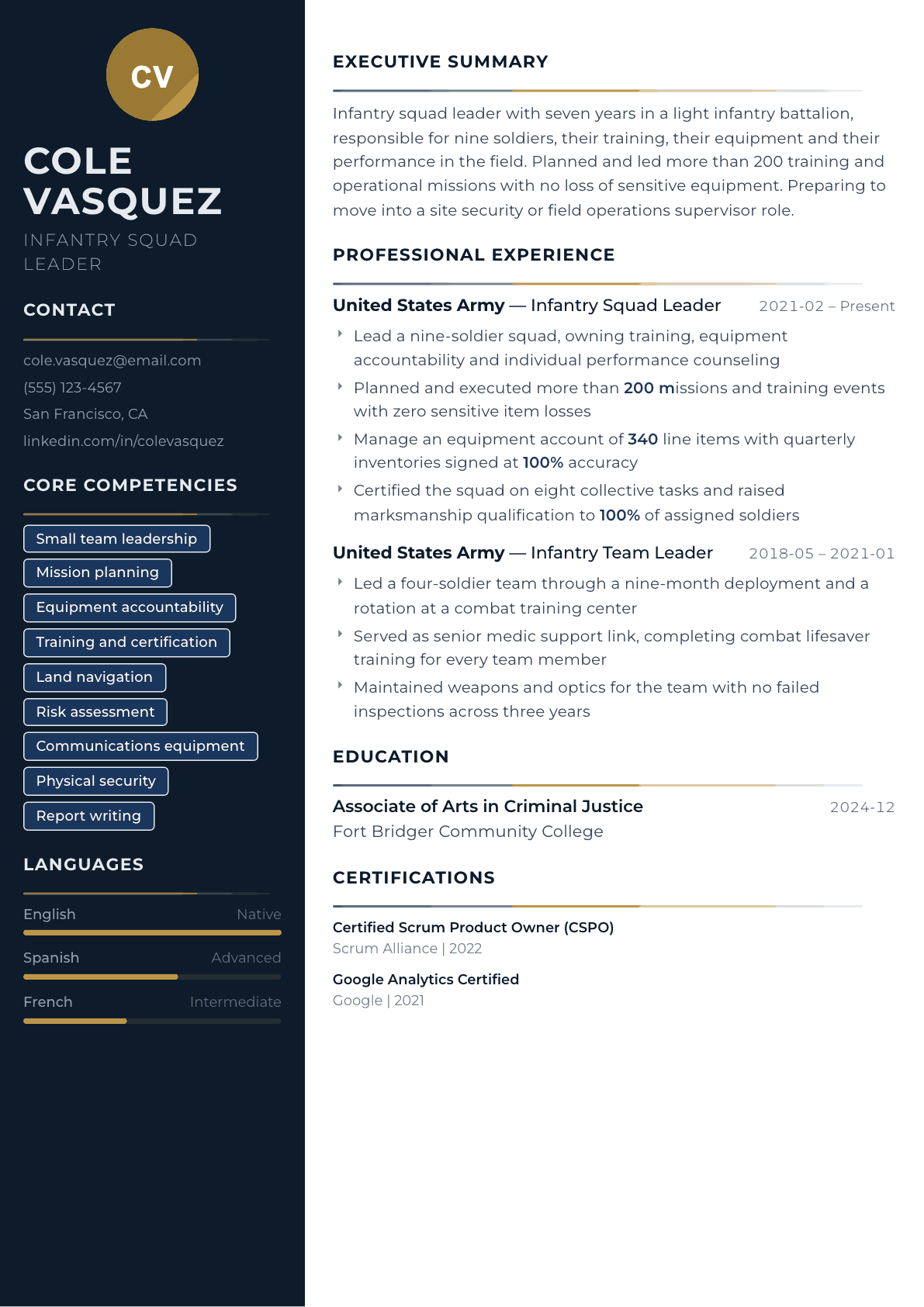
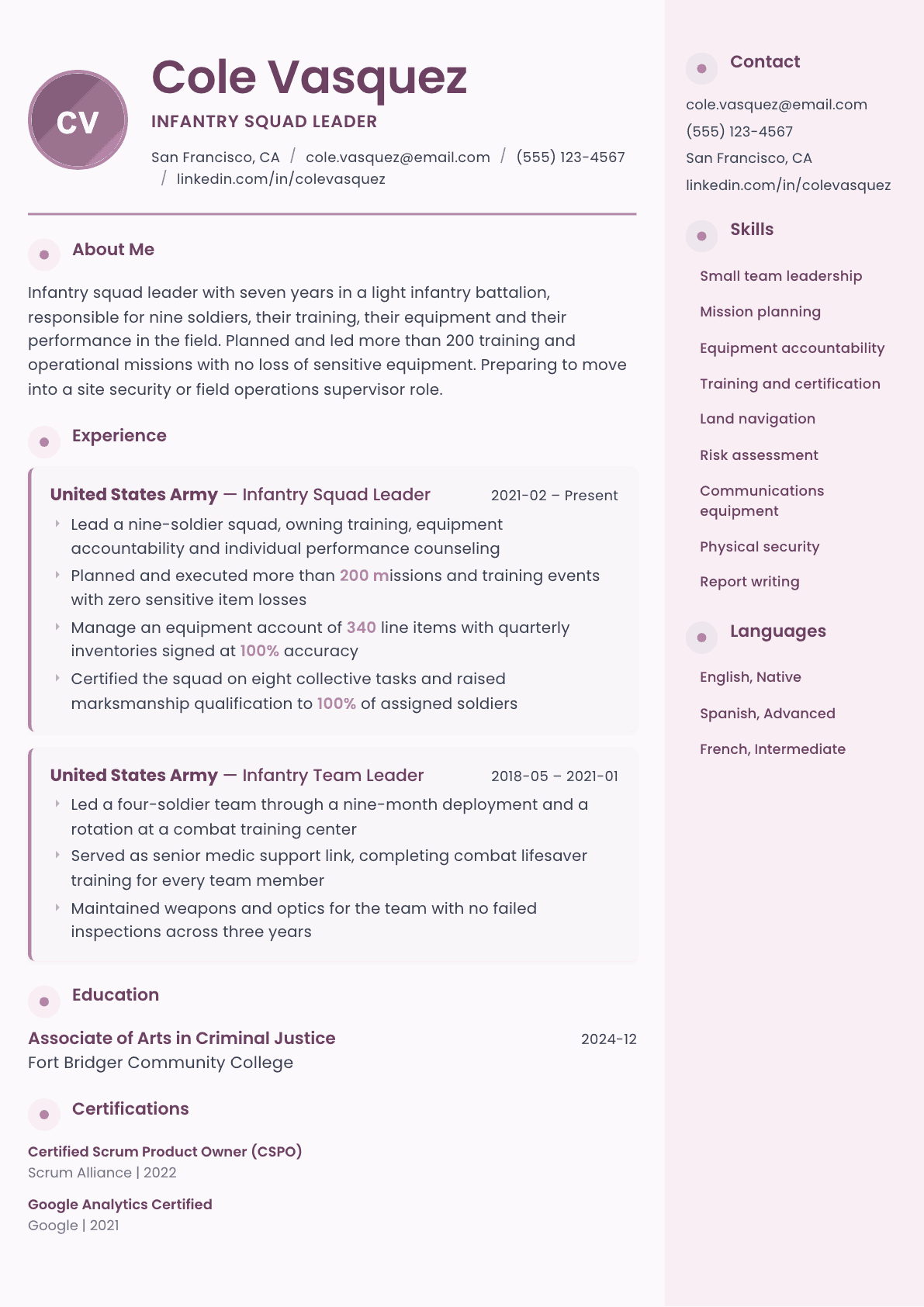
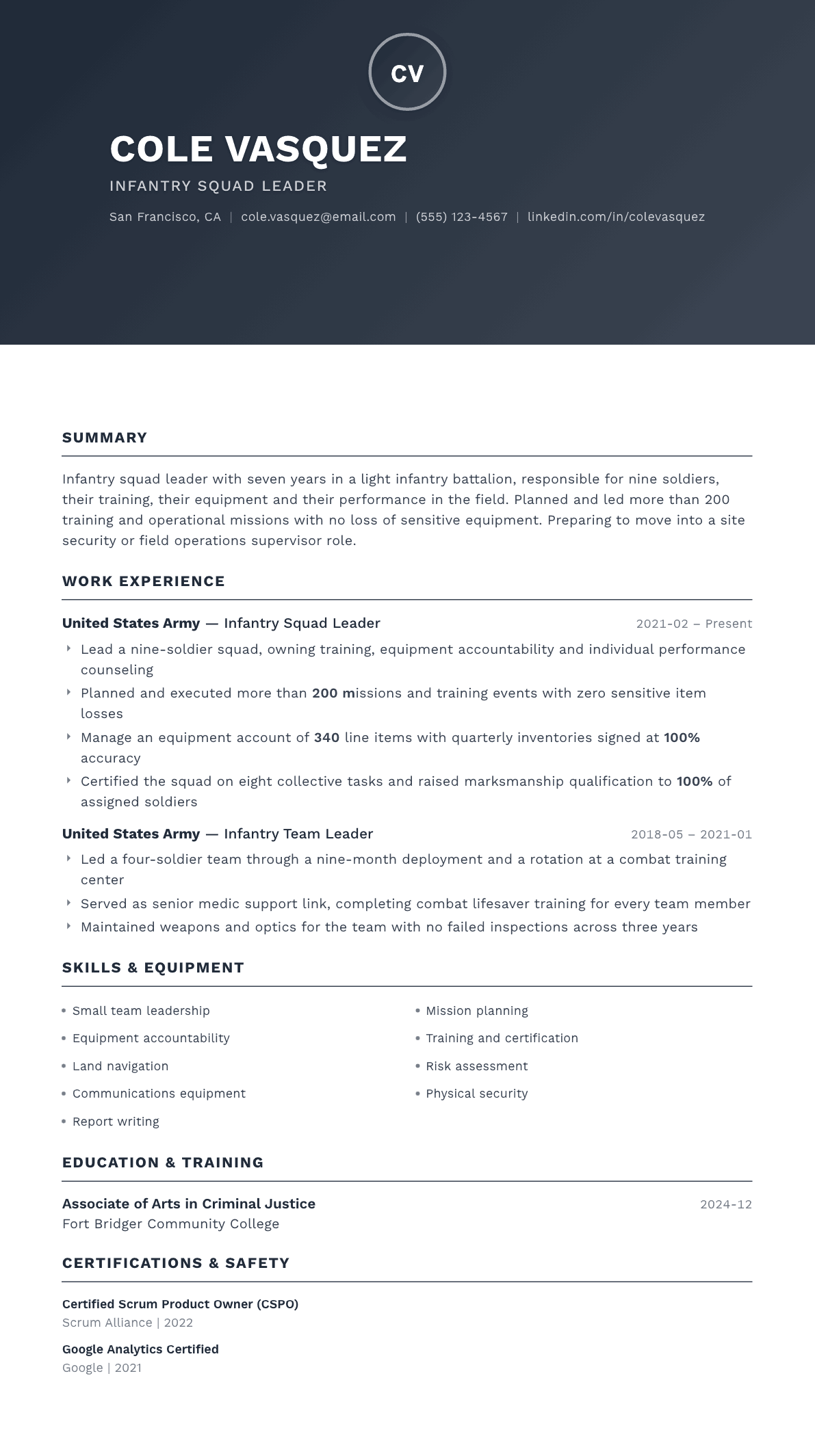
The same infantry content laid out in three CVBooster templates, so you can see what the finished document looks like before you write a word.
Example Infantry summary
Infantry squad leader with seven years in a light infantry battalion, leading nine soldiers through more than 200 missions and training events with no sensitive item losses. Signs for a 340-line equipment account and closes quarterly inventories at full accuracy. Certified the squad on eight collective tasks and finished an associate degree in criminal justice at night. Moving into site security supervision or field operations.
Skills to list on a Infantry resume
- Team and squad leadership
- Mission and operational planning
- Equipment and property accountability
- Risk assessment
- Training delivery
- Physical security
- Land navigation and route planning
- Radio and communications systems
- First aid and casualty care
- After action reporting
- Performance counseling
- Inventory management
- Crisis response
- Physical fitness leadership
What actually gets this resume read
- Write infantry duties as leadership and logistics work, because that is the part a civilian employer can price.
- State squad or team size, the equipment account you signed for, and the inventory accuracy you held.
- Turn field problems into planning language: risk assessment, resource allocation, contingency planning and after action review.
- Keep weapons and tactics detail light unless the target job is armed security or law enforcement.
- Highlight certifications like combat lifesaver, driver qualification and any instructor course you completed.
- Name the civilian roles you are aiming for in the summary so a recruiter does not guess from your MOS alone.
How to write a infantry resume
Infantry experience is the hardest service background to place on a civilian page, and almost all of that difficulty is self-inflicted. The job is written up as weapons, tactics and field craft, none of which a warehouse manager or a site security director can price. Underneath that layer sits the work they actually want: leading a small team, planning against constraints, signing for expensive equipment and getting people qualified on schedule.
Nobody outside the service will do that excavation for you. A recruiter looking at squad leader sees leadership with no scale attached, and a resume that never says nine soldiers, 340 line items or eight collective tasks leaves them guessing low. Numbers are the whole game here, and infantry units generate them constantly.
This guide covers how to structure the page, which parts of the tactical work to keep and which to cut, how to write for security, operations and trade apprenticeship targets, and the questions infantry soldiers and Marines ask when their first applications go unanswered.
Format: leadership scope in the heading, tactics in the detail
One page, reverse chronological. Under the name put the civilian title you want. Each position gets a heading with the equivalent civilian title, the official position, the branch as employer and the dates, followed by a scope line stating team size and the property you signed for.
If the whole page is service, the education and certifications block moves higher, right under the summary. It is the part a screener uses to confirm you meet the posted minimum, and infantry candidates often hold more of it than they show.
- Scope line pattern for infantry: team size led, equipment line items signed for, and the operational tempo or deployment count.
- Group your qualification courses together: driver, combat lifesaver, instructor courses, and any leadership school.
- Name the branch in full, and give the occupational code once beside the first position for veteran recruiters.
- Cut the section listing every weapon system unless you are applying for armed security or law enforcement.
Translating the field work into civilian operations
A mission is a project. It has a plan, a resource list, a rehearsal, an execution window, a contingency and a review afterward. Written that way, an infantry soldier has run hundreds of small projects under time pressure with fixed resources and a real cost to failure. That is what an operations supervisor does with milder stakes.
Property accountability translates directly and is undervalued constantly. Signing for hundreds of line items of sensitive equipment and closing quarterly inventories without a loss is asset control at a level most civilian supervisors never carry. Give the line item count and the inventory record.
Training is the third pillar. Infantry leaders certify their people on defined tasks against a written standard, track who is current, and retrain the ones who fall behind. Say it in exactly those terms and it reads as a competency management system.
How much tactical detail to keep
Keep tactical vocabulary only where the target job rewards it. Armed security, executive protection, corrections and police work all want to see weapons qualification, use of force training, patrolling and reaction to contact. A distribution center does not, and every tactical line there costs you a bullet you needed for logistics or supervision.
When you do keep it, translate the outcome rather than the technique. Reaction drills become response time under stress. Route reconnaissance becomes site assessment and risk identification. Communications equipment becomes radio net discipline across a dispersed team.
Leave out anything that could read as glorified violence. A hiring manager scanning quickly is not evaluating your courage, and a page heavy with engagement language triggers the wrong instinct in someone who has never served.
Certifications and the school you can start now
Infantry service leaves fewer transferable certificates than a technical specialty, so build one before or immediately after separation. A safety card, a security license appropriate to your state, a commercial driving credential or a trade apprenticeship all convert leadership potential into a hireable line on the page.
List the leadership schools you completed with a clause explaining what they are. A basic leader course is a supervisor training program with an assessment, and saying so lets a civilian reader treat it as one instead of ignoring an unfamiliar name.
If you are studying, put the program, school and expected completion on the page immediately. It shows a plan, and it gives a hiring manager a reason to consider you for a role slightly above your current paper credentials.
Infantry resume summary examples
First term, team leader
Infantry team leader with four years in a light infantry battalion, leading four soldiers through a nine-month deployment and a combat training center rotation. Maintained team weapons and optics with no failed inspections and completed combat lifesaver certification for every team member. Seeking a site security or warehouse supervisor role.
Squad leader, seven years
Infantry squad leader with seven years leading nine soldiers through more than 200 missions and training events with no sensitive item losses. Signs for a 340-line equipment account and closes quarterly inventories at full accuracy. Certified the squad on eight collective tasks and raised marksmanship qualification to every assigned soldier.
Platoon sergeant
Infantry platoon sergeant with twelve years and responsibility for 38 soldiers, four squad leaders and a property account covering vehicles, optics and communications equipment. Built the platoon training calendar, ran the qualification cycle, and prepared the platoon for two deployments. Targeting operations supervision or physical security management.
Work experience bullets: before and after
Before: Served as an infantry squad leader responsible for assigned soldiers.
After: Led a nine-soldier squad, owning individual training, equipment accountability and monthly performance counseling for every member.
A duty statement lifted from a job description becomes a scope statement once headcount and the three real responsibilities are named.
Before: Participated in numerous training exercises and combat operations.
After: Planned and executed more than 200 missions and training events, each with a written plan, a rehearsal and an after action review that fed the next cycle.
Volume plus the planning cycle turns field work into project delivery a civilian operations manager recognizes.
Before: Accountable for weapons, optics and other sensitive equipment.
After: Signed for a 340-line equipment account including weapons, optics and radios, closing eight consecutive quarterly inventories with no losses or damage.
The line item count, the categories and the inventory streak make asset control provable rather than asserted.
Before: Trained soldiers to standard on individual and collective tasks.
After: Certified the squad on eight collective tasks and brought marksmanship qualification to every assigned soldier, retraining three who had failed the previous cycle.
Naming the tasks, the completion rate and the recovery of the soldiers who failed shows a training system with follow through.
Before: Maintained physical fitness and led by example at all times.
After: Ran the squad remedial fitness program, moving all three at-risk soldiers to a passing score within one testing cycle.
Leading by example is invisible on paper; a remedial program with an outcome is a management result.
Hard skills
- Small team leadership
- Mission and task planning
- Property and equipment accountability
- Training certification and tracking
- Risk assessment and mitigation
- Land navigation and route planning
- Radio and communications discipline
- Physical security and access control
- Casualty care fundamentals
- After action review and reporting
- Performance counseling
- Vehicle operation and maintenance checks
Soft skills
- Keeping a small team functional when conditions are bad
- Correcting a peer without losing the relationship
- Following a plan you disagree with, then improving it afterward
- Physical and mental endurance over long shifts
- Reading a group quickly and knowing who needs attention
Certifications worth listing
- OSHA 30-Hour Construction (OSHA Training Institute)
- Emergency Medical Technician (National Registry of Emergency Medical Technicians)
- Certified Protection Professional (CPP) (ASIS International)
Mistakes that cost infantry candidates the interview
- Filling the page with weapons systems and tactical vocabulary when the target job is logistics or facilities.
- Writing squad leader with no team size, so a reader assumes the smallest possible scope.
- Skipping the property account, which is the strongest single translation an infantry soldier has.
- Describing deployments as places visited rather than as periods of extended responsibility.
- Leaving leadership schools unexplained, so a civilian reader cannot tell they are supervisor training.
- Applying with no civilian credential at all when a short safety or security course would have added one.
Infantry resume questions
What civilian jobs actually hire infantry veterans?
Physical security and site supervision, warehouse and distribution operations, utilities and field service crews, corrections and law enforcement, and the skilled trades through apprenticeships. All of them value supervised teamwork, reliability and comfort with physical work over any specific technical background.
How do I write about deployments?
One line per deployment inside the relevant position, naming the length and what your responsibility was during it. The useful detail for a civilian reader is that you sustained a leadership job under continuous pressure, not the location or the campaign name.
Should I include my weapons qualification scores?
Only for armed security, law enforcement or corrections applications, where a current qualification is a hiring requirement. In any other field it reads as a mismatch and takes a line from the leadership and logistics content that will actually get you called.
Do I need a degree to get a supervisor role?
Not usually in operations, security or the trades, where demonstrated team leadership and a clean record carry more weight. A degree in progress helps, so list the program and completion date if you are enrolled rather than waiting until it is finished.
How do I explain that I have never worked a civilian job?
Do not apologize for it. Present the service as employment, because it was, with an employer, positions, dates and results. Then name any bridge you do have: a certification, a course, or work you did alongside contractors and civilian agencies.
Related resume examples
- Security Guard Resume example
- Bodyguard Resume example
- Military Police Resume example
- Veteran Resume example
- Marine Corps Veteran Resume example
- Combat Medic Resume example