Coast Guard Resume Examples: free ATS score and gap list
Turn Coast Guard Service Into a Resume Civilians Can Read
By Mustafa Tarabya, founder of CVBooster · Published · Updated
Coast Guard resume example and translation guide covering search and rescue, boarding, small boat operations and how to civilianize rate and rank language.
Sample resumes for a coast guard
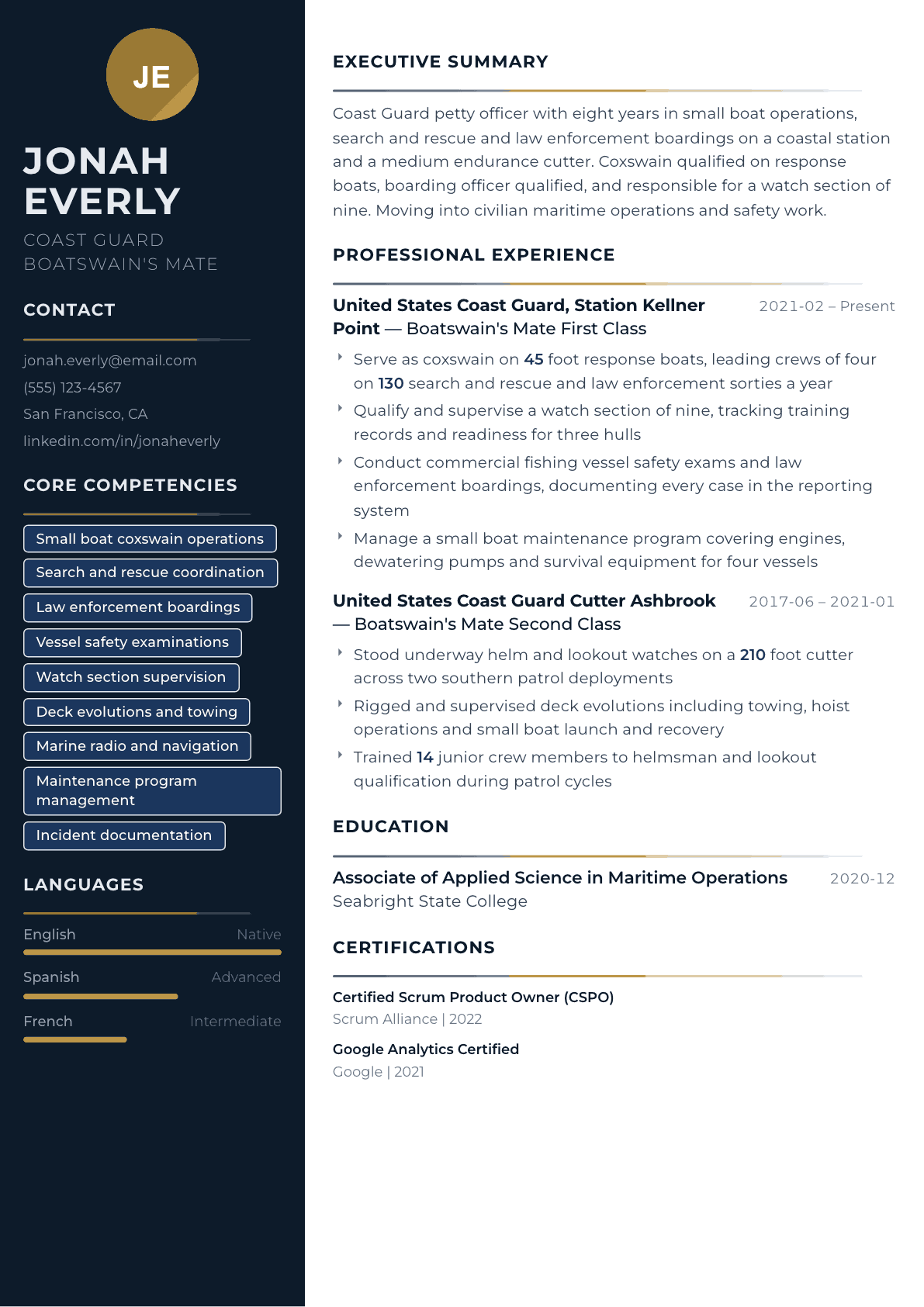
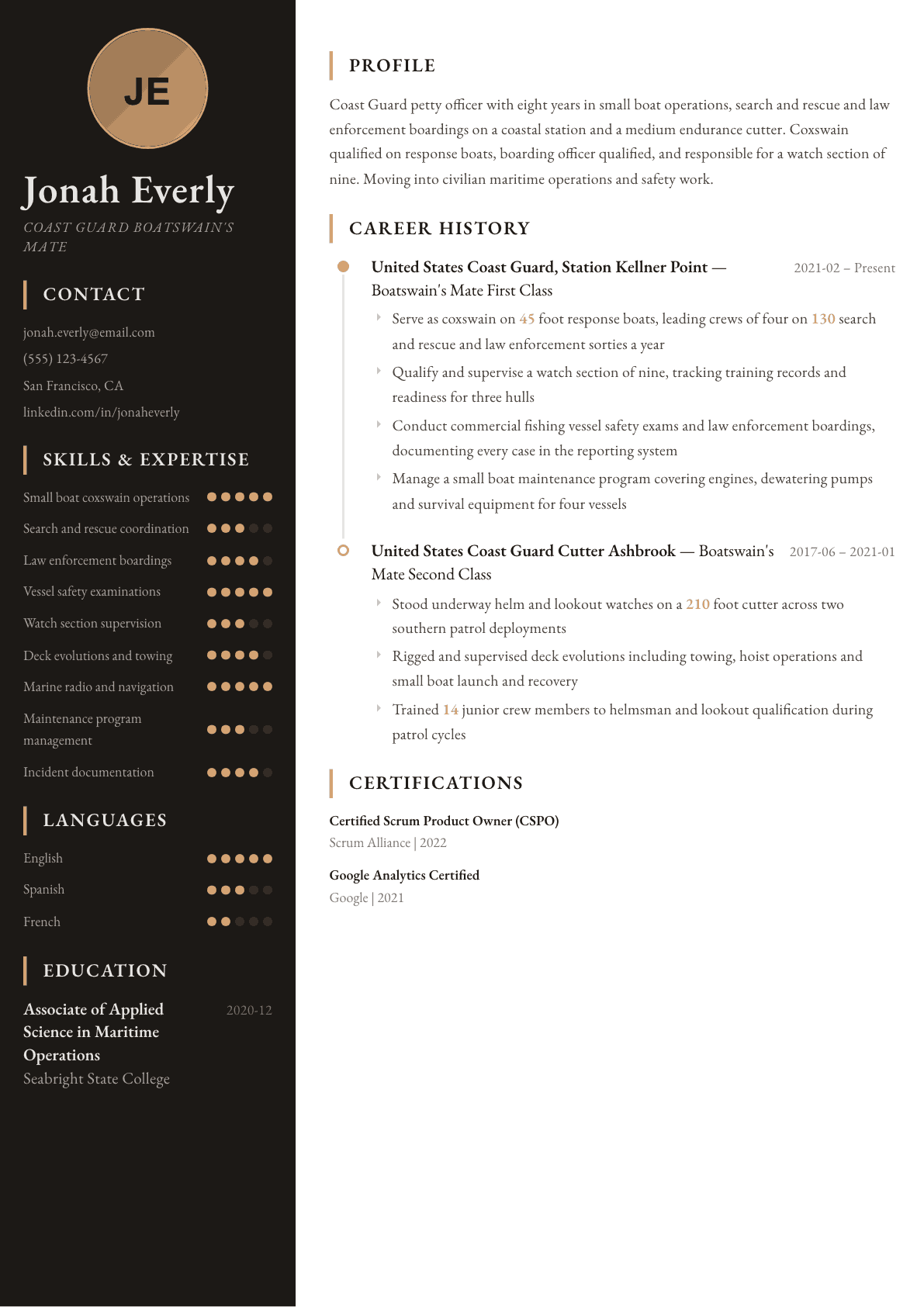
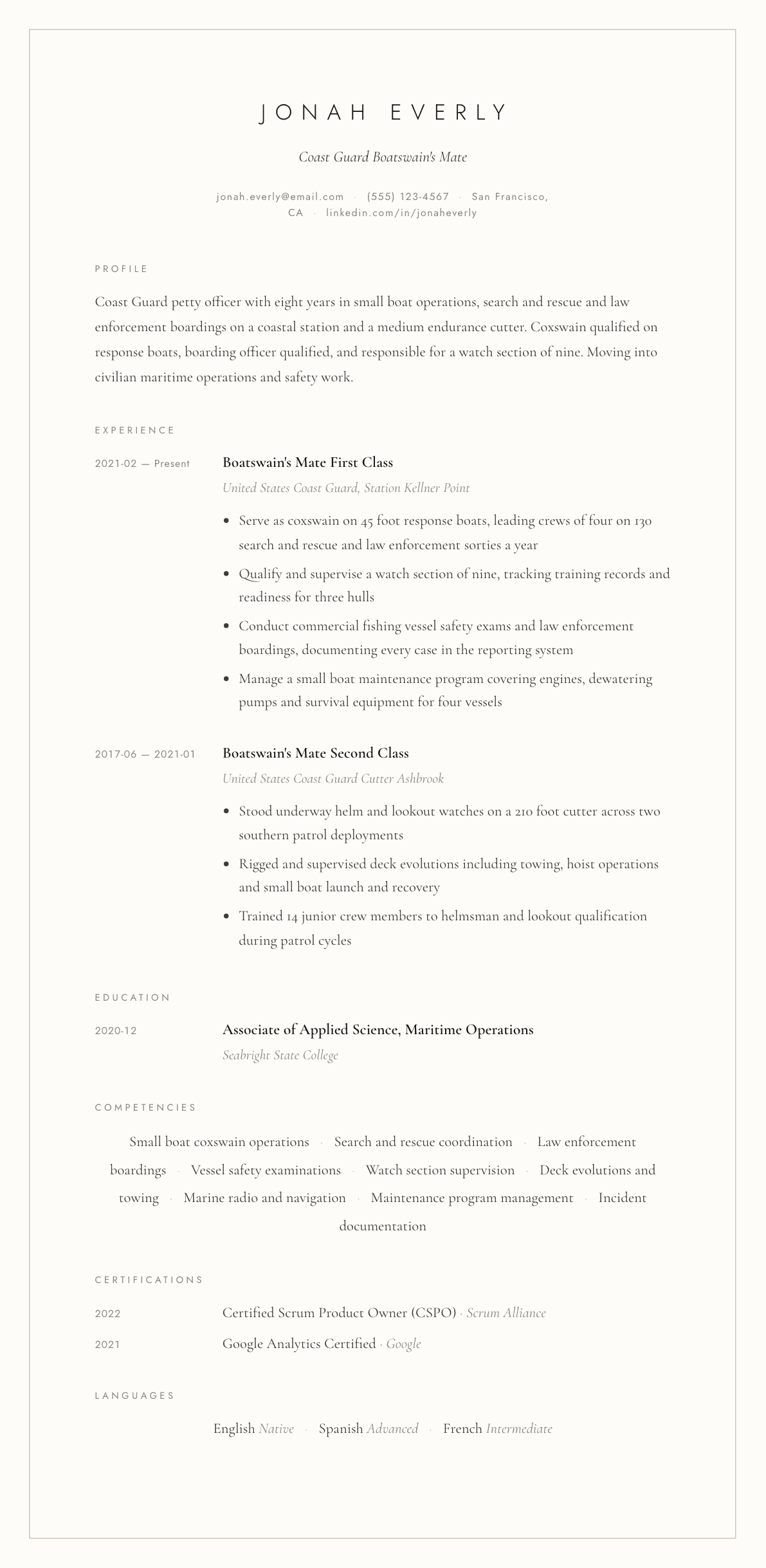
The same coast guard content laid out in three CVBooster templates, so you can see what the finished document looks like before you write a word.
Example Coast Guard summary
Coast Guard petty officer with eight years across a coastal station and a medium endurance cutter, qualified as a response boat coxswain and a boarding officer. Leads boat crews on search and rescue and enforcement sorties, supervises a watch section of nine, runs a small boat maintenance program across four hulls, and conducts commercial vessel safety exams. Moving into civilian marine operations and safety.
Skills to list on a Coast Guard resume
- Small boat coxswain
- Search and rescue
- Law enforcement boarding
- Commercial vessel safety exams
- Navigation and chart work
- Marine radio communications
- Towing and deck evolutions
- Watch standing and watch supervision
- Crew qualification and training
- Preventive maintenance systems
- Damage control and firefighting
- Incident and case documentation
- Pollution response support
- Risk assessment before a sortie
What actually gets this resume read
- Translate your rate and rank into a civilian job title on the first line and keep the military title beside it.
- Convert qualifications into responsibilities: coxswain becomes leading a boat crew of four on live rescue sorties.
- Give sortie counts, patrol days and watch section size so a civilian reader can see the scale of the work.
- Name your merchant mariner credential and any endorsements, because that is the certificate civilian employers know.
- Drop unit acronyms and program names that mean nothing outside the service, and explain the ones you have to keep.
- Put safety, training and maintenance program ownership high, since those transfer directly into port and marine operations.
How to write a coast guard resume
Two different readers pick up a Coast Guard resume. One is a military hiring manager or a federal panel who reads rate, rank and qualification fluently. The other is a civilian operations manager at a port, a marine terminal, an offshore operator or a safety department who has never heard of a boatswain's mate and will not spend effort guessing. The same document rarely satisfies both, and the mistake most veterans make is writing only for the first.
The work translates better than almost any other service experience. A coxswain leads a small crew making time critical decisions with lives on the line. A boarding officer conducts inspections against a regulation and writes a defensible case. A watch supervisor runs qualification tracking and readiness for a group of people and a set of equipment. Those are ordinary civilian job descriptions once the acronyms come out.
This guide shows how to translate a Coast Guard career into a resume a civilian will hire from, how to keep the version that federal panels need, three summaries at different points of service, before and after bullets, and the questions members ask in the year before they separate.
Format: build two versions and know which one you are sending
The federal version keeps rate, rank, unit names, month and year dates, hours per week and full duty descriptions, because a panel scores against a written standard and needs every field. The civilian version is two pages, uses a plain job title on the first line, and spends its space on what you ran rather than what you were called.
On the civilian version, keep the service identity visible but subordinate. A line that reads marine operations supervisor with the service and the rate beside it gives the reader a civilian handle and the credibility of the uniform at the same time. Do not delete the service, because it is the most trusted part of your history.
- Civilian first line: the job you are applying for, then the rate and rank in parentheses so nothing is hidden.
- A qualifications block naming coxswain, boarding officer, watch supervisor and any engineering or medical qualification in plain terms.
- A credentials block for the merchant mariner credential, endorsements, security credentials and incident command courses.
- Awards translated by reason, not by name, since a civilian reader cannot rank service medals.
Summary: the civilian job title, the scale, the credential
Three lines. Name the civilian function you are moving into, the years of service, the platforms and settings you worked, the size of the team you supervised, and the credential a civilian employer recognizes. That last item is usually the merchant mariner credential, and it should appear in the summary rather than being left to the bottom of page two.
Resist the temptation to lead with sea stories. A rescue in heavy weather is a strong interview answer and a weak summary line. The summary has to make an operations manager believe you can run his watch bill, keep his vessels legal and train his new hires.
Experience: sorties, watches, qualifications and equipment
Write each tour as a job. Name the unit and describe it in civilian terms: a coastal station operating four boats with a crew of thirty, or a two hundred foot cutter with a crew of seventy on multi month patrols. Then say what you owned inside it.
The strong bullets in this trade come in four families. Operations: sorties per year, crew size, the mission types, the weather and sea state you launched in. Supervision: watch section size, qualification tracking, training delivered and the number of people you signed off. Compliance: boardings and vessel safety exams conducted, deficiencies found, cases documented. Maintenance: the preventive maintenance program you ran, the hull or system count, the readiness rate you held.
Every one of those maps onto a civilian job. Sorties become dispatched operations. Boardings become inspections and audits. Watch supervision becomes shift supervision and competency management. Preventive maintenance becomes asset reliability. Write the military fact, then write the outcome in words a terminal manager already uses.
Translation: the acronyms to cut and the ones to keep
Cut unit designators, program abbreviations and anything that requires service knowledge to decode. Keep the handful of terms that are genuinely industry standard: search and rescue, incident command system, damage control, navigation, watch standing, preventive maintenance. Those are used in civilian marine and emergency work with the same meaning.
When a service term has no civilian twin, explain it once in the bullet and never again. A boarding becomes a regulatory inspection of a commercial vessel. A qualification board becomes a formal competency assessment. A deployment becomes a multi month operational period away from home port. One clause of explanation is enough, and it earns back more than it costs.
- Translate qualifications into responsibilities: coxswain becomes leading a four person boat crew on live emergency response.
- Give numbers civilians can size: sorties, patrol days, crew members trained, vessels maintained, inspections conducted.
- Name the credential a civilian recognizes and the endorsements on it.
- Keep incident command references, because port, energy and emergency employers use the same system.
Where the experience actually sells
Marine and port operations is the obvious landing, but it is not the only one. Safety and emergency management departments hire people who have run risk assessments before every launch. Regulatory and compliance teams hire boarding officers because they already know how to inspect against a written standard and document a finding. Maintenance and reliability groups hire people who ran a preventive maintenance program on demanding equipment in salt water.
Aim the resume at one of those, not all of them. A page that tries to be a marine operations resume and a safety resume at once ends up thinner than either, and the parts of your service that matter differ sharply between the two.
Coast Guard resume summary examples
Separating after one enlistment
Coast Guard petty officer separating after four years at a coastal station, qualified as a boat crew member and a helmsman. Stood duty watches, maintained response boats and survival equipment, and assisted on search and rescue and law enforcement sorties. Seeking marine operations or safety work ashore.
Eight years, coxswain qualified
Marine operations supervisor and Coast Guard petty officer with eight years across a station and a cutter. Coxswain qualified on response boats, leading crews of four on about 130 sorties a year, supervising a watch section of nine and running a maintenance program covering four hulls.
Chief moving into port operations
Coast Guard chief petty officer with sixteen years in small boat and cutter operations, most recently responsible for readiness across six hulls and a crew of forty. Ran the qualification board, the training plan and the maintenance program, and holds a merchant mariner credential with endorsements.
Work experience bullets: before and after
Before: Served as a coxswain on Coast Guard small boats.
After: Led four person boat crews as coxswain on 45 foot response boats across roughly 130 search and rescue and law enforcement sorties a year, launching in sea states up to the boat limit.
Crew size, sortie volume and operating limits give a civilian manager a scale he can compare to his own operation.
Before: Conducted boardings of vessels.
After: Conducted regulatory inspections of commercial fishing vessels, checking survival and firefighting equipment against federal requirements and documenting every deficiency in the case reporting system.
Framing a boarding as an inspection against a written standard is language a compliance manager understands immediately.
Before: Supervised junior personnel.
After: Supervised a watch section of nine, owned qualification tracking for three hulls and signed off fourteen crew members to helmsman and lookout standard during two patrol cycles.
Team size, competency ownership and sign off counts describe a supervisor rather than a rank.
Before: Maintained boats and equipment.
After: Ran the preventive maintenance program for four small boats covering engines, dewatering pumps and survival gear, and held all hulls available for immediate response through two peak seasons.
Asset count, system scope and an availability outcome is exactly how a reliability manager measures the same work.
Before: Received awards for performance.
After: Recognized twice by the unit commanding officer for rescue coordination in heavy weather and for rebuilding the boat crew training plan after a qualification backlog.
Explaining the reason behind an award lets a civilian judge the achievement without knowing the medal.
Hard skills
- Small boat coxswain operations
- Search and rescue coordination
- Regulatory vessel inspection and boarding
- Commercial vessel safety examination
- Navigation, chart work and radar
- Marine radio and distress communications
- Towing and deck evolutions
- Watch standing and watch supervision
- Crew qualification and training programs
- Preventive maintenance systems
- Damage control and shipboard firefighting
- Incident command system roles
- Pollution response support
- Operational risk assessment
Soft skills
- Making a launch decision with incomplete weather information
- Briefing a crew so everyone knows the abort criteria
- Keeping composure through a long recovery
- Teaching a qualification without lowering the standard
- Working with agencies that have different rules and radios
Certifications worth listing
- Merchant Mariner Credential (United States Coast Guard National Maritime Center)
- Transportation Worker Identification Credential (Transportation Security Administration)
- ICS-200 Basic Incident Command System for Initial Response (FEMA Emergency Management Institute)
Mistakes that cost coast guard candidates the interview
- Sending a resume full of unit designators and program abbreviations to a civilian manager who cannot decode any of them.
- Leading with rate and rank instead of the civilian job title the posting is actually for.
- Listing qualifications as titles without saying what responsibility each one carried in daily work.
- Leaving the merchant mariner credential on the last page when it is the credential a civilian employer recognizes first.
- Aiming one document at marine operations, safety and compliance at once, which weakens all three.
- Naming awards without explaining what they were given for, so a civilian reader cannot weigh them at all.
Coast Guard resume questions
How do I translate my rate into a civilian job title?
Start from the work rather than the rate. A boatswain's mate running boats and crews is a marine operations supervisor. A machinery technician is a marine maintenance technician. Use the title from the posting you want, then keep the rate beside it for credibility.
Should I keep the federal style resume when applying to companies?
Keep it for federal and contractor applications that ask for it, and build a separate two page version for companies. Hours per week and full duty narratives help a federal panel and bury the important points for a private hiring manager reading a stack.
What civilian jobs value Coast Guard experience most?
Port and marine terminal operations, vessel and offshore support, emergency management, marine safety and compliance, and maintenance or reliability roles. Each values a different half of your record, so pick the target first and shape the document toward it.
How do I handle a security clearance on my resume?
State the level and the status without describing the work it covered. That is enough for a recruiter to filter on. Adding detail about classified duties creates risk and gains nothing, since the clearance level itself is what the filter looks for.
Is it worth mentioning collateral duties from my tours?
Yes, when they map to civilian functions. Training coordinator, safety representative, maintenance program manager, equipment custodian and command investigator all translate cleanly, and they often prove skills your primary duties never demonstrate on paper.
Related resume examples
- Military to Civilian Resume example
- Military Resume example
- Marine Engineer Resume example
- Firefighter Resume example
- Marine Corps Veteran Resume example
- Wildland Firefighter Resume example