Safety Officer Resume Examples: the lines they read
Write a Safety Officer Resume That Shows Real Site Control
By Mustafa Tarabya, founder of CVBooster · Published · Updated
Safety officer resume example with inspection, incident investigation and training keywords, plus a guide to writing rates, audits and regulator visits.
Sample resumes for a safety officer
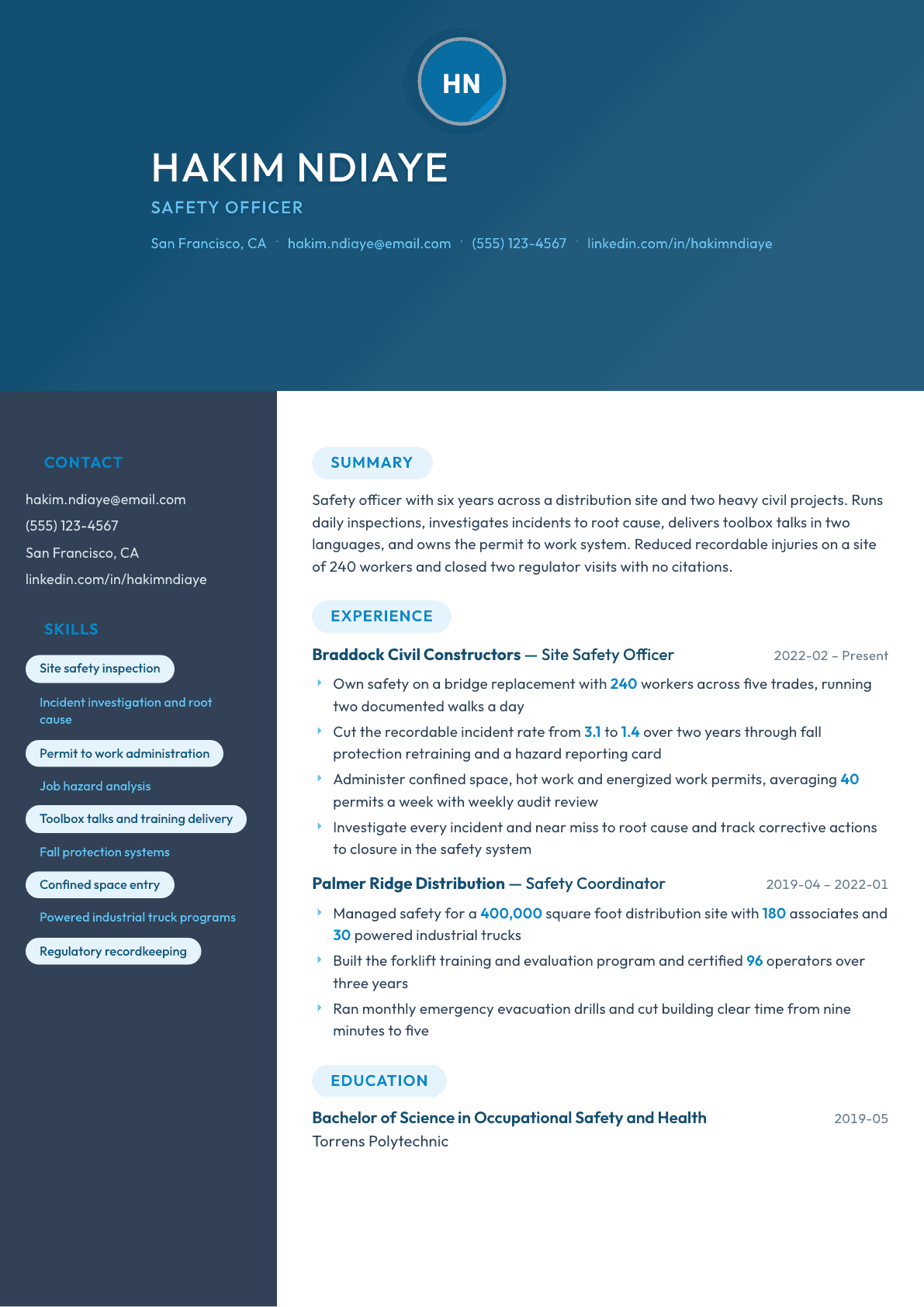
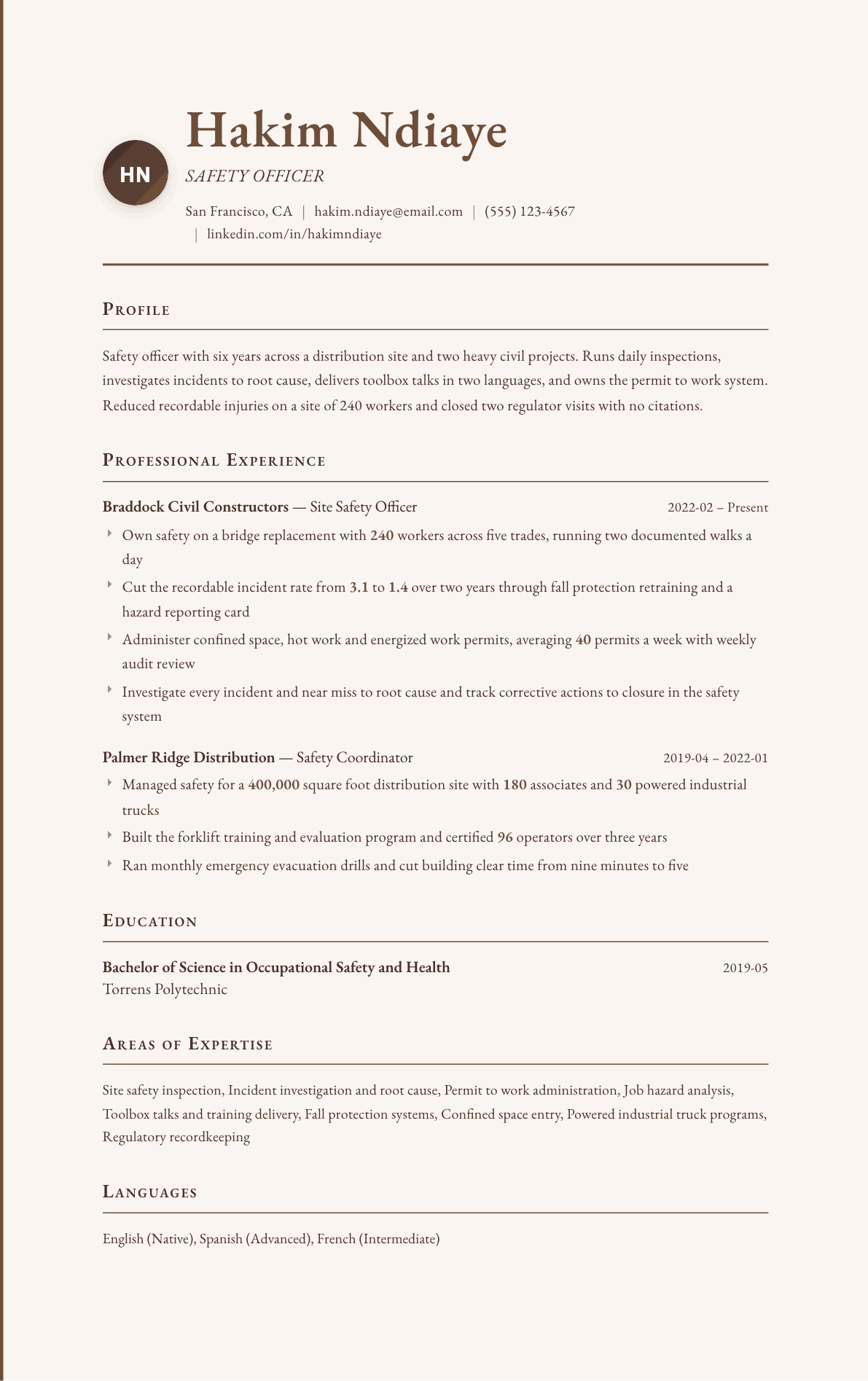
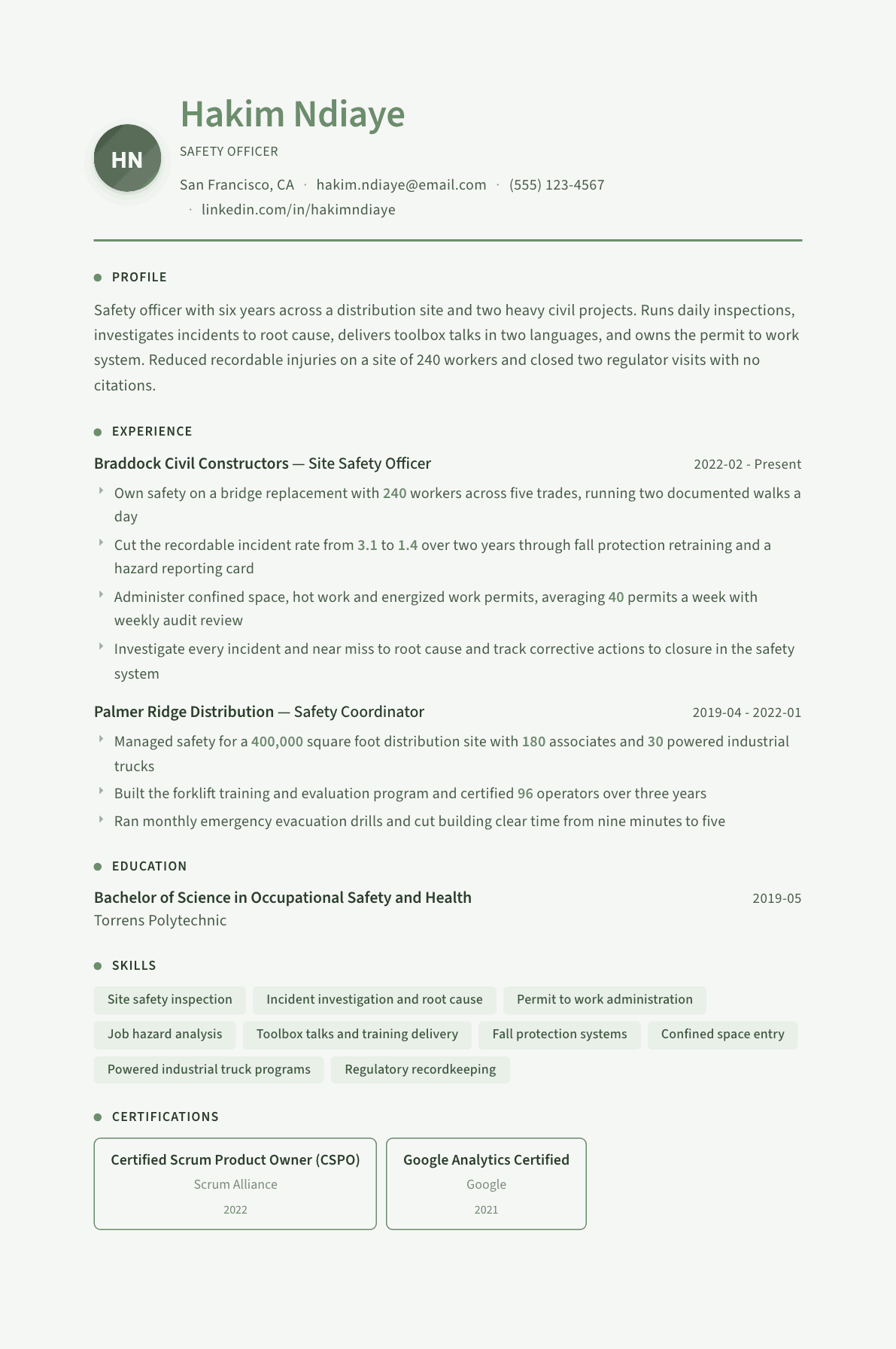
The same safety officer content laid out in three CVBooster templates, so you can see what the finished document looks like before you write a word.
Example Safety Officer summary
Safety officer with six years across heavy civil construction and distribution, currently covering a bridge replacement with 240 workers and five trades. Runs two documented walks a day, administers confined space and hot work permits at volume, investigates every incident to root cause, and drove the recordable rate from 3.1 to 1.4 over two years. Closed two regulator visits with no citations.
Skills to list on a Safety Officer resume
- Safety inspection and walkdowns
- Job hazard analysis
- Incident and near miss investigation
- Root cause analysis
- Permit to work systems
- Fall protection and rescue planning
- Confined space entry supervision
- Lockout and tagout verification
- Hazard communication and chemical inventory
- Powered industrial truck certification
- Emergency response planning and drills
- Regulatory recordkeeping and injury logs
- Toolbox talk and orientation delivery
- Contractor safety qualification
- Corrective action tracking
What actually gets this resume read
- Give the headcount, the site type and the trades you cover, because a safety officer on one site is not a peer of another.
- Show your recordable and lost time rates as a movement over a period, not as a single number with no baseline.
- Name the permits you administer and the weekly volume, since permit discipline is where site control is won or lost.
- Describe an investigation by method: root cause tool used, corrective actions raised and how you verified closure.
- Say how many training sessions you deliver a month and in which languages your crews actually work.
- Put regulator and client audit outcomes on the page, because a clean visit is the result a manager can bank.
How to write a safety officer resume
The person hiring a safety officer has a specific fear. He has a site full of people doing hazardous work, a client audit on the calendar, and a regulator who can walk through the gate without an appointment. He is not looking for someone who believes in safety. He is looking for someone whose presence changes what happens on the deck at seven in the morning.
That is why the resumes that win are unusually concrete. They name the site, the headcount and the trades. They give injury rates as a movement between two points rather than a single flattering number. They describe permits by volume because permit discipline is where site control is either real or theater. And they say what happened the last time an inspector arrived.
This guide walks through each part of a safety officer resume, how to write inspections, investigations and training so a construction or operations manager can weigh them, three summaries for different stages, before and after bullets, and the questions safety people ask when they move between construction, manufacturing and energy work.
Format: two pages, cards visible, sites described by risk
Reverse chronological over one or two pages, plain layout, no columns through the experience section. A safety resume is read quickly by a project manager who is deciding whether to hand you a site, and every design flourish costs you a fact he wanted.
Cards and courses belong in a block near the top with the awarding body named. Outreach training hours, first aid and defibrillator, confined space entry and rescue, fall protection competent person, and any professional certification are the items that decide whether you can sign a permit or stand a rescue watch. A project manager checks that block before he reads a single bullet.
- A site block describing each project or facility by type, headcount, trades on deck, and the high hazard activities present.
- Order that suits this trade: summary, certifications, site experience, training delivered, education.
- Every position states whether you were the only safety presence on site or part of a team, and who you reported to.
- A short line on regulator and client audit outcomes, since a clean visit is the result a manager can bank.
Summary: site type, headcount, and the direction of your numbers
Three lines. Name the industry, the site type and size, the headcount and trades you cover, and one measurable movement you own. A safety officer who took a recordable rate from one figure to a lower one over a stated period is making a claim that can be verified with a reference call, which is exactly the point.
Say plainly whether you are the sole safety officer or part of a department. Being the only safety presence on a site of two hundred is a different job from being one of five on a refinery turnaround, and the two hire on opposite evidence.
Experience: walks, permits, investigations and training
Inspections come first because they are the daily work. Say how many documented walks you run a day or a week, what you inspect against, how findings are raised, and how you verify a correction. A safety officer who raises findings but never closes them is describing a filing system rather than a safety program.
Permits are the clearest proof of control. Confined space, hot work, energized electrical, excavation, lift plans and work at height each carry their own preparation, gas testing, standby and closure steps. Give the weekly permit volume and say who audits them. A manager who has watched a job go wrong under a badly written permit reads that line with real attention.
Investigations should show method, not sympathy. Name the root cause technique you use, say that near misses get the same process as recordables, and describe how corrective actions are tracked to closure with a verification step. The strongest bullet in this whole trade is one where an investigation led to a physical change on site rather than a retraining session.
Training is the fourth pillar. Orientations delivered, toolbox talks per week, equipment certifications issued, and the languages your crews actually work in. A safety officer who can deliver a fall protection talk in the language the crew speaks changes behavior in a way a translated handout never will.
Numbers: rates, leading indicators and honest baselines
Give injury rates as movement with a period attached. A single low rate proves nothing because it may have come with the site. A rate that moved with you, over a stated span, with the intervention named beside it, is an argument.
Then add leading indicators, because they are what a modern operations manager watches between incidents: hazard cards submitted per worker, observations completed, permit audit scores, corrective action closure time, training compliance. A safety officer who reports only injuries after they happen looks reactive, and that impression is hard to shake in an interview.
- Documented walks per day or week, with the standard you inspect against.
- Permit volume by type per week and who reviews them for quality.
- Investigations per year, the root cause method used, and closure verification.
- Training delivered by session count, audience size and language.
- Leading indicators alongside recordable and lost time rates, with the period stated.
Keywords and the standards a posting expects to see named
Postings for this role reuse a stable vocabulary: job hazard analysis, hazard communication, lockout and tagout, confined space, fall protection, excavation and trenching, respiratory protection, powered industrial trucks, incident investigation, corrective action, contractor management and recordkeeping. Use each once in the skills area and once inside a bullet that shows it.
Name the regulatory framework you work under and the recordkeeping you own, including the injury log and any client reporting portal. Contractors are often judged on prequalification scores held in third party systems, and a safety officer who has managed those submissions is solving a commercial problem as well as a safety one.
Safety Officer resume summary examples
First safety post
Occupational safety graduate with a construction outreach card and first aid certification, moving into a first site role after two years as a working foreman. Comfortable running toolbox talks, completing job hazard analyses and inspecting fall protection and excavation work alongside a senior safety officer.
Sole safety officer on site
Safety officer covering a bridge replacement with 240 workers across five trades as the only safety presence on site. Runs two documented walks a day, administers about 40 permits a week for confined space and hot work, and investigates every incident and near miss to root cause.
Multi site safety lead
Senior safety officer covering three sites and a distribution facility, mentoring two junior officers. Drove the recordable rate from 3.1 to 1.4 across two years through fall protection retraining and a hazard card program, and closed two regulator visits and four client audits with no citations.
Work experience bullets: before and after
Before: Conducted regular safety inspections of the site.
After: Ran two documented walks a day across a bridge replacement with five trades on deck, raising findings into the tracking system and verifying every correction on the next walk.
Cadence, scope and a closure loop show a working inspection program instead of a habit of looking around.
Before: Managed the permit system.
After: Administered about 40 permits a week for confined space, hot work and energized electrical work, including gas testing, standby assignment and a weekly quality audit of closed permits.
Volume, permit types and an audit step prove control over the highest risk work on the site.
Before: Investigated accidents and wrote reports.
After: Investigated every incident and near miss to root cause, tracked 46 corrective actions to closure and replaced a repeat hand injury source by redesigning a rebar tying station.
A physical change on site is stronger evidence than any number of retraining sessions after the fact.
Before: Improved the safety record on my site.
After: Cut the recordable incident rate from 3.1 to 1.4 over two years by retraining every trade on fall protection and launching a hazard card that put 900 worker observations into the system.
A movement over a stated period with the intervention beside it is verifiable where a single rate is not.
Before: Trained employees on safety topics.
After: Delivered site orientation to 320 new workers and ran weekly toolbox talks in English and Spanish, then certified 96 powered industrial truck operators through classroom and practical evaluation.
Audience counts, languages and a certification pathway show training that actually reached the crew.
Hard skills
- Documented site inspection and walkdowns
- Job hazard analysis
- Permit to work administration
- Confined space entry supervision and gas testing
- Fall protection systems and rescue planning
- Lockout and tagout verification
- Excavation and trenching controls
- Hazard communication and chemical inventory
- Powered industrial truck certification
- Incident and near miss investigation
- Root cause analysis
- Injury recordkeeping and regulatory reporting
- Contractor prequalification and management
- Emergency response planning and drills
Soft skills
- Stopping work without turning the crew against you
- Holding a standard when the schedule is slipping
- Talking to a superintendent as a peer rather than a rule reader
- Teaching a toolbox talk that a tired crew actually listens to
- Writing a finding that reads as a fix rather than an accusation
Certifications worth listing
- OSHA 30-Hour Construction Outreach Training (OSHA Training Institute)
- Safety Trained Supervisor (STS) (Board of Certified Safety Professionals)
- Occupational Health and Safety Technologist (OHST) (Board of Certified Safety Professionals)
- Adult First Aid, CPR and AED (American Red Cross)
Mistakes that cost safety officer candidates the interview
- Giving a single injury rate with no baseline and no period, which proves nothing about your effect on a site.
- Describing inspections without a cadence or a closure step, so the reader sees observation rather than control.
- Leaving permits off the page even though permit quality is where high hazard work is either controlled or not.
- Writing investigations as narratives instead of naming the root cause method and the corrective action closure.
- Reporting only lagging indicators, which makes an experienced operations manager read you as reactive.
- Omitting site headcount and trade mix, so nobody can tell whether your experience matches the project being staffed.
Safety Officer resume questions
How do I move from a trade into a safety officer role?
Lead with the hazards you worked inside as a tradesperson, then add the outreach training hours and a first aid card. Crews accept a safety officer who has done the work, and hiring managers know it, so name the trade rather than hiding it.
Should I put injury rates on my resume?
Yes, as a movement between two figures across a stated period, with the intervention named. Never quote a single rate as if it were your achievement, because a reader assumes you inherited it, and an interviewer will ask what you actually changed.
What certification should I get first?
Start with the outreach training hours for your industry and a current first aid card, since those unlock site work immediately. Then work toward a professional certification from the safety certification board, which is what employers use to separate practitioners from card holders.
How different is a manufacturing safety resume from a construction one?
Construction emphasizes fall protection, excavation, mobile equipment, subcontractor management and constantly changing site conditions. Manufacturing emphasizes machine guarding, lockout, ergonomics, chemical exposure and process consistency. Reorder your skills and lead bullets toward whichever the posting describes.
What should I say about a recordable injury that happened on my watch?
Nothing on the resume, but prepare the answer. Describe the investigation, the root cause, the physical control you put in place and how you verified it held. Hiring managers respect an officer who can discuss a bad outcome without becoming defensive about it.
Related resume examples
- Safety Coordinator Resume example
- Health and Safety Officer Resume example
- Safety Engineer Resume example
- Construction Safety Manager Resume example
- Navy Veteran Resume example
- Environmental Health and Safety Manager Resume example