Nuclear Technician Resume Examples: the lines they read
Build a Nuclear Technician Resume with Critical Precision
By Mustafa Tarabya, founder of CVBooster · Published · Updated
Create a nuclear technician resume highlighting radiation protection, reactor operations support, and nuclear safety compliance with templates designed for nuclear power and government roles.
Sample resumes for a nuclear technician
The same nuclear technician content laid out in three CVBooster templates, so you can see what the finished document looks like before you write a word.
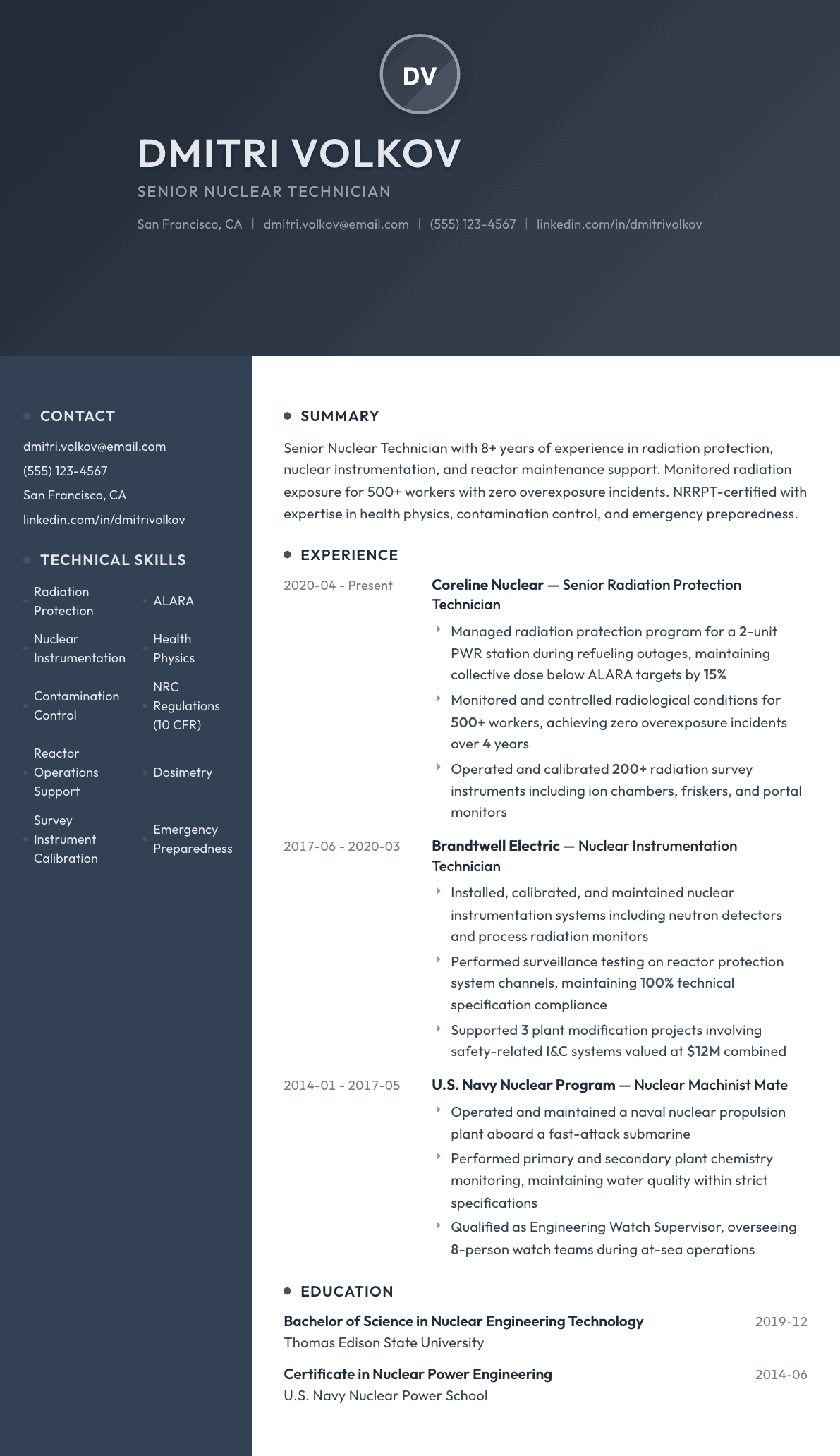
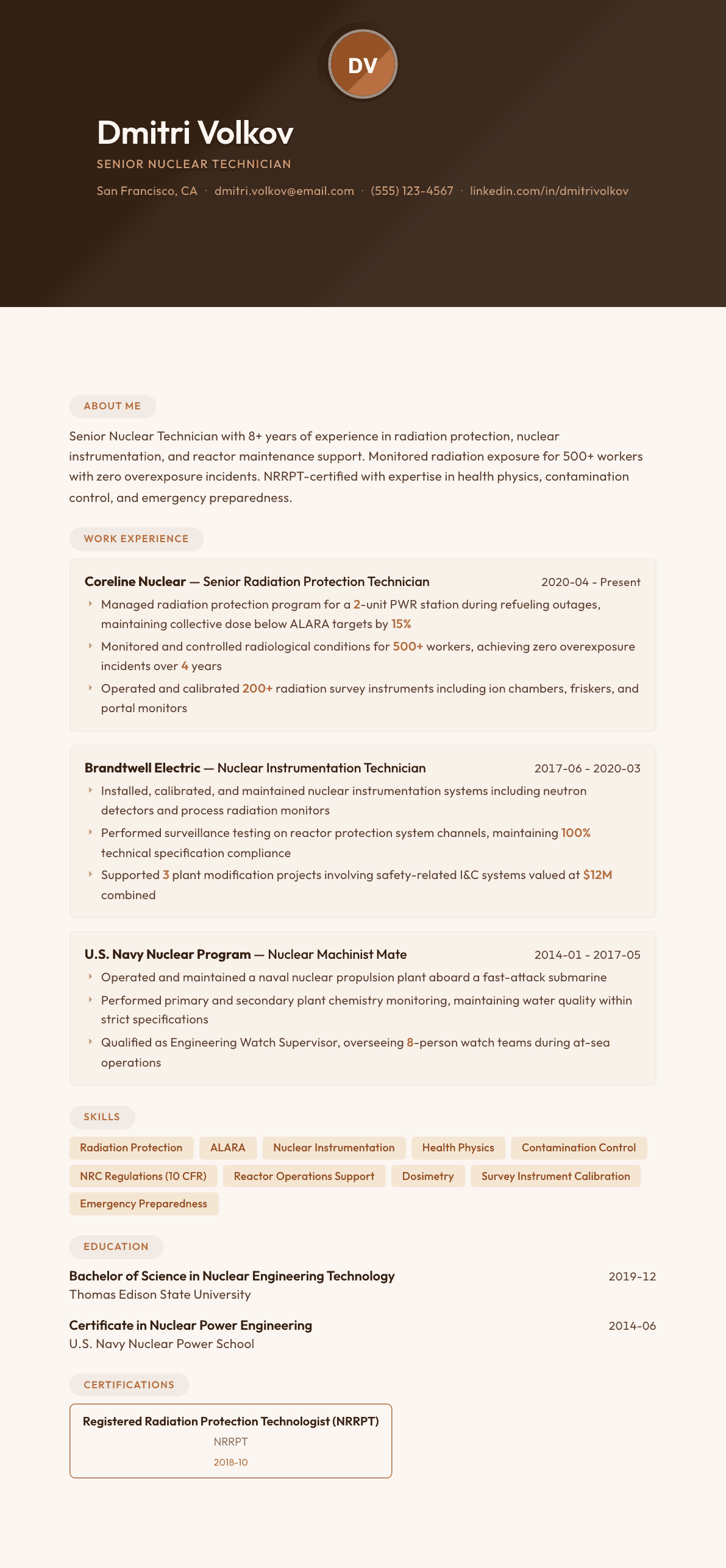
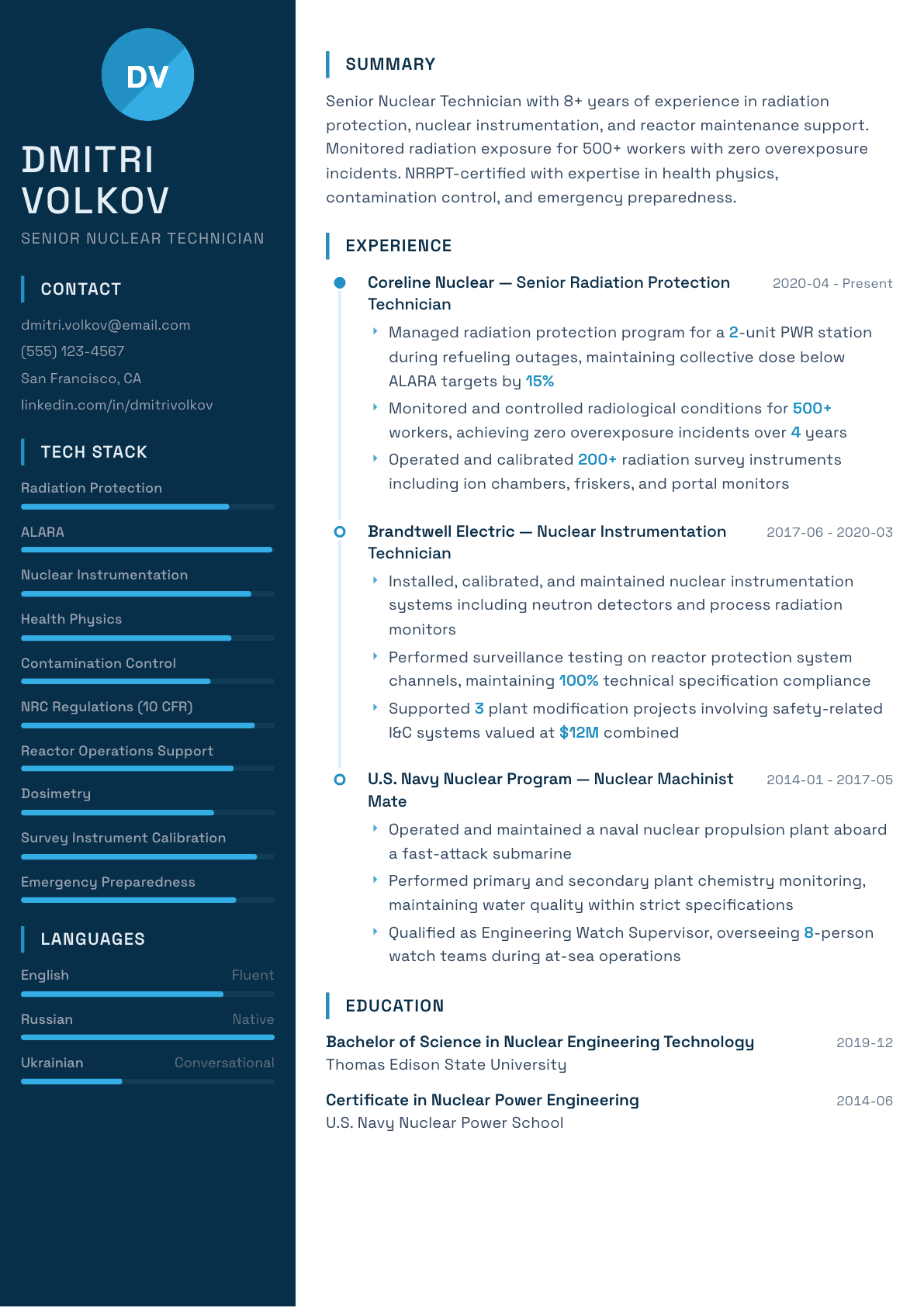
Example Nuclear Technician summary
NRRPT-certified Nuclear Technician with 8+ years in radiation protection and nuclear instrumentation. Maintained zero overexposure incidents while monitoring 500+ workers. Navy Nuclear-trained with commercial PWR and naval propulsion plant experience. Expert in ALARA, contamination control, and NRC regulatory compliance.
Skills to list on a Nuclear Technician resume
- Radiation Protection
- ALARA Program
- Health Physics
- Nuclear Instrumentation
- Contamination Control
- NRC Regulations (10 CFR)
- Dosimetry
- Reactor Operations
- Survey Instruments
- Emergency Preparedness
- Chemistry Control
- Refueling Outage Support
What actually gets this resume read
- Highlight NRC licensing, NRRPT certification, and Navy Nuclear program experience prominently.
- Quantify radiation protection performance: ALARA results, worker counts, and zero-overexposure records.
- Include specific reactor types: PWR, BWR, naval reactors, or research reactors.
- Mention regulatory compliance: 10 CFR 20, technical specifications, and NRC inspection readiness.
- Describe outage support experience: refueling, maintenance, and contamination control activities.
How to write a nuclear technician resume
Nuclear technician hiring is qualification hiring. The person reading your resume is filling a shift or an outage crew and needs to know three things quickly: what you are qualified to do, whether you can be granted unescorted access, and how much of your training they will have to repeat. Everything else is secondary to those three.
The title also spans several trades. Radiation protection technicians survey, control contamination and write radiation work permits. Instrumentation and control technicians calibrate detectors and perform surveillance testing. Chemistry technicians sample and analyze plant systems. Decommissioning and waste technicians characterize and package material. Say which one you are in the first line, because the skills sets barely overlap in daily practice.
This guide covers the layout a nuclear staffing coordinator expects, how to write qualification and outage experience so it can be verified, summaries from an entry technician to a senior, and the questions technicians ask about access, travel work and moving between plants, laboratories and defense sites.
Format: qualifications and access first, outage history clear
Keep it to a plain one or two page reverse chronological document. Put access and clearance status right under your name: current or past unescorted access, the last fitness for duty and background screening, and any clearance level with its status. Staffing coordinators sort on that line before reading anything else.
If you work outages, add an outage history block listing site type, season and your role. Travel technicians build careers out of these assignments, and a list of stations and outage seasons is the industry equivalent of a project portfolio.
- Header: name, city and state, phone, email, access or clearance status, and willingness to travel for outages.
- Order: summary, qualifications and training, experience, outage history, education, certifications.
- For each site, name the plant type and your qualification level rather than only your job title.
Summary: discipline, plant type, qualification level
One line to place you: radiation protection, instrumentation and control, chemistry, or waste and decommissioning. One line for the plant types you have worked: pressurized water, boiling water, research reactor, fuel cycle facility, defense site or naval propulsion plant.
Then your qualification level and what you are trusted to run alone. Writing and approving radiation work permits, performing job coverage on high radiation area entries, releasing material from the protected area, or independently calibrating a channel are the statements that tell a supervisor where you fit on the crew.
Experience: surveys, instruments, permits and dose
Write bullets that a health physics supervisor can picture. Performing routine and job specific surveys, air sampling and airborne assessment, contamination control and decontamination, posting and barricading, personnel frisking and portal monitoring, and release surveys for tools and material are the daily work of a radiation protection technician and each has a volume behind it.
Dose and exposure control is the measurable outcome. Collective dose against the outage target, job coverage that stayed within the pre job estimate, temporary shielding installed, and stay time management for high dose rate tasks all show that you manage exposure rather than only measure it. Reference the exposure limits framework and the principle of keeping doses as low as reasonably achievable in your own words rather than as a slogan.
For instrumentation work, name what you calibrate and to what standard: portable ion chambers, count rate instruments, teletectors, portal and area monitors, continuous air monitors, process radiation monitors, neutron detectors and the reactor protection channels you have surveillance tested. Say whether you performed the source check, the full calibration, or the channel functional test, because those are graded differently.
Chemistry technicians should name the systems sampled and the analyses run: primary and secondary chemistry, boron and lithium control, dissolved oxygen and conductivity, resin and demineralizer performance, and radiochemistry counting. Waste and decommissioning technicians should name characterization methods, packaging and transport classification, and survey release criteria.
Qualifications, training and the words that get you screened in
List your qualification cards and training explicitly, including general employee training, radiation worker training, respiratory protection qualification and fit testing, confined space, fall protection, electrical safety, and any plant specific qualification you completed. Note which are current, because a lapsed qualification means retraining time the employer must budget.
Registration and certification carry real weight here. A registered radiation protection technologist credential, nondestructive testing levels, or instrumentation certifications shorten the trust building period. Also state the counts of outages worked, because outage experience is the practical measure of a travel technician.
Military and shipyard backgrounds, and how to translate them
Naval nuclear and shipyard experience translates directly into commercial work but only if you drop the internal shorthand. Rate abbreviations, watch station codes and command names mean nothing to a civilian staffing coordinator. Write the plant type, the systems you operated or maintained, the watch responsibilities and the number of people you supervised in plain language.
Do the same for radiological controls experience. Describe the survey and contamination control work, the dose records you maintained, the permits you wrote and the areas you controlled. That language maps onto commercial radiation protection immediately, which is why the fleet and the vendors recruit heavily from this background.
Nuclear Technician resume summary examples
Entry technician
Entry-level radiation protection technician with completed radiation worker and general employee training and one outage worked as a junior technician. Experienced with frisking, contamination control, portable survey instruments and dosimetry issue. Seeking a full outage season with willingness to travel between stations.
Qualified technician
Qualified radiation protection technician with six years at pressurized water stations and 11 refueling outages worked. Writes radiation work permits, covers high radiation area entries, and performs release surveys. Held job coverage within the pre-job dose estimate on 95% of assignments during the last two outages.
Senior technician
Senior nuclear technician with 12 years across radiation protection and instrumentation at a two-unit station. Leads outage crews of 8, calibrates process and area radiation monitors, and plans shielding for high dose rate tasks. Holds current unescorted access and a national radiation protection registration.
Work experience bullets: before and after
Before: Performed radiation surveys around the plant.
After: Performed routine and job-specific dose rate and contamination surveys across the auxiliary building, posted and barricaded 30 high radiation areas, and maintained survey records for the shift turnover.
Area, survey types and record keeping give a supervisor a real picture of the scope you covered alone.
Before: Helped keep doses low during outages.
After: Planned coverage for a steam generator nozzle dam installation, staged temporary shielding and set stay times, and finished the task about 20% below the pre-job collective dose estimate.
A named high dose task with a planned outcome against an estimate is exposure control, not a general aspiration.
Before: Calibrated radiation detection instruments.
After: Calibrated 60 portable ion chambers and count rate meters against traceable sources, documented response checks, and removed 4 instruments from service for repeatable out-of-tolerance readings.
Quantity, traceability and the instruments you failed show a technician who applies the acceptance criteria.
Before: Wrote radiation work permits.
After: Wrote and approved radiation work permits for valve maintenance in a contaminated area, specified protective clothing, respiratory protection and dosimetry, and briefed the maintenance crew before entry.
Permit content and the pre-job brief demonstrate the judgment part of the role rather than the paperwork alone.
Before: Worked in the Navy on nuclear reactors.
After: Operated and maintained a naval pressurized water propulsion plant, qualified as a watch supervisor over an 8-person watch team, and performed primary and secondary chemistry sampling within specification limits.
Plain language plant type, watch responsibility and technical duties let a civilian recruiter map the experience.
Hard skills
- Radiation and contamination surveys
- Air sampling and airborne assessment
- Portable survey instrument operation
- Instrument calibration and source checks
- Dosimetry issue and dose record keeping
- Radiation work permit preparation
- Contamination control and decontamination
- Temporary shielding design and installation
- Area and process radiation monitor maintenance
- Surveillance testing of detection channels
- Respiratory protection use and fit testing
- Radioactive material packaging and release surveys
- Plant chemistry sampling
- Emergency preparedness response duties
Soft skills
- Strict procedure adherence
- Stop-work courage
- Briefing craft crews clearly
- Endurance through outage schedules
- Accurate logs under pressure
- Teamwork with maintenance and operations
Certifications worth listing
- Registered Radiation Protection Technologist (NRRPT) (National Registry of Radiation Protection Technologists)
- Radiation Worker II Training (United States Department of Energy site training program)
- Nondestructive Testing Level II (American Society for Nondestructive Testing)
- HAZWOPER 40-Hour Training (OSHA-authorized training provider)
- Department of Transportation Hazardous Materials Training (Employer program under United States Department of Transportation rules)
Mistakes that cost nuclear technician candidates the interview
- Leaving out unescorted access history, which is the single fastest screening question in nuclear staffing.
- Writing military shorthand that a civilian coordinator cannot decode. Translate ratings, watch stations and command names into plain plant language.
- Not listing outages worked. For travel technicians, the outage count and the stations are the resume.
- Blurring the line between assisting and being qualified. Say which tasks you performed independently and which you supported.
- Skipping current training status, so an employer cannot tell whether you arrive ready to badge in or need weeks of requalification.
- Describing safety as a personal value instead of showing the exposure numbers, permits and controls you actually managed.
Nuclear Technician resume questions
How do I get hired as a traveling outage technician?
Make access status, current training and availability dates unmissable at the top of the page, then list your outage history by station type and season. Staffing firms fill crews on short notice, so a resume that answers those questions without a phone call gets called first.
What certification helps most for a radiation protection technician?
A national radiation protection technologist registration is the recognized credential and is widely used to distinguish senior technicians. Alongside it, keeping general employee training, radiation worker training and respiratory qualification current is what determines whether you can start immediately.
How do I move from the Navy nuclear program to a commercial plant?
Rewrite everything in commercial terms: plant type, systems, watch responsibilities, supervision, procedural compliance and radiological controls. Utilities recruit actively from this background, so the only real barrier is a resume written in language that a civilian screener cannot parse.
Do I need a degree to work as a nuclear technician?
Usually not. An associate degree in nuclear or engineering technology helps, and many technicians enter through military service or an employer training program instead. Qualification cards, access history and demonstrated field competence carry more weight than the credential itself.
How should I describe dose and exposure results on my resume?
Use the measures the industry uses: collective dose against the planned estimate for a job or outage, stay time management, and shielding or work sequence changes that reduced exposure. Avoid any claim that implies you personally guaranteed an outcome outside your control.
Related resume examples
- Power Plant Operator Resume example
- Electrical Power Engineer Resume example
- Utility Manager Resume example
- Nuclear Engineer Resume example
- Electrical Engineering Technician Resume example
- Chemical Engineer Resume example